Kth Largest Element in an Array
Find the kth largest element using a min-heap of size k
Problem Statement
Given an integer array nums and an integer k, return the kth largest element in the array.
Note that it is the kth largest element in the sorted order, not the kth distinct element.
LeetCode: Problem 215 - Kth Largest Element in an Array
Examples
Example 1
Input: nums = [3, 2, 1, 5, 6, 4], k = 2
Output: 5Explanation: The sorted array is [1, 2, 3, 4, 5, 6]. The 2nd largest element is 5.
Example 2
Input: nums = [3, 2, 3, 1, 2, 4, 5, 5, 6], k = 4
Output: 4Explanation: The sorted array is [1, 2, 2, 3, 3, 4, 5, 5, 6]. The 4th largest element is 4.
Constraints
1 <= k <= nums.length <= 10^5-10^4 <= nums[i] <= 10^4
Visualization
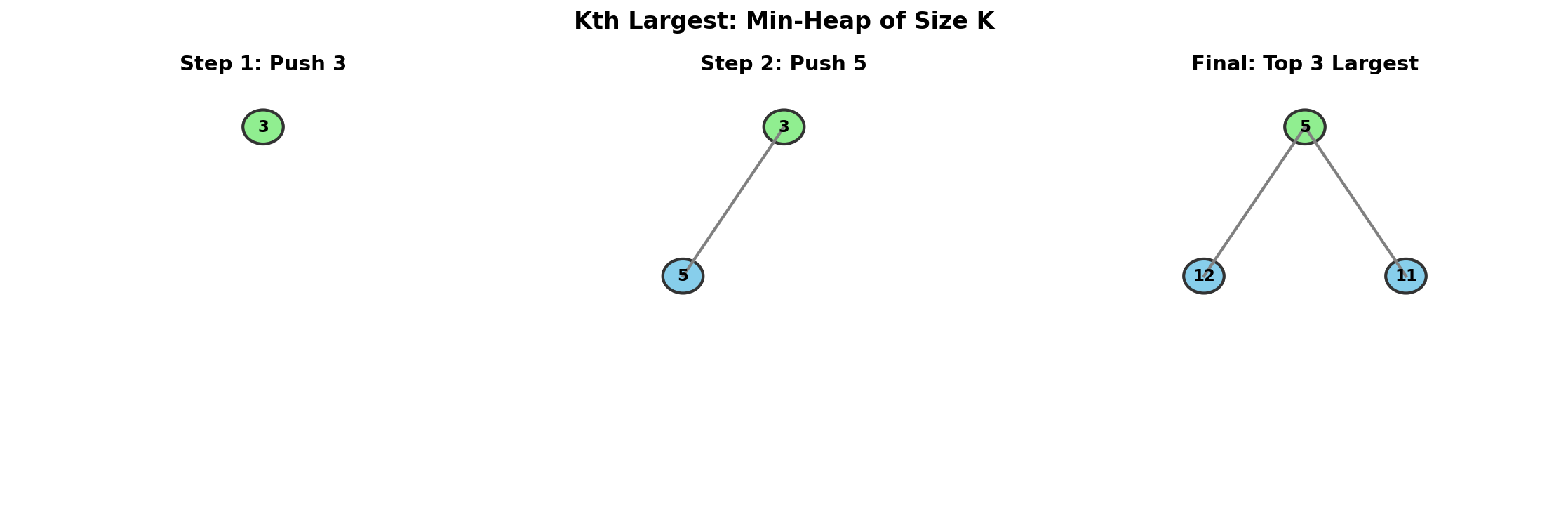
Why Min-Heap for Top K Largest?
The key insight is counterintuitive: to find the K largest elements, we use a Min-Heap. Here's why:
- We maintain a heap of exactly size K
- The smallest element in our "top K candidates" sits at the root
- When a new element comes in, we only compare with this minimum
- If the new element is larger, it deserves a spot in our top K (replacing the current minimum)
The Gatekeeper Analogy
Think of the min-heap as a VIP section with exactly K spots:
- The bouncer (heap root) is the smallest person in the VIP section
- New arrivals only need to beat the bouncer to get in
- If someone gets in, the current bouncer leaves
- The kth largest is always the bouncer (smallest in top K)
Approach
Algorithm Steps
- Initialize an empty min-heap
- Iterate through each number in the array:
- If heap size < k: push the number
- Else if number > heap root: replace root with number (heapreplace)
- Return the heap root (kth largest element)
Step-by-Step Walkthrough
Array: [3, 1, 5, 12, 2, 11]  k = 3

Step 1: Process 3
        heap size < k, push 3
        Heap: [3]

Step 2: Process 1
        heap size < k, push 1
        Heap: [1, 3]    <- Min-heap: root is smallest

Step 3: Process 5
        heap size < k, push 5
        Heap: [1, 3, 5] <- Heap is now FULL at size k

Step 4: Process 12
        12 > heap[0] (1)? YES!
        Replace 1 with 12
        Heap: [3, 12, 5]

Step 5: Process 2
        2 > heap[0] (3)? NO
        Skip (2 is not in top-3)
        Heap: [3, 12, 5] <- unchanged

Step 6: Process 11
        11 > heap[0] (3)? YES!
        Replace 3 with 11
        Heap: [5, 12, 11]

Result: heap[0] = 5 (the 3rd largest element)Solution
Optimal: Min-Heap of Size K
import heapq

def findKthLargest(nums: list[int], k: int) -> int:
    """
    Find the kth largest element using a min-heap of size k.

    Key Insight: Maintain k largest elements in a min-heap.
    The root (minimum of these k) is the kth largest overall.

    Time: O(n log k) - each of n elements may trigger heap operation
    Space: O(k) - heap stores exactly k elements
    """
    min_heap = []

    for num in nums:
        if len(min_heap) < k:
            heapq.heappush(min_heap, num)
        elif num > min_heap[0]:
            # heapreplace is more efficient than pop + push
            heapq.heapreplace(min_heap, num)

return min_heap[0]import java.util.PriorityQueue;
class Solution {
public int findKthLargest(int[] nums, int k) {
// Min-heap of size k: root is the kth largest
PriorityQueue<Integer> minHeap = new PriorityQueue<>();
for (int num : nums) {
if (minHeap.size() < k) {
minHeap.offer(num);
} else if (num > minHeap.peek()) {
// Replace root (more efficient: poll + offer)
minHeap.poll();
minHeap.offer(num);
}
}
return minHeap.peek();
}
}Complexity: Time O(n log k) · Space O(k)
- Time: We iterate through n elements, and each heap operation (push or heapreplace) costs O(log k) since the heap is bounded at size k
- Space: The min-heap stores exactly k elements
Using Built-in nlargest
import heapq

def findKthLargest_builtin(nums: list[int], k: int) -> int:
    """
    Uses Python's optimized nlargest implementation.

    Time: O(n log k)
    Space: O(k)
    """
return heapq.nlargest(k, nums)[-1]Complexity: Time O(n log k) · Space O(k)
- Time: Python's nlargest internally uses a heap-based algorithm, processing n elements with O(log k) operations
- Space: Maintains an internal heap of size k
Alternative: QuickSelect (Average O(n))
import random

def findKthLargest_quickselect(nums: list[int], k: int) -> int:
    """
    QuickSelect algorithm for average O(n) time.

    Time: O(n) average, O(n^2) worst case
    Space: O(1) if done in-place
    """
    def partition(left: int, right: int, pivot_idx: int) -> int:
        pivot = nums[pivot_idx]
        # Move pivot to end
        nums[pivot_idx], nums[right] = nums[right], nums[pivot_idx]
        store_idx = left

        for i in range(left, right):
            if nums[i] < pivot:
                nums[store_idx], nums[i] = nums[i], nums[store_idx]
                store_idx += 1

        # Move pivot to final position
        nums[right], nums[store_idx] = nums[store_idx], nums[right]
        return store_idx

    def quickselect(left: int, right: int, k_smallest: int) -> int:
        if left == right:
            return nums[left]

        pivot_idx = random.randint(left, right)
        pivot_idx = partition(left, right, pivot_idx)

        if k_smallest == pivot_idx:
            return nums[k_smallest]
        elif k_smallest < pivot_idx:
            return quickselect(left, pivot_idx - 1, k_smallest)
        else:
            return quickselect(pivot_idx + 1, right, k_smallest)

    # kth largest = (n-k)th smallest (0-indexed)
return quickselect(0, len(nums) - 1, len(nums) - k)Complexity: Time O(n) average, O(n^2) worst · Space O(1)
- Time: Average case partitions reduce problem size by half each time, giving O(n + n/2 + n/4 + ...) = O(n). Worst case is when partitions are unbalanced
- Space: Done in-place with recursion depth O(log n) average, but iterative version achieves O(1)
Complexity Analysis
| Approach | Time Complexity | Space Complexity | Best When |
|---|---|---|---|
| Min-Heap (size k) | O(n log k) | O(k) | k << n |
| Max-Heap (heapify all) | O(n + k log n) | O(n) | k is small |
| Sort + Index | O(n log n) | O(n) | k close to n |
| QuickSelect | O(n) average | O(1) | Need only kth, not top k |
Why Min-Heap is Preferred
For most interview scenarios:
- O(n log k) is better than O(n log n) when k << n
- O(k) space is better than O(n)
- Simple to implement and explain
- Works for streaming data (elements arriving one at a time)
Common Mistakes
Using max-heap instead of min-heap
- Max-heap would give 1st largest at root, not kth largest
Forgetting to check heap size before comparing
python# Wrong: might compare with empty heap if num > heap[0]: # IndexError if heap is empty # Correct: check size first if len(heap) < k: heapq.heappush(heap, num) elif num > heap[0]: heapq.heapreplace(heap, num)Using heappop + heappush instead of heapreplace
heapreplaceis more efficient (single sift operation)
Follow-up Questions
Q1: What if the array is streaming (elements arrive one at a time)?
The min-heap solution naturally handles streaming data:
class KthLargestStream:
    def __init__(self, k: int, nums: list[int]):
        self.k = k
        self.heap = []
        for num in nums:
            self.add(num)

    def add(self, val: int) -> int:
        if len(self.heap) < self.k:
            heapq.heappush(self.heap, val)
        elif val > self.heap[0]:
            heapq.heapreplace(self.heap, val)
return self.heap[0]Q2: What if we need the kth smallest instead?
Use a max-heap of size k (negate values in Python):
def findKthSmallest(nums: list[int], k: int) -> int:
    max_heap = []  # Store negated values

    for num in nums:
        if len(max_heap) < k:
            heapq.heappush(max_heap, -num)
        elif num < -max_heap[0]:
            heapq.heapreplace(max_heap, -num)

return -max_heap[0]Q3: Can we do better than O(n log k)?
Yes, QuickSelect achieves O(n) average time, but:
- Worst case is O(n^2)
- Modifies the original array
- Harder to implement correctly
For interviews, min-heap is usually preferred unless specifically asked about QuickSelect.
Related Problems
Top K Frequent Elements (LeetCode 347)
Problem: Given an array of integers and an integer k, return the k most frequent elements.
Key Insight: Combine hash map for frequency counting with min-heap for top-k selection.
Approach: Count frequencies with Counter, then maintain min-heap of size k with (frequency, element) pairs. Elements with higher frequency replace those with lower frequency.
Complexity: O(n log k) time, O(n) space for counter
K Closest Points to Origin (LeetCode 973)
Problem: Given an array of points on the X-Y plane and an integer k, return the k closest points to the origin (0, 0).
Key Insight: For k smallest (closest), use a max-heap of size k - the inverse of this problem.
Approach: Use max-heap (negate distances) to track k closest points. New points only enter if closer than the current farthest point in the heap.
Complexity: O(n log k) time, O(k) space
Find Median from Data Stream (LeetCode 295)
Problem: Design a data structure that supports adding integers from a stream and finding the median of all elements.
Key Insight: Use two heaps - max-heap for smaller half, min-heap for larger half. The median is always accessible from the heap roots.
Approach: Balance the heaps so max-heap has equal or one more element than min-heap. Median is either the max-heap root (odd count) or average of both roots (even count).
Complexity: O(log n) addNum, O(1) findMedian
Interview Tips
Clarify the problem:
- Is k 0-indexed or 1-indexed?
- Are there duplicates?
- Is the array in memory or streaming?
Start with the right approach:
- Mention sorting O(n log n) as baseline
- Explain why min-heap O(n log k) is better
Explain the counterintuitive insight:
- "Min-heap for max" is a key interview talking point
- The bouncer analogy works well
Handle edge cases:
- k = 1 (just find maximum)
- k = n (just find minimum)
- All elements are the same