Coin Change, Target Sum & Unique Paths
Classic DP problems with detailed visualizations
Table of Contents
Coin Change
Problem Statement (LeetCode 322)
Given an array of coin denominations coins and a target amount, return the minimum number of coins needed to make up that amount. If that amount cannot be made up by any combination of the coins, return -1. You may assume that you have an infinite number of each kind of coin.
Example:
- Input:
coins = [1, 2, 5],amount = 11 - Output:
3(explanation: 11 = 5 + 5 + 1)
Why Greedy Fails
Greedy approaches (always picking the largest coin) don't work for all coin systems:
coins = [1, 7, 10], amount = 14

Greedy: 10 + 1 + 1 + 1 + 1 = 5 coins (WRONG!)
Optimal: 7 + 7 = 2 coins (CORRECT!)DP Intuition
Key Insight: To find the minimum coins for amount a, we check all coins and take:
dp[a] = min(dp[a - coin] + 1) for all valid coinsThis builds solutions from smaller subproblems (optimal substructure).
DP State Visualization
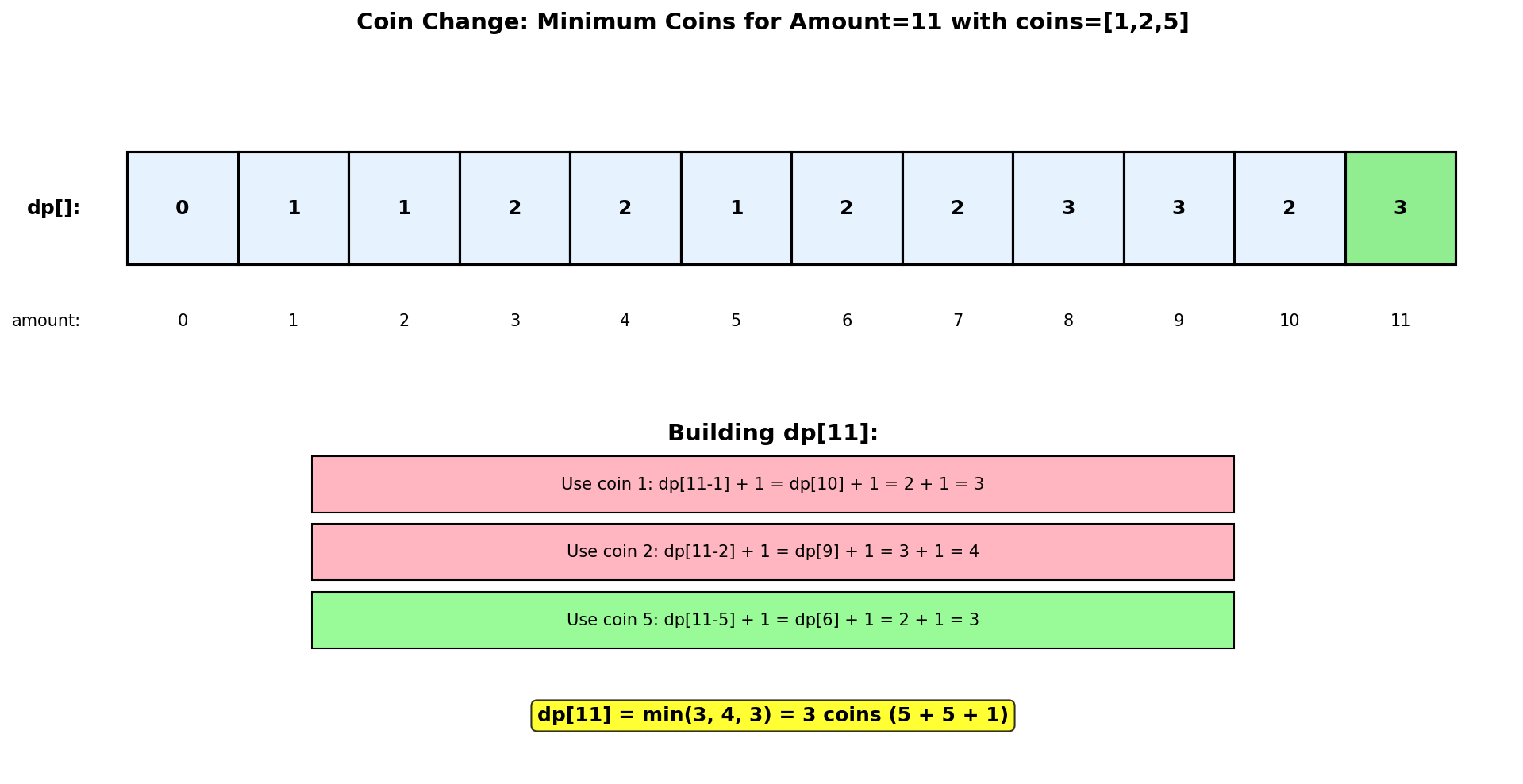
Coins: [1, 2, 5], Amount: 11

Building the DP table step by step:

Amount:   0   1   2   3   4   5   6   7   8   9  10  11
        ─────────────────────────────────────────────────
Init:   [ 0 , ∞ , ∞ , ∞ , ∞ , ∞ , ∞ , ∞ , ∞ , ∞ , ∞ , ∞ ]
         ↑
       base case (0 coins for amount 0)

After processing all amounts:
Min:    [ 0 , 1 , 1 , 2 , 2 , 1 , 2 , 2 , 3 , 3 , 2 , 3 ]
         ↑   ↑   ↑   ↑   ↑   ↑
        base 1   2  1+2  2+2  5
             coin coin      coin

Detailed breakdown for key amounts:
┌─────────┬────────────────────────────────────────────────┐
│ dp[0]   │ 0 (base case)                                  │
│ dp[1]   │ min(dp[1-1]+1) = dp[0]+1 = 1                  │
│ dp[2]   │ min(dp[2-1]+1, dp[2-2]+1) = min(2,1) = 1      │
│ dp[3]   │ min(dp[3-1]+1, dp[3-2]+1) = min(2,2) = 2      │
│ dp[5]   │ min(dp[4]+1, dp[3]+1, dp[0]+1) = min(3,3,1)=1 │
│ dp[11]  │ min(dp[10]+1, dp[9]+1, dp[6]+1) = min(3,4,3)=3│
└─────────┴────────────────────────────────────────────────┘

Answer: dp[11] = 3 coins (5 + 5 + 1)Solution
def coinChange(coins: list[int], amount: int) -> int:
    """
    Find minimum coins needed to make up amount.

    Time Complexity: O(amount * len(coins))
    Space Complexity: O(amount)

    Args:
        coins: List of coin denominations
        amount: Target amount to make

    Returns:
        Minimum coins needed, or -1 if impossible
    """
    # Initialize DP array with infinity (impossible state)
    dp = [float('inf')] * (amount + 1)
    dp[0] = 0  # Base case: 0 coins needed for amount 0

    # Build up solution for each amount from 1 to target
    for a in range(1, amount + 1):
        for coin in coins:
            if coin <= a:
                # Take minimum: don't use coin vs use coin
                dp[a] = min(dp[a], dp[a - coin] + 1)

return dp[amount] if dp[amount] != float('inf') else -1public int coinChange(int[] coins, int amount) {
int[] dp = new int[amount + 1];
Arrays.fill(dp, amount + 1); // impossible sentinel
dp[0] = 0;
for (int a = 1; a <= amount; a++) {
for (int coin : coins) {
if (coin <= a) {
dp[a] = Math.min(dp[a], dp[a - coin] + 1);
}
}
}
return dp[amount] <= amount ? dp[amount] : -1;
}Complexity: Time O(amount * k) · Space O(amount)
- Time: Outer loop over amounts, inner loop over k coins
- Space: Single 1D array of size amount+1
Alternative: BFS Solution
from collections import deque

def coinChange_BFS(coins: list[int], amount: int) -> int:
    """BFS approach - finds shortest path (min coins)"""
    if amount == 0:
        return 0

    visited = set([0])
    queue = deque([(0, 0)])  # (current_amount, num_coins)

    while queue:
        curr, num_coins = queue.popleft()

        for coin in coins:
            next_amount = curr + coin

            if next_amount == amount:
                return num_coins + 1

            if next_amount < amount and next_amount not in visited:
                visited.add(next_amount)
                queue.append((next_amount, num_coins + 1))

return -1Complexity: Time O(amount * k) · Space O(amount)
- Time: BFS explores each amount state once, trying k coins per state
- Space: Visited set and queue can hold up to amount distinct values
Visual Guide
The following visualization shows the coin change DP array, indicating the minimum coins needed for each amount:
Complexity Analysis
| Approach | Time | Space |
|---|---|---|
| Brute Force (recursion) | O(k^amount) | O(amount) |
| Memoization | O(amount * k) | O(amount) |
| Tabulation (DP) | O(amount * k) | O(amount) |
| BFS | O(amount * k) | O(amount) |
Where k = number of coin denominations
Coin Change II (Count Ways)
Problem Statement (LeetCode 518)
Return the number of combinations that make up the amount. Unlike Coin Change I, we count distinct ways (not minimum coins).
DP Visualization
Coins: [1, 2, 5], Amount: 5

Processing coins one by one (order matters for avoiding duplicates!):

Amount:     0   1   2   3   4   5
          ──────────────────────────
Init:     [ 1 , 0 , 0 , 0 , 0 , 0 ]
           ↑
          base case (1 way to make 0)

After coin 1:
          [ 1 , 1 , 1 , 1 , 1 , 1 ]
              all amounts reachable with 1s

After coin 2:
          [ 1 , 1 , 2 , 2 , 3 , 3 ]
                   ↑       ↑   ↑
                 1+1,2   ways  ways

After coin 5:
          [ 1 , 1 , 2 , 2 , 3 , 4 ]
                               ↑
                          +1 (just coin 5)

Answer: 4 ways to make amount 5
- [5]
- [2, 2, 1]
- [2, 1, 1, 1]
- [1, 1, 1, 1, 1]Solution
def change(amount: int, coins: list[int]) -> int:
    """
    Count number of combinations to make amount.

    Key difference from Coin Change I:
    - Outer loop: iterate over coins (not amounts)
    - This ensures we count combinations, not permutations

    Time: O(amount * len(coins))
    Space: O(amount)
    """
    dp = [0] * (amount + 1)
    dp[0] = 1  # One way to make amount 0: use no coins

    # Process each coin type
    for coin in coins:
        # Update amounts that can use this coin
        for a in range(coin, amount + 1):
            dp[a] += dp[a - coin]

return dp[amount]public int change(int amount, int[] coins) {
int[] dp = new int[amount + 1];
dp[0] = 1; // one way to make amount 0: use no coins
// Outer loop over coins ensures combinations, not permutations
for (int coin : coins) {
for (int a = coin; a <= amount; a++) {
dp[a] += dp[a - coin];
}
}
return dp[amount];
}Complexity: Time O(amount * k) · Space O(amount)
- Time: For each coin, iterate through all amounts from coin to target
- Space: Single 1D array of size amount+1
Target Sum
Problem Statement (LeetCode 494)
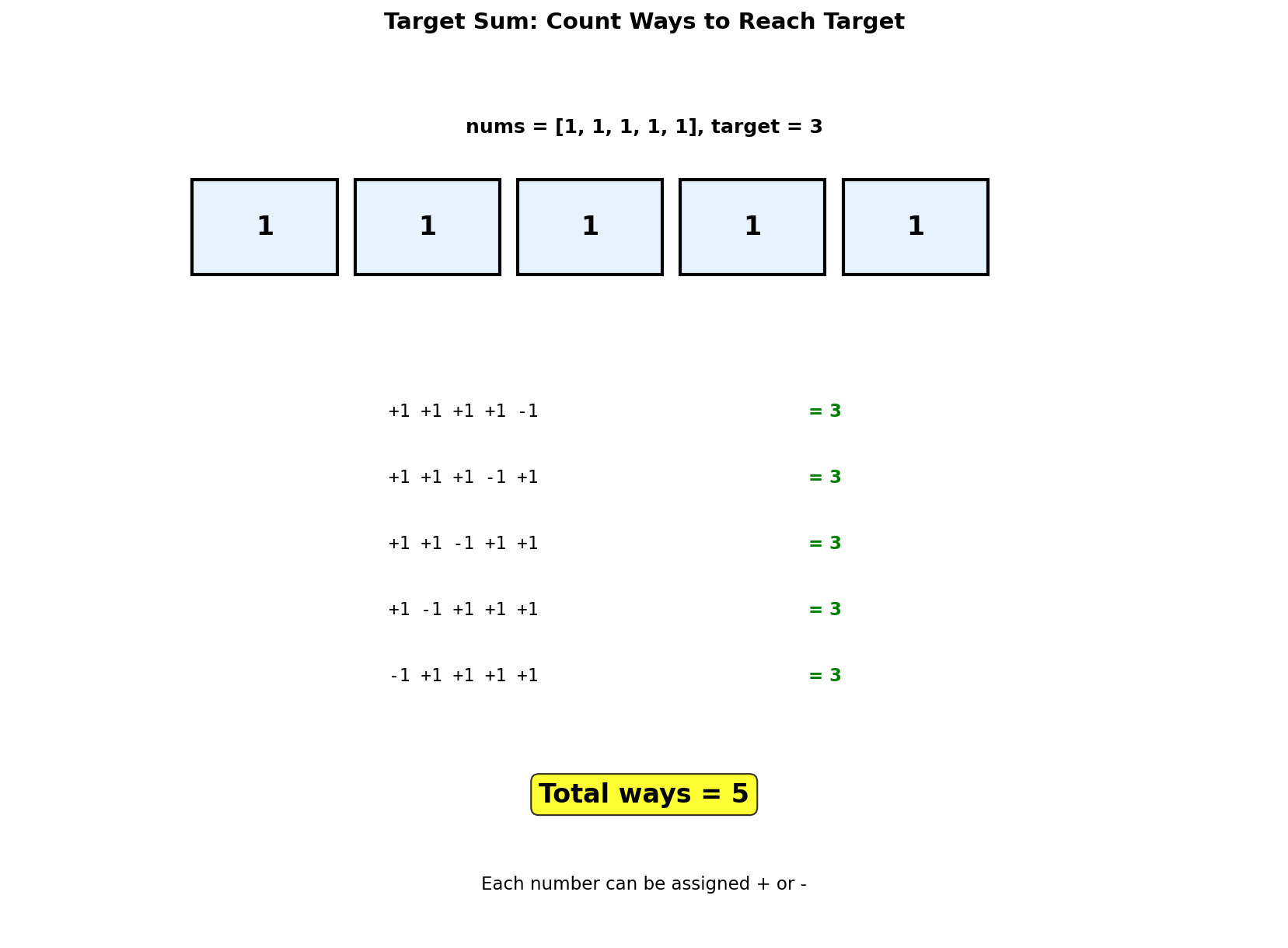
Given an integer array nums and an integer target, find the number of ways to assign + or - signs to elements to reach the target sum.
Example:
- Input:
nums = [1, 1, 1, 1, 1],target = 3 - Output:
5(ways: -1+1+1+1+1, +1-1+1+1+1, +1+1-1+1+1, +1+1+1-1+1, +1+1+1+1-1)
Mathematical Transformation
The key insight is transforming this into a subset sum problem:
Let P = set of positive numbers, N = set of negative numbers

sum(P) - sum(N) = target
sum(P) + sum(N) = total

Adding these equations:
2 * sum(P) = target + total
sum(P) = (target + total) / 2

Problem transforms to: Count subsets with sum = (target + total) / 2Visualization
nums = [1, 1, 1, 1, 1], target = 3
total = 5
subset_sum = (3 + 5) / 2 = 4

Finding subsets that sum to 4:

Sum:    0   1   2   3   4
      ──────────────────────
Init: [ 1 , 0 , 0 , 0 , 0 ]

+1:   [ 1 , 1 , 0 , 0 , 0 ]
+1:   [ 1 , 2 , 1 , 0 , 0 ]
+1:   [ 1 , 3 , 3 , 1 , 0 ]
+1:   [ 1 , 4 , 6 , 4 , 1 ]
+1:   [ 1 , 5 ,10 ,10 , 5 ]
                        ↑
                   Answer: 5 ways

These 5 subsets of size 4:
{1,1,1,1} (indices 0,1,2,3)
{1,1,1,1} (indices 0,1,2,4)
{1,1,1,1} (indices 0,1,3,4)
{1,1,1,1} (indices 0,2,3,4)
{1,1,1,1} (indices 1,2,3,4)Solution
def findTargetSumWays(nums: list[int], target: int) -> int:
    """
    Find number of ways to assign +/- to reach target.

    Transform to subset sum problem:
    - sum(P) - sum(N) = target
    - sum(P) + sum(N) = total
    - 2 * sum(P) = target + total
    - sum(P) = (target + total) / 2

    Time: O(n * subset_sum)
    Space: O(subset_sum)
    """
    total = sum(nums)

    # Check if solution is possible
    if (target + total) % 2 != 0:  # Must be even
        return 0
    if abs(target) > total:  # Target unreachable
        return 0

    subset_sum = (target + total) // 2

    # Count subsets with given sum
    dp = [0] * (subset_sum + 1)
    dp[0] = 1

    for num in nums:
        # Iterate backwards to avoid using same element twice
        for s in range(subset_sum, num - 1, -1):
            dp[s] += dp[s - num]

return dp[subset_sum]public int findTargetSumWays(int[] nums, int target) {
int total = 0;
for (int n : nums) total += n;
if ((target + total) % 2 != 0) return 0;
if (Math.abs(target) > total) return 0;
int subsetSum = (target + total) / 2;
int[] dp = new int[subsetSum + 1];
dp[0] = 1;
for (int num : nums) {
// Iterate backwards to avoid using same element twice
for (int s = subsetSum; s >= num; s--) {
dp[s] += dp[s - num];
}
}
return dp[subsetSum];
}Complexity: Time O(n * sum) · Space O(sum)
- Time: For each number, iterate backwards through achievable sums
- Space: Single 1D array of size (target + total) / 2 + 1
Alternative: 2D DP Solution
def findTargetSumWays_2D(nums: list[int], target: int) -> int:
    """
    Direct DP without transformation.
    dp[i][s] = ways to reach sum s using first i elements
    """
    from collections import defaultdict

    dp = defaultdict(int)
    dp[0] = 1

    for num in nums:
        next_dp = defaultdict(int)
        for s, count in dp.items():
            next_dp[s + num] += count  # Add with +
            next_dp[s - num] += count  # Add with -
        dp = next_dp

return dp[target]Complexity: Time O(n * sum) · Space O(sum)
- Time: For each number, update all reachable sums (positive and negative)
- Space: Dictionary stores all achievable sum values, bounded by 2 * sum + 1
Visual Guide
The following visualization shows the Target Sum DP evolution:
Partition Equal Subset Sum
Problem Statement (LeetCode 416)
Given an integer array nums, return true if you can partition the array into two subsets such that the sum of elements in both subsets is equal.
Example:
- Input:
nums = [1, 5, 11, 5] - Output:
true(subsets: [1, 5, 5] and [11])
Key Insight
If total sum is odd, partition is impossible. Otherwise, find if a subset with sum = total/2 exists.
DP Visualization
nums = [1, 5, 11, 5]
Total = 22, Target = 11

Building DP table (T = True, F = False):

Sum:     0   1   2   3   4   5   6   7   8   9  10  11
       ─────────────────────────────────────────────────
Init:  [ T , F , F , F , F , F , F , F , F , F , F , F ]
        ↑
       empty subset has sum 0

After processing num = 1:
       [ T , T , F , F , F , F , F , F , F , F , F , F ]
            ↑
          {1}

After processing num = 5:
       [ T , T , F , F , F , T , T , F , F , F , F , F ]
                            ↑   ↑
                          {5} {1,5}

After processing num = 11:
       [ T , T , F , F , F , T , T , F , F , F , F , T ]
                                                    ↑
                                                 {11}

After processing num = 5:
       [ T , T , F , F , F , T , T , F , F , F , T , T ]
                                               ↑   ↑
                                           {5,5} {11} or {1,5,5}

Answer: dp[11] = True

Valid partitions:
- {11} and {1, 5, 5}: both sum to 11
- {1, 5, 5} and {11}: same partitionStep-by-Step Trace
Processing 1:
  Check sums from 11 down to 1
  dp[1] = dp[1] OR dp[1-1] = F OR dp[0] = T

Processing 5:
  dp[6] = dp[6] OR dp[6-5] = F OR dp[1] = T
  dp[5] = dp[5] OR dp[5-5] = F OR dp[0] = T

Processing 11:
  dp[11] = dp[11] OR dp[11-11] = F OR dp[0] = T

Processing 5:
  dp[11] remains T
dp[10] = dp[10] OR dp[10-5] = F OR dp[5] = TSolution
def canPartition(nums: list[int]) -> bool:
    """
    Determine if array can be partitioned into two equal-sum subsets.

    Reduces to: Does a subset with sum = total/2 exist?

    Time: O(n * target)
    Space: O(target)
    """
    total = sum(nums)

    # Odd sum cannot be partitioned equally
    if total % 2 != 0:
        return False

    target = total // 2

    # dp[s] = True if subset with sum s exists
    dp = [False] * (target + 1)
    dp[0] = True  # Empty subset has sum 0

    for num in nums:
        # Iterate backwards to avoid reusing same element
        for s in range(target, num - 1, -1):
            dp[s] = dp[s] or dp[s - num]

        # Early termination if target found
        if dp[target]:
            return True

return dp[target]public boolean canPartition(int[] nums) {
int total = 0;
for (int n : nums) total += n;
if (total % 2 != 0) return false;
int target = total / 2;
boolean[] dp = new boolean[target + 1];
dp[0] = true;
for (int num : nums) {
// Iterate backwards to avoid reusing same element
for (int s = target; s >= num; s--) {
dp[s] = dp[s] || dp[s - num];
}
if (dp[target]) return true;
}
return dp[target];
}Complexity: Time O(n * sum) · Space O(sum)
- Time: For each number, iterate backwards through sums up to target
- Space: Boolean array of size target+1 where target = sum/2
With Path Reconstruction
def canPartition_with_path(nums: list[int]) -> tuple[bool, list[int]]:
    """Return both answer and one valid partition if exists"""
    total = sum(nums)
    if total % 2 != 0:
        return False, []

    target = total // 2
    n = len(nums)

    # dp[i][s] = True if subset of first i elements has sum s
    dp = [[False] * (target + 1) for _ in range(n + 1)]
    for i in range(n + 1):
        dp[i][0] = True

    for i in range(1, n + 1):
        for s in range(target + 1):
            dp[i][s] = dp[i-1][s]
            if s >= nums[i-1]:
                dp[i][s] = dp[i][s] or dp[i-1][s - nums[i-1]]

    if not dp[n][target]:
        return False, []

    # Reconstruct path
    subset = []
    s = target
    for i in range(n, 0, -1):
        if s >= nums[i-1] and dp[i-1][s - nums[i-1]]:
            subset.append(nums[i-1])
            s -= nums[i-1]

return True, subsetComplexity: Time O(n * sum) · Space O(n * sum)
- Time: Filling n rows and sum/2 columns with O(1) work per cell
- Space: 2D DP table required to enable path reconstruction via backtracking
Unique Paths
Problem Statement (LeetCode 62)
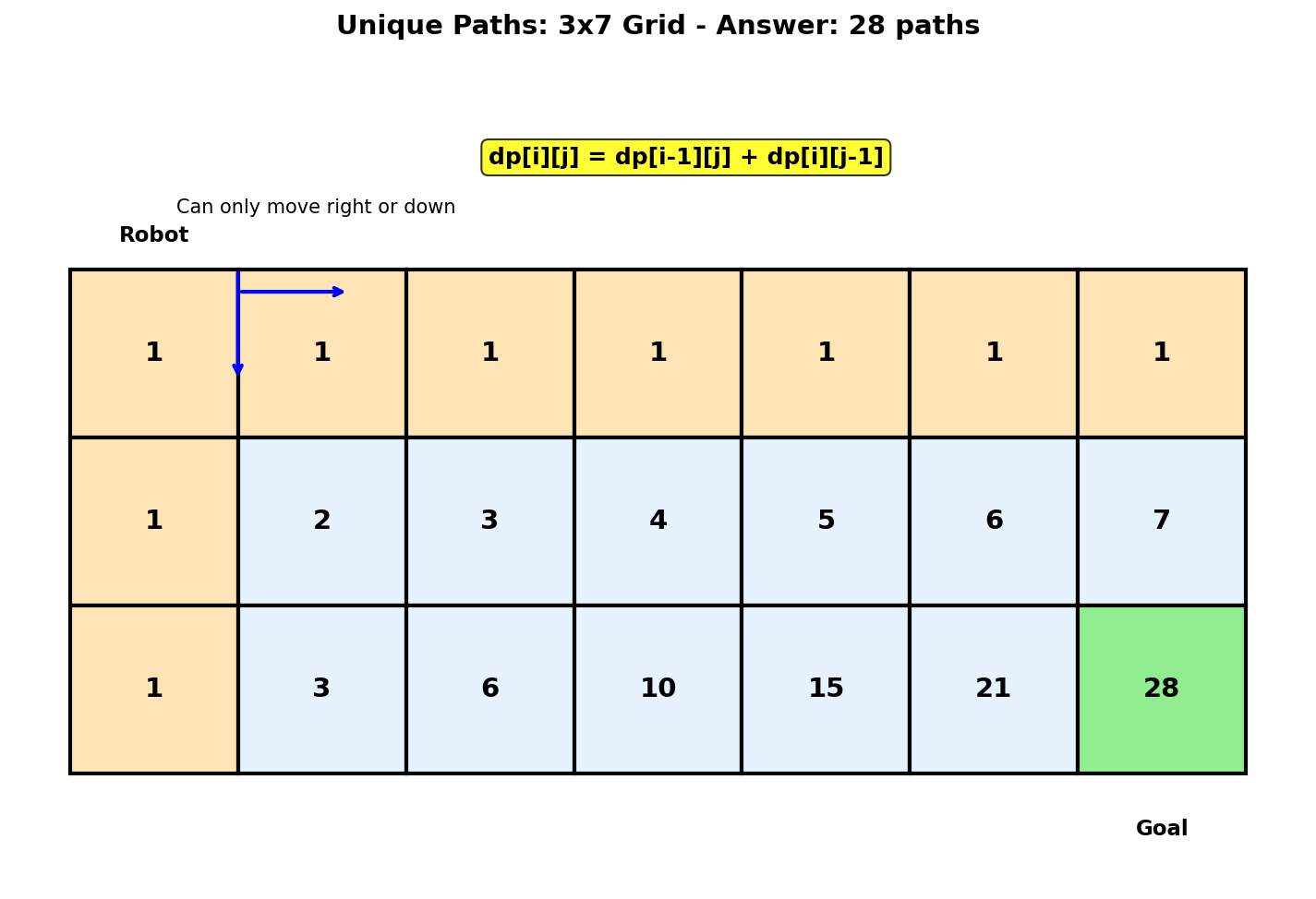
A robot is located at the top-left corner of an m x n grid. The robot can only move down or right. Count the number of unique paths to reach the bottom-right corner.
DP Intuition
Each cell (i,j) can be reached from:
- Cell above: (i-1, j)
- Cell to left: (i, j-1)

Therefore: dp[i][j] = dp[i-1][j] + dp[i][j-1]

Base case: First row and first column all have 1 path (only one direction)DP Grid Visualization
3x4 Grid:

Starting position: (0,0) marked as 'S'
Ending position: (2,3) marked as 'E'

Grid with path counts:

         col 0   col 1   col 2   col 3
       ┌───────┬───────┬───────┬───────┐
row 0  │   1   │   1   │   1   │   1   │  (only right moves)
       │  (S)  │   →   │   →   │   →   │
       ├───────┼───────┼───────┼───────┤
row 1  │   1   │   2   │   3   │   4   │
       │   ↓   │  ↓→   │  ↓→   │  ↓→   │
       ├───────┼───────┼───────┼───────┤
row 2  │   1   │   3   │   6   │  10   │
       │   ↓   │  ↓→   │  ↓→   │  (E)  │
       └───────┴───────┴───────┴───────┘
                               ↑
                         Answer: 10 paths

Calculation example for cell (2,2):
dp[2][2] = dp[1][2] + dp[2][1]
= 3 + 3 = 6Path Enumeration for 2x3 Grid
2x3 Grid (m=2, n=3):

All 3 unique paths from S to E:

Path 1: R → R → D        Path 2: R → D → R        Path 3: D → R → R
┌───┬───┬───┐            ┌───┬───┬───┐            ┌───┬───┬───┐
│ S → → │   │            │ S → │   │              │ S │   │   │
├───┼───┼─↓─┤            ├───┼─↓─┼───┤            ├─↓─┼───┼───┤
│   │   │ E │            │   │ → → E │            │ → → → E │
└───┴───┴───┘            └───┴───┴───┘            └───┴───┴───┘

R = Right, D = DownSolution
def uniquePaths_optimized(m: int, n: int) -> int:
    """
    Space-optimized version using single row.

    Time: O(m * n)
    Space: O(n)
    """
    dp = [1] * n

    for _ in range(1, m):
        for j in range(1, n):
            dp[j] += dp[j-1]  # dp[j] = old dp[j] + dp[j-1]

return dp[n-1]public int uniquePaths(int m, int n) {
// Space-optimized: single row, reused in-place
int[] dp = new int[n];
Arrays.fill(dp, 1); // base case: first row all 1s
for (int i = 1; i < m; i++) {
for (int j = 1; j < n; j++) {
dp[j] += dp[j - 1]; // dp[j] = old dp[j] (above) + dp[j-1] (left)
}
}
return dp[n - 1];
}Complexity: Time O(m * n) · Space O(n)
- Time: Fill m rows with n columns each
- Space: Single row of size n; previous row values reused in-place
def uniquePaths_math(m: int, n: int) -> int:
    """
    Mathematical solution using combinatorics.

    Total moves: (m-1) down + (n-1) right = (m+n-2) moves
    Choose which (m-1) are down: C(m+n-2, m-1)

    Time: O(min(m,n))
    Space: O(1)
    """
    from math import comb
return comb(m + n - 2, m - 1)Complexity: Time O(min(m, n)) · Space O(1)
- Time: Computing C(m+n-2, m-1) requires min(m-1, n-1) multiplications/divisions
- Space: Only stores intermediate computation values
Visual Guide
The following visualization shows the Unique Paths DP grid as a heatmap:
Unique Paths II (With Obstacles)
def uniquePathsWithObstacles(grid: list[list[int]]) -> int:
    """
    Count paths with obstacles (1 = obstacle, 0 = free).
    LeetCode 63.
    """
    m, n = len(grid), len(grid[0])

    # Start or end blocked
    if grid[0][0] == 1 or grid[m-1][n-1] == 1:
        return 0

    dp = [0] * n
    dp[0] = 1

    for i in range(m):
        for j in range(n):
            if grid[i][j] == 1:
                dp[j] = 0  # Blocked cell
            elif j > 0:
                dp[j] += dp[j-1]

return dp[n-1]Complexity: Time O(m * n) · Space O(n)
- Time: Iterate through all m*n cells once
- Space: Single row of size n; obstacles handled by setting cell to 0
Minimum Path Sum
Problem Statement (LeetCode 64)
Given an m x n grid filled with non-negative numbers, find a path from top-left to bottom-right that minimizes the sum of all numbers along the path.
Solution
def minPathSum(grid: list[list[int]]) -> int:
    """
    Find minimum path sum from top-left to bottom-right.

    Time: O(m * n)
    Space: O(1) - modify in place, or O(n) with separate array
    """
    m, n = len(grid), len(grid[0])

    # Fill first row (can only come from left)
    for j in range(1, n):
        grid[0][j] += grid[0][j-1]

    # Fill first column (can only come from above)
    for i in range(1, m):
        grid[i][0] += grid[i-1][0]

    # Fill rest of grid
    for i in range(1, m):
        for j in range(1, n):
            grid[i][j] += min(grid[i-1][j], grid[i][j-1])

return grid[m-1][n-1]Complexity: Time O(m * n) · Space O(1)
- Time: Single pass through all m*n cells
- Space: Modifies grid in-place; use O(n) auxiliary array if input must be preserved
Pattern Recognition
Common DP Patterns in These Problems
| Problem | Pattern | State | Transition |
|---|---|---|---|
| Coin Change | Unbounded Knapsack | dp[amount] | min(dp[a-coin]+1) |
| Coin Change II | Count Combinations | dp[amount] | dp[a] += dp[a-coin] |
| Target Sum | Subset Sum | dp[sum] | Transform + count |
| Partition | 0/1 Knapsack | dp[sum] | dp[s] or dp[s-num] |
| Unique Paths | Grid DP | dp[i][j] | dp[i-1][j] + dp[i][j-1] |
When to Use Each Pattern
Unbounded Knapsack (reuse items allowed):
├── Coin Change (min coins)
├── Coin Change II (count combinations)
└── Perfect Squares

0/1 Knapsack (each item once):
├── Partition Equal Subset Sum
├── Target Sum
└── Subset Sum

Grid DP (2D traversal):
├── Unique Paths
├── Minimum Path Sum
└── TriangleInterview Applications
Common Interview Variations
- Payment Systems: Minimum coins for change (exact Coin Change)
- Resource Allocation: Partition tasks into equal-load buckets
- Route Planning: Count paths in grid-based maps (like Google Maps routing)
- Ad Budget Optimization: Target sum for reaching advertising goals
- Data Center Load Balancing: Partition workloads equally across servers
Interview Tips
Always clarify constraints:
- Can coins/items be reused?
- Are there obstacles in the grid?
- What if no solution exists?
Start with brute force, then optimize:
- Explain recursive solution first
- Identify overlapping subproblems
- Add memoization, then convert to tabulation
Space optimization:
- Interviewers love seeing O(n) space solutions
- Demonstrate understanding of state dependencies
Edge cases to handle:
- Empty input
- Target = 0
- Single element arrays
- All zeros or all same values
Practice Problems
| Difficulty | Problem | Link |
|---|---|---|
| Medium | Coin Change | LeetCode 322 |
| Medium | Coin Change II | LeetCode 518 |
| Medium | Target Sum | LeetCode 494 |
| Medium | Partition Equal Subset Sum | LeetCode 416 |
| Medium | Unique Paths | LeetCode 62 |
| Medium | Unique Paths II | LeetCode 63 |
| Medium | Minimum Path Sum | LeetCode 64 |
| Medium | Perfect Squares | LeetCode 279 |
Complexity Summary
| Problem | Time | Space | Space (Optimized) |
|---|---|---|---|
| Coin Change | O(amount * k) | O(amount) | O(amount) |
| Coin Change II | O(amount * k) | O(amount) | O(amount) |
| Target Sum | O(n * sum) | O(sum) | O(sum) |
| Partition | O(n * sum/2) | O(sum/2) | O(sum/2) |
| Unique Paths | O(m * n) | O(m * n) | O(n) |
String Difference (Edit Operations)
Overview
The classic Edit Distance (LeetCode 72) problem returns the minimum number of operations to transform one string into another. But what if you need to list the actual edits - not just count them? This is common in:
- Diff tools (Git, text editors)
- Spell checkers (suggesting corrections)
- DNA sequence alignment
- Version control systems
Problem: List Edit Operations
Given two strings word1 and word2, return the sequence of operations (Insert, Delete, Replace) to transform word1 into word2 using the minimum number of edits.
Example
word1 = "horse"
word2 = "ros"

Minimum edits: 3
Operations:
1. Replace 'h' with 'r' -> "rorse"
2. Delete 'r' -> "rose"
3. Delete 'e' -> "ros"

Alternative valid sequence:
1. Delete 'h' -> "orse"
2. Replace 'o' with 'r' -> "rrse" (this is wrong, let's think again...)

Better sequence:
1. Replace 'h' with 'r' at index 0 -> "rorse"
2. Delete 'o' at index 1 -> "rrse" (no, still wrong)

Correct sequence:
1. Replace word1[0] 'h' -> 'r': "rorse"
2. Delete word1[2] 'r': "rose"
3. Delete word1[4] 'e': "ros"Building the DP Table (Review)
First, let's recall how Edit Distance builds its DP table:
def minDistance(word1: str, word2: str) -> int:
    """
    Edit Distance - returns minimum operations count.

    dp[i][j] = min edits to transform word1[0:i] to word2[0:j]

    Time: O(m * n)
    Space: O(m * n)
    """
    m, n = len(word1), len(word2)

    # dp[i][j] = min edits for word1[:i] -> word2[:j]
    dp = [[0] * (n + 1) for _ in range(m + 1)]

    # Base cases
    for i in range(m + 1):
        dp[i][0] = i  # Delete all characters
    for j in range(n + 1):
        dp[0][j] = j  # Insert all characters

    # Fill DP table
    for i in range(1, m + 1):
        for j in range(1, n + 1):
            if word1[i - 1] == word2[j - 1]:
                dp[i][j] = dp[i - 1][j - 1]  # No operation needed
            else:
                dp[i][j] = 1 + min(
                    dp[i - 1][j],      # Delete from word1
                    dp[i][j - 1],      # Insert into word1
                    dp[i - 1][j - 1]   # Replace
                )

return dp[m][n]Complexity: Time O(m * n) · Space O(m * n)
- Time: Fill m x n DP table with O(1) work per cell
- Space: 2D DP table of size (m+1) x (n+1)
Backtracking to Find Operations
The key insight is that we can backtrack through the DP table to reconstruct the operations:
from dataclasses import dataclass
from enum import Enum
from typing import Optional


class EditType(Enum):
    INSERT = "INSERT"
    DELETE = "DELETE"
    REPLACE = "REPLACE"
    MATCH = "MATCH"  # No operation needed


@dataclass
class EditOperation:
    """Represents a single edit operation."""
    type: EditType
    position: int  # Position in word1 (for DELETE/REPLACE)
    old_char: Optional[str] = None  # Character being replaced/deleted
    new_char: Optional[str] = None  # Character being inserted/replacing

    def __str__(self):
        if self.type == EditType.INSERT:
            return f"INSERT '{self.new_char}' at position {self.position}"
        elif self.type == EditType.DELETE:
            return f"DELETE '{self.old_char}' at position {self.position}"
        elif self.type == EditType.REPLACE:
            return f"REPLACE '{self.old_char}' with '{self.new_char}' at position {self.position}"
        else:
            return f"MATCH '{self.old_char}' at position {self.position}"


def getEditOperations(word1: str, word2: str) -> list[EditOperation]:
    """
    Find the sequence of edit operations to transform word1 into word2.

    Time: O(m * n) for DP + O(m + n) for backtracking
    Space: O(m * n) for DP table
    """
    m, n = len(word1), len(word2)

    # Build DP table
    dp = [[0] * (n + 1) for _ in range(m + 1)]

    for i in range(m + 1):
        dp[i][0] = i
    for j in range(n + 1):
        dp[0][j] = j

    for i in range(1, m + 1):
        for j in range(1, n + 1):
            if word1[i - 1] == word2[j - 1]:
                dp[i][j] = dp[i - 1][j - 1]
            else:
                dp[i][j] = 1 + min(
                    dp[i - 1][j],      # Delete
                    dp[i][j - 1],      # Insert
                    dp[i - 1][j - 1]   # Replace
                )

    # Backtrack to find operations
    operations = []
    i, j = m, n

    while i > 0 or j > 0:
        if i > 0 and j > 0 and word1[i - 1] == word2[j - 1]:
            # Characters match - no operation, just move diagonally
            operations.append(EditOperation(
                type=EditType.MATCH,
                position=i - 1,
                old_char=word1[i - 1]
            ))
            i -= 1
            j -= 1

        elif i > 0 and j > 0 and dp[i][j] == dp[i - 1][j - 1] + 1:
            # Replace operation
            operations.append(EditOperation(
                type=EditType.REPLACE,
                position=i - 1,
                old_char=word1[i - 1],
                new_char=word2[j - 1]
            ))
            i -= 1
            j -= 1

        elif i > 0 and dp[i][j] == dp[i - 1][j] + 1:
            # Delete operation
            operations.append(EditOperation(
                type=EditType.DELETE,
                position=i - 1,
                old_char=word1[i - 1]
            ))
            i -= 1

        elif j > 0 and dp[i][j] == dp[i][j - 1] + 1:
            # Insert operation
            operations.append(EditOperation(
                type=EditType.INSERT,
                position=i,  # Insert at current position in word1
                new_char=word2[j - 1]
            ))
            j -= 1

    # Reverse to get operations in order
    operations.reverse()

    return operations


def applyOperations(word1: str, operations: list[EditOperation]) -> str:
    """Apply operations to word1 to verify correctness."""
    result = list(word1)
    offset = 0  # Track position shifts from inserts/deletes

    for op in operations:
        if op.type == EditType.MATCH:
            pass  # No change
        elif op.type == EditType.REPLACE:
            result[op.position + offset] = op.new_char
        elif op.type == EditType.DELETE:
            result.pop(op.position + offset)
            offset -= 1
        elif op.type == EditType.INSERT:
            result.insert(op.position + offset, op.new_char)
            offset += 1

return ''.join(result)Complexity: Time O(m * n) · Space O(m * n)
- Time: O(m * n) for DP table construction plus O(m + n) for backtracking
- Space: Full 2D table required to enable path reconstruction
Visual Walkthrough
word1 = "horse", word2 = "ros"

DP Table:
      ""  r  o  s
   "" [0, 1, 2, 3]
   h  [1, 1, 2, 3]
   o  [2, 2, 1, 2]
   r  [3, 2, 2, 2]
   s  [4, 3, 3, 2]
   e  [5, 4, 4, 3]

Backtracking from dp[5][3] = 3:

Position (5,3): dp[5][3]=3, word1[4]='e', word2[2]='s'
  - dp[4][2]=2, dp[4][3]=2, dp[5][2]=4
  - dp[5][3] = dp[4][2] + 1? 3 = 2 + 1? YES -> DELETE 'e'
  - Move to (4, 3)

Position (4,3): dp[4][3]=2, word1[3]='s', word2[2]='s'
  - word1[3] == word2[2]? 's' == 's'? YES -> MATCH
  - Move to (3, 2)

Position (3,2): dp[3][2]=2, word1[2]='r', word2[1]='o'
  - dp[2][1]=2, dp[2][2]=1, dp[3][1]=2
  - dp[3][2] = dp[2][1] + 1? 2 = 2 + 1? NO
  - dp[3][2] = dp[2][2] + 1? 2 = 1 + 1? YES -> DELETE 'r'
  - Move to (2, 2)

Position (2,2): dp[2][2]=1, word1[1]='o', word2[1]='o'
  - word1[1] == word2[1]? 'o' == 'o'? YES -> MATCH
  - Move to (1, 1)

Position (1,1): dp[1][1]=1, word1[0]='h', word2[0]='r'
  - dp[0][0]=0, dp[0][1]=1, dp[1][0]=1
  - dp[1][1] = dp[0][0] + 1? 1 = 0 + 1? YES -> REPLACE 'h' with 'r'
  - Move to (0, 0)

Operations (in reverse order):
1. REPLACE 'h' -> 'r' at position 0
2. MATCH 'o' at position 1
3. DELETE 'r' at position 2
4. MATCH 's' at position 3
5. DELETE 'e' at position 4

Actual edits (excluding MATCH):
1. REPLACE 'h' -> 'r': "horse" -> "rorse"
2. DELETE 'r': "rorse" -> "rose"
3. DELETE 'e': "rose" -> "ros"Simplified Version (Just Edit Types)
def getEditSequence(word1: str, word2: str) -> list[str]:
    """
    Return simplified edit sequence as list of strings.

    Time: O(m * n)
    Space: O(m * n)
    """
    m, n = len(word1), len(word2)

    # Build DP table
    dp = [[0] * (n + 1) for _ in range(m + 1)]

    for i in range(m + 1):
        dp[i][0] = i
    for j in range(n + 1):
        dp[0][j] = j

    for i in range(1, m + 1):
        for j in range(1, n + 1):
            if word1[i - 1] == word2[j - 1]:
                dp[i][j] = dp[i - 1][j - 1]
            else:
                dp[i][j] = 1 + min(dp[i-1][j], dp[i][j-1], dp[i-1][j-1])

    # Backtrack
    edits = []
    i, j = m, n

    while i > 0 or j > 0:
        if i > 0 and j > 0 and word1[i-1] == word2[j-1]:
            i -= 1
            j -= 1
        elif i > 0 and j > 0 and dp[i][j] == dp[i-1][j-1] + 1:
            edits.append(f"Replace '{word1[i-1]}' with '{word2[j-1]}'")
            i -= 1
            j -= 1
        elif i > 0 and dp[i][j] == dp[i-1][j] + 1:
            edits.append(f"Delete '{word1[i-1]}'")
            i -= 1
        else:  # j > 0 and dp[i][j] == dp[i][j-1] + 1
            edits.append(f"Insert '{word2[j-1]}'")
            j -= 1

    edits.reverse()
    return edits


# Example usage
word1 = "intention"
word2 = "execution"
edits = getEditSequence(word1, word2)
print(f"Edits: {len(edits)}")
for edit in edits:
    print(f"  - {edit}")

# Output:
# Edits: 5
#   - Replace 'i' with 'e'
#   - Replace 'n' with 'x'
#   - Replace 't' with 'e'
#   - Replace 'e' with 'c'
# - Replace 'n' with 'u'Complexity: Time O(m * n) · Space O(m * n)
- Time: O(m * n) for DP table plus O(m + n) for backtracking path
- Space: 2D DP table needed to reconstruct edit sequence
Complexity Analysis
| Approach | Time | Space |
|---|---|---|
| Count only (Edit Distance) | O(m * n) | O(min(m, n))* |
| With backtracking | O(m * n) | O(m * n) |
| Space-optimized count | O(m * n) | O(min(m, n)) |
*Can be space-optimized since we only need the previous row
Related Problems
| Problem | Key Concept |
|---|---|
| Edit Distance (LC 72) | Basic DP formulation |
| One Edit Distance (LC 161) | Check if exactly 1 edit apart |
| Delete Operation for Two Strings (LC 583) | Only deletions allowed |
| Minimum ASCII Delete Sum (LC 712) | Weighted deletions |
| Longest Common Subsequence (LC 1143) | Related DP structure |
Interview Tips
- Start with count: First explain/implement basic Edit Distance
- Then add backtracking: Show how to reconstruct the path
- Handle ties: When multiple operations have the same cost, pick consistently (e.g., prioritize Replace > Delete > Insert)
- Verify correctness: Apply operations to word1 and check if you get word2
- Real-world applications: Mention Git diff, spell checkers, DNA alignment
Diff-Style Output
def getDiff(word1: str, word2: str) -> str:
    """
    Generate diff-style output showing changes.

    Returns string with:
    - '-' prefix for deleted characters
    - '+' prefix for inserted characters
    - ' ' prefix for unchanged characters
    """
    operations = getEditOperations(word1, word2)

    lines = []
    for op in operations:
        if op.type == EditType.MATCH:
            lines.append(f"  {op.old_char}")
        elif op.type == EditType.DELETE:
            lines.append(f"- {op.old_char}")
        elif op.type == EditType.INSERT:
            lines.append(f"+ {op.new_char}")
        elif op.type == EditType.REPLACE:
            lines.append(f"- {op.old_char}")
            lines.append(f"+ {op.new_char}")

    return '\n'.join(lines)


# Example:
# word1 = "horse", word2 = "ros"
# Output:
# - h
# + r
#   o
# - r
#   s
# - eComplexity: Time O(m * n) · Space O(m * n)
- Time: Relies on getEditOperations which builds full DP table
- Space: Stores operations list plus the diff output string
References
- LeetCode 322: Coin Change
- LeetCode 518: Coin Change II
- LeetCode 494: Target Sum
- LeetCode 416: Partition Equal Subset Sum
- LeetCode 62: Unique Paths
- LeetCode 63: Unique Paths II
- GeeksforGeeks: Coin Change DP
- AlgoMap: Coin Change Solution
- AlgoMap: Unique Paths Solution
- Design Gurus: Coin Change Explanation
- Design Gurus: Unique Paths Explanation
- Algo Monster: Coin Change In-Depth