Simplify Path
LeetCode 71 | Difficulty: Medium | Pattern: Stack Processing
Problem Statement
Given a string path, which is an absolute path (starting with a slash '/') to a file or directory in a Unix-style file system, convert it to the simplified canonical path.
In a Unix-style file system:
- A period
'.'refers to the current directory - A double period
'..'refers to the parent directory - Multiple consecutive slashes
'//'are treated as a single slash'/'
The canonical path should:
- Start with a single slash
'/' - Not end with a trailing slash (unless it's the root)
- Not have any
.or..segments - Directories are separated by a single
/
Examples
Example 1:
Input: path = "/home/"
Output: "/home"Example 2:
Input: path = "/../"
Output: "/"
Explanation: Going one level up from root still results in rootExample 3:
Input: path = "/home//foo/"
Output: "/home/foo"
Explanation: Multiple slashes are treated as oneExample 4:
Input: path = "/a/./b/../../c/"
Output: "/c"Constraints
1 <= path.length <= 3000pathconsists of English letters, digits, period., slash/or underscore_pathis a valid absolute Unix path
Intuition
Process path components one by one:
- Skip empty components and
.(current directory) - For
.., pop the last directory (go up) - For other names, push to stack
Key Insight: Use a stack to track the directory hierarchy. .. pops, valid names push.
Visualization
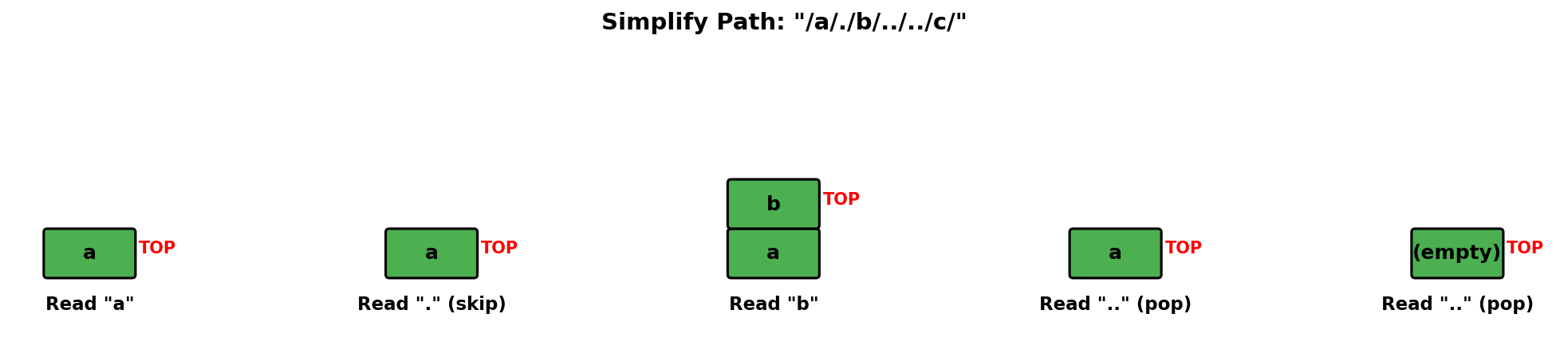
For path /a/./b/../../c/:
Split: ['a', '.', 'b', '..', '..', 'c']

Process 'a':  stack = ['a']
Process '.':  skip (current dir)
Process 'b':  stack = ['a', 'b']
Process '..': pop, stack = ['a']
Process '..': pop, stack = []
Process 'c':  stack = ['c']

Result: '/c'Solution
def simplifyPath(path: str) -> str:
    """
    Simplify Unix-style path using stack.

    Time: O(n) - process each character once
    Space: O(n) - stack can hold all components
    """
    stack = []

    # Split by '/' - handles multiple slashes
    components = path.split('/')

    for component in components:
        if component == '' or component == '.':
            # Empty (from '//' or trailing /) or current dir - skip
            continue
        elif component == '..':
            # Parent directory - go up if possible
            if stack:
                stack.pop()
        else:
            # Valid directory/file name
            stack.append(component)

return '/' + '/'.join(stack)public String simplifyPath(String path) {
Deque<String> stack = new ArrayDeque<>();
for (String component : path.split("/")) {
if (component.isEmpty() || component.equals(".")) {
continue;
} else if (component.equals("..")) {
if (!stack.isEmpty()) stack.pop();
} else {
stack.push(component);
}
}
StringBuilder sb = new StringBuilder();
// stack is LIFO, so rebuild in order using a list
List<String> parts = new ArrayList<>(stack);
Collections.reverse(parts);
for (String part : parts) sb.append('/').append(part);
return sb.length() == 0 ? "/" : sb.toString();
}Complexity: Time O(n) · Space O(n)
- Time: split() is O(n); iterating components is O(n); join() is O(n) where n is path length
- Space: Split creates list of components (O(n) total chars); stack stores directory names (O(n) worst case)
Alternative: Manual Parsing
def simplifyPath(path: str) -> str:
    """
    Parse path character by character.
    More control but more verbose.
    """
    stack = []
    i = 0
    n = len(path)

    while i < n:
        # Skip slashes
        while i < n and path[i] == '/':
            i += 1

        if i >= n:
            break

        # Extract component
        j = i
        while j < n and path[j] != '/':
            j += 1

        component = path[i:j]
        i = j

        if component == '.':
            continue
        elif component == '..':
            if stack:
                stack.pop()
        else:
            stack.append(component)

return '/' + '/'.join(stack)Complexity: Time O(n) · Space O(n)
- Time: Two-pointer scan through path is O(n); each character examined at most twice (once for slash, once for component)
- Space: Stack stores directory names; in worst case (no ".." operations), all components stored
Step-by-Step Walkthrough
For path /home/../usr/./bin/./:
Split by '/': ['', 'home', '..', 'usr', '.', 'bin', '.', '']

Component '': empty, skip
Component 'home': push, stack = ['home']
Component '..': pop, stack = []
Component 'usr': push, stack = ['usr']
Component '.': current dir, skip
Component 'bin': push, stack = ['usr', 'bin']
Component '.': current dir, skip
Component '': empty, skip

Result: '/usr/bin'Edge Cases
def test_simplify_path():
    # Root
    assert simplifyPath("/") == "/"

    # Go above root
    assert simplifyPath("/../") == "/"
    assert simplifyPath("/../../..") == "/"

    # Current directory
    assert simplifyPath("/./") == "/"
    assert simplifyPath("/a/./b/./c") == "/a/b/c"

    # Multiple slashes
    assert simplifyPath("//") == "/"
    assert simplifyPath("/a//b") == "/a/b"

    # Hidden files (start with .)
    assert simplifyPath("/.hidden") == "/.hidden"
    assert simplifyPath("/...") == "/..."  # Three dots is a valid name

    # Complex path
    assert simplifyPath("/a/b/c/../d/./e/../../f") == "/a/b/f"

    # Just a name
assert simplifyPath("/home") == "/home"Common Mistakes
Not handling
.and..correctlypython# '.' is skip, '..' is pop # '...' is a valid directory name! if component == '..': # Not component.startswith('..')Popping from empty stack
python# '/../' should return '/', not crash if stack: stack.pop()Forgetting leading slash in result
pythonreturn '/' + '/'.join(stack) # Not '/'.join(stack)Not handling trailing slash
python# '/home/' split gives [..., ''] # Empty strings should be skipped
Complexity Analysis
| Aspect | Complexity | Explanation |
|---|---|---|
| Time | O(n) | Split is O(n), process each component once |
| Space | O(n) | Stack and split result can hold O(n) chars |
Real-World Applications
- File System Navigation:
cdcommand processing - URL Normalization: Simplify paths in URLs
- Symbolic Link Resolution: Resolve relative paths
- Build Systems: Normalize include paths
Variations
1. Relative Path Simplification
def simplifyRelativePath(path: str, base: str = "/") -> str:
    """
    Simplify a relative path from a base directory.
    """
    if path.startswith('/'):
        return simplifyPath(path)

    full_path = base.rstrip('/') + '/' + path
return simplifyPath(full_path)Complexity: Time O(n) · Space O(n)
- Time: String concatenation is O(n); simplifyPath is O(n) where n is combined path length
- Space: Creates combined path string; simplifyPath uses O(n) for stack
2. Check if Paths Are Equivalent
def areEquivalent(path1: str, path2: str) -> bool:
    """Check if two paths point to the same location."""
return simplifyPath(path1) == simplifyPath(path2)Complexity: Time O(n + m) · Space O(n + m)
- Time: Simplify both paths O(n) + O(m); string comparison is O(min(n, m))
- Space: Each simplifyPath call uses O(path length) for stack and result
3. Get Relative Path
def getRelativePath(from_path: str, to_path: str) -> str:
    """Get relative path from one location to another."""
    from_parts = simplifyPath(from_path).split('/')[1:]
    to_parts = simplifyPath(to_path).split('/')[1:]

    # Find common prefix
    i = 0
    while i < len(from_parts) and i < len(to_parts):
        if from_parts[i] != to_parts[i]:
            break
        i += 1

    # Go up from source, then down to target
    ups = ['..'] * (len(from_parts) - i)
    downs = to_parts[i:]

    relative = ups + downs
return '/'.join(relative) if relative else '.'Complexity: Time O(n + m) · Space O(n + m)
- Time: Simplify both paths; find common prefix in O(min(n, m)); build result lists
- Space: Store split path components for both paths; result list for relative path
Interview Tips
What Interviewers Look For
- Edge Case Handling: Root, empty,
.,.. - Clean Code: Use split vs manual parsing appropriately
- Understanding: Know what each component means
Common Follow-up Questions
"How would you handle symbolic links?"
- Need to resolve symlinks, might need filesystem access
- Could recurse on the link target
"What if the path doesn't start with
/?"- It's a relative path, prepend current working directory
"How would you validate if the path exists?"
- Use
os.path.exists()or filesystem API
- Use
"What about Windows paths?"
- Handle drive letters (
C:), backslashes, UNC paths
- Handle drive letters (
Related Problems
Valid Parentheses (LeetCode 20)
Problem: Check if string with brackets '()', '{}', '[]' is properly nested and balanced.
Key Insight: Stack matches closing brackets with most recent opening bracket.
Approach: Push opening brackets. On closing, check stack top matches. Valid if empty at end.
Complexity: O(n) time, O(n) space
Decode String (LeetCode 394)
Problem: Decode "3[a2[c]]" to "accaccacc". Nested repetition with brackets.
Key Insight: Stack saves state (string so far, multiplier) when entering '['.
Approach: Track current string and number. Push on '[', pop and combine on ']'.
Complexity: O(output length) time, O(depth) space
Remove All Adjacent Duplicates (LeetCode 1047)
Problem: Remove adjacent duplicates repeatedly until none remain. "abbaca" -> "ca".
Key Insight: Stack naturally handles cascading removals. Don't push if matches top.
Approach: If current char equals stack top, pop (cancel pair). Else push.
Complexity: O(n) time, O(n) space
Baseball Game (LeetCode 682)
Problem: Calculate score with operations: number (add), '+' (sum last two), 'D' (double last), 'C' (remove last).
Key Insight: Stack tracks valid scores. Operations modify stack accordingly.
Approach: Stack of scores. Apply each operation, sum stack at end.
Complexity: O(n) time, O(n) space
Unix Path Rules Summary
| Component | Meaning | Stack Action |
|---|---|---|
Empty '' | Multiple slashes | Skip |
. | Current directory | Skip |
.. | Parent directory | Pop (if not root) |
| Name | Directory/file | Push |