Regular Expression Matching
Complex 2D dynamic programming with pattern matching
Regular Expression Matching is one of the most challenging string DP problems and a classic hard problem in technical interviews. It requires careful handling of the * operator which can match zero or more characters.
Problem Statement
Given an input string s and a pattern p, implement regular expression matching with support for '.' and '*' where:
'.'Matches any single character.'*'Matches zero or more of the preceding element.
The matching should cover the entire input string (not partial).
This is LeetCode Problem #10 - a Hard difficulty problem.
Examples
| s | p | Output | Explanation |
|---|---|---|---|
"aa" | "a" | false | "a" doesn't match entire "aa" |
"aa" | "a*" | true | * means zero or more of 'a' |
"ab" | ".*" | true | .* matches any sequence |
"aab" | "c*a*b" | true | c* = "", a* = "aa", b = "b" |
"mississippi" | "mis*is*p*." | false | Can't match the whole string |
Constraints
1 <= s.length <= 201 <= p.length <= 20scontains only lowercase English letterspcontains only lowercase English letters,'.', and'*'- Guaranteed that for each
'*', there is a preceding character to match
Note: The empty-string cases shown in the Edge Cases table and the test suite below (e.g.
s = "") go beyond the LeetCode constraints above. They are included to illustrate that the algorithm handless.length == 0correctly.
DP Table Visualization
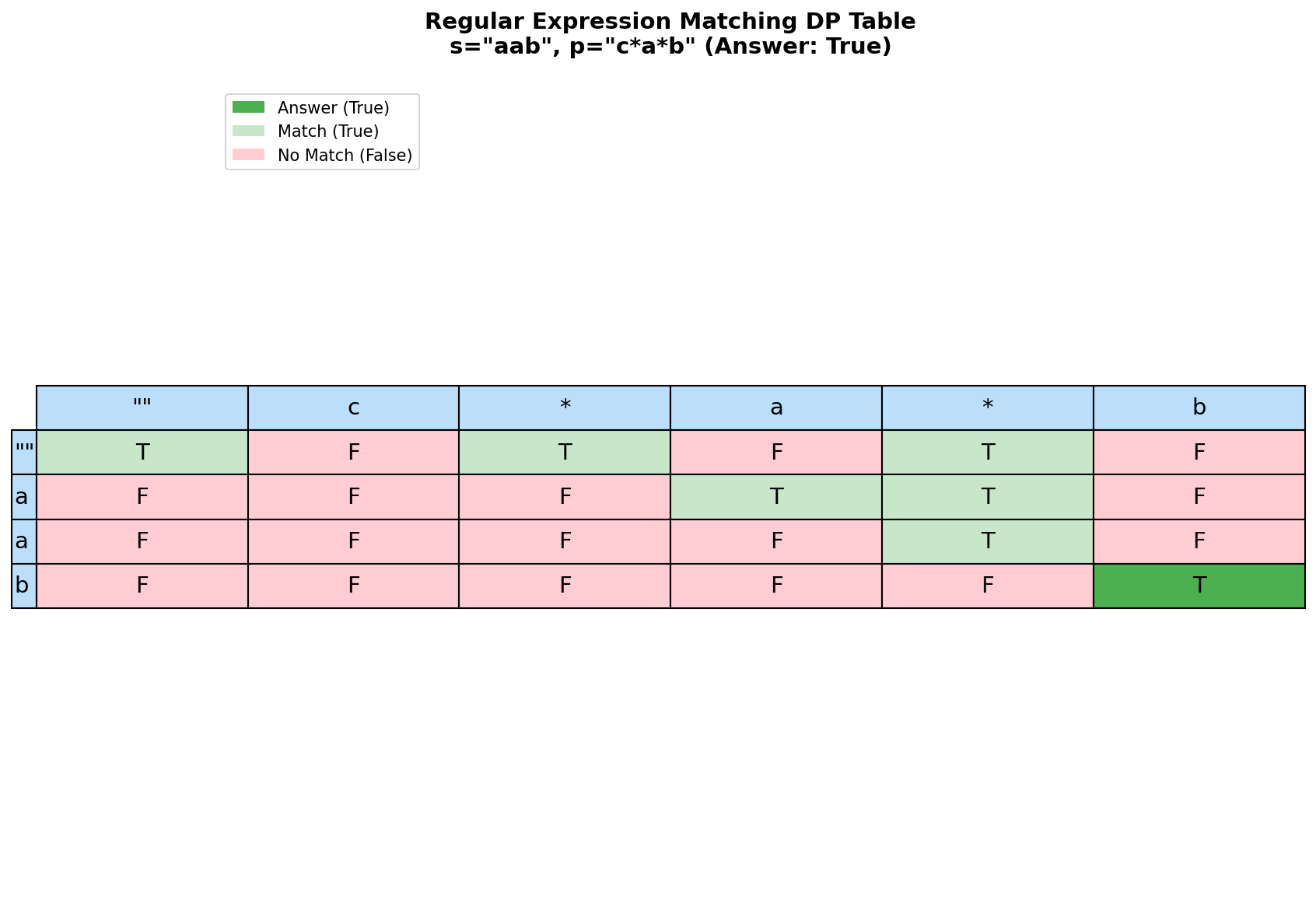
Key Insight: Handling *
The * operator is what makes this problem challenging. For a pattern like a*:
- Match zero occurrences: Skip
a*entirely (dp[i][j-2]) - Match one or more: If
s[i]matchesa(or.), try matching more (dp[i-1][j])
Pattern Matching Rules
| Pattern | Meaning | DP Transition |
|---|---|---|
a matches a | Exact match | dp[i][j] = dp[i-1][j-1] |
. matches any | Wildcard | dp[i][j] = dp[i-1][j-1] |
a* matches "" | Zero of a | dp[i][j] = dp[i][j-2] |
a* matches aaa | Multiple as | dp[i][j] = dp[i-1][j] if s[i-1]=='a' |
Solution: 2D Dynamic Programming
def isMatch(s: str, p: str) -> bool:
    """
    Regular expression matching with '.' and '*' support.

    Args:
        s: Input string
        p: Pattern with '.' (any char) and '*' (zero or more)

    Returns:
        True if pattern matches entire string

    Time: O(m * n) where m = len(s), n = len(p)
    Space: O(m * n) for DP table
    """
    m, n = len(s), len(p)

    # dp[i][j] = True if s[0:i] matches p[0:j]
    dp = [[False] * (n + 1) for _ in range(m + 1)]

    # Base case: empty string matches empty pattern
    dp[0][0] = True

    # Base case: empty string with pattern like a*, a*b*, a*b*c*
    # These patterns can match empty string
    for j in range(2, n + 1):
        if p[j - 1] == '*':
            dp[0][j] = dp[0][j - 2]

    # Fill the DP table
    for i in range(1, m + 1):
        for j in range(1, n + 1):
            if p[j - 1] == '*':
                # Case 1: Zero occurrences of preceding element
                # Just skip the "x*" pattern (look at dp[i][j-2])
                dp[i][j] = dp[i][j - 2]

                # Case 2: One or more occurrences
                # If preceding element matches s[i-1], inherit from dp[i-1][j]
                if p[j - 2] == '.' or p[j - 2] == s[i - 1]:
                    dp[i][j] = dp[i][j] or dp[i - 1][j]

            elif p[j - 1] == '.' or p[j - 1] == s[i - 1]:
                # Direct match (either '.' or exact character)
                dp[i][j] = dp[i - 1][j - 1]

            # else: dp[i][j] remains False

return dp[m][n]public boolean isMatch(String s, String p) {
int m = s.length(), n = p.length();
boolean[][] dp = new boolean[m + 1][n + 1];
dp[0][0] = true;
for (int j = 2; j <= n; j++) {
if (p.charAt(j - 1) == '*') dp[0][j] = dp[0][j - 2];
}
for (int i = 1; i <= m; i++) {
for (int j = 1; j <= n; j++) {
char pc = p.charAt(j - 1);
if (pc == '*') {
dp[i][j] = dp[i][j - 2]; // zero occurrences
char prev = p.charAt(j - 2);
if (prev == '.' || prev == s.charAt(i - 1)) {
dp[i][j] = dp[i][j] || dp[i - 1][j];
}
} else if (pc == '.' || pc == s.charAt(i - 1)) {
dp[i][j] = dp[i - 1][j - 1];
}
}
}
return dp[m][n];
}Complexity: Time O(m * n) · Space O(m * n)
- Time: O(m * n) where m = len(s), n = len(p) - we fill each cell of the DP table exactly once
- Space: O(m * n) for the 2D DP table storing boolean match states for all subproblem combinations
Visual Walkthrough
For s = "aab", p = "c*a*b":
Pattern "c*a*b" interpretation:
- c* = match zero or more 'c' (we use zero)
- a* = match zero or more 'a' (we use two: "aa")
- b  = match exactly 'b'

DP Table:
          ""    c    *    a    *    b
    ""     T    F    T    F    T    F
     a     F    F    F    T    T    F
     a     F    F    F    F    T    F
     b     F    F    F    F    F    T

Building the table:
- dp[0][0] = True (empty matches empty)
- dp[0][2] = dp[0][0] = True (c* matches empty)
- dp[0][4] = dp[0][2] = True (a* also matches empty)
- dp[1][3]: 'a' matches 'a', dp[1][3] = dp[0][2] = True
- dp[1][4]: a* with 'a', dp[1][4] = dp[1][2] = True (zero a's) OR dp[0][4] = True (one a)
- dp[2][4]: a* with 'aa', dp[2][4] = dp[1][4] = True (matching 'aa')
- dp[3][5]: 'b' matches 'b', dp[3][5] = dp[2][4] = True

Answer: dp[3][5] = TrueMemoization Approach (Top-Down DP)
from functools import lru_cache

def isMatch_memo(s: str, p: str) -> bool:
    """
    Top-down DP with memoization.

    Time: O(m * n)
    Space: O(m * n) for memoization
    """
    @lru_cache(maxsize=None)
    def dp(i: int, j: int) -> bool:
        # Base case: pattern exhausted
        if j == len(p):
            return i == len(s)

        # Check if current characters match
        first_match = i < len(s) and (p[j] == s[i] or p[j] == '.')

        # Handle '*'
        if j + 1 < len(p) and p[j + 1] == '*':
            # Zero occurrences OR one+ occurrences
            return (dp(i, j + 2) or  # Skip "x*"
                    (first_match and dp(i + 1, j)))  # Match and continue

        # No '*', direct match required
        return first_match and dp(i + 1, j + 1)

return dp(0, 0)Complexity: Time O(m * n) · Space O(m * n)
- Time: O(m * n) - each unique state (i, j) is computed once due to memoization
- Space: O(m * n) for memoization cache plus O(m + n) recursion stack depth
Recursive Approach (Without Memoization)
For understanding the logic before optimization:
def isMatch_recursive(s: str, p: str) -> bool:
    """
    Recursive solution (exponential time without memo).

    Good for understanding the logic.
    """
    if not p:
        return not s

    # Check first character match
    first_match = bool(s) and (p[0] == s[0] or p[0] == '.')

    # Handle '*'
    if len(p) >= 2 and p[1] == '*':
        # Option 1: Zero occurrences (skip x*)
        # Option 2: One occurrence (if first matches, continue with rest of s)
        return (isMatch_recursive(s, p[2:]) or
                (first_match and isMatch_recursive(s[1:], p)))

    # No '*', require direct match
return first_match and isMatch_recursive(s[1:], p[1:])Complexity: Time O(2^(m+n)) · Space O(m + n)
- Time: O(2^(m+n)) exponential - each '*' creates two recursive branches, leading to exponential blowup without memoization
- Space: O(m + n) for the recursion call stack depth in the worst case
Space-Optimized Solution
def isMatch_optimized(s: str, p: str) -> bool:
    """
    Space-optimized using two rows.

    Time: O(m * n)
    Space: O(n)
    """
    m, n = len(s), len(p)

    prev = [False] * (n + 1)
    curr = [False] * (n + 1)

    # Base case
    prev[0] = True
    for j in range(2, n + 1):
        if p[j - 1] == '*':
            prev[j] = prev[j - 2]

    for i in range(1, m + 1):
        curr[0] = False  # Non-empty string can't match empty pattern

        for j in range(1, n + 1):
            if p[j - 1] == '*':
                curr[j] = curr[j - 2]
                if p[j - 2] == '.' or p[j - 2] == s[i - 1]:
                    curr[j] = curr[j] or prev[j]
            elif p[j - 1] == '.' or p[j - 1] == s[i - 1]:
                curr[j] = prev[j - 1]
            else:
                curr[j] = False

        prev, curr = curr, prev

return prev[n]Complexity: Time O(m * n) · Space O(n)
- Time: O(m * n) - same as 2D DP, we still process all subproblems
- Space: O(n) - only storing two rows of size n+1 instead of the full m x n table
Complexity Analysis
| Approach | Time | Space |
|---|---|---|
| 2D DP | O(m * n) | O(m * n) |
| Memoization | O(m * n) | O(m * n) |
| Space-Optimized | O(m * n) | O(n) |
| Recursive (no memo) | O(2^(m+n)) | O(m + n) |
Edge Cases
| s | p | Output | Note |
|---|---|---|---|
"" | "" | true | Empty matches empty |
"" | "a*" | true | * can match zero |
"" | "a*b*" | true | Multiple * can all be zero |
"a" | ".*" | true | .* matches anything |
"a" | "a*a" | true | a* = "", then match "a" |
"ab" | ".*c" | false | Need 'c' at end |
Common Mistakes
| Mistake | Example | Problem |
|---|---|---|
Forgetting * can be zero | "ab" vs "c*ab" | c* means zero 'c's |
Wrong index for * | Off-by-one | * affects p[j-2], not p[j-1] |
Not handling .* | "ab" vs ".*" | . before * matches any char |
| Missing base cases | Empty string with pattern | a*b* matches "" |
Interview Tips
- Clarify the operators: Make sure you understand
.and* - Start with recursion: Explain the logic before optimizing
- Draw the DP table: Visual helps with understanding transitions
- Handle
*carefully: It's the key to this problem - Test edge cases: Empty string, patterns like
.*,a*b*
Key Insights to Mention
*always follows a character (never alone)*means "zero or more" of the preceding element.*is the most powerful pattern (matches anything)
Related Problems
Wildcard Matching (LeetCode 44)
Problem: Implement wildcard pattern matching with '?' (any single char) and '*' (any sequence including empty).
Key Insight: Unlike regex, '*' here is independent - matches any sequence on its own, not tied to preceding character.
Approach: 2D DP or greedy with backtracking. For DP: dp[i][j] true if s[0:i] matches p[0:j]. '*' can match empty (dp[i][j-1]) or extend match (dp[i-1][j]).
Complexity: O(m * n) time, O(m * n) space (or O(1) with greedy)
Edit Distance (LeetCode 72)
Problem: Find minimum operations (insert, delete, replace) to transform word1 into word2.
Key Insight: Similar 2D DP structure but different transitions - three operations instead of pattern matching rules.
Approach: dp[i][j] = min ops for word1[0:i] to word2[0:j]. Match: inherit diagonal. Mismatch: 1 + min(replace, insert, delete).
Complexity: O(m * n) time, O(m * n) space (can optimize to O(n))
Is Subsequence (LeetCode 392)
Problem: Given strings s and t, return true if s is a subsequence of t.
Key Insight: Simpler version of matching - just need to match characters in order without wildcards.
Approach: Two pointers: advance through t, move s pointer when characters match. Return true if s pointer reaches end.
Complexity: O(n) time, O(1) space
Complete Solution with Tests
def isMatch(s: str, p: str) -> bool:
    """
    Regular expression matching with '.' and '*'.

    Time: O(m * n)
    Space: O(m * n)
    """
    m, n = len(s), len(p)
    dp = [[False] * (n + 1) for _ in range(m + 1)]

    dp[0][0] = True

    for j in range(2, n + 1):
        if p[j - 1] == '*':
            dp[0][j] = dp[0][j - 2]

    for i in range(1, m + 1):
        for j in range(1, n + 1):
            if p[j - 1] == '*':
                dp[i][j] = dp[i][j - 2]
                if p[j - 2] == '.' or p[j - 2] == s[i - 1]:
                    dp[i][j] = dp[i][j] or dp[i - 1][j]
            elif p[j - 1] == '.' or p[j - 1] == s[i - 1]:
                dp[i][j] = dp[i - 1][j - 1]

    return dp[m][n]


# Test cases
if __name__ == "__main__":
    test_cases = [
        ("aa", "a", False),
        ("aa", "a*", True),
        ("ab", ".*", True),
        ("aab", "c*a*b", True),
        ("mississippi", "mis*is*p*.", False),
        ("", "", True),
        ("", "a*", True),
        ("", "a*b*c*", True),
        ("a", "ab*", True),
        ("aaa", "a*a", True),
        ("aaa", "ab*a*c*a", True),
    ]

    for s, p, expected in test_cases:
        result = isMatch(s, p)
        status = "PASS" if result == expected else "FAIL"
print(f'{status}: isMatch("{s}", "{p}") = {result} (expected {expected})')Summary
| Key Point | Details |
|---|---|
| Pattern | 2D String DP with special operator handling |
| Key Challenge | * can match zero or more of preceding element |
| State | dp[i][j] = does s[0:i] match p[0:j]? |
| Time | O(m * n) |
| Space | O(m * n) or O(n) optimized |
Takeaway: Regular Expression Matching is challenging because of the * operator. The key insight is that x* can either be skipped entirely (zero matches) or can consume characters from s (one or more matches). Master this transition logic for the DP solution.