Redundant Connection & Union-Find
Detecting cycles and managing disjoint sets
Visual Guides
Union Operations Step-by-Step
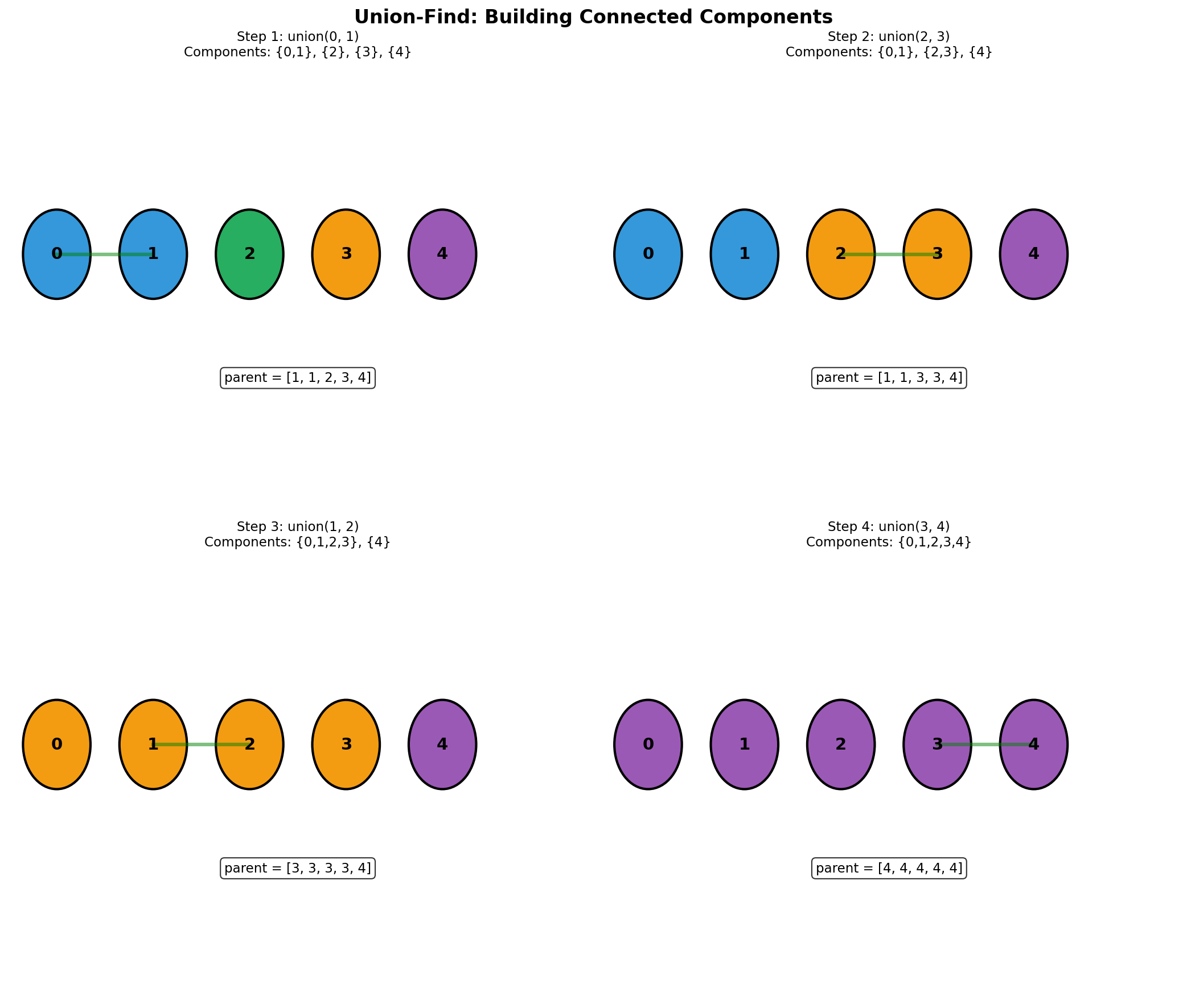
Path Compression
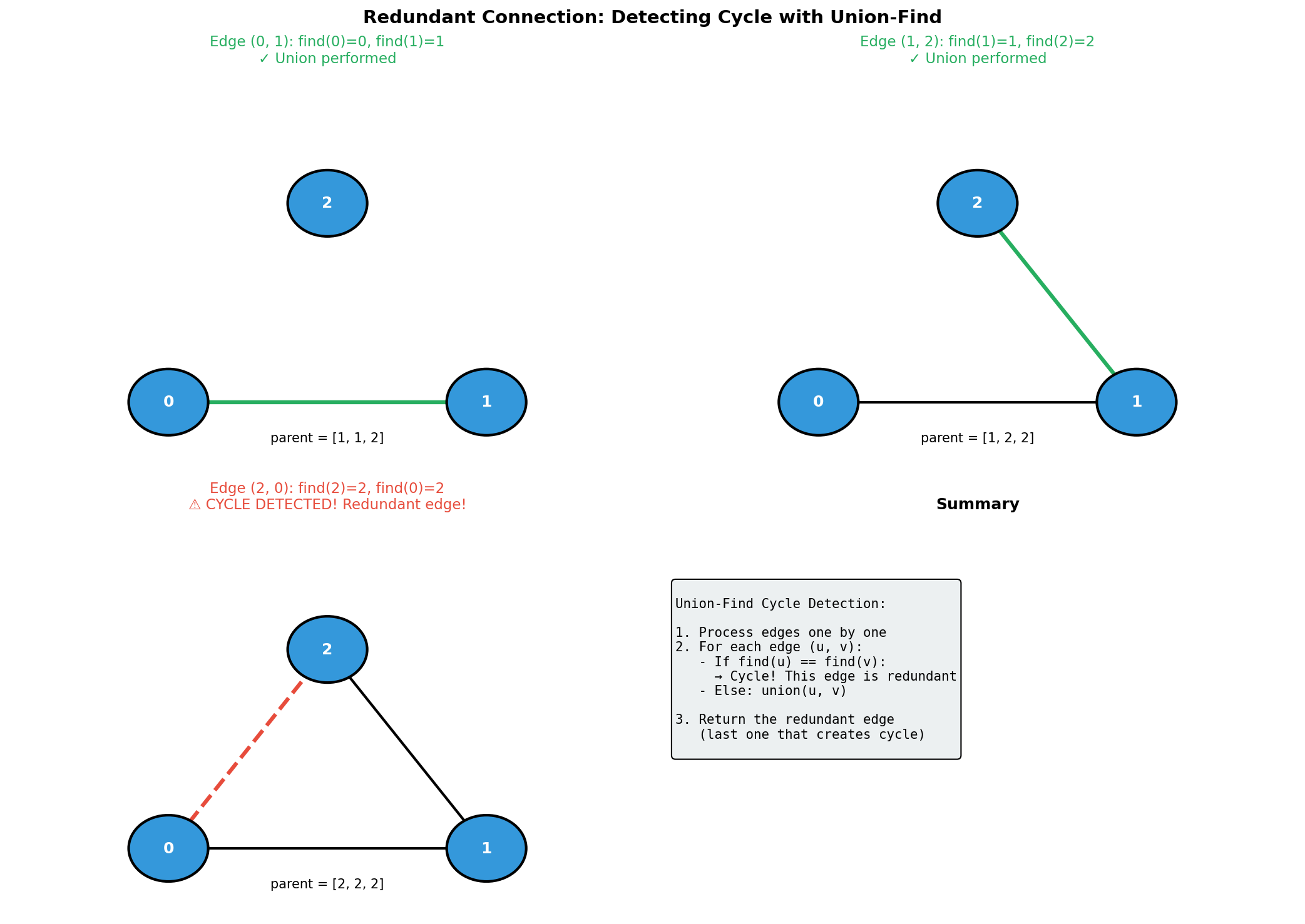
Cycle Detection with Union-Find
Union-Find (Disjoint Set Union)
Overview
Union-Find (also known as Disjoint Set Union or DSU) is a data structure that stores a collection of disjoint (non-overlapping) sets. It efficiently supports two primary operations:
- Find: Determine which set a particular element belongs to
- Union: Merge two sets into one
When to Use Union-Find:
- Detecting cycles in undirected graphs
- Finding connected components
- Kruskal's algorithm for Minimum Spanning Tree
- Determining if two elements are in the same group
- Dynamic connectivity problems
- Network connectivity queries
The key insight is that Union-Find represents each set as a rooted tree, where each node points to its parent. The root of each tree serves as the representative (or "leader") of that set.
Implementation
class UnionFind:
    def __init__(self, n):
        self.parent = list(range(n))
        self.rank = [0] * n

    def find(self, x):
        if self.parent[x] != x:
            self.parent[x] = self.find(self.parent[x])  # Path compression
        return self.parent[x]

    def union(self, x, y):
        px, py = self.find(x), self.find(y)
        if px == py:
            return False  # Already connected

        # Union by rank
        if self.rank[px] < self.rank[py]:
            px, py = py, px
        self.parent[py] = px
        if self.rank[px] == self.rank[py]:
            self.rank[px] += 1

        return True

    def connected(self, x, y):
return self.find(x) == self.find(y)Complexity: Time O(alpha(n)) per operation · Space O(n)
- Time: Find and Union operations take O(alpha(n)) amortized time where alpha is inverse Ackermann function (effectively constant)
- Space: Parent and rank arrays each require O(n) space for n elements
Key Optimizations
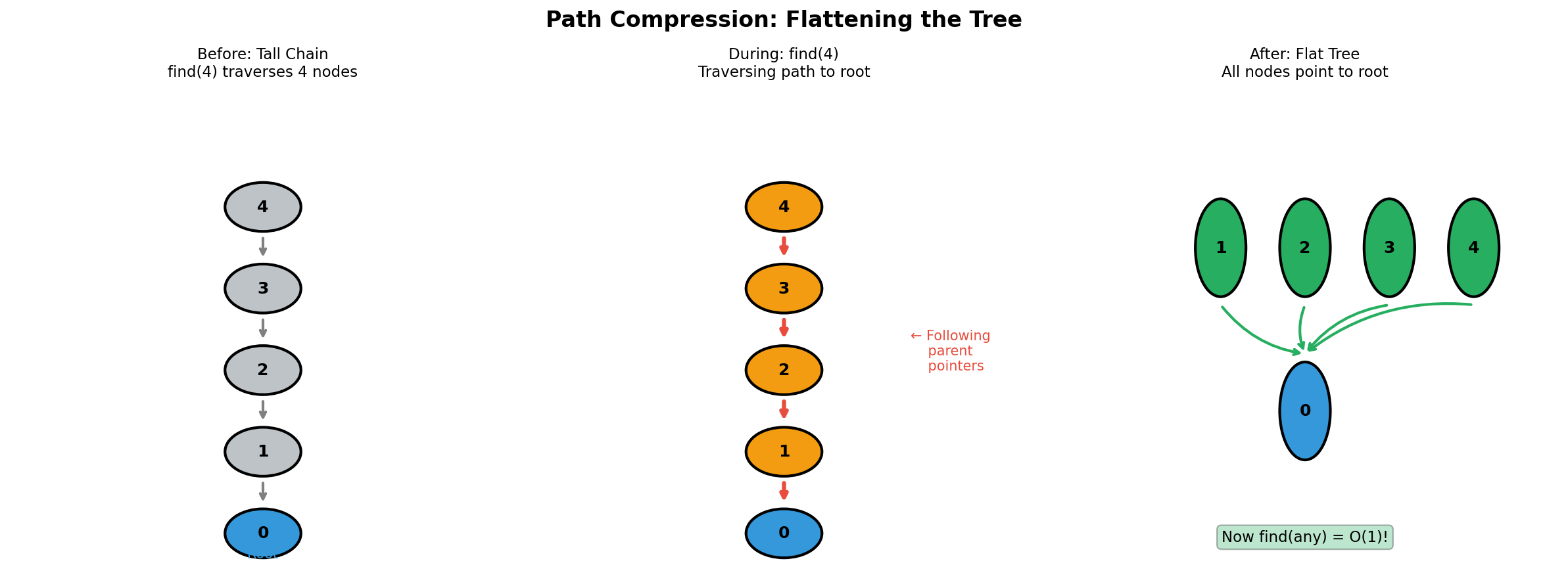
1. Path Compression (in find) When finding the root of an element, we update each visited node to point directly to the root. This flattens the tree structure, making future operations faster.
Before: 1 -> 2 -> 3 -> 4 (root)
After: 1 -> 4, 2 -> 4, 3 -> 42. Union by Rank (in union) Always attach the shorter tree under the root of the taller tree. This keeps trees balanced and prevents degenerate cases where trees become linked lists.
Complexity
| Operation | Without Optimization | With Path Compression + Union by Rank |
|---|---|---|
| Find | O(n) | O(alpha(n)) approx O(1) amortized |
| Union | O(n) | O(alpha(n)) approx O(1) amortized |
| Space | O(n) | O(n) |
Where alpha(n) is the inverse Ackermann function, which grows so slowly that it is effectively constant (at most 4) for all practical values of n.
Redundant Connection
Problem Statement
LeetCode 684: Redundant Connection
In this problem, a tree is an undirected graph that is connected and has no cycles. You are given a graph that started as a tree with n nodes (labeled 1 to n), with one additional edge added.
The added edge connects two existing nodes and creates exactly one cycle. Return an edge that can be removed so that the resulting graph is a tree. If there are multiple answers, return the edge that occurs last in the input.
Example
Input: edges = [[1,2],[1,3],[2,3]]
Output: [2,3]

Explanation:
  1
 / \
2 - 3

The edge [2,3] creates a cycle. Removing it leaves a valid tree.Input: edges = [[1,2],[2,3],[3,4],[1,4],[1,5]]
Output: [1,4]
Explanation:
5 - 1 - 2
| |
4 - 3
The edge [1,4] creates a cycle with path 1-2-3-4.Approach
Key Insight: Process edges in order. The first edge that connects two already-connected nodes creates a cycle - that's our redundant edge.
Algorithm:
- Initialize Union-Find with n nodes
- Iterate through each edge
[u, v] - If
uandvare already in the same component (connected), this edge creates a cycle - return it - Otherwise, union
uandv
This works because:
- A tree with n nodes has exactly n-1 edges
- We have n edges (one extra), so exactly one edge creates a cycle
- Processing in order ensures we return the last such edge if multiple exist
Mermaid Diagram
Solution
def findRedundantConnection(edges: list[list[int]]) -> list[int]:
    n = len(edges)
    uf = UnionFind(n + 1)  # 1-indexed nodes

    for u, v in edges:
        if not uf.union(u, v):
            return [u, v]  # This edge creates cycle

return []public int[] findRedundantConnection(int[][] edges) {
int n = edges.length;
int[] parent = new int[n + 1];
for (int i = 0; i <= n; i++) parent[i] = i;
for (int[] edge : edges) {
int pu = find(parent, edge[0]), pv = find(parent, edge[1]);
if (pu == pv) return edge;
parent[pu] = pv;
}
return new int[]{};
}
private int find(int[] parent, int x) {
if (parent[x] != x) parent[x] = find(parent, parent[x]);
return parent[x];
}Complexity: Time O(n * alpha(n)) · Space O(n)
- Time: Processing n edges, each union/find operation O(alpha(n)) with optimizations
- Space: UnionFind data structure uses O(n) for parent and rank arrays
Inline Version (Without Class)
def findRedundantConnection_inline(edges: list[list[int]]) -> list[int]:
    parent = list(range(len(edges) + 1))

    def find(x):
        if parent[x] != x:
            parent[x] = find(parent[x])  # Path compression
        return parent[x]

    for u, v in edges:
        pu, pv = find(u), find(v)
        if pu == pv:
            return [u, v]  # Already connected - cycle!
        parent[pu] = pv  # Union

return []Complexity: Time O(n * alpha(n)) · Space O(n)
- Time: Each edge processed once with find operations; path compression ensures near-constant amortized time
- Space: Single parent array of size n+1 for 1-indexed nodes
Complexity
| Aspect | Complexity |
|---|---|
| Time | O(n * alpha(n)) approx O(n) |
| Space | O(n) for parent array |
Union-Find Applications
Connected Components
Count the number of connected components in an undirected graph.
def countComponents(n: int, edges: list[list[int]]) -> int:
    uf = UnionFind(n)
    for u, v in edges:
        uf.union(u, v)

    # Count unique roots
return len(set(uf.find(i) for i in range(n)))Complexity: Time O(E * alpha(n)) · Space O(n)
- Time: E union operations plus n find operations to count unique roots
- Space: UnionFind structure O(n), set for counting roots O(n) worst case
Graph Valid Tree
Determine if given edges form a valid tree (connected, no cycles).
def validTree(n: int, edges: list[list[int]]) -> bool:
    # Tree property: exactly n-1 edges for n nodes
    if len(edges) != n - 1:
        return False

    uf = UnionFind(n)
    for u, v in edges:
        if not uf.union(u, v):
            return False  # Cycle detected
return TrueComplexity: Time O(n * alpha(n)) · Space O(n)
- Time: Edge count check O(1), then n-1 union operations each O(alpha(n))
- Space: UnionFind parent and rank arrays O(n)
Accounts Merge (LeetCode 721)
Merge accounts that share common emails using Union-Find.
def accountsMerge(accounts: list[list[str]]) -> list[list[str]]:
    from collections import defaultdict

    email_to_id = {}
    email_to_name = {}

    # Map each email to a unique ID
    for account in accounts:
        name = account[0]
        for email in account[1:]:
            if email not in email_to_id:
                email_to_id[email] = len(email_to_id)
            email_to_name[email] = name

    uf = UnionFind(len(email_to_id))

    # Union emails within same account
    for account in accounts:
        first_id = email_to_id[account[1]]
        for email in account[2:]:
            uf.union(first_id, email_to_id[email])

    # Group emails by root
    groups = defaultdict(list)
    for email, idx in email_to_id.items():
        groups[uf.find(idx)].append(email)

    # Format result
    return [[email_to_name[emails[0]]] + sorted(emails)
for emails in groups.values()]Complexity: Time O(N * K * alpha(NK) + NK log NK) · Space O(NK)
- Time: Building email maps O(NK), union operations O(NK * alpha(NK)), sorting emails O(NK log NK)
- Space: Maps and UnionFind store up to NK unique emails across N accounts with K emails each
Number of Islands II (LeetCode 305)
Track number of islands as land positions are added dynamically.
def numIslands2(m: int, n: int, positions: list[list[int]]) -> list[int]:
    parent = {}
    count = 0
    result = []

    def find(x):
        if parent[x] != x:
            parent[x] = find(parent[x])
        return parent[x]

    def union(x, y):
        nonlocal count
        px, py = find(x), find(y)
        if px != py:
            parent[px] = py
            count -= 1

    directions = [(0, 1), (0, -1), (1, 0), (-1, 0)]

    for r, c in positions:
        if (r, c) in parent:
            result.append(count)
            continue

        parent[(r, c)] = (r, c)
        count += 1

        for dr, dc in directions:
            nr, nc = r + dr, c + dc
            if (nr, nc) in parent:
                union((r, c), (nr, nc))

        result.append(count)

return resultComplexity: Time O(L * alpha(mn)) · Space O(mn)
- Time: L positions processed, each with up to 4 union operations; each union/find O(alpha(mn))
- Space: Parent dictionary grows up to O(mn) for all possible grid cells
Interview Applications
Union-Find is a favorite data structure in technical interviews due to its elegant solution to connectivity problems. Common scenarios include:
1. Social Network Connectivity
Determine if two users are connected through friends, or count friend groups.
2. Image Processing
Connected component labeling in image segmentation - identifying distinct regions in binary images.
3. Network Design
- Determining if adding a connection would create a redundant path
- Finding minimum connections needed for full network connectivity
4. Distributed Systems
- Tracking which servers are in the same cluster
- Detecting partition boundaries
5. Related LeetCode Problems
| Problem | Difficulty | Key Concept |
|---|---|---|
| 684. Redundant Connection | Medium | Cycle detection |
| 685. Redundant Connection II | Hard | Directed graph cycle |
| 547. Number of Provinces | Medium | Connected components |
| 200. Number of Islands | Medium | Grid connectivity |
| 721. Accounts Merge | Medium | Grouping by shared attribute |
| 1319. Number of Operations to Make Network Connected | Medium | Component counting |
| 990. Satisfiability of Equality Equations | Medium | Constraint satisfaction |
| 1202. Smallest String With Swaps | Medium | Character grouping |
Interview Tips
Recognize the pattern: Any problem involving grouping elements or checking connectivity is a candidate for Union-Find
Consider alternatives: Sometimes BFS/DFS is simpler for one-time queries, but Union-Find excels at multiple dynamic queries
Don't forget optimizations: Always mention path compression and union by rank in interviews
Handle edge cases:
- 0-indexed vs 1-indexed nodes
- Self-loops
- Duplicate edges
- Disconnected components
Time complexity communication: Explain that while technically O(alpha(n)), it's effectively O(1) for all practical purposes