Binary Search
search in sorted/monotonic data
Overview
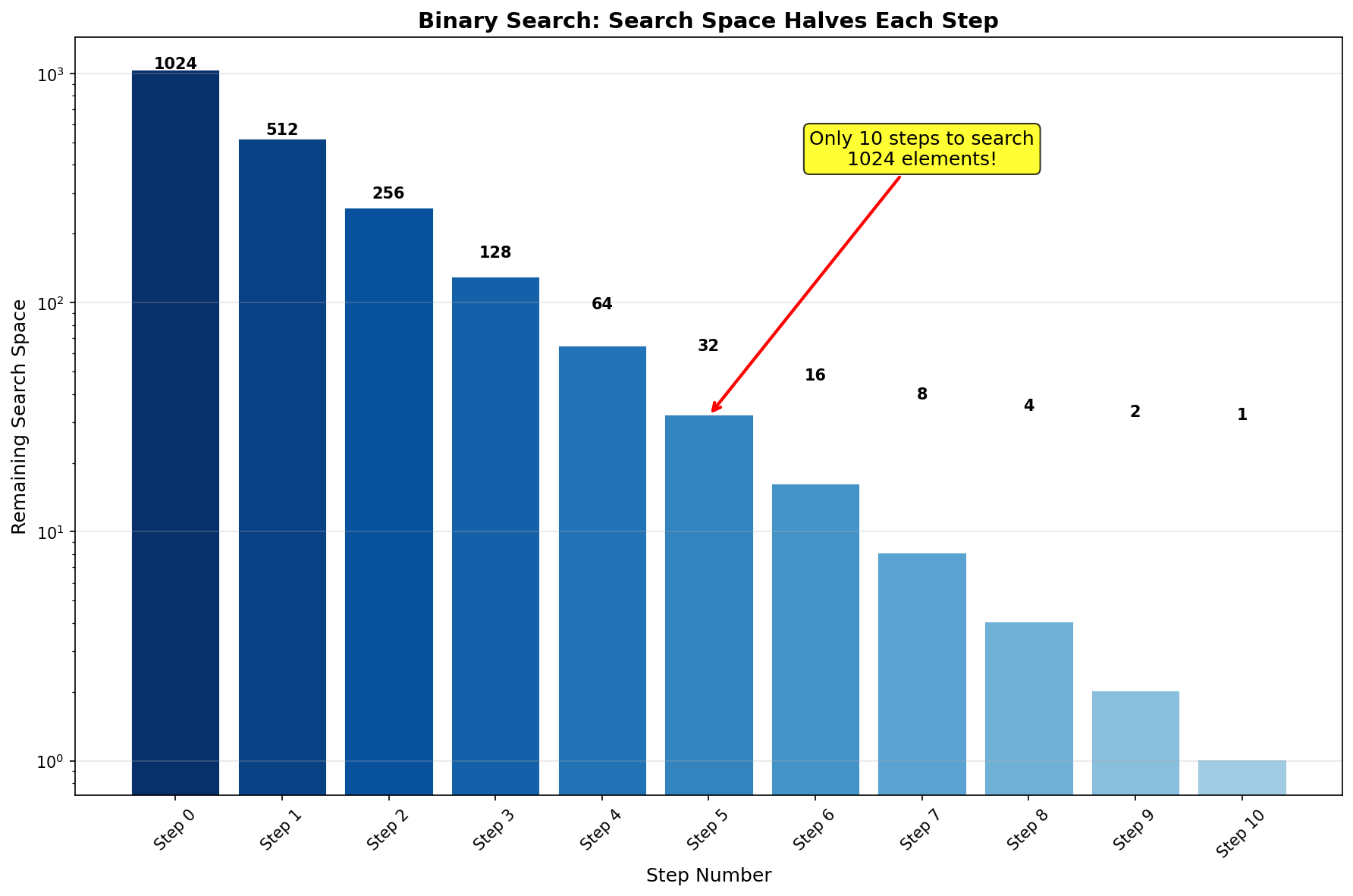
Binary Search is one of the most fundamental and efficient searching algorithms, with a time complexity of
When to Use Binary Search
- Sorted Arrays: The classic use case - searching for an element in a sorted array
- Monotonic Functions: When there's a monotonic relationship (always increasing or decreasing)
- Search Space Reduction: When you can eliminate half of the possibilities with each comparison
- Optimization Problems: Finding minimum/maximum values that satisfy a condition
- Answer Range Problems: When the answer lies between a range L to R with monotonic behavior
Key Insight
Binary search is applicable whenever you can answer a yes/no question about your search space, and the answers form a pattern like:
F F F F F T T T T(find first True)T T T T T F F F F(find last True)
Visual Guides
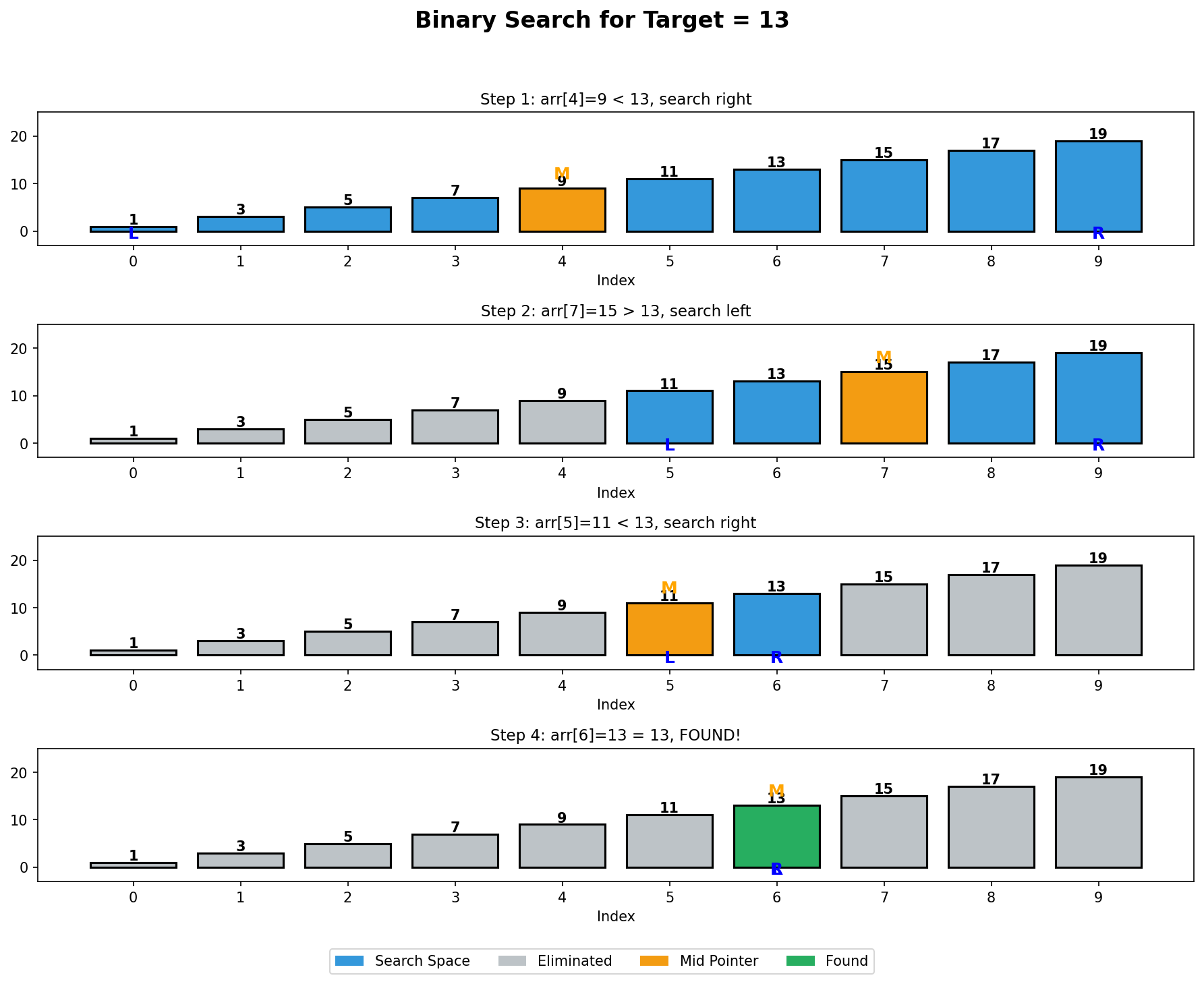
Binary Search Step-by-Step
Search Space Halving (O(log n))
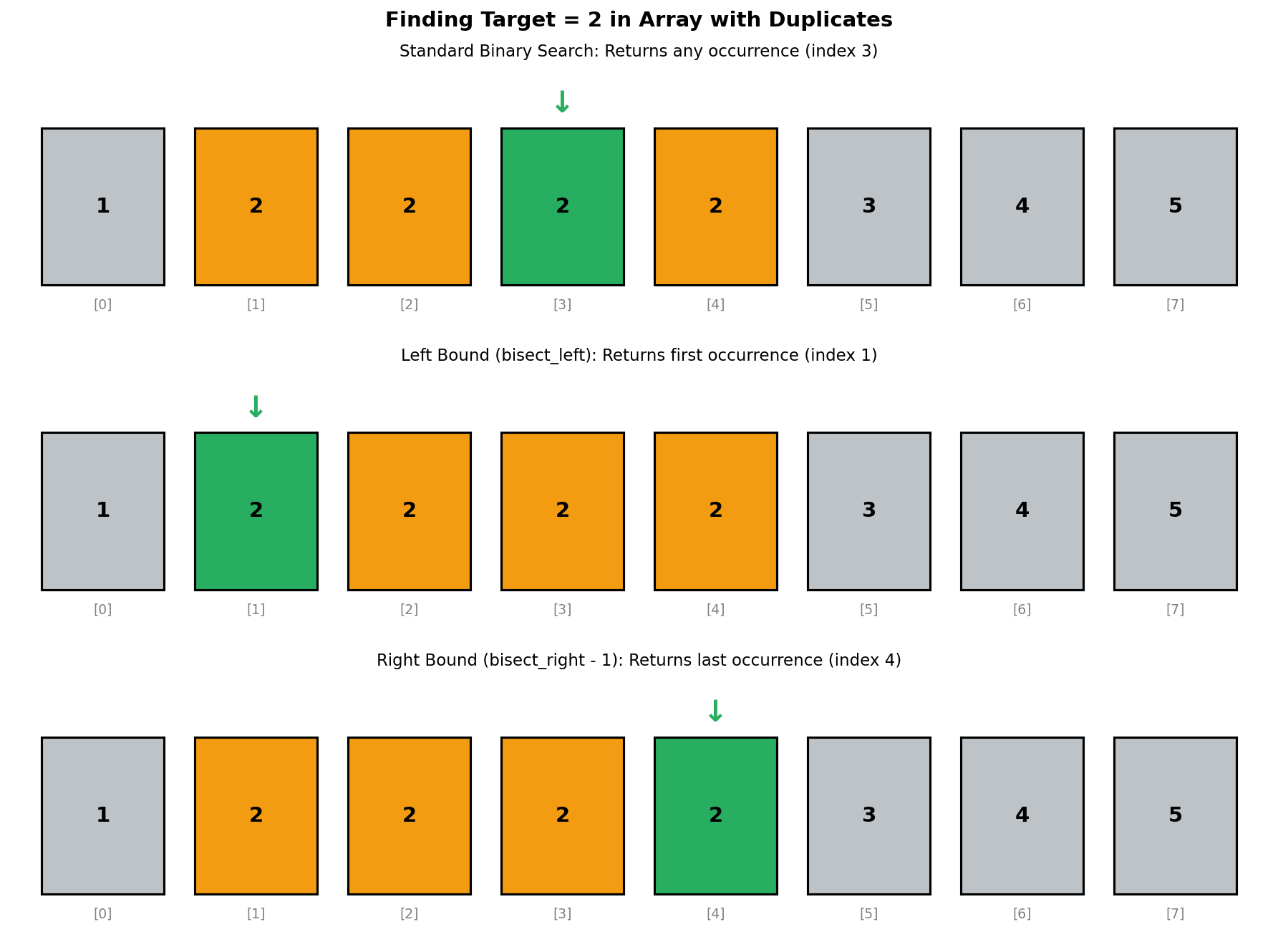
Left Bound vs Right Bound
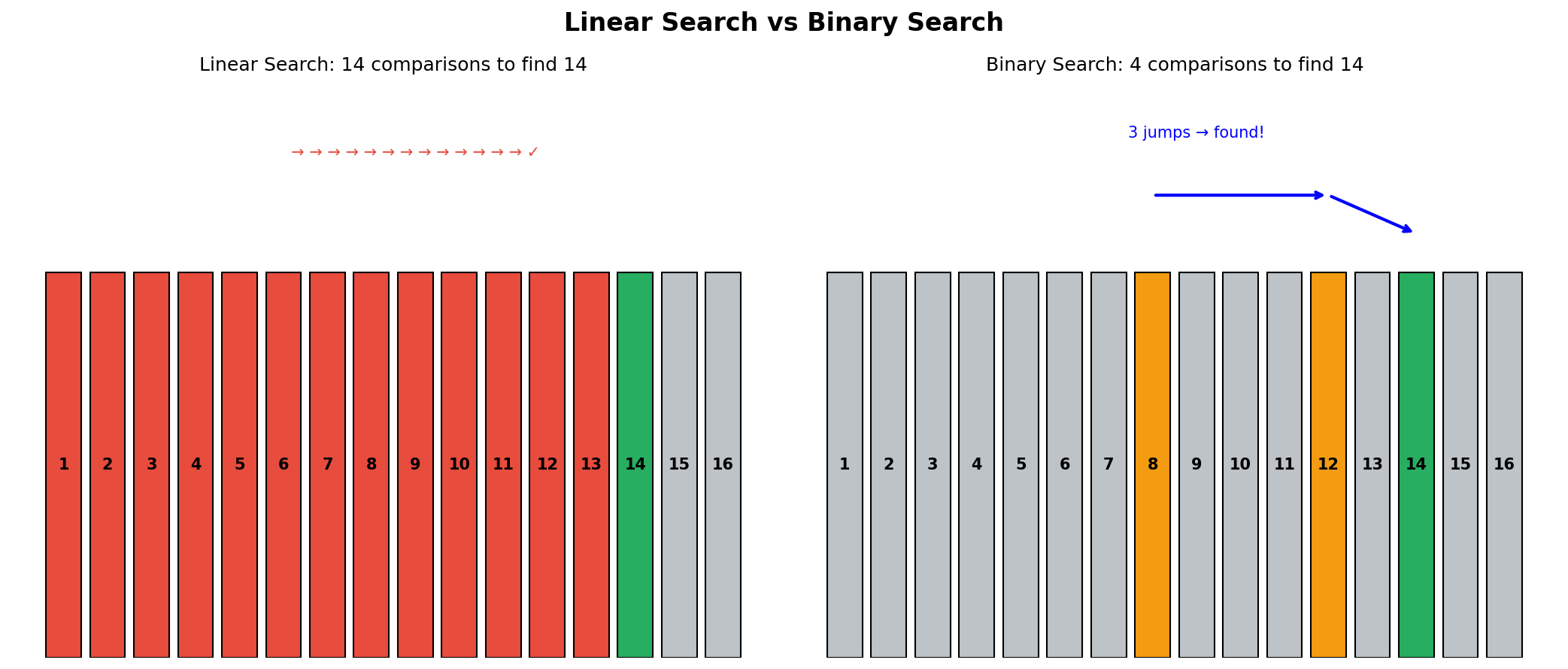
Linear vs Binary Search
The Three Templates
Template 1: Basic (Find Exact Match)
Use when searching for an exact value in a sorted array.
def binary_search(nums, target):
    """
    Find exact match in sorted array.
    Returns index if found, -1 otherwise.

    Time: O(log n), Space: O(1)
    """
    left, right = 0, len(nums) - 1

    while left <= right:
        mid = left + (right - left) // 2  # Prevents overflow

        if nums[mid] == target:
            return mid
        elif nums[mid] < target:
            left = mid + 1
        else:
            right = mid - 1

return -1public int binarySearch(int[] nums, int target) {
int left = 0, right = nums.length - 1;
while (left <= right) {
int mid = left + (right - left) / 2;
if (nums[mid] == target) return mid;
else if (nums[mid] < target) left = mid + 1;
else right = mid - 1;
}
return -1;
}Complexity: Time O(log n) · Space O(1)
- Time: Each iteration halves search space; at most log2(n) comparisons to find target or exhaust space
- Space: Only constant variables for left, right, and mid pointers
Key Points:
- Loop condition:
left <= right(inclusive bounds) - Search space:
[left, right] - Termination: when
left > right(search space empty) - Returns: exact index or -1
Template 2: Left Bound (First Occurrence / Lower Bound)
Use when finding the first position where condition is true, or insert position.
def search_left(nums, target):
    """
    Find leftmost position where target could be inserted.
    Returns first index where nums[i] >= target.

    This is equivalent to bisect_left.
    Time: O(log n), Space: O(1)
    """
    left, right = 0, len(nums)  # Note: right = len(nums), not len(nums) - 1

    while left < right:
        mid = left + (right - left) // 2

        if nums[mid] < target:
            left = mid + 1
        else:
            right = mid  # Don't exclude mid, it could be the answer

    return left

def find_first_occurrence(nums, target):
    """Find first occurrence of target in sorted array."""
    idx = search_left(nums, target)
    if idx < len(nums) and nums[idx] == target:
        return idx
return -1public int searchLeft(int[] nums, int target) {
int left = 0, right = nums.length;
while (left < right) {
int mid = left + (right - left) / 2;
if (nums[mid] < target) left = mid + 1;
else right = mid;
}
return left;
}
public int findFirstOccurrence(int[] nums, int target) {
int idx = searchLeft(nums, target);
if (idx < nums.length && nums[idx] == target) return idx;
return -1;
}Complexity: Time O(log n) · Space O(1)
- Time: Each iteration shrinks search space by half until left == right
- Space: Only constant space for pointer variables
Key Points:
- Loop condition:
left < right(non-inclusive right) - Search space:
[left, right) - When condition is true:
right = mid(keep mid in search space) - Termination: when
left == right(single element) - Returns: leftmost valid position
Template 3: Right Bound (Last Occurrence / Upper Bound)
Use when finding the last position of an element.
def search_right(nums, target):
    """
    Find rightmost position where target could be inserted.
    Returns first index where nums[i] > target.

    This is equivalent to bisect_right.
    Time: O(log n), Space: O(1)
    """
    left, right = 0, len(nums)

    while left < right:
        mid = left + (right - left) // 2

        if nums[mid] <= target:
            left = mid + 1  # Move past elements <= target
        else:
            right = mid

    return left  # This is the insertion point

def find_last_occurrence(nums, target):
    """Find last occurrence of target in sorted array."""
    idx = search_right(nums, target) - 1
    if idx >= 0 and nums[idx] == target:
        return idx
return -1public int searchRight(int[] nums, int target) {
int left = 0, right = nums.length;
while (left < right) {
int mid = left + (right - left) / 2;
if (nums[mid] <= target) left = mid + 1;
else right = mid;
}
return left; // insertion point after last occurrence
}
public int findLastOccurrence(int[] nums, int target) {
int idx = searchRight(nums, target) - 1;
if (idx >= 0 && nums[idx] == target) return idx;
return -1;
}Complexity: Time O(log n) · Space O(1)
- Time: Same as left bound - logarithmic search for rightmost position
- Space: Constant space for pointer variables
Key Points:
- Difference from Template 2: condition is
nums[mid] <= target - Returns position AFTER the last occurrence
- Subtract 1 to get actual last occurrence
Universal Template (Minimizing k)
A powerful generalized template that works for most binary search problems:
def binary_search_universal(search_space, condition):
    """
    Find minimum k in search_space such that condition(k) is True.

    Pattern: F F F F T T T T
             ^       ^
             |       First True (what we want)
             Last False
    """
    left, right = min(search_space), max(search_space) + 1

    while left < right:
        mid = left + (right - left) // 2

        if condition(mid):
            right = mid      # Condition is True, search left for smaller k
        else:
            left = mid + 1   # Condition is False, search right

return left # Minimum k where condition(k) is TrueTo adapt this template:
- Define the search space (all possible answers)
- Design the condition function that returns True/False
- Initialize boundaries to include all possibilities
Mermaid Diagram
Search Space Reduction Visualization
Initial:  [1, 2, 3, 4, 5, 6, 7, 8, 9, 10]  Target: 7
           L                          R

Step 1:   [1, 2, 3, 4, 5, 6, 7, 8, 9, 10]  mid=5, 5<7, go right
           L              M           R

Step 2:   [1, 2, 3, 4, 5, 6, 7, 8, 9, 10]  mid=8, 8>7, go left
                          L     M     R

Step 3:   [1, 2, 3, 4, 5, 6, 7, 8, 9, 10]  mid=6, 6<7, go right
                          L  M  R

Step 4:   [1, 2, 3, 4, 5, 6, 7, 8, 9, 10]  mid=7, FOUND!
LMRPython bisect Module
Python's built-in bisect module provides optimized binary search functions:
import bisect

# Example array with duplicates
arr = [1, 3, 3, 3, 5, 7, 9]

# bisect_left: leftmost position to insert (first occurrence)
bisect.bisect_left(arr, 3)   # Returns 1 (first index where 3 appears)

# bisect_right (or bisect): rightmost position to insert (after last occurrence)
bisect.bisect_right(arr, 3)  # Returns 4 (index after last 3)
bisect.bisect(arr, 3)        # Same as bisect_right

# insort_left: insert element maintaining sorted order (left position)
bisect.insort_left(arr, 4)   # arr becomes [1, 3, 3, 3, 4, 5, 7, 9]

# insort_right: insert element (right position)
bisect.insort_right(arr, 4) # Inserts after existing 4s if anyPractical Uses of bisect
import bisect

# 1. Check if element exists
def binary_search_exists(arr, target):
    idx = bisect.bisect_left(arr, target)
    return idx < len(arr) and arr[idx] == target

# 2. Count occurrences in sorted array
def count_occurrences(arr, target):
    left = bisect.bisect_left(arr, target)
    right = bisect.bisect_right(arr, target)
    return right - left

# 3. Find range [first, last] of target
def find_range(arr, target):
    left = bisect.bisect_left(arr, target)
    right = bisect.bisect_right(arr, target) - 1
    if left <= right and arr[left] == target:
        return [left, right]
    return [-1, -1]

# 4. Find closest element
def find_closest(arr, target):
    idx = bisect.bisect_left(arr, target)
    if idx == 0:
        return arr[0]
    if idx == len(arr):
        return arr[-1]
    # Compare with neighbors
    if arr[idx] - target < target - arr[idx-1]:
        return arr[idx]
return arr[idx-1]Beyond Sorted Arrays
Binary Search on Answer
When the problem asks for an optimal value in a range, and you can verify if a value is feasible, use binary search on the answer space.
Pattern Recognition:
- "Find the minimum X such that..."
- "Find the maximum X such that..."
- "What is the smallest/largest value where..."
# Example: Minimum capacity to ship within D days (LeetCode 1011)
def shipWithinDays(weights, days):
    """
    Find minimum ship capacity to deliver all packages within 'days' days.

    Search space: [max(weights), sum(weights)]
    Condition: can we ship with this capacity in <= days?
    """
    def can_ship(capacity):
        current_load = 0
        days_needed = 1

        for weight in weights:
            if current_load + weight > capacity:
                days_needed += 1
                current_load = 0
            current_load += weight

        return days_needed <= days

    # Binary search on answer
    left = max(weights)      # Minimum: at least carry heaviest item
    right = sum(weights)     # Maximum: carry everything at once

    while left < right:
        mid = (left + right) // 2
        if can_ship(mid):
            right = mid      # Can ship, try smaller capacity
        else:
            left = mid + 1   # Can't ship, need larger capacity

return leftpublic int shipWithinDays(int[] weights, int days) {
int left = 0, right = 0;
for (int w : weights) {
left = Math.max(left, w);
right += w;
}
while (left < right) {
int mid = left + (right - left) / 2;
int dayCount = 1, load = 0;
for (int w : weights) {
if (load + w > mid) { dayCount++; load = 0; }
load += w;
}
if (dayCount <= days) right = mid;
else left = mid + 1;
}
return left;
}Complexity: Time O(n * log(sum(weights) - max(weights))) · Space O(1)
- Time: Binary search over capacity range O(log(range)); each iteration simulates shipping O(n)
- Space: Only constant space for counters and pointers
Koko Eating Bananas (LeetCode 875)
def minEatingSpeed(piles, h):
    """
    Find minimum eating speed to finish all bananas in h hours.

    Search space: [1, max(piles)]
    """
    def can_finish(speed):
        hours = 0
        for pile in piles:
            hours += (pile + speed - 1) // speed  # Ceiling division
        return hours <= h

    left, right = 1, max(piles)

    while left < right:
        mid = (left + right) // 2
        if can_finish(mid):
            right = mid
        else:
            left = mid + 1

return leftpublic int minEatingSpeed(int[] piles, int h) {
int left = 1, right = 0;
for (int p : piles) right = Math.max(right, p);
while (left < right) {
int mid = left + (right - left) / 2;
long hours = 0;
for (int pile : piles) hours += (pile + mid - 1) / mid;
if (hours <= h) right = mid;
else left = mid + 1;
}
return left;
}Complexity: Time O(n * log(max(piles))) · Space O(1)
- Time: Binary search over speed range [1, max(piles)]; each iteration computes hours for all piles O(n)
- Space: Only constant space for loop variables
Split Array Largest Sum (LeetCode 410)
def splitArray(nums, k):
    """
    Split array into k subarrays minimizing the largest sum.

    Search space: [max(nums), sum(nums)]
    """
    def can_split(max_sum):
        count = 1
        current_sum = 0

        for num in nums:
            if current_sum + num > max_sum:
                count += 1
                current_sum = 0
            current_sum += num

        return count <= k

    left, right = max(nums), sum(nums)

    while left < right:
        mid = (left + right) // 2
        if can_split(mid):
            right = mid
        else:
            left = mid + 1

return leftpublic int splitArray(int[] nums, int k) {
int left = 0, right = 0;
for (int n : nums) {
left = Math.max(left, n);
right += n;
}
while (left < right) {
int mid = left + (right - left) / 2;
int count = 1, curSum = 0;
for (int num : nums) {
if (curSum + num > mid) { count++; curSum = 0; }
curSum += num;
}
if (count <= k) right = mid;
else left = mid + 1;
}
return left;
}Complexity: Time O(n * log(sum(nums) - max(nums))) · Space O(1)
- Time: Binary search on max subarray sum range; O(n) greedy split count per iteration
- Space: Only constant space for split tracking
Classic Problems
1. Search in Rotated Sorted Array (LeetCode 33)
def search_rotated(nums, target):
    """
    Search in a rotated sorted array.

    Key insight: One half is always sorted.
    Time: O(log n), Space: O(1)
    """
    left, right = 0, len(nums) - 1

    while left <= right:
        mid = (left + right) // 2

        if nums[mid] == target:
            return mid

        # Left half is sorted
        if nums[left] <= nums[mid]:
            if nums[left] <= target < nums[mid]:
                right = mid - 1
            else:
                left = mid + 1
        # Right half is sorted
        else:
            if nums[mid] < target <= nums[right]:
                left = mid + 1
            else:
                right = mid - 1

return -1public int searchRotated(int[] nums, int target) {
int left = 0, right = nums.length - 1;
while (left <= right) {
int mid = left + (right - left) / 2;
if (nums[mid] == target) return mid;
if (nums[left] <= nums[mid]) {
if (nums[left] <= target && target < nums[mid]) right = mid - 1;
else left = mid + 1;
} else {
if (nums[mid] < target && target <= nums[right]) left = mid + 1;
else right = mid - 1;
}
}
return -1;
}Complexity: Time O(log n) · Space O(1)
- Time: Each iteration determines which half is sorted and eliminates the other half
- Space: Only constant space for pointers
2. Find Minimum in Rotated Sorted Array (LeetCode 153)
def findMin(nums):
    """
    Find minimum element in rotated sorted array.

    Time: O(log n), Space: O(1)
    """
    left, right = 0, len(nums) - 1

    while left < right:
        mid = (left + right) // 2

        if nums[mid] > nums[right]:
            # Minimum is in right half
            left = mid + 1
        else:
            # Minimum is in left half (including mid)
            right = mid

return nums[left]public int findMin(int[] nums) {
int left = 0, right = nums.length - 1;
while (left < right) {
int mid = left + (right - left) / 2;
if (nums[mid] > nums[right]) left = mid + 1;
else right = mid;
}
return nums[left];
}Complexity: Time O(log n) · Space O(1)
- Time: Binary search comparing mid with right to determine which half contains minimum
- Space: Only constant pointer variables
3. Find Peak Element (LeetCode 162)
def findPeakElement(nums):
    """
    Find a peak element (greater than neighbors).

    Key insight: If mid < mid+1, peak exists on right.
    Time: O(log n), Space: O(1)
    """
    left, right = 0, len(nums) - 1

    while left < right:
        mid = (left + right) // 2

        if nums[mid] < nums[mid + 1]:
            left = mid + 1  # Peak is on the right
        else:
            right = mid     # Peak is on the left (including mid)

return leftpublic int findPeakElement(int[] nums) {
int left = 0, right = nums.length - 1;
while (left < right) {
int mid = left + (right - left) / 2;
if (nums[mid] < nums[mid + 1]) left = mid + 1;
else right = mid;
}
return left;
}Complexity: Time O(log n) · Space O(1)
- Time: Binary search following ascending slope toward guaranteed peak
- Space: Only constant space for pointers
4. Search a 2D Matrix (LeetCode 74)
def searchMatrix(matrix, target):
    """
    Each row is sorted left-to-right, and the first element of each row is
    greater than the last element of the previous row, so the matrix can be
    treated as a single flattened 1D sorted array.

    Time: O(log(m*n)), Space: O(1)
    """
    if not matrix or not matrix[0]:
        return False

    m, n = len(matrix), len(matrix[0])
    left, right = 0, m * n - 1

    while left <= right:
        mid = (left + right) // 2
        # Convert 1D index to 2D
        row, col = mid // n, mid % n
        val = matrix[row][col]

        if val == target:
            return True
        elif val < target:
            left = mid + 1
        else:
            right = mid - 1

return Falsepublic boolean searchMatrix(int[][] matrix, int target) {
if (matrix == null || matrix.length == 0 || matrix[0].length == 0) return false;
int m = matrix.length, n = matrix[0].length;
int left = 0, right = m * n - 1;
while (left <= right) {
int mid = left + (right - left) / 2;
int val = matrix[mid / n][mid % n];
if (val == target) return true;
else if (val < target) left = mid + 1;
else right = mid - 1;
}
return false;
}Complexity: Time O(log(m*n)) · Space O(1)
- Time: Matrix treated as 1D sorted array; binary search over m*n elements
- Space: Only constant space for index conversion and pointers
5. First and Last Position (LeetCode 34)
def searchRange(nums, target):
    """
    Find first and last position of target.

    Time: O(log n), Space: O(1)
    """
    def find_first():
        left, right = 0, len(nums)
        while left < right:
            mid = (left + right) // 2
            if nums[mid] < target:
                left = mid + 1
            else:
                right = mid
        return left

    def find_last():
        left, right = 0, len(nums)
        while left < right:
            mid = (left + right) // 2
            if nums[mid] <= target:
                left = mid + 1
            else:
                right = mid
        return left - 1

    first = find_first()
    if first == len(nums) or nums[first] != target:
        return [-1, -1]

return [first, find_last()]public int[] searchRange(int[] nums, int target) {
int first = findBound(nums, target, true);
if (first == nums.length || nums[first] != target) return new int[]{-1, -1};
int last = findBound(nums, target, false) - 1;
return new int[]{first, last};
}
private int findBound(int[] nums, int target, boolean findFirst) {
int left = 0, right = nums.length;
while (left < right) {
int mid = left + (right - left) / 2;
if (findFirst ? nums[mid] < target : nums[mid] <= target) left = mid + 1;
else right = mid;
}
return left;
}Complexity: Time O(log n) · Space O(1)
- Time: Two binary searches - one for first occurrence, one for last
- Space: Only constant space for pointers
6. Find K Closest Elements (LeetCode 658)
def findClosestElements(arr, k, x):
    """
    Find k closest elements to x.

    Binary search for the left bound of the window.
    Time: O(log(n-k) + k), Space: O(1)
    """
    left, right = 0, len(arr) - k

    while left < right:
        mid = (left + right) // 2

        # Compare distances from x to window boundaries
        if x - arr[mid] > arr[mid + k] - x:
            left = mid + 1
        else:
            right = mid

return arr[left:left + k]public List<Integer> findClosestElements(int[] arr, int k, int x) {
int left = 0, right = arr.length - k;
while (left < right) {
int mid = left + (right - left) / 2;
if (x - arr[mid] > arr[mid + k] - x) left = mid + 1;
else right = mid;
}
List<Integer> result = new ArrayList<>();
for (int i = left; i < left + k; i++) result.add(arr[i]);
return result;
}Complexity: Time O(log(n-k) + k) · Space O(1)
- Time: Binary search for window start O(log(n-k)); slicing result O(k)
- Space: Only constant space for binary search; output slice not counted
Interview Applications
Based on recent interview patterns, here are key binary search applications frequently seen in technical interviews:
1. Median of Two Sorted Arrays (LeetCode 4) - Hard
def findMedianSortedArrays(nums1, nums2):
    """
    Find median of two sorted arrays in O(log(min(m,n))).

    Key insight: Binary search on partition point.
    """
    if len(nums1) > len(nums2):
        nums1, nums2 = nums2, nums1

    m, n = len(nums1), len(nums2)
    left, right = 0, m

    while left <= right:
        partition1 = (left + right) // 2
        partition2 = (m + n + 1) // 2 - partition1

        maxLeft1 = float('-inf') if partition1 == 0 else nums1[partition1 - 1]
        minRight1 = float('inf') if partition1 == m else nums1[partition1]

        maxLeft2 = float('-inf') if partition2 == 0 else nums2[partition2 - 1]
        minRight2 = float('inf') if partition2 == n else nums2[partition2]

        if maxLeft1 <= minRight2 and maxLeft2 <= minRight1:
            if (m + n) % 2 == 0:
                return (max(maxLeft1, maxLeft2) + min(minRight1, minRight2)) / 2
            else:
                return max(maxLeft1, maxLeft2)
        elif maxLeft1 > minRight2:
            right = partition1 - 1
        else:
            left = partition1 + 1

return 0.0Complexity: Time O(log(min(m,n))) · Space O(1)
- Time: Binary search on smaller array to find partition point; constant work per iteration
- Space: Only constant space for partition indices and boundary values
2. Allocate Books / Painter's Partition
def allocate_books(books, students):
    """
    Minimize maximum pages allocated to any student.

    Common interview problem.
    """
    if len(books) < students:
        return -1

    def can_allocate(max_pages):
        students_needed = 1
        current_pages = 0

        for pages in books:
            if current_pages + pages > max_pages:
                students_needed += 1
                current_pages = 0
            current_pages += pages

        return students_needed <= students

    left, right = max(books), sum(books)

    while left < right:
        mid = (left + right) // 2
        if can_allocate(mid):
            right = mid
        else:
            left = mid + 1

return leftComplexity: Time O(n * log(sum(books) - max(books))) · Space O(1)
- Time: Binary search on max pages range; O(n) allocation check per iteration
- Space: Only constant space for tracking allocation
3. Aggressive Cows / Magnetic Force Between Balls (LeetCode 1552)
def maxDistance(position, m):
    """
    Place m balls to maximize minimum distance between any two.

    Binary search on the answer (minimum distance).
    """
    position.sort()

    def can_place(min_dist):
        count = 1
        last_pos = position[0]

        for i in range(1, len(position)):
            if position[i] - last_pos >= min_dist:
                count += 1
                last_pos = position[i]

        return count >= m

    left, right = 1, position[-1] - position[0]

    while left < right:
        mid = (left + right + 1) // 2  # Note: +1 for maximization
        if can_place(mid):
            left = mid
        else:
            right = mid - 1

return leftComplexity: Time O(n * log(max_distance)) · Space O(n) for sorting
- Time: Sort positions O(n log n); binary search on distance with O(n) placement check
- Space: Sorting may require O(n) auxiliary space
4. Capacity To Ship Packages (Variation with deadlines)
Google often adds constraints like deadlines or costs:
def min_cost_shipping(weights, days, costs):
    """
    Find minimum cost ship that can deliver within days.
    Ships have different capacities and costs.
    """
    def can_deliver(capacity):
        current = 0
        days_needed = 1
        for w in weights:
            if current + w > capacity:
                days_needed += 1
                current = 0
            current += w
        return days_needed <= days

    # Sort ships by capacity, find minimum capacity that works
    valid_ships = []
    for capacity, cost in costs:
        if can_deliver(capacity):
            valid_ships.append((cost, capacity))

return min(valid_ships)[0] if valid_ships else -1Common Mistakes and Tips
Mistakes to Avoid
Integer Overflow: Use
mid = left + (right - left) // 2instead ofmid = (left + right) // 2Wrong Loop Condition:
left <= rightfor Template 1 (exact match)left < rightfor Templates 2 and 3 (boundary search)
Off-by-One Errors: Be careful with
right = len(nums)vsright = len(nums) - 1Infinite Loops: Ensure
leftorrightalways changes in each iterationMissing Edge Cases: Handle empty arrays, single elements, and not-found cases
Tips for Interviews
Clarify the Problem: Ask about duplicates, sorted order, and expected output
Identify the Pattern:
- Exact match -> Template 1
- First occurrence / lower bound -> Template 2
- Last occurrence / upper bound -> Template 3
- Optimization -> Binary search on answer
Define Search Space: Always clearly identify
leftandrightboundariesDesign Condition Function: For "binary search on answer" problems, the condition function is key
Test with Examples: Walk through with small examples to verify correctness
Practice Problems by Difficulty
Easy
Binary Search (LeetCode 704)
Problem: Given a sorted array of integers and a target value, return the index if the target is found, otherwise return -1.
Key Insight: Classic binary search on a sorted array - the foundation of all binary search problems.
Approach: Initialize left and right pointers, repeatedly calculate mid and compare with target. Narrow search space by half each iteration.
Complexity: O(log n) time, O(1) space
Search Insert Position (LeetCode 35)
Problem: Given a sorted array and a target, return the index if found, or the index where it would be inserted to maintain sorted order.
Key Insight: This is essentially finding the leftmost position where nums[i] >= target (lower bound).
Approach: Use left bound binary search template. When loop ends, left points to the insertion position regardless of whether target exists.
Complexity: O(log n) time, O(1) space
First Bad Version (LeetCode 278)
Problem: Given n versions where all versions after the first bad one are also bad, find the first bad version using an API isBadVersion(version).
Key Insight: Binary search for the boundary between good (False) and bad (True) versions. Pattern: G G G G B B B B - find first Bad.
Approach: Use left bound template. If isBadVersion(mid) is True, search left (including mid); otherwise search right.
Complexity: O(log n) time, O(1) space
Sqrt(x) (LeetCode 69)
Problem: Given a non-negative integer x, return the square root of x rounded down to the nearest integer.
Key Insight: Binary search on the answer space [0, x]. Find the largest integer k where k * k <= x.
Approach: Search space is [1, x/2] for x >= 2. For each mid, if mid * mid <= x, record mid as potential answer and search right; otherwise search left.
Complexity: O(log x) time, O(1) space
Medium
Search in Rotated Sorted Array (LeetCode 33)
Problem: Search for a target in a rotated sorted array with distinct values. Return index or -1.
Key Insight: At least one half of the array is always sorted. Determine which half is sorted, then check if target lies within that sorted range.
Approach: Compare nums[left] with nums[mid] to identify sorted half. If target is in sorted half's range, search there; otherwise search the other half.
Complexity: O(log n) time, O(1) space
Find First and Last Position (LeetCode 34)
Problem: Given a sorted array with duplicates, find the starting and ending position of a given target value.
Key Insight: Run two binary searches - one for left bound (first occurrence) and one for right bound (last occurrence).
Approach: Use bisect_left to find first position where nums[i] >= target. Use modified search to find first position where nums[i] > target, then subtract 1.
Complexity: O(log n) time, O(1) space
Find Peak Element (LeetCode 162)
Problem: Find a peak element (strictly greater than neighbors) in an array. Boundaries are considered -infinity.
Key Insight: If nums[mid] < nums[mid+1], a peak must exist on the right (rising slope). Otherwise, peak is on left or at mid.
Approach: Binary search without a target. Compare mid with mid+1 to decide direction. Guaranteed to find a peak due to boundary conditions.
Complexity: O(log n) time, O(1) space
Koko Eating Bananas (LeetCode 875)
Problem: Koko eats bananas at speed k per hour. Find minimum k to finish all piles within h hours.
Key Insight: Binary search on the answer (eating speed). The condition canFinish(speed) is monotonic - if Koko can finish at speed k, she can finish at any speed > k.
Approach: Search space: [1, max(piles)]. For each speed, calculate total hours needed (ceiling division). Find minimum speed where hours <= h.
Complexity: O(n * log(max(piles))) time, O(1) space
Capacity To Ship Packages (LeetCode 1011)
Problem: Ship packages with given weights within D days. Find minimum ship capacity.
Key Insight: Binary search on capacity. Similar to Koko - the feasibility function is monotonic.
Approach: Search space: [max(weights), sum(weights)]. For each capacity, greedily count days needed. Find minimum capacity where days <= D.
Complexity: O(n * log(sum)) time, O(1) space
Find K Closest Elements (LeetCode 658)
Problem: Given a sorted array, find k elements closest to target x, returned in sorted order.
Key Insight: Binary search for the left boundary of the k-element window. Compare distances from x to window endpoints.
Approach: Search for optimal left index in range [0, n-k]. Compare x - arr[mid] with arr[mid+k] - x to decide direction.
Complexity: O(log(n-k) + k) time, O(1) space
Hard
Median of Two Sorted Arrays (LeetCode 4)
Problem: Find the median of two sorted arrays in O(log(min(m,n))) time.
Key Insight: Binary search to partition both arrays such that all elements on left <= all elements on right. The partition point determines the median.
Approach: Binary search on the smaller array. For partition at i in nums1, the corresponding partition in nums2 is (m+n+1)/2 - i. Validate: maxLeft1 <= minRight2 and maxLeft2 <= minRight1.
Complexity: O(log(min(m,n))) time, O(1) space
Split Array Largest Sum (LeetCode 410)
Problem: Split array into k subarrays to minimize the largest subarray sum.
Key Insight: Binary search on the answer (maximum subarray sum). If we can split with max sum X, we can also split with any sum > X.
Approach: Search space: [max(nums), sum(nums)]. For each max_sum, greedily count minimum splits needed. Find minimum max_sum that allows <= k splits.
Complexity: O(n * log(sum)) time, O(1) space
Minimize Max Distance to Gas Station (LeetCode 774)
Problem: Add k gas stations to minimize the maximum distance between adjacent stations.
Key Insight: Binary search on the answer (max distance). For a given distance D, count how many stations needed to ensure all gaps <= D.
Approach: For each gap, stations needed = floor(gap / D). Sum all stations needed and check if <= k. Use floating-point binary search with precision 10^-6.
Complexity: O(n * log(maxGap / precision)) time, O(1) space
Divide Chocolate (LeetCode 1231)
Problem: Cut chocolate bar into k+1 pieces. You get the piece with minimum sweetness. Maximize your piece's sweetness.
Key Insight: Binary search to maximize the minimum (opposite of Split Array). If you can get sweetness X, you might be able to get more.
Approach: Search space: [min(sweetness), sum//(k+1)]. For each target sweetness, greedily count how many pieces >= target can be formed. Maximize target where pieces >= k+1.
Complexity: O(n * log(sum)) time, O(1) space
Summary
| Template | Loop Condition | Use Case | Returns |
|---|---|---|---|
| Basic | left <= right | Exact match | Index or -1 |
| Left Bound | left < right | First occurrence | Leftmost valid index |
| Right Bound | left < right | Last occurrence | left - 1 after loop |
| On Answer | left < right | Optimization | Minimum valid value |
Key Takeaway: Master the universal template and practice identifying when binary search applies - not just on sorted arrays, but on any problem with a monotonic search space.
References
- LeetCode Binary Search Explore Card
- Powerful Ultimate Binary Search Template - LeetCode Discuss
- Binary Search Thought Process: 4 Templates
- Binary Search On Answer Template
- Top Binary Search Interview Questions - TakeUForward
- Most Asked Binary Search Interview Questions - GeeksforGeeks
- Binary Search Interview Questions - Interviewing.io
- Google DS & Algo Interview Preparation Roadmap 2025