Rotting Oranges
LeetCode 994 | Difficulty: Medium | Pattern: BFS Queue / Multi-Source BFS
Problem Statement
You are given an m x n grid where each cell can have one of three values:
0representing an empty cell1representing a fresh orange2representing a rotten orange
Every minute, any fresh orange that is 4-directionally adjacent to a rotten orange becomes rotten.
Return the minimum number of minutes that must elapse until no cell has a fresh orange. If this is impossible, return -1.
Examples
Example 1:
Input: grid = [[2,1,1],[1,1,0],[0,1,1]]
Output: 4

Initial:        After 1 min:    After 2 min:
2 1 1           2 2 1           2 2 2
1 1 0    ->     2 1 0    ->     2 2 0    -> ...
0 1 1 0 1 1 0 1 1Example 2:
Input: grid = [[2,1,1],[0,1,1],[1,0,1]]
Output: -1
Explanation: The orange in the bottom left corner is never reached.Example 3:
Input: grid = [[0,2]]
Output: 0
Explanation: No fresh oranges to rot.Constraints
m == grid.lengthn == grid[i].length1 <= m, n <= 10grid[i][j]is0,1, or2
Intuition
This is a Multi-Source BFS problem. All rotten oranges spread simultaneously, like ripples from multiple stones dropped in water.
Key Insight: Start BFS from ALL rotten oranges at once. Track the time (level) when each fresh orange becomes rotten.
Visualization
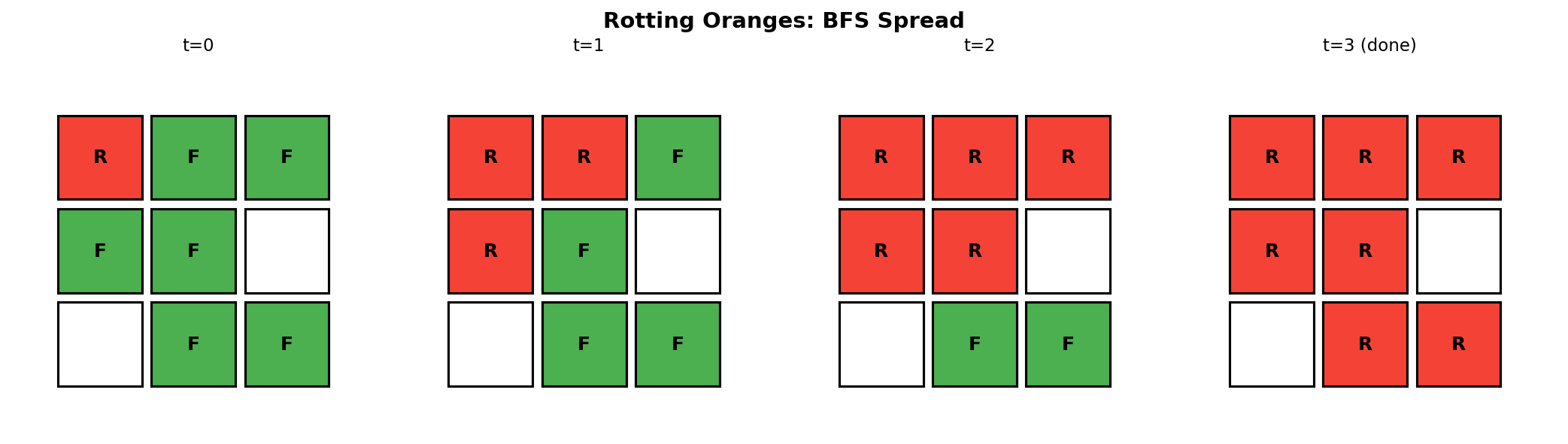
Initial Grid:
2 1 1
1 1 0
0 1 1

t=0: Rotten = {(0,0)}

t=1: (0,0) rots (0,1) and (1,0)
2 2 1
2 1 0
0 1 1

t=2: (0,1) rots (0,2), (1,0) rots (1,1)
2 2 2
2 2 0
0 1 1

t=3: (1,1) rots (2,1)
2 2 2
2 2 0
0 2 1

t=4: (2,1) rots (2,2)
2 2 2
2 2 0
0 2 2

All fresh oranges rotted in 4 minutes.Solution: Multi-Source BFS
from collections import deque

def orangesRotting(grid: list[list[int]]) -> int:
    """
    Multi-source BFS from all rotten oranges.

    Time: O(m * n) - visit each cell at most once
    Space: O(m * n) - queue can hold all cells
    """
    rows, cols = len(grid), len(grid[0])
    queue = deque()
    fresh_count = 0

    # Find all rotten oranges and count fresh ones
    for r in range(rows):
        for c in range(cols):
            if grid[r][c] == 2:
                queue.append((r, c))
            elif grid[r][c] == 1:
                fresh_count += 1

    # No fresh oranges to rot
    if fresh_count == 0:
        return 0

    directions = [(0, 1), (0, -1), (1, 0), (-1, 0)]
    minutes = 0

    while queue:
        minutes += 1
        # Process all oranges at current time level
        for _ in range(len(queue)):
            r, c = queue.popleft()

            for dr, dc in directions:
                nr, nc = r + dr, c + dc

                if (0 <= nr < rows and 0 <= nc < cols and
                    grid[nr][nc] == 1):
                    grid[nr][nc] = 2  # Mark as rotten
                    fresh_count -= 1
                    queue.append((nr, nc))

        # Check if all fresh oranges rotted
        if fresh_count == 0:
            return minutes

    # Some fresh oranges unreachable
return -1public int orangesRotting(int[][] grid) {
int rows = grid.length, cols = grid[0].length;
Deque<int[]> queue = new ArrayDeque<>();
int freshCount = 0;
for (int r = 0; r < rows; r++) {
for (int c = 0; c < cols; c++) {
if (grid[r][c] == 2) queue.offer(new int[]{r, c});
else if (grid[r][c] == 1) freshCount++;
}
}
if (freshCount == 0) return 0;
int[][] dirs = {{0,1},{0,-1},{1,0},{-1,0}};
int minutes = 0;
while (!queue.isEmpty()) {
minutes++;
int size = queue.size();
for (int i = 0; i < size; i++) {
int[] cell = queue.poll();
for (int[] d : dirs) {
int nr = cell[0] + d[0], nc = cell[1] + d[1];
if (nr >= 0 && nr < rows && nc >= 0 && nc < cols && grid[nr][nc] == 1) {
grid[nr][nc] = 2;
freshCount--;
queue.offer(new int[]{nr, nc});
}
}
}
if (freshCount == 0) return minutes;
}
return -1;
}Complexity: Time O(m * n) · Space O(m * n)
- Time: Initial scan is O(m*n); BFS visits each cell at most once; each cell enqueued/dequeued at most once
- Space: Queue can hold all cells in worst case (e.g., all initially rotten spreading simultaneously)
Alternative: Track Time per Orange
from collections import deque

def orangesRotting(grid: list[list[int]]) -> int:
    """
    Alternative: Include time in queue tuple.
    """
    rows, cols = len(grid), len(grid[0])
    queue = deque()
    fresh_count = 0

    for r in range(rows):
        for c in range(cols):
            if grid[r][c] == 2:
                queue.append((r, c, 0))  # (row, col, time)
            elif grid[r][c] == 1:
                fresh_count += 1

    if fresh_count == 0:
        return 0

    directions = [(0, 1), (0, -1), (1, 0), (-1, 0)]
    max_time = 0

    while queue:
        r, c, time = queue.popleft()
        max_time = max(max_time, time)

        for dr, dc in directions:
            nr, nc = r + dr, c + dc

            if (0 <= nr < rows and 0 <= nc < cols and
                grid[nr][nc] == 1):
                grid[nr][nc] = 2
                fresh_count -= 1
                queue.append((nr, nc, time + 1))

return max_time if fresh_count == 0 else -1Complexity: Time O(m * n) · Space O(m * n)
- Time: Each cell processed at most once; storing time in tuple doesn't affect asymptotic complexity
- Space: Queue stores (row, col, time) tuples; at most m*n entries; tuple overhead is O(1) per entry
Step-by-Step Walkthrough
For grid [[2,1,1],[1,1,0],[0,1,1]]:
Initial:
  queue = [(0,0)]  # Rotten orange at (0,0)
  fresh_count = 6

Minute 1:
  Process (0,0):
    - (0,1) is fresh, rot it, add to queue
    - (1,0) is fresh, rot it, add to queue
  queue = [(0,1), (1,0)]
  fresh_count = 4
  Grid:
    2 2 1
    2 1 0
    0 1 1

Minute 2:
  Process (0,1): rot (0,2)
  Process (1,0): rot (1,1)
  queue = [(0,2), (1,1)]
  fresh_count = 2
  Grid:
    2 2 2
    2 2 0
    0 1 1

Minute 3:
  Process (0,2): no fresh neighbors
  Process (1,1): rot (2,1)
  queue = [(2,1)]
  fresh_count = 1
  Grid:
    2 2 2
    2 2 0
    0 2 1

Minute 4:
  Process (2,1): rot (2,2)
  queue = [(2,2)]
  fresh_count = 0
Return 4Complexity Analysis
| Aspect | Complexity | Explanation |
|---|---|---|
| Time | O(m * n) | Visit each cell at most once |
| Space | O(m * n) | Queue can hold all cells in worst case |
Edge Cases
def test_rotting_oranges():
    # No fresh oranges
    assert orangesRotting([[2, 0], [0, 2]]) == 0
    assert orangesRotting([[0]]) == 0

    # No rotten oranges but fresh exist
    assert orangesRotting([[1, 1], [1, 1]]) == -1

    # Single rotten, no fresh
    assert orangesRotting([[2]]) == 0

    # All already rotten
    assert orangesRotting([[2, 2], [2, 2]]) == 0

    # Isolated fresh orange
    assert orangesRotting([[2, 1, 1], [0, 1, 1], [1, 0, 1]]) == -1

    # Linear spread
assert orangesRotting([[2, 1, 1, 1, 1]]) == 4Why BFS, Not DFS?
BFS processes level by level, naturally tracking the minimum time for each orange to rot.
DFS would explore one path fully before backtracking, making it harder to track simultaneous rotting.
BFS (correct):          DFS (wrong approach):
Level 0: Source         Explore one path first
Level 1: All at dist 1  Would give non-optimal times
Level 2: All at dist 2
...Common Mistakes
Forgetting to check fresh_count initially
pythonif fresh_count == 0: return 0 # No fresh oranges to rotOff-by-one in minute counting
python# Increment minutes at start of each level # Or track time with each orange in queueNot checking all rotten oranges initially
python# Must add ALL rotten oranges to queue, not just oneModifying grid while iterating
python# Mark as rotten immediately to prevent revisiting grid[nr][nc] = 2
Interview Tips
What Interviewers Look For
- BFS Recognition: Identify multi-source BFS pattern
- Level Tracking: Properly count time/minutes
- Edge Cases: No fresh, no rotten, isolated cells
Common Follow-up Questions
"What if rotting spreads at different speeds?"
- Use priority queue (Dijkstra's-like approach)
- Each rotten orange has a "speed" attribute
"What about 8-directional spread?"
pythondirections = [ (0, 1), (0, -1), (1, 0), (-1, 0), (1, 1), (1, -1), (-1, 1), (-1, -1) ]"Return the order oranges rot?"
pythondef rottingOrder(grid): order = [] # Track when each orange rots while queue: r, c, time = queue.popleft() if grid[r][c] == 1: # Was fresh order.append(((r, c), time)) # ... rest of BFS return order"What if we can place one additional rotten orange?"
- Try placing at each fresh position
- Run BFS for each, find minimum time
Similar Multi-Source BFS Problems
| Problem | Sources | Goal |
|---|---|---|
| Rotting Oranges | All rotten oranges | Time to rot all |
| Walls and Gates (LC 286) | All gates | Distance to nearest gate |
| 01 Matrix (LC 542) | All 0s | Distance to nearest 0 |
| Shortest Bridge (LC 934) | One island | Distance to other island |
01 Matrix (Similar Pattern)
def updateMatrix(mat: list[list[int]]) -> list[list[int]]:
    """
    Find distance to nearest 0 for each cell.
    Multi-source BFS from all 0s.
    """
    rows, cols = len(mat), len(mat[0])
    queue = deque()

    for r in range(rows):
        for c in range(cols):
            if mat[r][c] == 0:
                queue.append((r, c))
            else:
                mat[r][c] = float('inf')  # Mark as unvisited

    directions = [(0, 1), (0, -1), (1, 0), (-1, 0)]

    while queue:
        r, c = queue.popleft()
        for dr, dc in directions:
            nr, nc = r + dr, c + dc
            if 0 <= nr < rows and 0 <= nc < cols:
                if mat[nr][nc] > mat[r][c] + 1:
                    mat[nr][nc] = mat[r][c] + 1
                    queue.append((nr, nc))

return matComplexity: Time O(m * n) · Space O(m * n)
- Time: Initial scan is O(m*n); BFS visits each cell at most once to update distance
- Space: Queue can hold all cells; modifies input matrix in-place for distances
Related Problems
Walls and Gates (LeetCode 286)
Problem: Fill each empty room with distance to nearest gate (0). Walls are -1.
Key Insight: Multi-source BFS from all gates. Spread outward, first visit = shortest distance.
Approach: Initialize queue with all gates. BFS fills rooms with distance level.
Complexity: O(mn) time, O(mn) space
01 Matrix (LeetCode 542)
Problem: Return matrix where each cell contains distance to nearest 0.
Key Insight: Same as Walls and Gates. Multi-source BFS from all 0s.
Approach: Initialize all 0s in queue, all 1s as infinity. BFS updates distances.
Complexity: O(mn) time, O(mn) space
Shortest Bridge (LeetCode 934)
Problem: Find minimum flips to connect two islands (1s) in binary matrix.
Key Insight: DFS to find one island, BFS to expand toward other island.
Approach: DFS marks first island and queues its boundary. BFS expands until reaching second island.
Complexity: O(mn) time, O(mn) space
Surrounded Regions (LeetCode 130)
Problem: Capture all 'O' regions completely surrounded by 'X' (not touching border).
Key Insight: Border-connected 'O's survive. BFS/DFS from border 'O's, flip the rest.
Approach: BFS/DFS from border 'O's marking as safe. Then flip all unmarked 'O' to 'X'.
Complexity: O(mn) time, O(mn) space
Number of Islands (LeetCode 200)
Problem: Count number of islands (connected 1s) in grid.
Key Insight: Classic BFS/DFS flood fill. Count number of times we start a new traversal.
Approach: For each unvisited 1, BFS/DFS to mark entire island, increment count.
Complexity: O(mn) time, O(mn) space