Subarray Sum Equals K
Problem Statement
Given an array of integers nums and an integer k, return the total number of subarrays whose sum equals to k.
A subarray is a contiguous non-empty sequence of elements within an array.
LeetCode: 560. Subarray Sum Equals K
Examples
Example 1:
Input: nums = [1, 1, 1], k = 2
Output: 2
Explanation: Subarrays [1,1] (indices 0-1) and [1,1] (indices 1-2) sum to 2.Example 2:
Input: nums = [1, 2, 3], k = 3
Output: 2
Explanation: Subarrays [1,2] and [3] sum to 3.Constraints
1 <= nums.length <= 2 * 10^4-1000 <= nums[i] <= 1000-10^7 <= k <= 10^7
Prefix Sum + Hash Map Approach
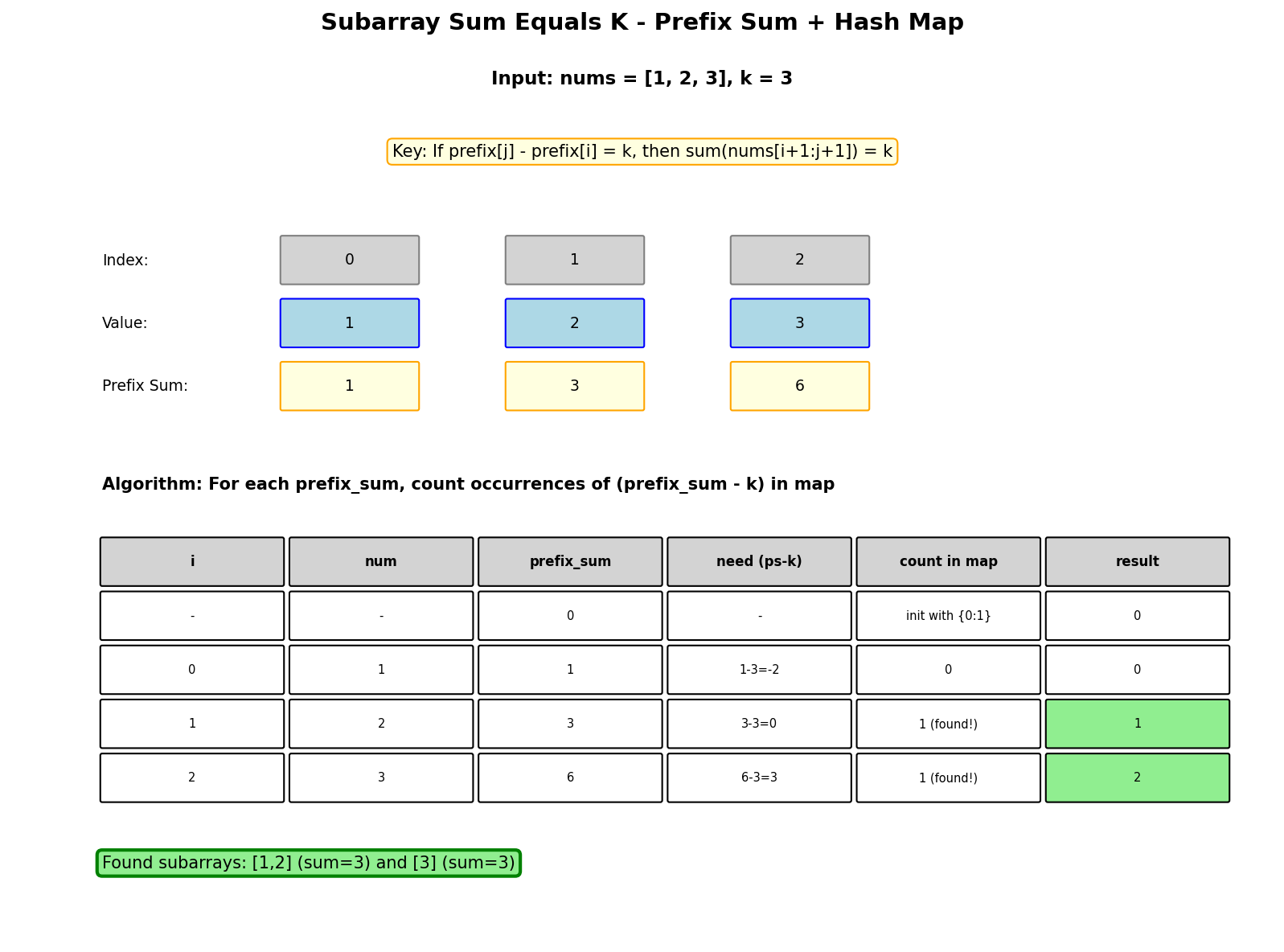
Key Insight
If prefix_sum[j] - prefix_sum[i] = k, then the subarray nums[i+1:j+1] sums to k.
We need to count how many previous prefix sums equal current_prefix_sum - k.
Algorithm
- Use a hash map to count prefix sum frequencies
- Initialize with
{0: 1}(empty prefix has sum 0) - For each element:
- Update running prefix sum
- Add count of
(prefix_sum - k)to result - Increment count of current prefix sum in map
Solution
from typing import List
from collections import defaultdict

def subarraySum(nums: List[int], k: int) -> int:
    """
    Count subarrays with sum equal to k.

    Time: O(n) - single pass
    Space: O(n) - hash map for prefix sums
    """
    count = 0
    prefix_sum = 0
    prefix_counts = defaultdict(int)
    prefix_counts[0] = 1  # Empty prefix

    for num in nums:
        prefix_sum += num

        # Check if (prefix_sum - k) exists
        # This means there's a subarray ending here with sum k
        count += prefix_counts[prefix_sum - k]

        # Update prefix sum count
        prefix_counts[prefix_sum] += 1

return countimport java.util.*;
class Solution {
public int subarraySum(int[] nums, int k) {
int count = 0;
int prefixSum = 0;
Map<Integer, Integer> prefixCounts = new HashMap<>();
prefixCounts.put(0, 1); // Empty prefix
for (int num : nums) {
prefixSum += num;
// Check if (prefixSum - k) exists
count += prefixCounts.getOrDefault(prefixSum - k, 0);
// Update prefix sum count
prefixCounts.merge(prefixSum, 1, Integer::sum);
}
return count;
}
}Complexity: Time O(n) · Space O(n)
- Time: O(n) for single pass through the array, with O(1) hash map operations at each step
- Space: O(n) for the hash map storing prefix sum counts - in worst case, all prefix sums are unique
Why This Works
Consider array [1, 2, 3] and k = 3:
| Index | Num | Prefix Sum | Need (prefix - k) | Found? | Count |
|---|---|---|---|---|---|
| - | - | 0 | - | Init | 0 |
| 0 | 1 | 1 | 1 - 3 = -2 | No | 0 |
| 1 | 2 | 3 | 3 - 3 = 0 | Yes(1) | 1 |
| 2 | 3 | 6 | 6 - 3 = 3 | Yes(1) | 2 |
Subarrays found: [1,2] (sum=3) and [3] (sum=3).
Complexity Analysis
| Approach | Time | Space |
|---|---|---|
| Prefix Sum + Hash Map | O(n) | O(n) |
| Brute Force | O(n^2) | O(1) |
| Prefix Sum Array | O(n^2) | O(n) |
Brute Force (For Comparison)
def subarraySumBruteForce(nums: List[int], k: int) -> int:
    """
    Check all subarrays.

    Time: O(n^2)
    Space: O(1)
    """
    count = 0
    n = len(nums)

    for i in range(n):
        current_sum = 0
        for j in range(i, n):
            current_sum += nums[j]
            if current_sum == k:
                count += 1

return countComplexity: Time O(n^2) · Space O(1)
- Time: O(n^2) for checking all possible subarrays with nested loops
- Space: O(1) using only a running sum variable, no additional data structures
Edge Cases
- Single element equals k:
[5], k=5- Return 1 - Negative numbers:
[-1, -1, 1], k=-1- Handle negatives - Zero sum:
[1, -1, 1, -1], k=0- Multiple valid subarrays - Entire array:
[1, 2, 3], k=6- Include full array - No valid subarray:
[1, 2, 3], k=10- Return 0
Variations
Return All Subarrays
def subarraySumIndices(nums: List[int], k: int) -> List[tuple]:
    """
    Return all (start, end) indices of subarrays summing to k.

    Time: O(n^2) worst case
    Space: O(n)
    """
    result = []
    prefix_sum = 0
    # Map: prefix_sum -> list of indices where this sum occurred
    prefix_indices = defaultdict(list)
    prefix_indices[0].append(-1)

    for j, num in enumerate(nums):
        prefix_sum += num
        target = prefix_sum - k

        # All previous indices where prefix_sum was (current - k)
        for i in prefix_indices[target]:
            result.append((i + 1, j))

        prefix_indices[prefix_sum].append(j)

return resultSubarray Sum Divisible by K
def subarraysDivByK(nums: List[int], k: int) -> int:
    """
    Count subarrays with sum divisible by k.

    Time: O(n)
    Space: O(k)
    """
    count = 0
    prefix_sum = 0
    remainder_counts = defaultdict(int)
    remainder_counts[0] = 1

    for num in nums:
        prefix_sum += num
        # Handle negative remainders
        remainder = prefix_sum % k
        count += remainder_counts[remainder]
        remainder_counts[remainder] += 1

return countCount Subarrays with Sum in Range
def countSubarraysInRange(nums: List[int], lower: int, upper: int) -> int:
    """
    Count subarrays with sum in [lower, upper].

    Time: O(n^2)
    Space: O(n)
    """
    def countAtMost(target):
        """Count subarrays with sum <= target."""
        count = 0
        # This needs a different approach - sorted data structure
        # For simplicity, using brute force here
        n = len(nums)
        for i in range(n):
            current_sum = 0
            for j in range(i, n):
                current_sum += nums[j]
                if current_sum <= target:
                    count += 1
                # Can't break early due to negative numbers

        return count

    # For positive numbers only, we can use sliding window
    # For general case, need merge sort or segment tree
return countAtMost(upper) - countAtMost(lower - 1)Shortest Subarray with Sum at Least K
from collections import deque

def shortestSubarray(nums: List[int], k: int) -> int:
    """
    Find shortest subarray with sum >= k.
    Uses monotonic deque.

    Time: O(n)
    Space: O(n)
    """
    n = len(nums)
    # Compute prefix sums
    prefix = [0] * (n + 1)
    for i in range(n):
        prefix[i + 1] = prefix[i] + nums[i]

    result = float('inf')
    # Monotonic increasing deque of indices
    dq = deque()

    for i in range(n + 1):
        # Check if we found a valid subarray
        while dq and prefix[i] - prefix[dq[0]] >= k:
            result = min(result, i - dq.popleft())

        # Maintain monotonic property
        while dq and prefix[i] <= prefix[dq[-1]]:
            dq.pop()

        dq.append(i)

return result if result != float('inf') else -1Maximum Size Subarray Sum Equals k
def maxSubArrayLen(nums: List[int], k: int) -> int:
    """
    Find length of longest subarray with sum k.

    Time: O(n)
    Space: O(n)
    """
    max_len = 0
    prefix_sum = 0
    # Store first occurrence of each prefix sum
    first_occurrence = {0: -1}

    for i, num in enumerate(nums):
        prefix_sum += num

        if prefix_sum - k in first_occurrence:
            max_len = max(max_len, i - first_occurrence[prefix_sum - k])

        # Only store first occurrence for maximum length
        if prefix_sum not in first_occurrence:
            first_occurrence[prefix_sum] = i

return max_lenCommon Mistakes
- Forgetting to initialize
{0: 1}for empty prefix - Updating hash map before checking (order matters!)
- Not handling negative numbers (can't use sliding window)
Related Problems
Continuous Subarray Sum (LeetCode 523)
Problem: Check if subarray of length >= 2 has sum that's multiple of k.
Key Insight: If prefix[i] % k == prefix[j] % k, subarray between is divisible by k.
Approach: Store first index of each remainder. Check if same remainder seen 2+ indices earlier.
Complexity: Time O(n), Space O(min(n, k))
Subarray Sums Divisible by K (LeetCode 974)
Problem: Count subarrays whose sum is divisible by k.
Key Insight: Same remainder at two positions means subarray sum divisible by k.
Approach: Count remainders. For each remainder with count c, add c*(c-1)/2 pairs.
Complexity: Time O(n), Space O(k)
Shortest Subarray with Sum at Least K (LeetCode 862)
Problem: Find shortest subarray with sum >= k (can have negative numbers).
Key Insight: Monotonic deque to track prefix sums. Can't use sliding window with negatives.
Approach: Use deque maintaining increasing prefix sums. For each position, find valid shorter subarrays.
Complexity: Time O(n), Space O(n)
Maximum Size Subarray Sum Equals k (LeetCode 325)
Problem: Find longest subarray with sum exactly k.
Key Insight: Store first occurrence of each prefix sum. Current_sum - k gives required earlier sum.
Approach: Hash map with first index of each prefix sum. Check if current_sum - k exists.
Complexity: Time O(n), Space O(n)
Binary Subarrays With Sum (LeetCode 930)
Problem: Count subarrays of binary array with sum equal to goal.
Key Insight: Prefix sum with counting. Can also use atMost(goal) - atMost(goal-1).
Approach: Track prefix sum frequencies. For each position, count how many earlier have sum = current - goal.
Complexity: Time O(n), Space O(n)