Move Zeros
Problem Statement
Given an integer array nums, move all 0s to the end of it while maintaining the relative order of the non-zero elements.
Note: You must do this in-place without making a copy of the array.
Examples
Example 1
Input: nums = [0, 1, 0, 3, 12]
Output: [1, 3, 12, 0, 0]Example 2
Input: nums = [0]
Output: [0]Example 3
Input: nums = [1, 2, 3]
Output: [1, 2, 3]Visual Explanation
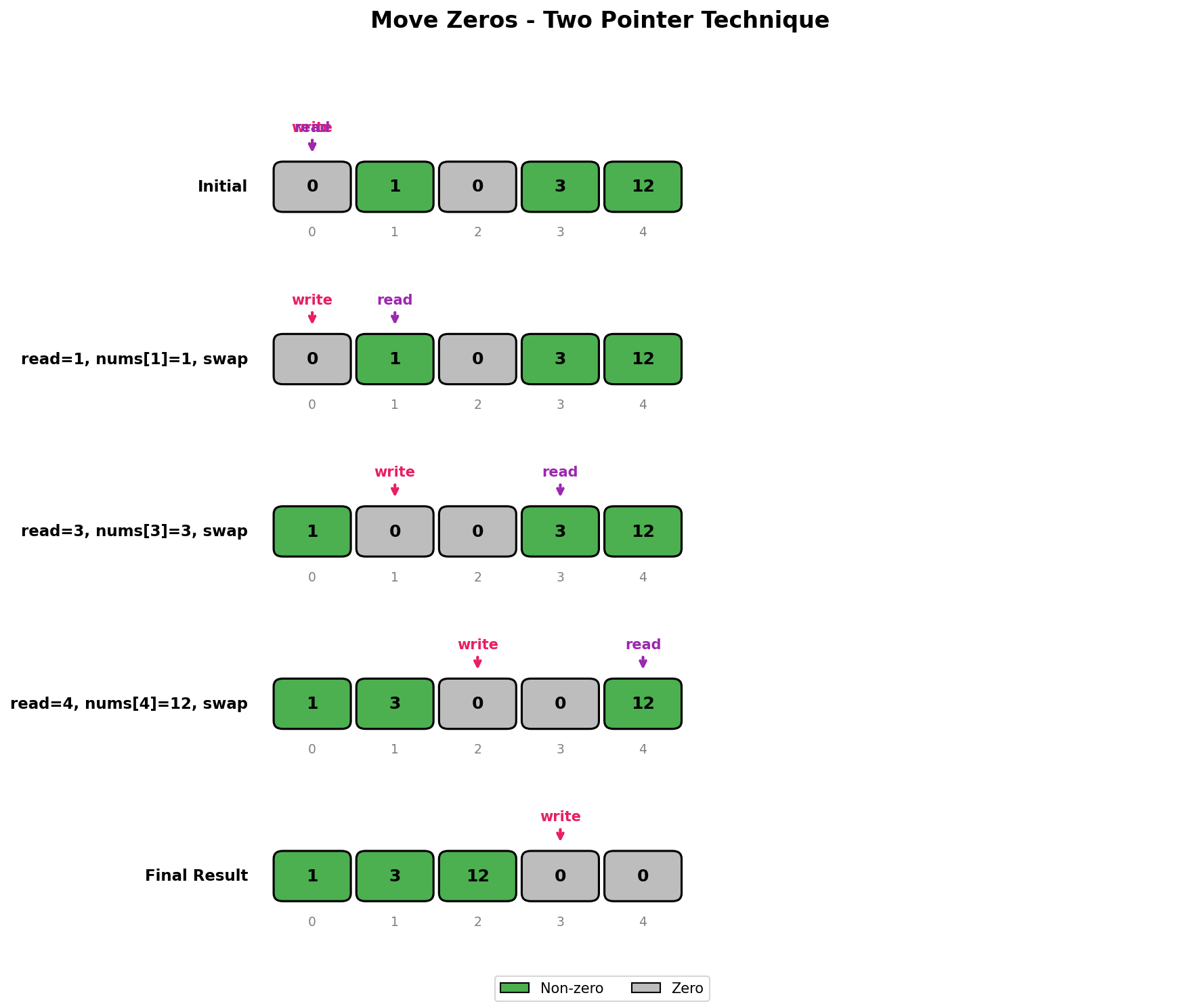
Approach: Two Pointers
The key insight is to use two pointers:
write_ptr: Points to the position where the next non-zero element should be placedread_ptr: Scans through the array looking for non-zero elements
Algorithm
- Initialize
write_ptr = 0 - Iterate through the array with
read_ptr - When a non-zero element is found, swap it with the element at
write_ptrand incrementwrite_ptr - All zeros naturally bubble to the end
Solution
def moveZeroes(nums: list[int]) -> None:
    """
    Move all zeros to the end while maintaining relative order of non-zeros.
    Modifies nums in-place.

    Time Complexity: O(n)
    Space Complexity: O(1)
    """
    write_ptr = 0

    for read_ptr in range(len(nums)):
        if nums[read_ptr] != 0:
            # Swap non-zero element to the write position
            nums[write_ptr], nums[read_ptr] = nums[read_ptr], nums[write_ptr]
write_ptr += 1public void moveZeroes(int[] nums) {
int writePtr = 0;
for (int readPtr = 0; readPtr < nums.length; readPtr++) {
if (nums[readPtr] != 0) {
// Swap non-zero element to the write position
int tmp = nums[writePtr];
nums[writePtr] = nums[readPtr];
nums[readPtr] = tmp;
writePtr++;
}
}
}Complexity: Time O(n) · Space O(1)
- Time: Single pass through the array; each element is visited exactly once with O(1) swap operation
- Space: In-place modification using only two pointer variables (
write_ptr,read_ptr)
# Alternative: Two-pass approach (easier to understand)
def moveZeroes_twopass(nums: list[int]) -> None:
    """
    Two-pass solution: first move non-zeros, then fill zeros.
    """
    write_ptr = 0

    # First pass: move all non-zero elements to front
    for num in nums:
        if num != 0:
            nums[write_ptr] = num
            write_ptr += 1

    # Second pass: fill remaining positions with zeros
    while write_ptr < len(nums):
        nums[write_ptr] = 0
write_ptr += 1Complexity: Time O(n) · Space O(1)
- Time: Two passes through the array: first pass copies non-zeros, second fills zeros; total is O(n) + O(k) where k is zero count
- Space: In-place modification using only a single pointer variable (
write_ptr)
Step-by-Step Trace
For nums = [0, 1, 0, 3, 12]:
| Step | read_ptr | write_ptr | Action | Array State |
|---|---|---|---|---|
| 1 | 0 | 0 | nums[0]=0, skip | [0, 1, 0, 3, 12] |
| 2 | 1 | 0 | nums[1]=1, swap | [1, 0, 0, 3, 12] |
| 3 | 2 | 1 | nums[2]=0, skip | [1, 0, 0, 3, 12] |
| 4 | 3 | 1 | nums[3]=3, swap | [1, 3, 0, 0, 12] |
| 5 | 4 | 2 | nums[4]=12, swap | [1, 3, 12, 0, 0] |
Complexity Analysis
| Metric | Complexity |
|---|---|
| Time | O(n) - Single pass through the array |
| Space | O(1) - In-place modification, only using pointers |
Edge Cases
- Empty array:
[]->[] - No zeros:
[1, 2, 3]->[1, 2, 3] - All zeros:
[0, 0, 0]->[0, 0, 0] - Single element:
[0]->[0]or[1]->[1] - Zeros at end:
[1, 2, 0, 0]->[1, 2, 0, 0] - Large array: Handle efficiently with O(n) time
Common Mistakes
- Creating a new array - The problem requires in-place modification
- Not maintaining order - Non-zero elements must keep their relative order
- Off-by-one errors - Careful with pointer increments
Related Problems
Remove Element (LeetCode 27)
Problem: Remove all occurrences of a value in-place, return new length.
Key Insight: Same two-pointer pattern as Move Zeros, but filtering a specific value.
Approach: Write pointer advances only when current element is NOT the target value. Copy non-target elements forward.
Complexity: O(n) time, O(1) space
Remove Duplicates from Sorted Array (LeetCode 26)
Problem: Remove duplicates in-place from sorted array, return new length.
Key Insight: Since sorted, duplicates are adjacent. Write pointer tracks position for next unique element.
Approach: Compare current with previous written element. If different, write it and advance write pointer.
Complexity: O(n) time, O(1) space
Sort Colors (LeetCode 75)
Problem: Sort array with only 0s, 1s, and 2s in-place (Dutch National Flag).
Key Insight: Three-way partitioning with three pointers: low (0s), mid (current), high (2s).
Approach: If nums[mid]==0, swap with low and advance both. If nums[mid]==2, swap with high and decrement high. If nums[mid]==1, just advance mid.
Complexity: O(n) time, O(1) space, single pass
Key Takeaways
- Two-pointer technique is powerful for in-place array manipulation
- The "read-write" pointer pattern is common for filtering/partitioning arrays
- Swapping maintains relative order while moving elements to correct positions