Sliding Window Maximum
LeetCode 239 | Difficulty: Hard | Pattern: Monotonic Deque
Problem Statement
You are given an array of integers nums, there is a sliding window of size k which is moving from the very left of the array to the very right. You can only see the k numbers in the window. Each time the sliding window moves right by one position.
Return the max sliding window.
Examples
Example 1:
Input: nums = [1,3,-1,-3,5,3,6,7], k = 3
Output: [3,3,5,5,6,7]

Window position                Max
---------------               -----
[1  3  -1] -3  5  3  6  7       3
 1 [3  -1  -3] 5  3  6  7       3
 1  3 [-1  -3  5] 3  6  7       5
 1  3  -1 [-3  5  3] 6  7       5
 1  3  -1  -3 [5  3  6] 7       6
1 3 -1 -3 5 [3 6 7] 7Example 2:
Input: nums = [1], k = 1
Output: [1]Constraints
1 <= nums.length <= 10^5-10^4 <= nums[i] <= 10^41 <= k <= nums.length
Intuition
Brute force: For each window, find max in O(k) time. Total: O(n*k).
Optimization: Use a monotonic decreasing deque that maintains elements in decreasing order. The front is always the maximum. Remove elements that:
- Fall outside the window (from front)
- Are smaller than the current element (from back)
Visualization
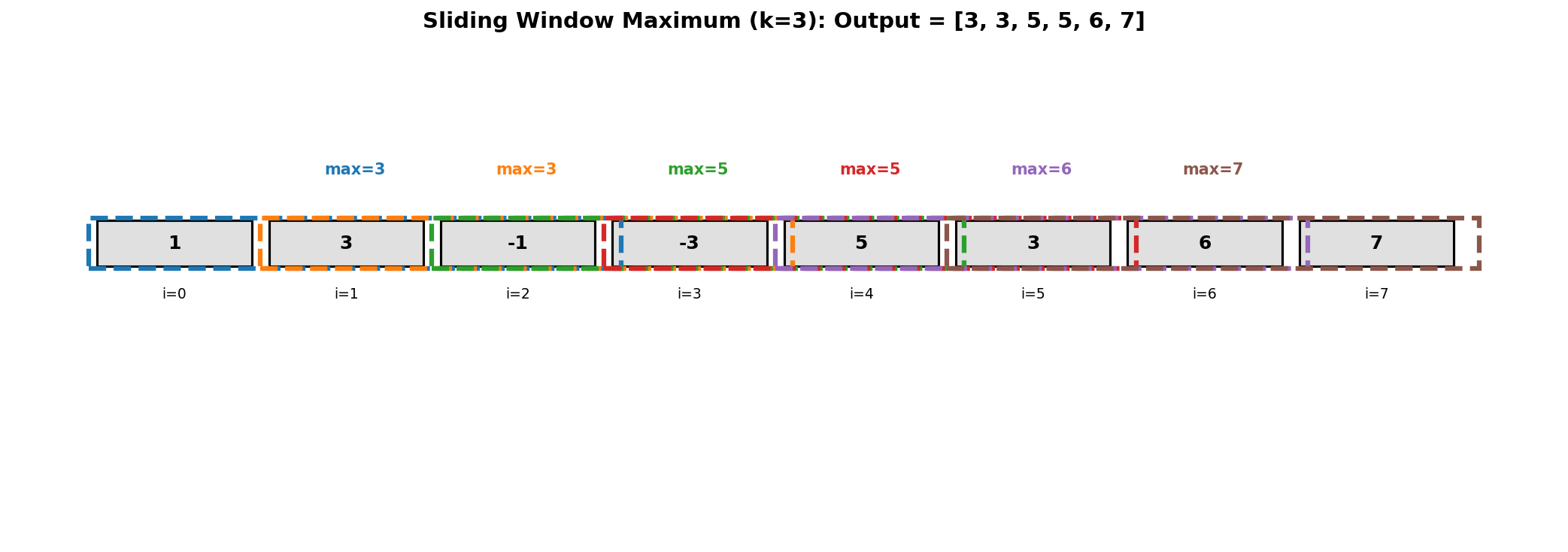
nums = [1, 3, -1, -3, 5, 3, 6, 7], k = 3

Window [1, 3, -1]:
  Deque: [3, -1]  (1 removed because 3 > 1)
  Max = 3

Window [3, -1, -3]:
  Deque: [3, -1, -3]
  Max = 3

Window [-1, -3, 5]:
  Deque: [5]  (3, -1, -3 all removed because 5 > all)
Max = 5Solution: Monotonic Deque
from collections import deque

def maxSlidingWindow(nums: list[int], k: int) -> list[int]:
    """
    Find maximum in each sliding window using monotonic decreasing deque.

    Deque stores indices (not values) in decreasing order of their values.
    Front of deque is always the maximum.

    Time: O(n) - each element added and removed at most once
    Space: O(k) - deque never exceeds window size
    """
    dq = deque()  # Stores indices, values are in decreasing order
    result = []

    for i, num in enumerate(nums):
        # Remove indices outside the window
        while dq and dq[0] <= i - k:
            dq.popleft()

        # Remove smaller elements (they can never be max)
        while dq and nums[dq[-1]] < num:
            dq.pop()

        dq.append(i)

        # Add to result once we have a full window
        if i >= k - 1:
            result.append(nums[dq[0]])

return resultpublic int[] maxSlidingWindow(int[] nums, int k) {
int n = nums.length;
int[] result = new int[n - k + 1];
Deque<Integer> dq = new ArrayDeque<>(); // monotonic decreasing; stores indices
for (int i = 0; i < n; i++) {
// Remove indices outside the window
while (!dq.isEmpty() && dq.peekFirst() <= i - k) dq.pollFirst();
// Remove smaller elements
while (!dq.isEmpty() && nums[dq.peekLast()] < nums[i]) dq.pollLast();
dq.offerLast(i);
if (i >= k - 1) result[i - k + 1] = nums[dq.peekFirst()];
}
return result;
}Complexity: Time O(n) · Space O(k)
- Time: Each element added to deque exactly once and removed at most once; total operations 2n = O(n)
- Space: Deque stores at most k indices (elements outside window are removed from front)
Why Monotonic Decreasing?
We maintain elements in decreasing order because:
- Front is always max: The largest element is always at the front
- Smaller elements are useless: If
nums[j] < nums[i]andj < i, thennums[j]can never be the maximum whilenums[i]is in the window
If window contains [5, 3, 4]:
- We only need to track [5, 4]
- 3 is useless because 4 > 3 and 4 entered later
- When 5 leaves, 4 becomes maxStep-by-Step Walkthrough
For nums = [1, 3, -1, -3, 5, 3, 6, 7], k = 3:
i=0, num=1:
  Deque empty, append 0
  deque = [0] (values: [1])
  i < k-1, no result yet

i=1, num=3:
  nums[0]=1 < 3, pop 0
  Append 1
  deque = [1] (values: [3])
  i < k-1, no result yet

i=2, num=-1:
  nums[1]=3 > -1, no pop
  Append 2
  deque = [1, 2] (values: [3, -1])
  i >= k-1, result.append(nums[1]) = 3
  result = [3]

i=3, num=-3:
  Index 1 not outside window (1 > 3-3=0)
  nums[2]=-1 > -3, no pop
  Append 3
  deque = [1, 2, 3] (values: [3, -1, -3])
  result.append(nums[1]) = 3
  result = [3, 3]

i=4, num=5:
  Index 1 outside window (1 <= 4-3=1), popleft
  nums[3]=-3 < 5, pop 3
  nums[2]=-1 < 5, pop 2
  Append 4
  deque = [4] (values: [5])
  result.append(nums[4]) = 5
  result = [3, 3, 5]

i=5, num=3:
  Index 4 not outside window
  nums[4]=5 > 3, no pop
  Append 5
  deque = [4, 5] (values: [5, 3])
  result.append(nums[4]) = 5
  result = [3, 3, 5, 5]

i=6, num=6:
  Index 4 not outside window (4 > 6-3=3)
  nums[5]=3 < 6, pop 5
  nums[4]=5 < 6, pop 4
  Append 6
  deque = [6] (values: [6])
  result.append(nums[6]) = 6
  result = [3, 3, 5, 5, 6]

i=7, num=7:
  Index 6 not outside window
  nums[6]=6 < 7, pop 6
  Append 7
  deque = [7] (values: [7])
  result.append(nums[7]) = 7
result = [3, 3, 5, 5, 6, 7]Complexity Analysis
| Aspect | Complexity | Explanation |
|---|---|---|
| Time | O(n) | Each element added/removed at most once |
| Space | O(k) | Deque size bounded by window size |
Why O(n)?
- Each index is added to deque exactly once
- Each index is removed from deque at most once
- Total operations: 2n = O(n)
Edge Cases
def test_sliding_window_max():
    # Window size equals array length
    assert maxSlidingWindow([1, 3, 2], 3) == [3]

    # Window size 1
    assert maxSlidingWindow([1, 3, 2], 1) == [1, 3, 2]

    # All same elements
    assert maxSlidingWindow([5, 5, 5, 5], 2) == [5, 5, 5]

    # Decreasing array
    assert maxSlidingWindow([5, 4, 3, 2, 1], 3) == [5, 4, 3]

    # Increasing array
    assert maxSlidingWindow([1, 2, 3, 4, 5], 3) == [3, 4, 5]

    # Negative numbers
assert maxSlidingWindow([-1, -3, -5], 2) == [-1, -3]Sliding Window Minimum
Same approach, but maintain monotonic increasing deque:
from collections import deque

def minSlidingWindow(nums: list[int], k: int) -> list[int]:
    """Minimum in each sliding window."""
    dq = deque()
    result = []

    for i, num in enumerate(nums):
        while dq and dq[0] <= i - k:
            dq.popleft()

        # Change: remove LARGER elements
        while dq and nums[dq[-1]] > num:
            dq.pop()

        dq.append(i)

        if i >= k - 1:
            result.append(nums[dq[0]])

return resultComplexity: Time O(n) · Space O(k)
- Time: Same amortized analysis as maximum version; each element pushed/popped once
- Space: Monotonic increasing deque bounded by window size k
Applications
1. Shortest Subarray with Sum >= K (LC 862)
Uses monotonic deque with prefix sums.
from collections import deque

def shortestSubarray(nums: list[int], k: int) -> int:
    """Find shortest subarray with sum >= k."""
    n = len(nums)
    prefix = [0] * (n + 1)
    for i in range(n):
        prefix[i + 1] = prefix[i] + nums[i]

    dq = deque()  # Monotonic increasing of prefix sums
    min_len = float('inf')

    for i in range(n + 1):
        # Check if current position gives valid subarray
        while dq and prefix[i] - prefix[dq[0]] >= k:
            min_len = min(min_len, i - dq.popleft())

        # Maintain monotonic increasing
        while dq and prefix[dq[-1]] >= prefix[i]:
            dq.pop()

        dq.append(i)

return min_len if min_len != float('inf') else -1Complexity: Time O(n) · Space O(n)
- Time: Build prefix sums O(n); each index added/removed from deque once; total O(n) deque operations
- Space: Prefix array is O(n); deque can hold up to n indices in worst case
2. Jump Game VI (LC 1696)
def maxResult(nums: list[int], k: int) -> int:
    """Maximum score to reach end with at most k jumps."""
    n = len(nums)
    dp = [0] * n
    dp[0] = nums[0]
    dq = deque([0])  # Track max dp values in window

    for i in range(1, n):
        # Remove indices outside window
        while dq and dq[0] < i - k:
            dq.popleft()

        dp[i] = nums[i] + dp[dq[0]]

        # Maintain monotonic decreasing
        while dq and dp[dq[-1]] <= dp[i]:
            dq.pop()

        dq.append(i)

return dp[-1]Complexity: Time O(n) · Space O(n)
- Time: Single pass computing dp values; deque operations amortized O(1) per element
- Space: dp array is O(n); deque stores at most k indices representing window
Interview Tips
What Interviewers Look For
- Deque Usage: Know when monotonic deque applies
- Index vs Value: Store indices to handle window bounds
- Invariant Maintenance: Explain why deque stays monotonic
Common Follow-up Questions
"Why store indices instead of values?"
- Need to check if elements are within window
- Can't determine position from value alone
"How would you find the k-th largest instead of max?"
- Use a data structure like sorted list or balanced BST
- Can't do with just a deque
"What about sliding window median?"
- Use two heaps (max heap for smaller half, min heap for larger)
- LeetCode 480
"How about a 2D sliding window?"
- Apply 1D solution row-wise, then column-wise
- O(m * n) time for m x n matrix
Common Mistakes
Not removing elements outside window first
python# Must check popleft BEFORE pop from back while dq and dq[0] <= i - k: dq.popleft()Wrong comparison for back removal
python# For max: remove elements < current # For min: remove elements > currentAdding to result too early
python# Only add when i >= k - 1 (full window) if i >= k - 1: result.append(nums[dq[0]])
Related Problems
Sliding Window Median (LeetCode 480)
Problem: Return median of each sliding window of size k.
Key Insight: Two heaps - max heap for smaller half, min heap for larger half. Rebalance on slide.
Approach: Maintain two heaps with lazy deletion. Median is max-heap top (odd k) or average of both tops.
Complexity: O(n log k) time, O(k) space
Shortest Subarray with Sum >= K (LeetCode 862)
Problem: Find shortest subarray with sum at least k (can have negative numbers).
Key Insight: Prefix sums + monotonic increasing deque. Valid subarray when prefix[i] - prefix[deque[0]] >= k.
Approach: Deque stores indices with increasing prefix sums. Check valid subarrays, maintain monotonicity.
Complexity: O(n) time, O(n) space
Jump Game VI (LeetCode 1696)
Problem: Maximum score to reach end, can jump 1 to k steps. Score = sum of values at positions visited.
Key Insight: DP with sliding window maximum. dp[i] = nums[i] + max(dp[i-k:i]).
Approach: Monotonic decreasing deque tracks max dp value in window of k previous positions.
Complexity: O(n) time, O(k) space
Constrained Subsequence Sum (LeetCode 1425)
Problem: Max sum of subsequence where consecutive elements are at most k indices apart.
Key Insight: Similar to Jump Game VI. DP with monotonic deque for window maximum.
Approach: dp[i] = nums[i] + max(0, max dp in window). Use deque for O(1) window max.
Complexity: O(n) time, O(k) space
Max Value of Equation (LeetCode 1499)
Problem: Find max value of yi + yj + |xi - xj| for points with |xi - xj| <= k.
Key Insight: Rewrite as (yi - xi) + (yj + xj). Maximize first term in sliding window.
Approach: Monotonic decreasing deque stores (y-x, x). For each point, compute max equation value.
Complexity: O(n) time, O(n) space