Implement Queue using Stacks
LeetCode 232 | Difficulty: Easy | Pattern: Stack Simulation
Problem Statement
Implement a first in first out (FIFO) queue using only two stacks. The implemented queue should support all the functions of a normal queue (push, peek, pop, and empty).
Implement the MyQueue class:
void push(int x)- Pushes element x to the back of the queueint pop()- Removes the element from the front of the queue and returns itint peek()- Returns the element at the front of the queueboolean empty()- Returns true if the queue is empty, false otherwise
Examples
Example 1:
Input:
["MyQueue", "push", "push", "peek", "pop", "empty"]
[[], [1], [2], [], [], []]

Output: [null, null, null, 1, 1, false]

Explanation:
MyQueue myQueue = new MyQueue();
myQueue.push(1); // queue is: [1]
myQueue.push(2); // queue is: [1, 2]
myQueue.peek();  // return 1
myQueue.pop();   // return 1, queue is [2]
myQueue.empty(); // return falseConstraints
1 <= x <= 9- At most 100 calls will be made to
push,pop,peek, andempty - All the calls to
popandpeekare valid
Follow-up
Can you implement the queue such that each operation is amortized O(1) time complexity?
Intuition
A stack is LIFO (Last In, First Out), but a queue is FIFO (First In, First Out). To simulate FIFO behavior using LIFO stacks, we need to reverse the order of elements.
Key Insight: If you push elements onto stack1 and then pop them all onto stack2, the order is reversed - making stack2 behave like a queue's front!
Stack State Visualization
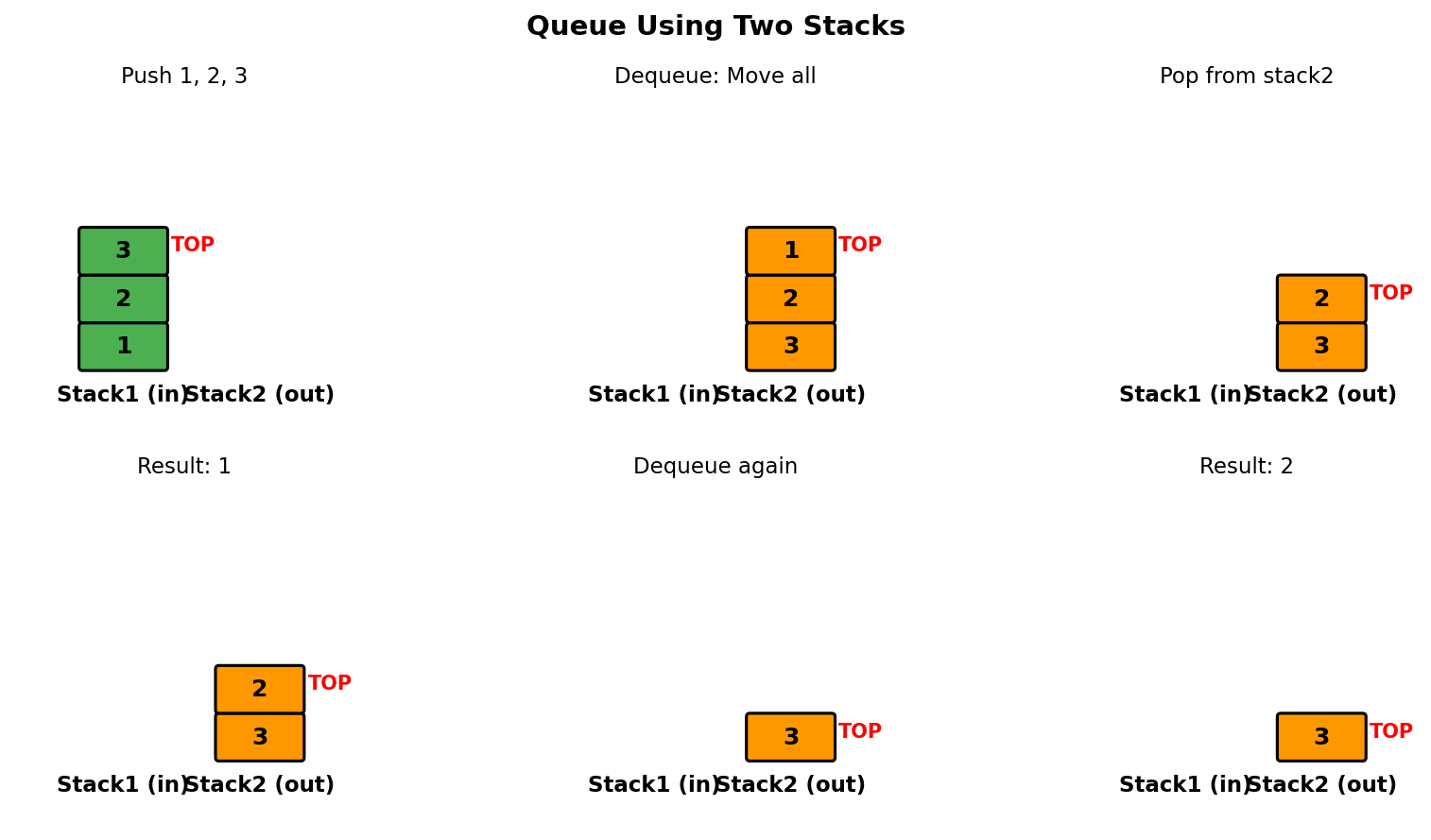
Push 1, 2, 3 to Queue:
  Stack1 (input):  [1, 2, 3]  <- TOP is 3
  Stack2 (output): []

Dequeue (pop from front):
  Step 1: Move all from Stack1 to Stack2
    Stack1: []
    Stack2: [3, 2, 1]  <- TOP is 1 (originally first!)

  Step 2: Pop from Stack2
    Return: 1
    Stack2: [3, 2]

Next Dequeue:
  Stack2 not empty, just pop
  Return: 2
Stack2: [3]Solution 1: Amortized O(1) Dequeue
class MyQueue:
    """
    Queue implementation using two stacks.

    Approach: Lazy transfer
    - stack_in: for push operations
    - stack_out: for pop/peek operations
    - Only transfer when stack_out is empty
    """

    def __init__(self):
        self.stack_in = []   # For pushing new elements
        self.stack_out = []  # For popping/peeking (reversed order)

    def push(self, x: int) -> None:
        """Push element to back of queue. O(1)"""
        self.stack_in.append(x)

    def pop(self) -> int:
        """Remove and return front element. Amortized O(1)"""
        self._transfer()
        return self.stack_out.pop()

    def peek(self) -> int:
        """Return front element without removing. Amortized O(1)"""
        self._transfer()
        return self.stack_out[-1]

    def empty(self) -> bool:
        """Check if queue is empty. O(1)"""
        return not self.stack_in and not self.stack_out

    def _transfer(self) -> None:
        """Transfer elements from stack_in to stack_out if needed."""
        if not self.stack_out:
            while self.stack_in:
self.stack_out.append(self.stack_in.pop())class MyQueue {
private Deque<Integer> stackIn;
private Deque<Integer> stackOut;
public MyQueue() {
stackIn = new ArrayDeque<>();
stackOut = new ArrayDeque<>();
}
public void push(int x) {
stackIn.push(x);
}
public int pop() {
transfer();
return stackOut.pop();
}
public int peek() {
transfer();
return stackOut.peek();
}
public boolean empty() {
return stackIn.isEmpty() && stackOut.isEmpty();
}
private void transfer() {
if (stackOut.isEmpty()) {
while (!stackIn.isEmpty()) stackOut.push(stackIn.pop());
}
}
}Complexity: Time Amortized O(1) · Space O(n)
- Time: push is O(1); pop/peek are amortized O(1) because each element is moved from stack_in to stack_out exactly once over its lifetime
- Space: Both stacks together hold all n elements; at any time, elements are distributed between stack_in and stack_out
Why Amortized O(1)?
Each element is:
- Pushed onto
stack_inonce: O(1) - Popped from
stack_inonce: O(1) - Pushed onto
stack_outonce: O(1) - Popped from
stack_outonce: O(1)
Total: 4 operations per element = O(4n) for n elements = O(1) amortized per operation.
Solution 2: O(1) Push, O(n) Pop
class MyQueue:
    """
    Alternative: Make push O(1), pop O(n).
    Transfer on every pop operation.
    """

    def __init__(self):
        self.stack1 = []
        self.stack2 = []

    def push(self, x: int) -> None:
        """O(1) - Just push to stack1"""
        self.stack1.append(x)

    def pop(self) -> int:
        """O(n) - Transfer all, pop, transfer back"""
        # Transfer all to stack2
        while self.stack1:
            self.stack2.append(self.stack1.pop())

        # Pop the front element
        result = self.stack2.pop()

        # Transfer back to stack1
        while self.stack2:
            self.stack1.append(self.stack2.pop())

        return result

    def peek(self) -> int:
        """O(n) - Similar to pop but don't remove"""
        while self.stack1:
            self.stack2.append(self.stack1.pop())

        result = self.stack2[-1]

        while self.stack2:
            self.stack1.append(self.stack2.pop())

        return result

    def empty(self) -> bool:
return len(self.stack1) == 0Complexity: Time O(1) push, O(n) pop/peek · Space O(n)
- Time: push is O(1) append; pop/peek transfer all n elements twice (to stack2 and back) = O(2n) = O(n)
- Space: Both stacks combined hold n elements; during transfer, all elements temporarily in stack2
Solution 3: O(n) Push, O(1) Pop
class MyQueue:
    """
    Alternative: Make push O(n), pop O(1).
    Maintain elements in correct queue order in one stack.
    """

    def __init__(self):
        self.stack1 = []
        self.stack2 = []

    def push(self, x: int) -> None:
        """O(n) - Reverse stack, add element, reverse back"""
        # Move all to stack2
        while self.stack1:
            self.stack2.append(self.stack1.pop())

        # Push new element to stack1 (will be at bottom)
        self.stack1.append(x)

        # Move all back from stack2
        while self.stack2:
            self.stack1.append(self.stack2.pop())

    def pop(self) -> int:
        """O(1) - Just pop from stack1"""
        return self.stack1.pop()

    def peek(self) -> int:
        """O(1) - Just peek stack1"""
        return self.stack1[-1]

    def empty(self) -> bool:
return len(self.stack1) == 0Complexity: Time O(n) push, O(1) pop/peek · Space O(n)
- Time: push moves all n elements to stack2, adds new element, moves all back = O(2n) = O(n); pop/peek are O(1) direct access
- Space: During push, stack2 temporarily holds all n elements; stack1 always contains elements in queue order
Algorithm Comparison
| Approach | Push | Pop | Peek | Space |
|---|---|---|---|---|
| Amortized (Lazy Transfer) | O(1) | Amortized O(1) | Amortized O(1) | O(n) |
| O(1) Push | O(1) | O(n) | O(n) | O(n) |
| O(1) Pop | O(n) | O(1) | O(1) | O(n) |
Best Choice: Amortized approach (Solution 1) - all operations are amortized O(1).
Step-by-Step Walkthrough
For operations: push(1), push(2), peek(), pop(), push(3), pop()
Operation: push(1)
  stack_in:  [1]
  stack_out: []

Operation: push(2)
  stack_in:  [1, 2]
  stack_out: []

Operation: peek()
  stack_out empty, transfer!
  stack_in:  []
  stack_out: [2, 1]  <- 1 is at top (front of queue)
  Return: 1

Operation: pop()
  stack_out not empty
  Pop from stack_out
  stack_out: [2]
  Return: 1

Operation: push(3)
  stack_in:  [3]
  stack_out: [2]

Operation: pop()
  stack_out not empty
  Pop from stack_out
  stack_out: []
Return: 2Complexity Analysis
Amortized Analysis (Solution 1)
| Operation | Time Complexity | Explanation |
|---|---|---|
push | O(1) | Direct append to stack_in |
pop | Amortized O(1) | Each element transferred at most once |
peek | Amortized O(1) | Same as pop |
empty | O(1) | Check both stacks |
Space Complexity: O(n) where n is number of elements in queue
Worst Case for Single Operation
A single pop() can take O(n) if all n elements need to be transferred. But this transfer benefits all subsequent pops until stack_out is empty again.
Edge Cases
# Test cases
def test_queue():
    q = MyQueue()

    # Empty queue
    assert q.empty() == True

    # Single element
    q.push(1)
    assert q.peek() == 1
    assert q.pop() == 1
    assert q.empty() == True

    # Multiple elements
    q.push(1)
    q.push(2)
    q.push(3)
    assert q.pop() == 1  # FIFO order
    assert q.pop() == 2

    # Interleaved operations
    q.push(4)
    assert q.pop() == 3
assert q.pop() == 4Interview Tips
What Interviewers Look For
- Understanding of data structures: Stack (LIFO) vs Queue (FIFO)
- Amortized analysis: Explain why lazy transfer gives O(1) amortized
- Trade-offs: Discuss different approaches and their complexities
Common Follow-up Questions
"How does amortized O(1) work?"
- Each element is moved at most twice (into stack_in, into stack_out)
- Total work is O(2n) for n operations = O(1) per operation
"What if we have many more pushes than pops?"
- Lazy transfer is efficient since we don't transfer until needed
- O(1) pop approach would waste work on every push
"Can you do this with one stack?"
- Yes, using recursion (call stack as second stack)
- But recursion uses O(n) space on call stack
One Stack Solution (Using Recursion)
class MyQueue:
    def __init__(self):
        self.stack = []

    def push(self, x: int) -> None:
        self.stack.append(x)

    def pop(self) -> int:
        if len(self.stack) == 1:
            return self.stack.pop()

        # Remove top
        top = self.stack.pop()
        # Recursively get bottom element
        result = self.pop()
        # Put top back
        self.stack.append(top)
        return result

    def peek(self) -> int:
        result = self.pop()
        self.push(result)
        return result

    def empty(self) -> bool:
return len(self.stack) == 0Complexity: Time O(n) pop/peek · Space O(n) including call stack
- Time: pop recursively removes and restores n-1 elements = O(n); peek calls pop then push = O(n)
- Space: Single stack holds n elements; recursion uses O(n) call stack space during pop operation
Related Problems
Implement Stack using Queues (LeetCode 225)
Problem: Implement LIFO stack using only queue operations.
Key Insight: Reverse problem. Need to make newest element accessible first - rotate queue on push.
Approach: After push, rotate queue n-1 times to put new element at front.
Complexity: O(n) push, O(1) pop/top
Design Circular Queue (LeetCode 622)
Problem: Implement fixed-size circular queue with array.
Key Insight: Use head/tail pointers with modulo arithmetic for wrap-around.
Approach: Track head index and count. Tail computed as (head + count) % capacity.
Complexity: O(1) all operations
Design Circular Deque (LeetCode 641)
Problem: Double-ended queue with add/remove from both front and rear.
Key Insight: Extension of circular queue. Front moves backward (with wrap), rear moves forward.
Approach: Doubly-linked list or circular array with bidirectional pointer movement.
Complexity: O(1) all operations
Moving Average from Data Stream (LeetCode 346)
Problem: Calculate moving average of last k elements in stream.
Key Insight: Queue maintains window. Sum updates incrementally on add/remove.
Approach: Queue for window, track running sum. Average = sum / min(count, k).
Complexity: O(1) per call