Two Sum
Problem Statement
Given an array of integers nums and an integer target, return indices of the two numbers such that they add up to target.
You may assume that each input would have exactly one solution, and you may not use the same element twice.
You can return the answer in any order.
LeetCode: 1. Two Sum
Examples
Example 1:
Input: nums = [2,7,11,15], target = 9
Output: [0,1]
Explanation: Because nums[0] + nums[1] == 9, we return [0, 1].Example 2:
Input: nums = [3,2,4], target = 6
Output: [1,2]Example 3:
Input: nums = [3,3], target = 6
Output: [0,1]Constraints
2 <= nums.length <= 10^4-10^9 <= nums[i] <= 10^9-10^9 <= target <= 10^9- Only one valid answer exists.
Hash Map Approach
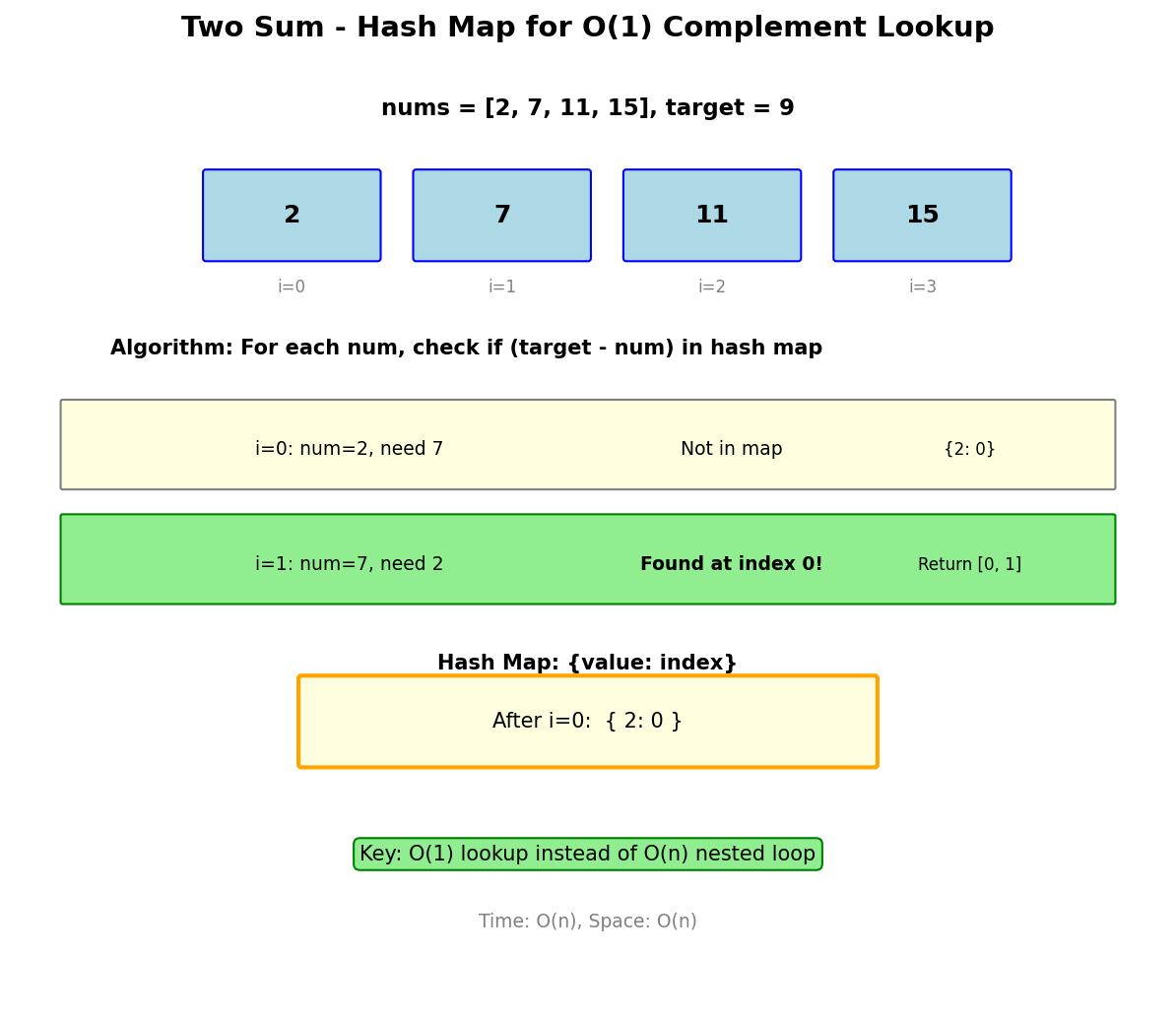
Key Insight
For each number num, we need to find if target - num exists in the array. Using a hash map allows O(1) lookup.
Algorithm
- Create an empty hash map to store
{value: index} - Iterate through the array
- For each element, calculate
complement = target - nums[i] - Check if complement exists in hash map
- If found, return
[hash_map[complement], i] - Otherwise, add current element to hash map
Solution
from typing import List

def twoSum(nums: List[int], target: int) -> List[int]:
    """
    Find two indices whose values sum to target.

    Time: O(n) - single pass through array
    Space: O(n) - hash map storage
    """
    num_to_index = {}

    for i, num in enumerate(nums):
        complement = target - num

        if complement in num_to_index:
            return [num_to_index[complement], i]

        num_to_index[num] = i

return [] # No solution foundimport java.util.*;
class Solution {
public int[] twoSum(int[] nums, int target) {
Map<Integer, Integer> numToIndex = new HashMap<>();
for (int i = 0; i < nums.length; i++) {
int complement = target - nums[i];
if (numToIndex.containsKey(complement)) {
return new int[]{numToIndex.get(complement), i};
}
numToIndex.put(nums[i], i);
}
return new int[]{}; // No solution found
}
}Complexity: Time O(n) · Space O(n)
- Time: Single pass through array; each lookup and insertion in hash map is O(1) average
- Space: Hash map stores at most n key-value pairs (one per array element)
# Alternative: Return all pairs (if multiple solutions exist)
def twoSumAllPairs(nums: List[int], target: int) -> List[List[int]]:
    """Find all pairs that sum to target."""
    result = []
    num_to_indices = {}

    for i, num in enumerate(nums):
        if num not in num_to_indices:
            num_to_indices[num] = []
        num_to_indices[num].append(i)

    seen = set()
    for i, num in enumerate(nums):
        complement = target - num
        if complement in num_to_indices:
            for j in num_to_indices[complement]:
                if i < j:
                    pair = (i, j)
                    if pair not in seen:
                        seen.add(pair)
                        result.append([i, j])

return resultComplexity: Time O(n^2) · Space O(n)
- Time: Building index map is O(n), but checking all pairs can be O(n^2) in worst case with many duplicate complements
- Space: Hash map stores indices for each unique number, plus seen set and result list
Complexity Analysis
| Approach | Time | Space |
|---|---|---|
| Brute Force | O(n^2) | O(1) |
| Hash Map | O(n) | O(n) |
| Two Pointers (sorted) | O(n log n) | O(1) |
Why Hash Map is Optimal
- Brute Force: Check every pair - O(n^2) time
- Hash Map: Single pass with O(1) lookups - O(n) time
- Two Pointers: Requires sorting, loses original indices
Edge Cases
- Two same numbers:
[3,3], target=6- Works because we check before adding - Negative numbers:
[-1,2], target=1- Hash map handles negatives - Single valid pair: Guaranteed by problem constraints
- Large numbers: Use appropriate data types
Common Mistakes
- Using the same element twice
- Not handling duplicate values correctly
- Returning values instead of indices
Variations
Two Sum II - Sorted Array
If the input is sorted, use two pointers:
def twoSumSorted(numbers: List[int], target: int) -> List[int]:
    left, right = 0, len(numbers) - 1
    while left < right:
        current_sum = numbers[left] + numbers[right]
        if current_sum == target:
            return [left + 1, right + 1]  # 1-indexed
        elif current_sum < target:
            left += 1
        else:
            right -= 1
return []Complexity: Time O(n) · Space O(1)
- Time: Two pointers traverse array once - each step moves one pointer, at most n steps total
- Space: Only uses two pointer variables, no additional data structures
Two Sum - Data Structure Design
class TwoSum:
    def __init__(self):
        self.nums = {}

    def add(self, number: int) -> None:
        self.nums[number] = self.nums.get(number, 0) + 1

    def find(self, value: int) -> bool:
        for num in self.nums:
            complement = value - num
            if complement in self.nums:
                if complement != num or self.nums[num] > 1:
                    return True
return FalseComplexity: Time O(1) add / O(n) find · Space O(n)
- Time: add is O(1) hash map update; find iterates all unique numbers with O(1) complement lookup
- Space: Hash map grows with number of unique elements added
Related Problems
3Sum (LeetCode 15)
Problem: Find all unique triplets that sum to zero.
Key Insight: Sort array, fix first element, use two-pointer on remaining. Skip duplicates.
Approach: For each i, use left/right pointers from i+1 and end. Move pointers based on sum comparison.
Complexity: Time O(n^2), Space O(1) extra
4Sum (LeetCode 18)
Problem: Find all unique quadruplets that sum to target.
Key Insight: Extend 3Sum by adding another outer loop. Two nested loops + two-pointer.
Approach: Fix first two elements, use two-pointer for remaining two. Handle duplicates at each level.
Complexity: Time O(n^3), Space O(1) extra
Two Sum II - Input Array Is Sorted (LeetCode 167)
Problem: Find two numbers in sorted array that sum to target. Return 1-indexed positions.
Key Insight: Sorted array allows two-pointer approach without hash map.
Approach: Left pointer at start, right at end. If sum < target, move left. If sum > target, move right.
Complexity: Time O(n), Space O(1)
Two Sum III - Data Structure Design (LeetCode 170)
Problem: Design a data structure supporting add and find operations for two-sum.
Key Insight: Trade-off between add and find complexity. Hash map tracks counts.
Approach: Store number counts in map. For find, iterate checking if complement exists (handle same number case).
Complexity: Add O(1), Find O(n)