Decode String
LeetCode 394 | Difficulty: Medium | Pattern: Stack Recursion
Problem Statement
Given an encoded string, return its decoded string.
The encoding rule is: k[encoded_string], where the encoded_string inside the square brackets is being repeated exactly k times. Note that k is guaranteed to be a positive integer.
You may assume that the input string is always valid; no extra white spaces, square brackets are well-formed, etc. Furthermore, you may assume that the original data does not contain any digits and that digits are only for those repeat numbers, k. For example, there will not be input like 3a or 2[4].
The test cases are generated so that the length of the output will never exceed 10^5.
Examples
Example 1:
Input: s = "3[a]2[bc]"
Output: "aaabcbc"Example 2:
Input: s = "3[a2[c]]"
Output: "accaccacc"Example 3:
Input: s = "2[abc]3[cd]ef"
Output: "abcabccdcdcdef"Constraints
1 <= s.length <= 30sconsists of lowercase English letters, digits, and square brackets'[]'sis guaranteed to be a valid input- All the integers in
sare in the range[1, 300]
Intuition
When we see [, we need to remember our current state (string so far, multiplier) and start fresh. When we see ], we combine the inner result with the saved state.
Key Insight: This is similar to evaluating nested expressions. Use a stack to save context when entering nested brackets.
Stack State Visualization
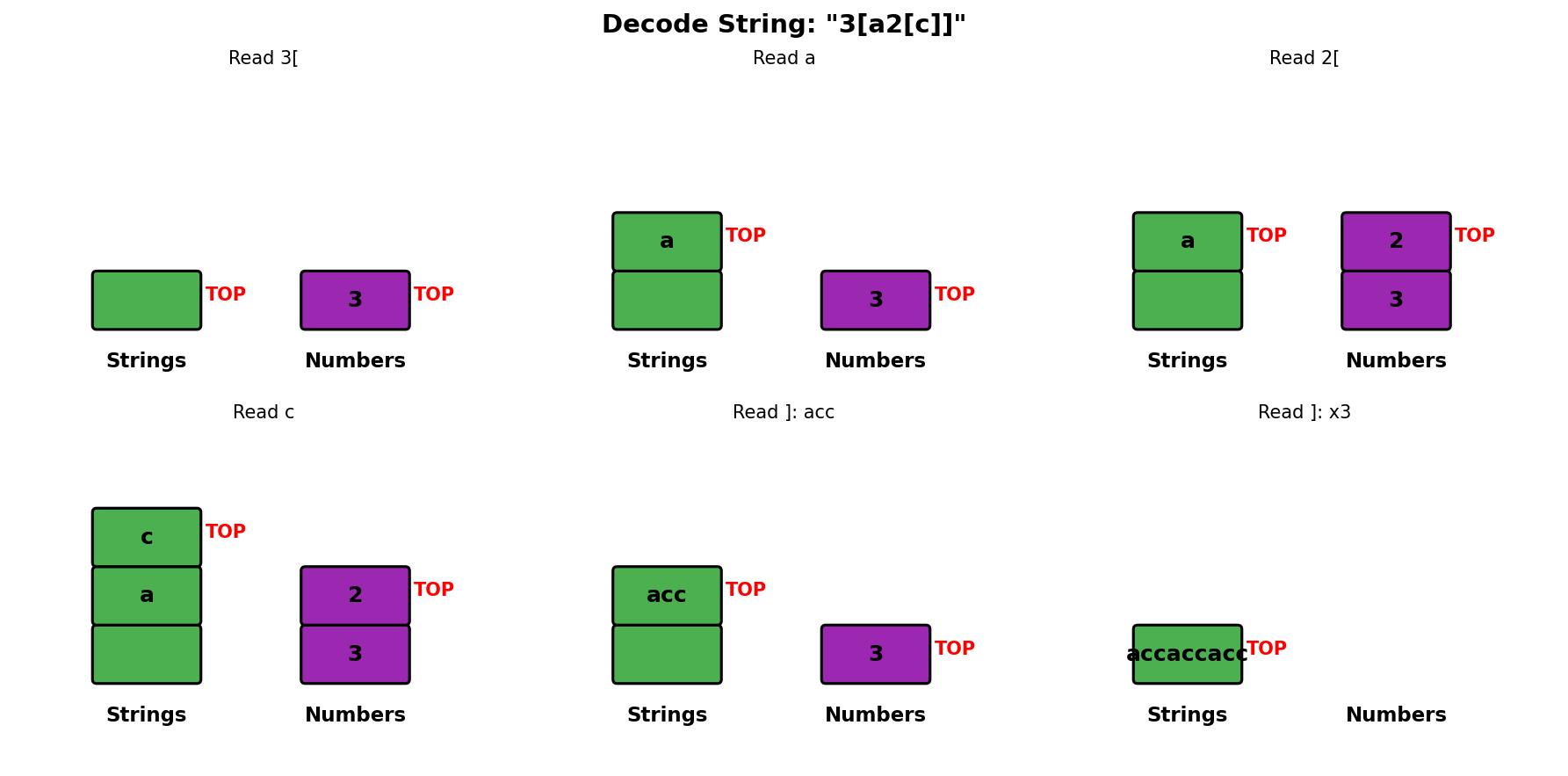
For 3[a2[c]]:
Process '3':
  num = 3

Process '[':
  Push ("", 3) to stack
  Reset: current_str = "", num = 0
  Stack: [("", 3)]

Process 'a':
  current_str = "a"

Process '2':
  num = 2

Process '[':
  Push ("a", 2) to stack
  Reset: current_str = "", num = 0
  Stack: [("", 3), ("a", 2)]

Process 'c':
  current_str = "c"

Process ']':
  Pop (prev_str="a", k=2)
  current_str = "a" + "c"*2 = "acc"
  Stack: [("", 3)]

Process ']':
  Pop (prev_str="", k=3)
  current_str = "" + "acc"*3 = "accaccacc"
  Stack: []

Result: "accaccacc"Solution: Stack Approach
def decodeString(s: str) -> str:
    """
    Decode encoded string using stack.

    Stack stores (previous_string, multiplier) when entering [
    On ], combine current string with saved context.

    Time: O(n * max_k) where max_k is maximum repeat count
    Space: O(n) for stack
    """
    stack = []
    current_str = ""
    num = 0

    for char in s:
        if char.isdigit():
            num = num * 10 + int(char)

        elif char == '[':
            # Save current state and start fresh
            stack.append((current_str, num))
            current_str = ""
            num = 0

        elif char == ']':
            # Pop saved state and combine
            prev_str, k = stack.pop()
            current_str = prev_str + current_str * k

        else:  # Letter
            current_str += char

return current_strpublic String decodeString(String s) {
Deque<String> strStack = new ArrayDeque<>();
Deque<Integer> numStack = new ArrayDeque<>();
StringBuilder current = new StringBuilder();
int num = 0;
for (char c : s.toCharArray()) {
if (Character.isDigit(c)) {
num = num * 10 + (c - '0');
} else if (c == '[') {
strStack.push(current.toString());
numStack.push(num);
current = new StringBuilder();
num = 0;
} else if (c == ']') {
int k = numStack.pop();
String prev = strStack.pop();
String repeated = current.toString().repeat(k);
current = new StringBuilder(prev + repeated);
} else {
current.append(c);
}
}
return current.toString();
}Complexity: Time O(maxK * n) · Space O(n)
- Time: Output length dominates; each character in final output created once. For input like "300[a]", output is 300 chars
- Space: Stack depth equals max bracket nesting level; worst case O(n) for deeply nested input
Solution: Recursive Approach
def decodeString(s: str) -> str:
    """
    Recursive solution using index tracking.

    Time: O(n * max_k)
    Space: O(n) for recursion depth
    """
    def decode(s: str, i: int) -> tuple[str, int]:
        """Returns (decoded_string, next_index)"""
        result = ""
        num = 0

        while i < len(s):
            char = s[i]

            if char.isdigit():
                num = num * 10 + int(char)

            elif char == '[':
                # Recursively decode inner string
                inner_str, i = decode(s, i + 1)
                result += inner_str * num
                num = 0

            elif char == ']':
                # Return to caller
                return result, i

            else:  # Letter
                result += char

            i += 1

        return result, i

return decode(s, 0)[0]Complexity: Time O(maxK * n) · Space O(n)
- Time: Same as iterative; recursion processes each character once, output creation is the bottleneck
- Space: Recursion call stack depth equals bracket nesting level; each frame stores local result string
Solution: Two Stacks (More Explicit)
def decodeString(s: str) -> str:
    """
    Use two stacks: one for strings, one for numbers.

    More explicit than single stack with tuples.
    """
    str_stack = []
    num_stack = []
    current_str = ""
    num = 0

    for char in s:
        if char.isdigit():
            num = num * 10 + int(char)

        elif char == '[':
            str_stack.append(current_str)
            num_stack.append(num)
            current_str = ""
            num = 0

        elif char == ']':
            prev_str = str_stack.pop()
            k = num_stack.pop()
            current_str = prev_str + current_str * k

        else:
            current_str += char

return current_strComplexity: Time O(maxK * n) · Space O(n)
- Time: Same complexity; two stacks vs one tuple-stack is stylistic, not algorithmic difference
- Space: Two stacks together hold same data as single stack with tuples; total space unchanged
Step-by-Step Walkthrough
For 2[abc]3[cd]ef:
Initial: current_str = "", num = 0, stack = []

char = '2':
  num = 2

char = '[':
  Push ("", 2)
  current_str = "", num = 0
  stack = [("", 2)]

char = 'a': current_str = "a"
char = 'b': current_str = "ab"
char = 'c': current_str = "abc"

char = ']':
  Pop ("", 2)
  current_str = "" + "abc"*2 = "abcabc"
  stack = []

char = '3':
  num = 3

char = '[':
  Push ("abcabc", 3)
  current_str = "", num = 0
  stack = [("abcabc", 3)]

char = 'c': current_str = "c"
char = 'd': current_str = "cd"

char = ']':
  Pop ("abcabc", 3)
  current_str = "abcabc" + "cd"*3 = "abcabccdcdcd"
  stack = []

char = 'e': current_str = "abcabccdcdcde"
char = 'f': current_str = "abcabccdcdcdef"

Result: "abcabccdcdcdef"Complexity Analysis
| Aspect | Complexity | Explanation |
|---|---|---|
| Time | O(sum of k_i * n_i) | Each character in output is created once |
| Space | O(n) | Stack depth = nesting level |
Time Complexity Details
- Let
Sbe the length of the decoded string - We create each character in
Sexactly once - Time is O(S), but S can be much larger than input
For 300[a], input is 6 characters, output is 300 characters.
Edge Cases
def test_decode_string():
    # No encoding
    assert decodeString("abc") == "abc"

    # Simple encoding
    assert decodeString("3[a]") == "aaa"

    # Multiple groups
    assert decodeString("2[a]3[b]") == "aabbb"

    # Nested encoding
    assert decodeString("2[a2[b]]") == "abbabb"

    # Multi-digit numbers
    assert decodeString("10[a]") == "aaaaaaaaaa"

    # Deep nesting
    assert decodeString("2[2[2[a]]]") == "aaaaaaaa"

    # Letters between groups
assert decodeString("2[a]b3[c]") == "aabccc"Common Mistakes
Forgetting multi-digit numbers
python# Wrong: num = int(char) # Correct: num = num * 10 + int(char)Not resetting state on '['
python# Must reset both current_str and num current_str = "" num = 0String concatenation inefficiency
python# For very long strings, use list and join chars = [] chars.append(char) return ''.join(chars)
Optimized for Long Strings
def decodeString(s: str) -> str:
    """
    Optimized version using list for string building.
    Avoids O(n^2) string concatenation.
    """
    stack = []
    current = []  # List of characters
    num = 0

    for char in s:
        if char.isdigit():
            num = num * 10 + int(char)
        elif char == '[':
            stack.append((''.join(current), num))
            current = []
            num = 0
        elif char == ']':
            prev_str, k = stack.pop()
            current_str = ''.join(current)
            current = list(prev_str + current_str * k)
        else:
            current.append(char)

return ''.join(current)Complexity: Time O(maxK * n) · Space O(n)
- Time: List append is O(1) amortized; avoids O(n^2) string concatenation overhead of naive approach
- Space: Same O(n) stack depth; list-based string building uses similar memory to direct concatenation
Interview Tips
What Interviewers Look For
- Stack for Nesting: Recognize the pattern of saving/restoring state
- Edge Cases: Multi-digit numbers, deep nesting, letters outside brackets
- Clean Code: Clear variable names, well-structured logic
Common Follow-up Questions
"How would you handle invalid input?"
pythondef decodeString(s: str) -> str: # Validate before processing bracket_count = 0 for char in s: if char == '[': bracket_count += 1 elif char == ']': bracket_count -= 1 if bracket_count < 0: raise ValueError("Unbalanced brackets") if bracket_count != 0: raise ValueError("Unbalanced brackets") # ... proceed with decoding"What if k could be 0?"
0[abc]should produce empty string- Our solution handles this correctly
"Can you solve it iteratively without a stack?"
- Find innermost brackets, decode, replace, repeat
- Less efficient but possible
"How would you encode a string?"
pythondef encodeString(s: str) -> str: # Find repeated patterns and encode them # This is much harder - requires pattern matching pass
Similar Pattern Problems
| Problem | What to Save on Stack |
|---|---|
| Decode String | (previous string, multiplier) |
| Basic Calculator | (previous result, sign) |
| Nested List Weight Sum | (current depth) |
| Number of Atoms | (previous count map) |
Related Problems
Number of Atoms (LeetCode 726)
Problem: Parse chemical formula like "K4(ON(SO3)2)2" and return atom counts sorted alphabetically.
Key Insight: Similar nested structure. Stack stores count maps. On ')', multiply inner counts and merge with outer.
Approach: Stack stores dictionaries. Parse element names and numbers. On ')', pop and multiply counts.
Complexity: O(n^2) worst case for string operations, O(n) space
Brace Expansion (LeetCode 1087)
Problem: Given string like "{a,b}c{d,e}f", generate all possible strings in sorted order.
Key Insight: Backtracking or iterative expansion. Track options at each position.
Approach: Parse groups and literals. Use backtracking or BFS to generate all combinations.
Complexity: O(n * k^m) where k = max options per group, m = number of groups
Flatten Nested List Iterator (LeetCode 341)
Problem: Implement iterator over nested list structure supporting hasNext() and next().
Key Insight: Use stack to track position in nested structure. On hasNext(), flatten until integer found.
Approach: Stack stores iterators. Flatten lazily - only process when hasNext() called.
Complexity: O(1) amortized per operation, O(d) space for depth d
Valid Parentheses (LeetCode 20)
Problem: Check if string with '()', '{}', '[]' has balanced and properly nested brackets.
Key Insight: Stack matches closing brackets with most recent opening bracket (LIFO property).
Approach: Push opening brackets, pop and verify match on closing brackets. Valid if stack empty at end.
Complexity: O(n) time, O(n) space