Remove K Digits
LeetCode 402 | Difficulty: Medium | Pattern: Monotonic Stack
Problem Statement
Given string num representing a non-negative integer num, and an integer k, return the smallest possible integer after removing k digits from num.
Examples
Example 1:
Input: num = "1432219", k = 3
Output: "1219"
Explanation: Remove 4, 3, and 2 to form "1219", the smallest possible.Example 2:
Input: num = "10200", k = 1
Output: "200"
Explanation: Remove the leading 1, result is "0200" which becomes "200".Example 3:
Input: num = "10", k = 2
Output: "0"
Explanation: Remove both digits, nothing left but "0".Constraints
1 <= k <= num.length <= 10^5numconsists of only digitsnumdoes not have any leading zeros except for the zero itself
Intuition
To minimize a number, we want smaller digits to appear first. Specifically:
- If we see digits
abwherea > b, removingagives a smaller number - Remove digits from left that are larger than the next digit
Key Insight: Maintain a monotonic increasing stack. When current digit is smaller than stack top, pop the larger digit (counts as one removal).
Visualization
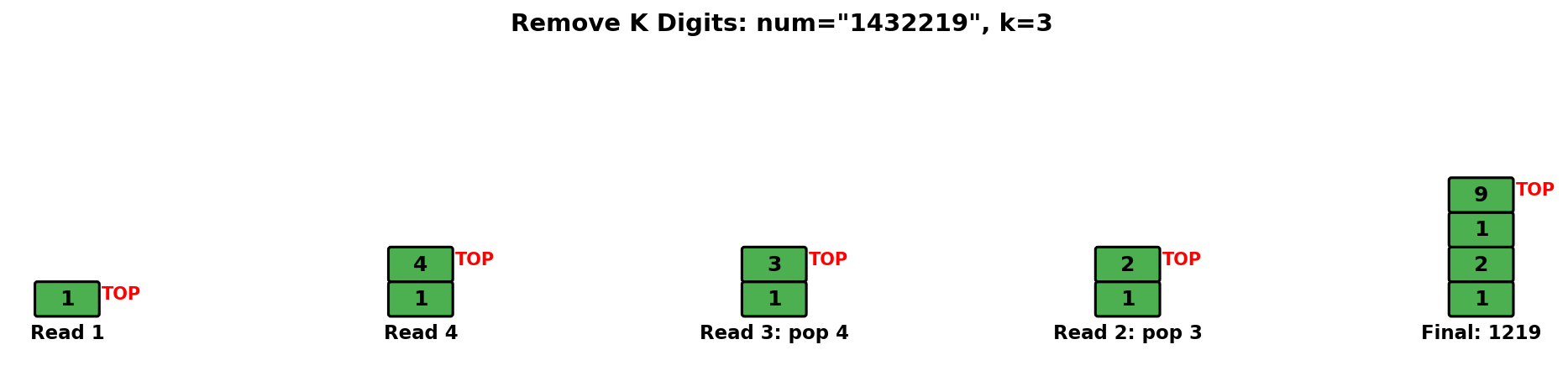
For num = "1432219", k = 3:
Process '1': stack = ['1']
Process '4': stack = ['1', '4']
Process '3': 3 < 4, pop '4' (k=2), stack = ['1', '3']
Process '2': 2 < 3, pop '3' (k=1), stack = ['1', '2']
Process '2': stack = ['1', '2', '2']
Process '1': 1 < 2, pop '2' (k=0), stack = ['1', '2', '1']
Process '9': stack = ['1', '2', '1', '9']

Result: "1219"Solution
def removeKdigits(num: str, k: int) -> str:
    """
    Remove k digits to form smallest number using monotonic increasing stack.

    Time: O(n) - each digit pushed/popped at most once
    Space: O(n) - stack size
    """
    stack = []

    for digit in num:
        # Pop larger digits (they make the number bigger)
        while k > 0 and stack and stack[-1] > digit:
            stack.pop()
            k -= 1
        stack.append(digit)

    # If k > 0, remove from end (remaining digits are in increasing order)
    if k > 0:
        stack = stack[:-k]

    # Remove leading zeros and handle empty result
    result = ''.join(stack).lstrip('0')

return result if result else '0'public String removeKdigits(String num, int k) {
Deque<Character> stack = new ArrayDeque<>();
for (char digit : num.toCharArray()) {
while (k > 0 && !stack.isEmpty() && stack.peek() > digit) {
stack.pop();
k--;
}
stack.push(digit);
}
// Remove remaining k digits from the end (top of stack)
while (k-- > 0) stack.pop();
// Build result, removing leading zeros
StringBuilder sb = new StringBuilder();
while (!stack.isEmpty()) sb.append(stack.pop());
sb.reverse();
// Strip leading zeros
int start = 0;
while (start < sb.length() - 1 && sb.charAt(start) == '0') start++;
return sb.substring(start);
}Complexity: Time O(n) · Space O(n)
- Time: Each digit is pushed onto the stack at most once and popped at most once, giving O(n) total operations across all iterations
- Space: Stack stores at most n digits when no removals occur (e.g., strictly increasing sequence)
Step-by-Step Walkthrough
For num = "1432219", k = 3:
Initial: stack = [], k = 3

digit = '1':
  Stack empty, push '1'
  stack = ['1']

digit = '4':
  '4' > '1', just push
  stack = ['1', '4']

digit = '3':
  '3' < '4', pop '4', k = 2
  '3' > '1', push '3'
  stack = ['1', '3']

digit = '2':
  '2' < '3', pop '3', k = 1
  '2' > '1', push '2'
  stack = ['1', '2']

digit = '2':
  '2' == '2', just push
  stack = ['1', '2', '2']

digit = '1':
  '1' < '2', pop '2', k = 0
  Push '1'
  stack = ['1', '2', '1']

digit = '9':
  k = 0, can't pop
  Push '9'
  stack = ['1', '2', '1', '9']

k = 0, no trimming needed
Result = "1219"Why Monotonic Increasing Stack?
Consider number abc... where a > b:
- Original:
abc... - After removing
a:bc...
Since a > b, bc... < ac..., so removing a is beneficial.
By maintaining an increasing stack, we ensure:
- Larger digits followed by smaller ones are removed
- We process left-to-right, so leftmost (most significant) digits are optimized first
Edge Cases
def test_remove_k_digits():
    # Remove all digits
    assert removeKdigits("10", 2) == "0"

    # No removal needed (k=0)
    assert removeKdigits("123", 0) == "123"

    # Remove from end (increasing sequence)
    assert removeKdigits("12345", 2) == "123"

    # Remove all but one
    assert removeKdigits("9", 1) == "0"

    # Leading zeros after removal
    assert removeKdigits("10200", 1) == "200"
    assert removeKdigits("10001", 1) == "1"

    # All same digits
    assert removeKdigits("1111", 2) == "11"

    # Decreasing then increasing
assert removeKdigits("54321", 2) == "321"Alternative: Using List as Stack with Cleanup
def removeKdigits(num: str, k: int) -> str:
    """Alternative with explicit list operations."""
    result = []

    for digit in num:
        while k and result and result[-1] > digit:
            result.pop()
            k -= 1
        result.append(digit)

    # Remove remaining k digits from the end
    result = result[:len(result) - k] if k else result

    # Convert to string and remove leading zeros
return ''.join(result).lstrip('0') or '0'Complexity: Time O(n) · Space O(n)
- Time: Each digit pushed/popped at most once; slicing and joining are O(n) but don't change overall linear complexity
- Space: Result list holds at most n elements; lstrip creates a new string of at most n characters
Complexity Analysis
| Aspect | Complexity | Explanation |
|---|---|---|
| Time | O(n) | Each digit pushed and popped at most once |
| Space | O(n) | Stack stores up to n digits |
Common Mistakes
Forgetting to remove from end when k > 0
python# Input: "12345", k = 2 # After loop: stack = ['1', '2', '3', '4', '5'], k = 2 # Must remove last 2: ['1', '2', '3']Not handling leading zeros
python# Input: "10200", k = 1 # After removal: ['0', '2', '0', '0'] # Must strip leading zeros: "200"Not returning "0" for empty result
python# Input: "10", k = 2 # After removal: [] # Must return "0", not ""
Variations
1. Remove K Digits to Get Largest Number
def removeKdigitsLargest(num: str, k: int) -> str:
    """Remove k digits to form largest number."""
    stack = []

    for digit in num:
        # Pop SMALLER digits (opposite of min problem)
        while k > 0 and stack and stack[-1] < digit:
            stack.pop()
            k -= 1
        stack.append(digit)

    if k > 0:
        stack = stack[:-k]

    result = ''.join(stack).lstrip('0')
return result if result else '0'Complexity: Time O(n) · Space O(n)
- Time: Each digit pushed/popped at most once using monotonic decreasing stack (opposite direction from minimum)
- Space: Stack stores at most n digits when sequence is strictly decreasing
2. Create Maximum Number (LC 321)
Given two arrays, create the maximum number of length k using at most all digits from both arrays.
def maxNumber(nums1: list[int], nums2: list[int], k: int) -> list[int]:
    """
    Select i from nums1, k-i from nums2, merge to maximize.
    """
    def maxSubarray(nums, length):
        """Get max subsequence of given length."""
        drop = len(nums) - length
        stack = []
        for num in nums:
            while drop and stack and stack[-1] < num:
                stack.pop()
                drop -= 1
            stack.append(num)
        return stack[:length]

    def merge(nums1, nums2):
        """Merge two arrays to form largest number."""
        result = []
        while nums1 or nums2:
            if nums1 > nums2:
                result.append(nums1.pop(0))
            else:
                result.append(nums2.pop(0))
        return result

    best = []
    for i in range(max(0, k - len(nums2)), min(len(nums1), k) + 1):
        candidate = merge(maxSubarray(nums1, i), maxSubarray(nums2, k - i))
        if candidate > best:
            best = candidate

return bestComplexity: Time O(k * (m + n + k)) · Space O(m + n)
- Time: Try O(k) splits; each maxSubarray is O(m) or O(n); merge is O(k) for comparing/building result
- Space: Stack in maxSubarray holds up to min(length, array size); merged result is O(k)
Interview Tips
What Interviewers Look For
- Greedy + Stack Pattern: Recognize this as monotonic stack
- Edge Cases: Leading zeros, remove all, k = 0
- Clean Code: Handle edge cases without many if-statements
Common Follow-up Questions
"What if we want to keep exactly k digits instead?"
python# Remove n - k digits instead removeKdigits(num, len(num) - k)"What if the number can have a leading negative sign?"
- Handle sign separately, apply algorithm to absolute value
"How would you minimize a number with at most k removals?"
- Same algorithm, but can stop early if we've made enough removals
"What about Create Maximum Number (LC 321)?"
- Combine subsequences from two arrays to maximize
Related Problems
Create Maximum Number (LeetCode 321)
Problem: Given two arrays, create max number of length k using digits from both (preserving order).
Key Insight: Try all splits: i from nums1, k-i from nums2. Get max subsequence from each, merge optimally.
Approach: For each valid split, extract max subsequence using monotonic stack, then greedy merge.
Complexity: O(k * (m + n + k)) time
Monotonic Array (LeetCode 896)
Problem: Check if array is monotonic (entirely non-increasing or non-decreasing).
Key Insight: Track if we've seen increase and decrease. Can't have both.
Approach: Single pass tracking whether we've seen any increase or decrease.
Complexity: O(n) time, O(1) space
Remove Duplicate Letters (LeetCode 316)
Problem: Remove duplicates to get smallest lexicographic string with one of each letter.
Key Insight: Monotonic increasing stack, but only pop if that letter appears later.
Approach: Track last occurrence of each letter. Pop larger letters only if they appear again later.
Complexity: O(n) time, O(1) space (26 letters max)
Smallest Subsequence of Distinct Characters (LeetCode 1081)
Problem: Same as Remove Duplicate Letters - smallest lexicographic string with unique characters.
Key Insight: Identical problem. Monotonic stack with last occurrence tracking.
Approach: Same algorithm as LC 316. Stack + seen set + last occurrence map.
Complexity: O(n) time, O(1) space
Remove Duplicate Letters (Similar Pattern)
def removeDuplicateLetters(s: str) -> str:
    """
    Return smallest lexicographic string with each letter once.
    Uses monotonic increasing stack with additional constraints.
    """
    last_occurrence = {c: i for i, c in enumerate(s)}
    stack = []
    seen = set()

    for i, c in enumerate(s):
        if c in seen:
            continue

        # Pop if: current is smaller AND we'll see the popped char again
        while stack and c < stack[-1] and last_occurrence[stack[-1]] > i:
            seen.remove(stack.pop())

        stack.append(c)
        seen.add(c)

return ''.join(stack)Complexity: Time O(n) · Space O(1)
- Time: Single pass through string; each character pushed/popped at most once from stack
- Space: Stack stores at most 26 characters (unique letters); last_occurrence dict is O(26); seen set is O(26)