Next Greater Element
LeetCode 496, 503 | Difficulty: Easy/Medium | Pattern: Monotonic Stack
Problem Statement
Next Greater Element I (LeetCode 496)
The next greater element of some element x in an array is the first greater element that is to the right of x in the same array.
You are given two distinct 0-indexed integer arrays nums1 and nums2, where nums1 is a subset of nums2.
For each 0 <= i < nums1.length, find the index j such that nums1[i] == nums2[j] and determine the next greater element of nums2[j] in nums2. If there is no next greater element, the answer is -1.
Return an array ans of length nums1.length such that ans[i] is the next greater element for nums1[i].
Examples
Example 1:
Input: nums1 = [4,1,2], nums2 = [1,3,4,2]
Output: [-1,3,-1]
Explanation:
- For 4: No element greater than 4 to its right in nums2. Answer: -1
- For 1: Next greater element is 3. Answer: 3
- For 2: No element greater than 2 to its right. Answer: -1Example 2:
Input: nums1 = [2,4], nums2 = [1,2,3,4]
Output: [3,-1]Constraints
1 <= nums1.length <= nums2.length <= 10000 <= nums1[i], nums2[i] <= 10^4- All integers in
nums1andnums2are unique - All integers of
nums1also appear innums2
Intuition: Monotonic Stack
The brute force approach checks every element to the right for each element - O(n^2). We can do better with a monotonic decreasing stack.
Key Insight: Maintain a stack of elements for which we haven't found the next greater element yet. When we encounter a larger element, it's the "next greater" for all smaller elements on the stack.
Stack State Visualization
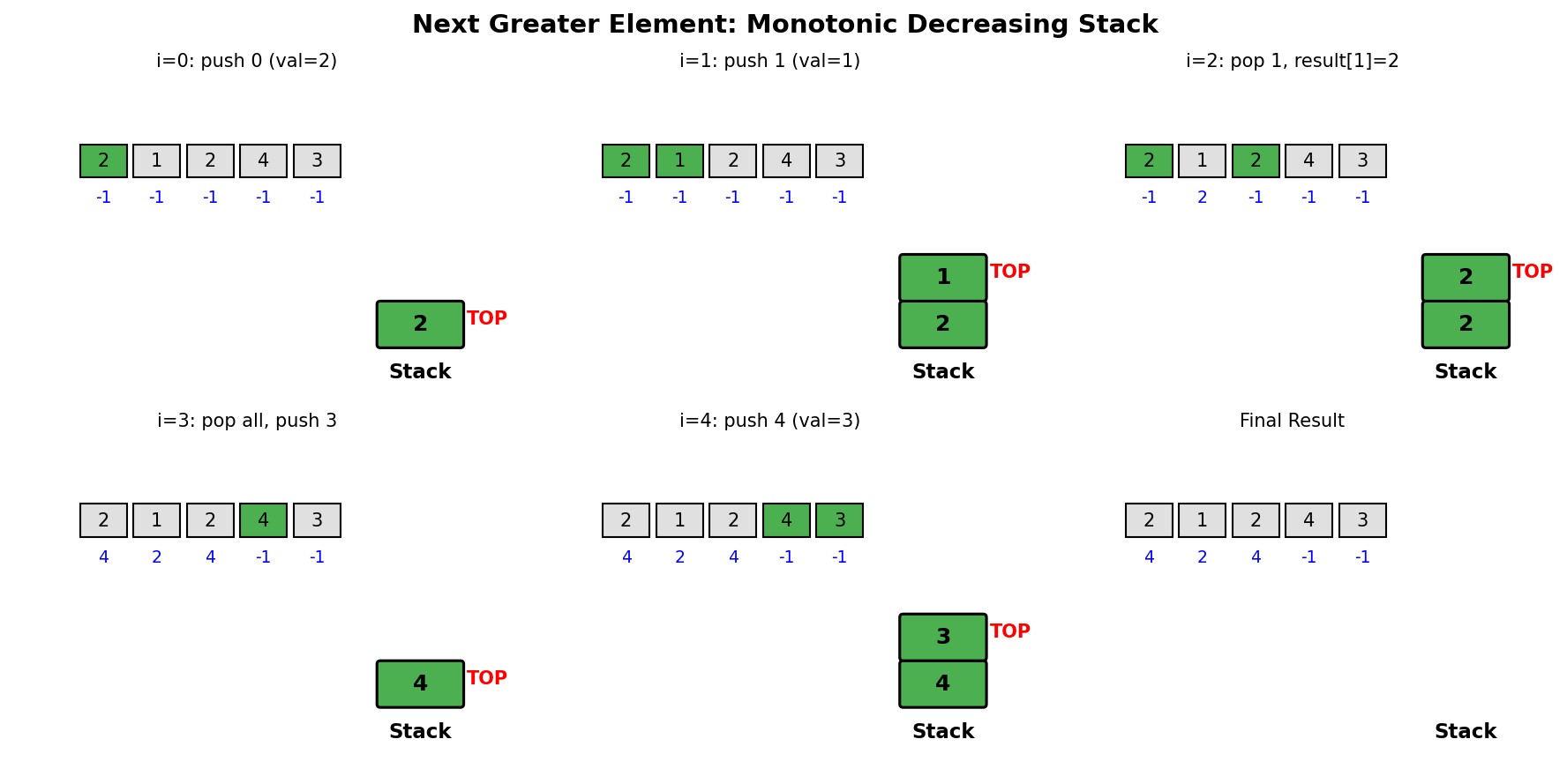
For array [2, 1, 2, 4, 3]:
i=0, val=2:
  Stack empty, push 0
  Stack: [0] (values: [2])

i=1, val=1:
  1 < 2 (stack top), push 1
  Stack: [0, 1] (values: [2, 1])

i=2, val=2:
  2 > 1, pop index 1, result[1] = 2
  2 == 2 (stack top), push 2
  Stack: [0, 2] (values: [2, 2])

i=3, val=4:
  4 > 2, pop index 2, result[2] = 4
  4 > 2, pop index 0, result[0] = 4
  Stack empty, push 3
  Stack: [3] (values: [4])

i=4, val=3:
  3 < 4 (stack top), push 4
  Stack: [3, 4] (values: [4, 3])

Done: result = [4, 2, 4, -1, -1]Solution: Next Greater Element I
def nextGreaterElement(nums1: list[int], nums2: list[int]) -> list[int]:
    """
    Find next greater element for each element in nums1.

    Approach:
    1. Build a map of next greater elements for all elements in nums2
    2. Look up each element of nums1 in the map

    Time: O(n + m) where n = len(nums1), m = len(nums2)
    Space: O(m) for the stack and hashmap
    """
    # Map: element -> its next greater element
    next_greater = {}
    stack = []  # Monotonic decreasing stack

    for num in nums2:
        # Pop elements smaller than current - they found their next greater
        while stack and stack[-1] < num:
            smaller = stack.pop()
            next_greater[smaller] = num
        stack.append(num)

    # Elements remaining in stack have no next greater
    # They default to -1 (not in next_greater map)

return [next_greater.get(num, -1) for num in nums1]public int[] nextGreaterElement(int[] nums1, int[] nums2) {
Map<Integer, Integer> nextGreater = new HashMap<>();
Deque<Integer> stack = new ArrayDeque<>(); // monotonic decreasing
for (int num : nums2) {
while (!stack.isEmpty() && stack.peek() < num) {
nextGreater.put(stack.pop(), num);
}
stack.push(num);
}
int[] result = new int[nums1.length];
for (int i = 0; i < nums1.length; i++) {
result[i] = nextGreater.getOrDefault(nums1[i], -1);
}
return result;
}Complexity: Time O(n + m) · Space O(m)
- Time: Single pass through nums2 (m elements), each element pushed/popped at most once = O(m); lookup for n elements in nums1 = O(n)
- Space: HashMap stores at most m key-value pairs; stack holds at most m elements at any time
Solution: Next Greater Element II (Circular Array)
For circular arrays, iterate twice through the array.
def nextGreaterElements(nums: list[int]) -> list[int]:
    """
    LeetCode 503: Circular array version.

    Iterate through array twice to handle wrap-around.

    Time: O(n)
    Space: O(n)
    """
    n = len(nums)
    result = [-1] * n
    stack = []  # Store indices

    # Iterate twice (2n iterations for circular)
    for i in range(2 * n):
        idx = i % n

        while stack and nums[stack[-1]] < nums[idx]:
            result[stack.pop()] = nums[idx]

        # Only push indices in first pass
        if i < n:
            stack.append(idx)

return resultpublic int[] nextGreaterElements(int[] nums) {
int n = nums.length;
int[] result = new int[n];
Arrays.fill(result, -1);
Deque<Integer> stack = new ArrayDeque<>(); // indices
for (int i = 0; i < 2 * n; i++) {
int idx = i % n;
while (!stack.isEmpty() && nums[stack.peek()] < nums[idx]) {
result[stack.pop()] = nums[idx];
}
if (i < n) stack.push(idx);
}
return result;
}Complexity: Time O(n) · Space O(n)
- Time: Loop runs 2n iterations; each index is pushed once (first pass only) and popped at most once = O(2n) = O(n)
- Space: Result array uses O(n); stack stores at most n indices (all elements if strictly decreasing)
Example for circular [1, 2, 1]:
First pass (i=0,1,2):
  i=0: push 0, stack=[0]
  i=1: 2>1, pop 0, result[0]=2, push 1, stack=[1]
  i=2: 1<2, push 2, stack=[1,2]

Second pass (i=3,4,5 -> idx=0,1,2):
  i=3 (idx=0): nums[2]=1 < nums[0]=1? No, no pop
  i=4 (idx=1): nums[2]=1 < nums[1]=2? Yes, pop 2, result[2]=2
  i=5 (idx=2): nums[1]=2 < nums[2]=1? No, no pop

result = [2, -1, 2]
(result[1]=-1: no element greater than 2 anywhere in the circular array)Generic Template: Next Greater/Smaller
def nextGreater(nums: list[int]) -> list[int]:
    """Find next greater element for each position."""
    n = len(nums)
    result = [-1] * n
    stack = []  # Monotonic DECREASING stack (stores indices)

    for i in range(n):
        while stack and nums[stack[-1]] < nums[i]:
            result[stack.pop()] = nums[i]
        stack.append(i)

    return result


def nextSmaller(nums: list[int]) -> list[int]:
    """Find next smaller element for each position."""
    n = len(nums)
    result = [-1] * n
    stack = []  # Monotonic INCREASING stack

    for i in range(n):
        while stack and nums[stack[-1]] > nums[i]:
            result[stack.pop()] = nums[i]
        stack.append(i)

    return result


def prevGreater(nums: list[int]) -> list[int]:
    """Find previous greater element for each position."""
    n = len(nums)
    result = [-1] * n
    stack = []  # Monotonic DECREASING stack

    for i in range(n):
        while stack and nums[stack[-1]] <= nums[i]:
            stack.pop()
        if stack:
            result[i] = nums[stack[-1]]
        stack.append(i)

    return result


def prevSmaller(nums: list[int]) -> list[int]:
    """Find previous smaller element for each position."""
    n = len(nums)
    result = [-1] * n
    stack = []  # Monotonic INCREASING stack

    for i in range(n):
        while stack and nums[stack[-1]] >= nums[i]:
            stack.pop()
        if stack:
            result[i] = nums[stack[-1]]
        stack.append(i)

return resultComplexity: Time O(n) · Space O(n) for each function
- Time: Each element is pushed exactly once and popped at most once, giving O(2n) = O(n) operations
- Space: Result array is O(n); stack can hold up to n indices in worst case (e.g., strictly decreasing for nextGreater)
Monotonic Stack Types
| Type | Stack Order | Use Case | Pop Condition |
|---|---|---|---|
| Decreasing | Top is smallest | Next Greater | stack[-1] < current |
| Increasing | Top is largest | Next Smaller | stack[-1] > current |
Visual Comparison
Decreasing Stack for Next Greater:
Array: [3, 1, 4, 2]

i=0: stack=[3]
i=1: stack=[3,1]     (1<3, keep 3)
i=2: 4>1, pop 1 (next greater=4)
     4>3, pop 3 (next greater=4)
     stack=[4]
i=3: stack=[4,2]     (2<4)

Next Greater: [4, 4, -1, -1]Complexity Analysis
| Approach | Time | Space |
|---|---|---|
| Brute Force | O(n^2) | O(1) |
| Monotonic Stack | O(n) | O(n) |
Why O(n)? Each element is pushed and popped at most once.
Edge Cases
def test_next_greater():
    # All same elements
    assert nextGreater([1, 1, 1, 1]) == [-1, -1, -1, -1]

    # Strictly increasing
    assert nextGreater([1, 2, 3, 4]) == [2, 3, 4, -1]

    # Strictly decreasing
    assert nextGreater([4, 3, 2, 1]) == [-1, -1, -1, -1]

    # Single element
    assert nextGreater([5]) == [-1]

    # Two elements
    assert nextGreater([1, 2]) == [2, -1]
assert nextGreater([2, 1]) == [-1, -1]Related Applications
1. Daily Temperatures
def dailyTemperatures(temperatures: list[int]) -> list[int]:
    """Days until warmer temperature (index difference, not value)."""
    n = len(temperatures)
    result = [0] * n
    stack = []

    for i in range(n):
        while stack and temperatures[stack[-1]] < temperatures[i]:
            prev_idx = stack.pop()
            result[prev_idx] = i - prev_idx  # Days difference
        stack.append(i)

return resultComplexity: Time O(n) · Space O(n)
- Time: Each index pushed once, popped at most once when a warmer day is found = O(n) total operations
- Space: Result array O(n); stack stores indices of days waiting for warmer temperature, at most n
2. Stock Span
def stockSpan(prices: list[int]) -> list[int]:
    """Days including today where price was <= today's price."""
    n = len(prices)
    result = [1] * n
    stack = []  # Stores indices

    for i in range(n):
        while stack and prices[stack[-1]] <= prices[i]:
            stack.pop()
        result[i] = i - stack[-1] if stack else i + 1
        stack.append(i)

return resultComplexity: Time O(n) · Space O(n)
- Time: Each index pushed once and popped at most once when a higher price appears = O(n) amortized
- Space: Result array O(n); stack stores indices of prices not yet "spanned over," at most n
Interview Tips
What Interviewers Look For
- Pattern Recognition: Identify monotonic stack applicability
- Stack Type: Know when to use increasing vs decreasing
- Edge Cases: Handle all same, sorted, reverse sorted arrays
Common Follow-up Questions
"What if we need both next greater AND previous greater?"
- Run monotonic stack twice, or compute both in single pass
"How would you handle duplicates?"
- Decide on strict (
<) vs non-strict (<=) comparison
- Decide on strict (
"Can you find the next greater element's INDEX instead of value?"
- Store indices in stack, return indices instead of values
"What's the intuition behind monotonic stack?"
- We maintain a "waiting list" of elements looking for their answer
- When a larger element comes, it resolves all smaller waiting elements
Common Mistakes
- Storing values instead of indices: Usually need indices for calculations
- Wrong comparison:
<vs<=matters for duplicates - Forgetting remaining stack elements: They have no next greater (return -1)
- Circular array: Remember to iterate twice, but only push once
Related Problems
Daily Temperatures (LeetCode 739)
Problem: Given temperatures array, return days until warmer temperature for each day.
Key Insight: Next greater element but return index difference instead of value.
Approach: Monotonic decreasing stack of indices. When current > stack top, result = current_idx - popped_idx.
Complexity: O(n) time, O(n) space
Online Stock Span (LeetCode 901)
Problem: Design class returning span (consecutive days <= today's price) for streaming prices.
Key Insight: Previous greater element pattern. Accumulate spans of popped elements.
Approach: Stack stores (price, accumulated_span). Pop all <= current, sum their spans + 1.
Complexity: O(1) amortized per call
Largest Rectangle in Histogram (LeetCode 84)
Problem: Find largest rectangular area in histogram.
Key Insight: Need both previous smaller and next smaller for each bar to determine width.
Approach: Monotonic increasing stack. When popping, left boundary = stack top, right boundary = current index.
Complexity: O(n) time, O(n) space
Trapping Rain Water (LeetCode 42)
Problem: Calculate water trapped between bars in elevation map.
Key Insight: Water bounded by min(left_max, right_max). Two pointers optimal, stack also works.
Approach: Two pointers from ends. Move pointer with smaller max, calculate water at that position.
Complexity: O(n) time, O(1) space
Remove K Digits (LeetCode 402)
Problem: Remove k digits from number string to get smallest possible result.
Key Insight: Greedy with monotonic increasing stack. Remove larger preceding digits.
Approach: Monotonic increasing stack. Pop larger digits when smaller digit found (counts as removal).
Complexity: O(n) time, O(n) space