Stock Span Problem
LeetCode 901 | Difficulty: Medium | Pattern: Monotonic Stack
Problem Statement
Design an algorithm that collects daily price quotes for some stock and returns the span of that stock's price for the current day.
The span of the stock's price today is defined as the maximum number of consecutive days (starting from today and going backward) for which the stock price was less than or equal to today's price.
Implement the StockSpanner class:
StockSpanner()Initializes the object of the classint next(int price)Returns the span of the stock's price given that today's price isprice
Examples
Example 1:
Input:
["StockSpanner", "next", "next", "next", "next", "next", "next", "next"]
[[], [100], [80], [60], [70], [60], [75], [85]]

Output: [null, 1, 1, 1, 2, 1, 4, 6]

Explanation:
StockSpanner stockSpanner = new StockSpanner();
stockSpanner.next(100); // return 1
stockSpanner.next(80);  // return 1
stockSpanner.next(60);  // return 1
stockSpanner.next(70);  // return 2 (70 >= 60)
stockSpanner.next(60);  // return 1
stockSpanner.next(75);  // return 4 (75 >= 60, 70, 60, so span = 4)
stockSpanner.next(85); // return 6 (85 >= 75, 60, 70, 60, 80)Constraints
1 <= price <= 10^5- At most
10^4calls will be made tonext
Intuition
The span is essentially finding the previous greater element - how many consecutive days back (including today) have prices <= today's price.
Key Insight: Use a monotonic decreasing stack. Pop elements with price <= current price, accumulating their spans. The current span is the sum of popped spans + 1.
Visualization
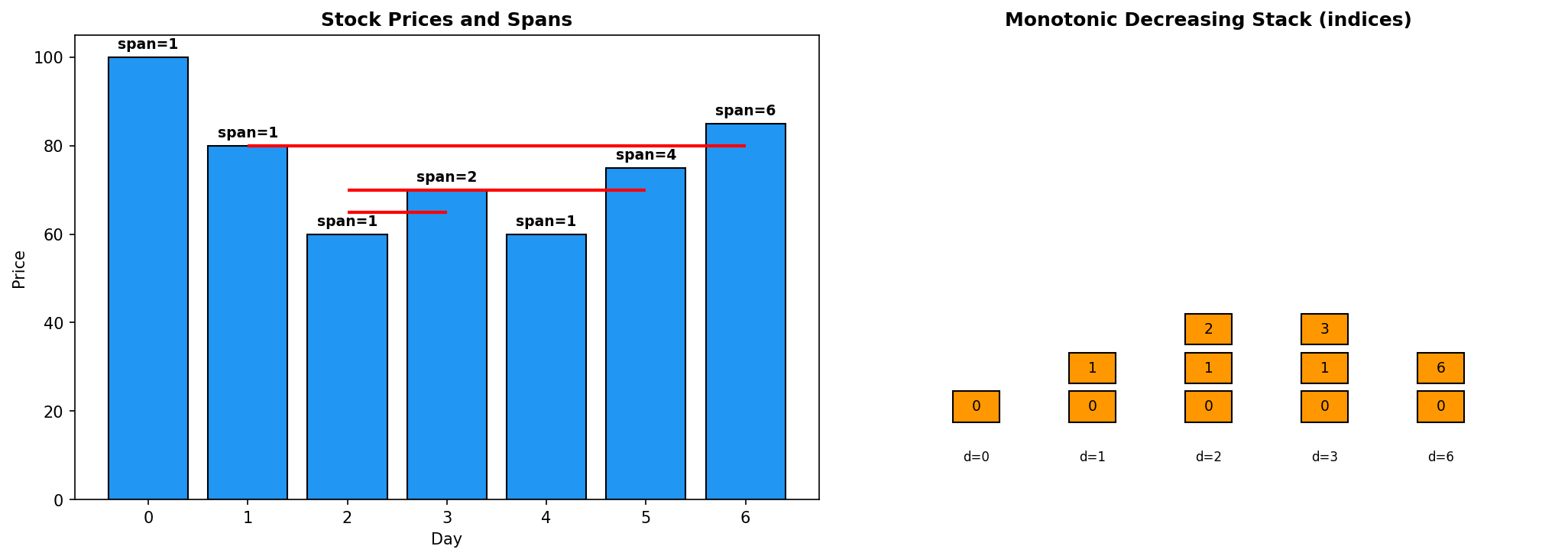
Prices: [100, 80, 60, 70, 60, 75, 85]

Day 0 (100): No previous, span = 1
  Stack: [(100, 1)]

Day 1 (80): 80 < 100, span = 1
  Stack: [(100, 1), (80, 1)]

Day 2 (60): 60 < 80, span = 1
  Stack: [(100, 1), (80, 1), (60, 1)]

Day 3 (70): 70 > 60, pop (60,1), span = 1+1 = 2
  Stack: [(100, 1), (80, 1), (70, 2)]

Day 4 (60): 60 < 70, span = 1
  Stack: [(100, 1), (80, 1), (70, 2), (60, 1)]

Day 5 (75): 75 > 60, pop (60,1), 75 > 70, pop (70,2), span = 1+1+2 = 4
  Stack: [(100, 1), (80, 1), (75, 4)]

Day 6 (85): 85 > 75, pop (75,4), 85 > 80, pop (80,1), span = 1+4+1 = 6
Stack: [(100, 1), (85, 6)]Solution
class StockSpanner:
    """
    Calculate stock span using monotonic decreasing stack.

    Stack stores (price, span) tuples.
    Pop all prices <= current, sum their spans.
    """

    def __init__(self):
        self.stack = []  # (price, span)

    def next(self, price: int) -> int:
        """
        Return span for today's price.

        Time: Amortized O(1) - each element pushed/popped at most once
        Space: O(n) - stack can hold all prices
        """
        span = 1

        # Pop prices <= current price, accumulate spans
        while self.stack and self.stack[-1][0] <= price:
            span += self.stack.pop()[1]

        self.stack.append((price, span))
return spanclass StockSpanner {
private Deque<int[]> stack; // [price, span]
public StockSpanner() {
stack = new ArrayDeque<>();
}
public int next(int price) {
int span = 1;
while (!stack.isEmpty() && stack.peek()[0] <= price) {
span += stack.pop()[1];
}
stack.push(new int[]{price, span});
return span;
}
}Complexity: Time Amortized O(1) per call · Space O(n) total
- Time: Each price is pushed exactly once and popped at most once across all calls. Over n calls, total operations = 2n = O(n), giving O(1) amortized per
next()call - Space: Stack can hold all n prices in worst case (strictly decreasing prices like [100, 90, 80, ...])
Alternative: Store Indices
class StockSpanner:
    """
    Alternative: Store indices instead of spans.
    Span = current_index - previous_greater_index
    """

    def __init__(self):
        self.stack = []  # (price, index)
        self.day = 0

    def next(self, price: int) -> int:
        # Pop smaller or equal prices
        while self.stack and self.stack[-1][0] <= price:
            self.stack.pop()

        # Span is distance to previous greater (or all days if none)
        if self.stack:
            span = self.day - self.stack[-1][1]
        else:
            span = self.day + 1

        self.stack.append((price, self.day))
        self.day += 1
return spanComplexity: Time Amortized O(1) per call · Space O(n) total
- Time: Same amortized analysis as main solution - each element enters and leaves the stack at most once
- Space: Stack stores (price, index) tuples; at most n elements in worst case when prices are strictly decreasing
Step-by-Step Walkthrough
For prices [100, 80, 60, 70, 60, 75, 85]:
next(100):
  Stack empty
  span = 1
  Push (100, 1)
  Stack: [(100, 1)]
  Return 1

next(80):
  Stack top (100, 1), 100 > 80, no pop
  span = 1
  Push (80, 1)
  Stack: [(100, 1), (80, 1)]
  Return 1

next(60):
  Stack top (80, 1), 80 > 60, no pop
  span = 1
  Push (60, 1)
  Stack: [(100, 1), (80, 1), (60, 1)]
  Return 1

next(70):
  Stack top (60, 1), 60 <= 70, pop, span = 1 + 1 = 2
  Stack top (80, 1), 80 > 70, stop
  Push (70, 2)
  Stack: [(100, 1), (80, 1), (70, 2)]
  Return 2

next(60):
  Stack top (70, 2), 70 > 60, no pop
  span = 1
  Push (60, 1)
  Stack: [(100, 1), (80, 1), (70, 2), (60, 1)]
  Return 1

next(75):
  Stack top (60, 1), 60 <= 75, pop, span = 1 + 1 = 2
  Stack top (70, 2), 70 <= 75, pop, span = 2 + 2 = 4
  Stack top (80, 1), 80 > 75, stop
  Push (75, 4)
  Stack: [(100, 1), (80, 1), (75, 4)]
  Return 4

next(85):
  Stack top (75, 4), 75 <= 85, pop, span = 1 + 4 = 5
  Stack top (80, 1), 80 <= 85, pop, span = 5 + 1 = 6
  Stack top (100, 1), 100 > 85, stop
  Push (85, 6)
  Stack: [(100, 1), (85, 6)]
Return 6Complexity Analysis
| Operation | Time | Space |
|---|---|---|
__init__ | O(1) | O(1) |
next | Amortized O(1) | O(n) total |
Why Amortized O(1)?
- Each price is pushed onto the stack exactly once
- Each price is popped at most once
- Over n calls: n pushes + n pops = O(2n) total = O(1) amortized per call
Batch Version (Array Input)
def calculateSpan(prices: list[int]) -> list[int]:
    """
    Calculate span for all prices at once.
    Equivalent to calling next() for each price.
    """
    n = len(prices)
    spans = [1] * n
    stack = []  # Stores indices

    for i in range(n):
        while stack and prices[stack[-1]] <= prices[i]:
            stack.pop()

        # Span = distance to previous greater element
        spans[i] = i - stack[-1] if stack else i + 1

        stack.append(i)

    return spans

# Example:
# prices = [100, 80, 60, 70, 60, 75, 85]
# spans = [1, 1, 1, 2, 1, 4, 6]Complexity: Time O(n) · Space O(n)
- Time: Each index is pushed once and popped at most once, so total operations across all n elements is O(2n) = O(n)
- Space: Stack stores indices; worst case holds all n indices when prices are strictly decreasing
Edge Cases
def test_stock_span():
    spanner = StockSpanner()

    # Single price
    assert spanner.next(100) == 1

    # Increasing prices
    spanner = StockSpanner()
    assert spanner.next(10) == 1
    assert spanner.next(20) == 2
    assert spanner.next(30) == 3

    # Decreasing prices
    spanner = StockSpanner()
    assert spanner.next(30) == 1
    assert spanner.next(20) == 1
    assert spanner.next(10) == 1

    # All same prices
    spanner = StockSpanner()
    assert spanner.next(50) == 1
    assert spanner.next(50) == 2
    assert spanner.next(50) == 3

    # Valley
    spanner = StockSpanner()
    assert spanner.next(50) == 1
    assert spanner.next(30) == 1
assert spanner.next(60) == 3Relation to Other Problems
| Problem | Stack Type | What We Find |
|---|---|---|
| Stock Span | Decreasing | Previous Greater Element (count) |
| Next Greater Element | Decreasing | Next Greater Element (value) |
| Daily Temperatures | Decreasing | Next Greater Element (index diff) |
| Largest Rectangle | Increasing | Next/Prev Smaller Element |
Common Mistakes
Using
<instead of<=python# Wrong: while self.stack and self.stack[-1][0] < price # Correct: while self.stack and self.stack[-1][0] <= price # Equal prices should also be included in spanForgetting to add 1 for current day
pythonspan = 1 # Start with 1 for todayNot storing span information
python# Must store (price, span) or (price, index) # Just storing price loses accumulated span info
Interview Tips
What Interviewers Look For
- Monotonic Stack: Recognize the pattern
- Online Algorithm: Handle streaming data
- Amortized Analysis: Explain O(1) amortized complexity
Common Follow-up Questions
"What if we also need the maximum span so far?"
pythondef __init__(self): self.stack = [] self.max_span = 0 def next(self, price): span = 1 while self.stack and self.stack[-1][0] <= price: span += self.stack.pop()[1] self.stack.append((price, span)) self.max_span = max(self.max_span, span) return span def getMaxSpan(self): return self.max_span"How would you handle deleting the oldest price?"
- Use a deque with (price, span, index) tuples
- More complex to maintain
"What about finding span for k days back only?"
- Maintain a window of k days
- Similar to sliding window maximum
Related Problems
Daily Temperatures (LeetCode 739)
Problem: Return days until warmer temperature for each day.
Key Insight: Next greater element (looking forward) vs stock span (looking backward).
Approach: Monotonic decreasing stack. Pop when current > top, record index difference.
Complexity: O(n) time, O(n) space
Next Greater Element I (LeetCode 496)
Problem: For nums1 subset, find next greater element in nums2.
Key Insight: Precompute next greater for all nums2, query for nums1.
Approach: Monotonic stack on nums2 builds hashmap. Lookup for each nums1 element.
Complexity: O(n + m) time
Largest Rectangle in Histogram (LeetCode 84)
Problem: Find largest rectangular area in histogram.
Key Insight: For each bar, need both previous and next smaller elements for boundaries.
Approach: Monotonic increasing stack. On pop, calculate area using popped height and boundaries.
Complexity: O(n) time, O(n) space
Sum of Subarray Minimums (LeetCode 907)
Problem: Sum of minimum elements of all subarrays.
Key Insight: Contribution technique - each element contributes to multiple subarrays as minimum.
Approach: Find prev/next smaller for each. Contribution = value * count of subarrays where it's minimum.
Complexity: O(n) time, O(n) space
132 Pattern (LeetCode 456)
Problem: Find i < j < k where nums[i] < nums[k] < nums[j].
Key Insight: Track max "2" (nums[k]) seen while scanning right-to-left with monotonic stack.
Approach: Monotonic decreasing stack stores candidates for "3". Track max "2" from pops.
Complexity: O(n) time, O(n) space