Reverse, Cycle & Merge Sort Linked List
Fundamental linked list manipulations
Visual Guides
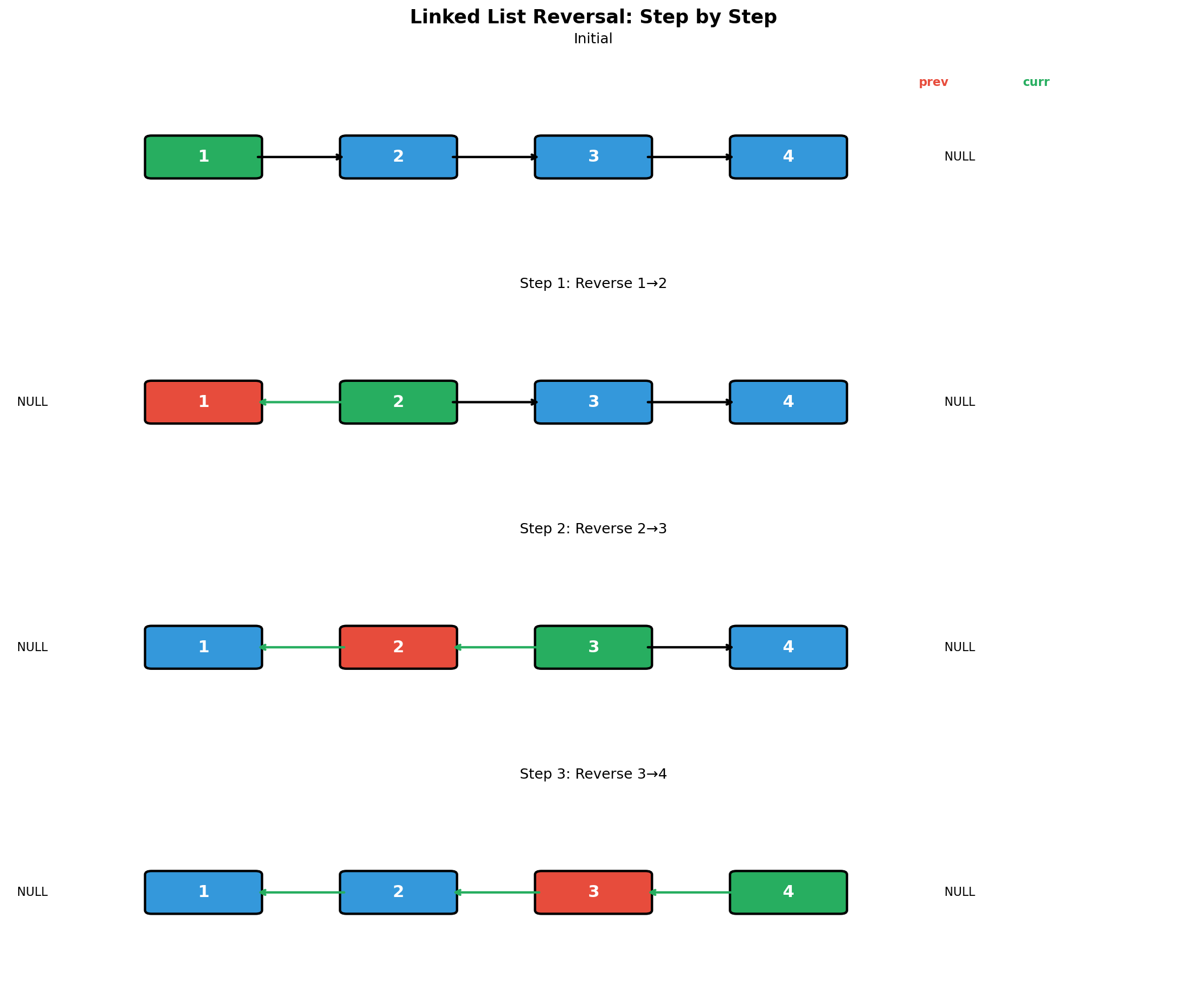
Linked List Reversal
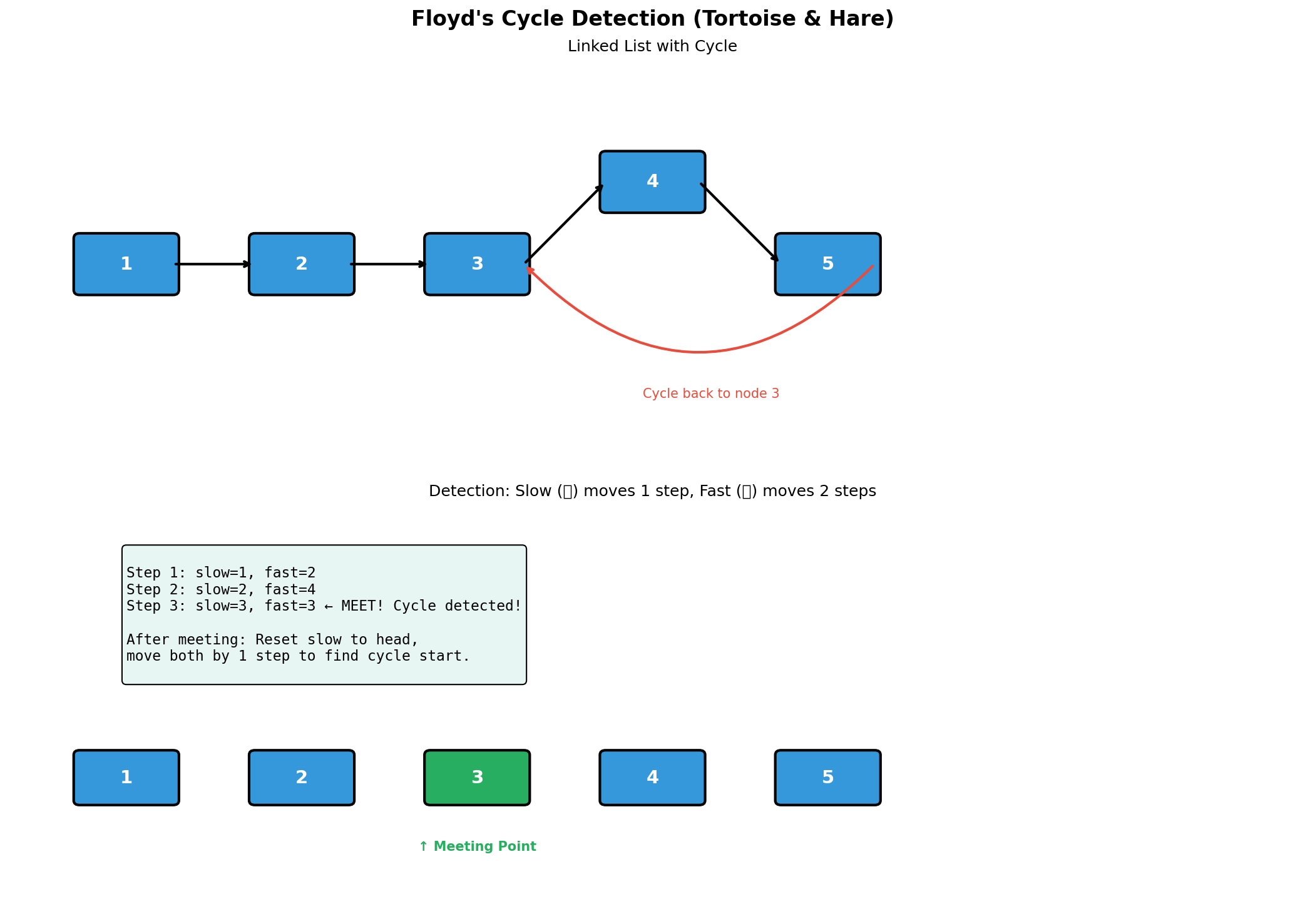
Floyd's Cycle Detection
Reverse Linked List
Reversing a linked list is one of the most fundamental problems in data structures (LeetCode #206). It tests your understanding of pointer manipulation and is a building block for many advanced linked list operations.
Iterative Solution
The iterative approach uses three pointers to reverse links in place:
def reverseList(head):
    prev, curr = None, head

    while curr:
        next_temp = curr.next  # Save next node before breaking link
        curr.next = prev       # Reverse the link
        prev = curr            # Move prev forward
        curr = next_temp       # Move curr forward

return prevpublic ListNode reverseList(ListNode head) {
ListNode prev = null, curr = head;
while (curr != null) {
ListNode nextTemp = curr.next;
curr.next = prev;
prev = curr;
curr = nextTemp;
}
return prev;
}Complexity: Time O(n) · Space O(1)
- Time: O(n) because we traverse each node exactly once, performing constant-time pointer operations at each step
- Space: O(1) because we only use three pointers (prev, curr, next_temp) regardless of list size
Key Insight: Always save curr.next before modifying it, or you'll lose the rest of the list!
Recursive Solution
The recursive approach reverses the rest of the list first, then fixes the current node's pointer:
def reverseList_recursive(head):
    # Base case: empty list or single node
    if not head or not head.next:
        return head

    # Reverse the rest of the list
    new_head = reverseList_recursive(head.next)

    # Fix pointers for current node
    head.next.next = head  # Make next node point back to current
    head.next = None       # Break original forward link

return new_headComplexity: Time O(n) · Space O(n)
- Time: O(n) because each node is visited exactly once during the recursive calls
- Space: O(n) because the recursion creates n stack frames, one for each node in the list
How it works: For list 1 -> 2 -> 3, after recursion returns with new_head = 3:
- At node 2:
2.next.next = 2makes3 -> 2, then2.next = None - At node 1:
1.next.next = 1makes2 -> 1, then1.next = None
Mermaid Diagram
Visual Step-by-Step:
Original: 1 -> 2 -> 3 -> null
          ^
         curr (prev = null)

Step 1:   null <- 1    2 -> 3 -> null
                 ^     ^
               prev   curr

Step 2:   null <- 1 <- 2    3 -> null
                       ^     ^
                     prev   curr

Step 3:   null <- 1 <- 2 <- 3
                            ^
                          prev (curr = null, exit loop)

Return: prev (node 3)Complexity
| Approach | Time | Space |
|---|---|---|
| Iterative | O(n) | O(1) |
| Recursive | O(n) | O(n) - call stack |
Linked List Cycle
Floyd's Cycle Detection Algorithm (also known as the "Tortoise and Hare" algorithm) is an elegant solution for detecting cycles in linked lists.
Detect Cycle (LeetCode #141)
def hasCycle(head) -> bool:
    slow = fast = head

    while fast and fast.next:
        slow = slow.next        # Move 1 step
        fast = fast.next.next   # Move 2 steps
        if slow == fast:
            return True

return Falsepublic boolean hasCycle(ListNode head) {
ListNode slow = head, fast = head;
while (fast != null && fast.next != null) {
slow = slow.next;
fast = fast.next.next;
if (slow == fast) return true;
}
return false;
}Complexity: Time O(n) · Space O(1)
- Time: O(n) because in the worst case (no cycle), fast pointer traverses n/2 nodes; with a cycle, pointers meet within n iterations
- Space: O(1) because we only use two pointers (slow, fast) regardless of list size
Intuition: If there's a cycle, the fast pointer will eventually "lap" the slow pointer. If no cycle exists, fast will reach the end.
Find Cycle Start (LeetCode #142)
def detectCycle(head):
    slow = fast = head

    # Phase 1: Detect cycle
    while fast and fast.next:
        slow = slow.next
        fast = fast.next.next
        if slow == fast:
            break
    else:
        return None  # No cycle found

    # Phase 2: Find entrance
    slow = head
    while slow != fast:
        slow = slow.next
        fast = fast.next

return slow # This is the cycle startpublic ListNode detectCycle(ListNode head) {
ListNode slow = head, fast = head;
boolean hasCycle = false;
while (fast != null && fast.next != null) {
slow = slow.next;
fast = fast.next.next;
if (slow == fast) { hasCycle = true; break; }
}
if (!hasCycle) return null;
slow = head;
while (slow != fast) {
slow = slow.next;
fast = fast.next;
}
return slow;
}Complexity: Time O(n) · Space O(1)
- Time: O(n) because phase 1 takes O(n) to detect cycle, and phase 2 takes at most O(n) to find the cycle start
- Space: O(1) because we only use two pointers (slow, fast) throughout both phases
Why This Works (Mathematical Proof)
Let's define:
- F = distance from head to cycle start
- C = cycle length
- a = distance from cycle start to meeting point
Head ----F---- Cycle Start ----a---- Meeting Point
                    |                      |
+--- (C - a) ----------+When slow and fast meet:
- Slow has traveled:
F + a - Fast has traveled:
F + a + nC(where n >= 1 cycles)
Since fast moves twice as fast:
2(F + a) = F + a + nC
F + a = nC
F = nC - a
F = (n-1)C + (C - a)Key insight: The distance from head to cycle start (F) equals the distance from meeting point to cycle start going forward (C - a) plus some complete cycles.
Therefore, if we move one pointer from head and another from meeting point (both at speed 1), they will meet at the cycle start!
Edge Cases
def detectCycle_robust(head):
    # Handle empty list or single node
    if not head or not head.next:
        return None

    slow = fast = head
    has_cycle = False

    while fast and fast.next:
        slow = slow.next
        fast = fast.next.next
        if slow == fast:
            has_cycle = True
            break

    if not has_cycle:
        return None

    slow = head
    while slow != fast:
        slow = slow.next
        fast = fast.next

return slowComplexity: Time O(n) · Space O(1)
- Time: O(n) because we traverse the list twice at most (once for detection, once for finding start)
- Space: O(1) because we use only a constant number of pointers regardless of list size
Merge Sort Doubly Linked List
Merge sort is ideal for linked lists because it doesn't require random access and achieves O(n log n) time complexity.
Approach
- Split: Find the middle of the list and split it into two halves
- Recursively sort: Apply merge sort to each half
- Merge: Combine the sorted halves maintaining sorted order
DLL Node Definition
class DLLNode:
    def __init__(self, val=0, prev=None, next=None):
        self.val = val
        self.prev = prev
self.next = nextSolution
def sortDLL(head):
    """Sort a doubly linked list using merge sort."""
    # Base case: empty or single node
    if not head or not head.next:
        return head

    # Split list at middle
    middle = get_middle(head)
    second = middle.next
    middle.next = None
    if second:
        second.prev = None

    # Recursively sort both halves
    left = sortDLL(head)
    right = sortDLL(second)

    # Merge sorted halves
    return merge(left, right)


def get_middle(head):
    """Find the middle node using slow/fast pointers."""
    slow = fast = head
    while fast.next and fast.next.next:
        slow = slow.next
        fast = fast.next.next
    return slow


def merge(left, right):
    """Merge two sorted doubly linked lists."""
    dummy = DLLNode(0)
    curr = dummy

    while left and right:
        if left.val <= right.val:
            curr.next = left
            left.prev = curr
            left = left.next
        else:
            curr.next = right
            right.prev = curr
            right = right.next
        curr = curr.next

    # Attach remaining nodes
    if left:
        curr.next = left
        left.prev = curr
    if right:
        curr.next = right
        right.prev = curr

    # Fix head's prev pointer
    result = dummy.next
    if result:
        result.prev = None
return resultstatic class DLLNode {
int val;
DLLNode prev, next;
DLLNode(int val) { this.val = val; }
}
public DLLNode sortDLL(DLLNode head) {
if (head == null || head.next == null) return head;
DLLNode slow = head, fast = head;
while (fast.next != null && fast.next.next != null) {
slow = slow.next;
fast = fast.next.next;
}
DLLNode second = slow.next;
slow.next = null;
if (second != null) second.prev = null;
DLLNode left = sortDLL(head);
DLLNode right = sortDLL(second);
return mergeDLL(left, right);
}
private DLLNode mergeDLL(DLLNode l1, DLLNode l2) {
DLLNode dummy = new DLLNode(0);
DLLNode curr = dummy;
while (l1 != null && l2 != null) {
if (l1.val <= l2.val) {
curr.next = l1; l1.prev = curr; l1 = l1.next;
} else {
curr.next = l2; l2.prev = curr; l2 = l2.next;
}
curr = curr.next;
}
if (l1 != null) { curr.next = l1; l1.prev = curr; }
if (l2 != null) { curr.next = l2; l2.prev = curr; }
DLLNode result = dummy.next;
if (result != null) result.prev = null;
return result;
}Complexity: Time O(n log n) · Space O(log n)
- Time: O(n log n) because we perform log n levels of splitting/merging, and each level processes all n nodes
- Space: O(log n) for the recursion stack depth; the merge operation itself is O(1) as we only rearrange pointers
Merge Sort for Singly Linked List (LeetCode #148)
def sortList(head):
    """Sort a singly linked list using merge sort."""
    if not head or not head.next:
        return head

    # Find middle using slow/fast pointers
    slow, fast = head, head.next
    while fast and fast.next:
        slow = slow.next
        fast = fast.next.next

    # Split the list
    mid = slow.next
    slow.next = None

    # Recursively sort and merge
    left = sortList(head)
    right = sortList(mid)
    return mergeLists(left, right)


def mergeLists(l1, l2):
    """Merge two sorted linked lists."""
    dummy = ListNode(0)
    curr = dummy

    while l1 and l2:
        if l1.val <= l2.val:
            curr.next = l1
            l1 = l1.next
        else:
            curr.next = l2
            l2 = l2.next
        curr = curr.next

    curr.next = l1 or l2
return dummy.nextComplexity: Time O(n log n) · Space O(log n)
- Time: O(n log n) because merge sort divides the list log n times and merges all n elements at each level
- Space: O(log n) for the recursion stack; unlike array merge sort, no O(n) auxiliary array is needed
Visualization
Complexity
| Metric | Value | Explanation |
|---|---|---|
| Time | O(n log n) | log n levels of recursion, O(n) work per level |
| Space | O(log n) | Recursion stack depth |
Note: Unlike array-based merge sort, linked list merge sort doesn't need O(n) extra space for merging since we just rearrange pointers.
Interview Applications
Common Interview Patterns
Reverse in Groups (LeetCode #25): Reverse nodes in k-group
pythondef reverseKGroup(head, k): # Count nodes count = 0 curr = head while curr and count < k: curr = curr.next count += 1 if count < k: return head # Reverse k nodes prev, curr = None, head for _ in range(k): next_temp = curr.next curr.next = prev prev = curr curr = next_temp # Recursively process rest head.next = reverseKGroup(curr, k) return prevPalindrome Linked List (LeetCode #234): Uses reversal + slow-fast
pythondef isPalindrome(head): # Find middle slow = fast = head while fast and fast.next: slow = slow.next fast = fast.next.next # Reverse second half prev = None while slow: next_temp = slow.next slow.next = prev prev = slow slow = next_temp # Compare halves left, right = head, prev while right: if left.val != right.val: return False left = left.next right = right.next return TrueComplexity: Time O(n) · Space O(1)
- Time: O(n) because we traverse the list 1.5 times: once to find middle/reverse, once to compare halves
- Space: O(1) because we reverse the second half in-place using only pointer variables
Reorder List (LeetCode #143): Combines finding middle, reversal, and merging
pythondef reorderList(head): if not head or not head.next: return # Find middle slow, fast = head, head while fast.next and fast.next.next: slow = slow.next fast = fast.next.next # Reverse second half prev, curr = None, slow.next slow.next = None while curr: next_temp = curr.next curr.next = prev prev = curr curr = next_temp # Merge alternating first, second = head, prev while second: tmp1, tmp2 = first.next, second.next first.next = second second.next = tmp1 first, second = tmp1, tmp2Complexity: Time O(n) · Space O(1)
- Time: O(n) because we traverse the list three times: find middle, reverse second half, merge alternating
- Space: O(1) because all operations are done in-place with only pointer manipulation
Interview Tips
| Topic | Key Points |
|---|---|
| Reversal | Always save next pointer before modifying; handle null cases |
| Cycle Detection | Floyd's algorithm is O(1) space; understand the math for finding start |
| Merge Sort | Preferred for linked lists; no random access needed; stable sort |
| Edge Cases | Empty list, single node, even/odd length |
Related LeetCode Problems
| Problem | Technique |
|---|---|
| #206 Reverse Linked List | Basic reversal |
| #92 Reverse Linked List II | Partial reversal |
| #25 Reverse Nodes in k-Group | Group reversal |
| #141 Linked List Cycle | Cycle detection |
| #142 Linked List Cycle II | Find cycle start |
| #148 Sort List | Merge sort |
| #21 Merge Two Sorted Lists | Merge operation |
| #23 Merge k Sorted Lists | Advanced merging |
| #234 Palindrome Linked List | Reversal + comparison |
| #143 Reorder List | Multiple techniques |
Summary
| Operation | Time | Space | Key Insight |
|---|---|---|---|
| Reverse (Iterative) | O(n) | O(1) | Three pointers, save next before modifying |
| Reverse (Recursive) | O(n) | O(n) | Reverse rest, then fix current node |
| Cycle Detection | O(n) | O(1) | Fast catches slow if cycle exists |
| Find Cycle Start | O(n) | O(1) | Distance math: F = (n-1)C + (C-a) |
| Merge Sort | O(n log n) | O(log n) | Split, recurse, merge |