Tier 3: Sliding Window / Two Pointers
PRIORITY: HIGH
Phone screen favorites that also appeared in onsites. Master the expand/shrink template and you cover 4 problems in one pattern.
The Sliding Window Mental Model
Every sliding window problem follows the same core idea: maintain a window defined by two pointers (left and right) that slides across the input. The algorithm has two phases that repeat:
- Expand -- move
rightforward, adding the new element to your window state. - Shrink -- while the window is invalid (violates the constraint), move
leftforward and remove elements from your window state.
Think of it like an inchworm crawling across a string. The right end reaches forward to explore, and the left end catches up to maintain a valid window.
Why this works: By never moving left or right backward, every element enters and exits the window at most once, giving you O(n) time instead of the O(n^2) brute force of checking every substring.
The key question to ask yourself: "What makes a window valid or invalid?" Once you answer that, the template writes itself.
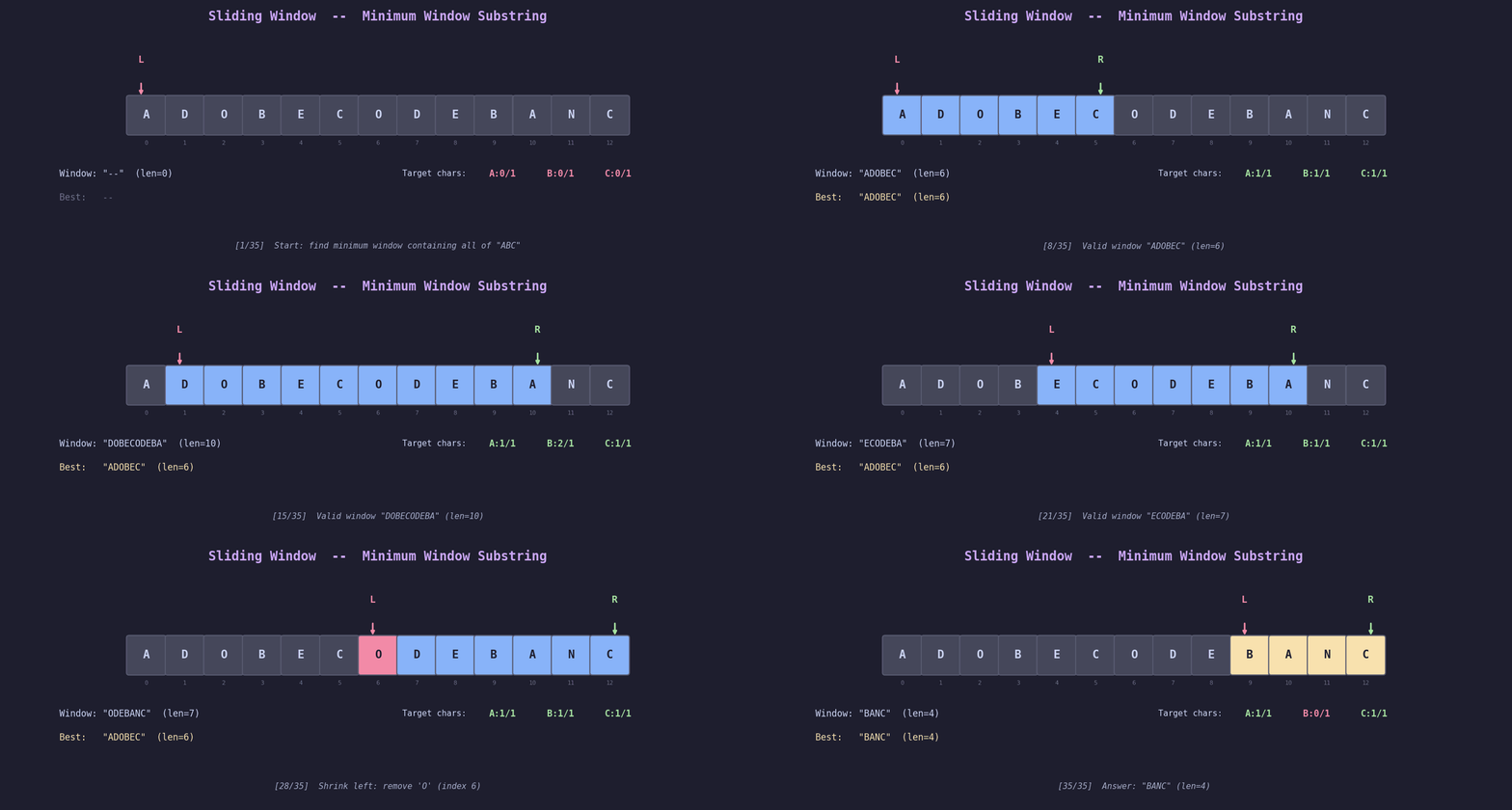
Problem Table
| # | Problem | LC # | Pattern | Why |
|---|---|---|---|---|
| 15 | Longest Substring Without Repeating Characters | 3 | Sliding window | Phone screen classic |
| 16 | Minimum Window Substring | 76 | Sliding window (hard) | Shows mastery |
| 17 | Sliding Window Maximum | 239 | Monotonic deque | Advanced pattern |
| 18 | Longest Repeating Character Replacement | 424 | Sliding window | Common variant |
Template: The Universal Sliding Window
This single template covers problems 15, 16, and 18. Memorize it.
def sliding_window(s):
    left = 0
    window = {}          # tracks window state (char counts, etc.)
    result = 0           # or float('inf') for minimization

    for right in range(len(s)):
        # --- EXPAND: add s[right] to window ---
        char = s[right]
        window[char] = window.get(char, 0) + 1

        # --- SHRINK: while window is INVALID, contract from left ---
        while WINDOW_IS_INVALID:
            window[s[left]] -= 1
            if window[s[left]] == 0:
                del window[s[left]]
            left += 1

        # --- UPDATE: record best valid window ---
        result = max(result, right - left + 1)

return resultint slidingWindow(String s) {
int left = 0, result = 0;
Map<Character, Integer> window = new HashMap<>();
for (int right = 0; right < s.length(); right++) {
// --- EXPAND: add s[right] to window ---
char c = s.charAt(right);
window.merge(c, 1, Integer::sum);
// --- SHRINK: while window is INVALID, contract from left ---
while (/* WINDOW_IS_INVALID */ false) {
char l = s.charAt(left);
window.merge(l, -1, Integer::sum);
if (window.get(l) == 0) window.remove(l);
left++;
}
// --- UPDATE: record best valid window ---
result = Math.max(result, right - left + 1);
}
return result;
}Adapt by changing three things:
- What you track in
window(character counts, sum, frequency map) - The
WINDOW_IS_INVALIDcondition (duplicates exist, sum exceeds target, missing required chars) - The
resultupdate (max length, min length, specific indices)
When to Use Sliding Window vs Two Pointers
These are related but distinct patterns. Use this decision guide:
| Signal | Technique | Example |
|---|---|---|
| Contiguous subarray/substring | Sliding Window | Longest substring without repeating chars |
| Sorted array + pair condition | Two Pointers (inward) | Two Sum II (sorted) |
| Linked list cycle/middle | Two Pointers (fast/slow) | Linked List Cycle |
| Fixed-size window (size k) | Sliding Window (fixed) | Max sum subarray of size k |
| Variable-size window with constraint | Sliding Window (variable) | Min window substring |
| Merging/comparing two sequences | Two Pointers (parallel) | Merge sorted arrays |
RULE OF THUMB
If the problem says "subarray" or "substring" and asks for a length, sum, or count -- it is almost certainly sliding window. If it says "sorted array" and asks about pairs or partitions -- think two pointers.
Problem Walkthroughs
#15 -- Longest Substring Without Repeating Characters (LC 3)
Problem: Given a string s, find the length of the longest substring without repeating characters.
Key insight: The window is valid when every character in it is unique. As soon as a character repeats, shrink from the left until it is unique again.
Why it shows up on phone screens: It is the purest application of the sliding window template. If you cannot solve this cleanly, the interviewer will not proceed.
def lengthOfLongestSubstring(self, s: str) -> int:
    left = 0
    window = {}
    result = 0

    for right in range(len(s)):
        char = s[right]
        window[char] = window.get(char, 0) + 1

        # shrink until no duplicates
        while window[char] > 1:
            window[s[left]] -= 1
            if window[s[left]] == 0:
                del window[s[left]]
            left += 1

        result = max(result, right - left + 1)

return resultint lengthOfLongestSubstring(String s) {
int left = 0, result = 0;
Map<Character, Integer> window = new HashMap<>();
for (int right = 0; right < s.length(); right++) {
char c = s.charAt(right);
window.merge(c, 1, Integer::sum);
// shrink until no duplicates
while (window.get(c) > 1) {
char l = s.charAt(left);
window.merge(l, -1, Integer::sum);
if (window.get(l) == 0) window.remove(l);
left++;
}
result = Math.max(result, right - left + 1);
}
return result;
}Optimized variant (jump left directly using last-seen index):
def lengthOfLongestSubstring(self, s: str) -> int:
    last_seen = {}
    left = 0
    result = 0

    for right in range(len(s)):
        char = s[right]
        if char in last_seen and last_seen[char] >= left:
            left = last_seen[char] + 1
        last_seen[char] = right
        result = max(result, right - left + 1)

return resultint lengthOfLongestSubstringOptimized(String s) {
Map<Character, Integer> lastSeen = new HashMap<>();
int left = 0, result = 0;
for (int right = 0; right < s.length(); right++) {
char c = s.charAt(right);
if (lastSeen.containsKey(c) && lastSeen.get(c) >= left) {
left = lastSeen.get(c) + 1;
}
lastSeen.put(c, right);
result = Math.max(result, right - left + 1);
}
return result;
}| Complexity | |
|---|---|
| Time | O(n) -- each character visited at most twice |
| Space | O(min(n, m)) -- m is the character set size |
:::
#16 -- Minimum Window Substring (LC 76)
Problem: Given strings s and t, find the minimum window in s that contains all characters of t (including duplicates).
Key insight: Use two frequency maps. Track how many distinct characters in t are fully satisfied in the current window (have vs need). Expand until all characters are satisfied, then shrink to minimize the window.
Why this shows mastery: It combines the sliding window template with frequency counting and a "formed" tracker. Clean code here signals strong fundamentals to the interviewer.
from collections import Counter

def minWindow(self, s: str, t: str) -> str:
    if not t or not s:
        return ""

    need = Counter(t)
    required = len(need)  # number of distinct chars we need

    left = 0
    have = 0              # how many distinct chars are fully satisfied
    window = {}
    result = (float('inf'), 0, 0)  # (length, left, right)

    for right in range(len(s)):
        char = s[right]
        window[char] = window.get(char, 0) + 1

        # check if this char is now fully satisfied
        if char in need and window[char] == need[char]:
            have += 1

        # shrink while window is valid (contains all of t)
        while have == required:
            # update result if this window is smaller
            if (right - left + 1) < result[0]:
                result = (right - left + 1, left, right)

            # remove s[left] and shrink
            window[s[left]] -= 1
            if s[left] in need and window[s[left]] < need[s[left]]:
                have -= 1
            left += 1

    length, lo, hi = result
return s[lo:hi + 1] if length != float('inf') else ""String minWindow(String s, String t) {
if (t.isEmpty() || s.isEmpty()) return "";
Map<Character, Integer> need = new HashMap<>();
for (char c : t.toCharArray()) need.merge(c, 1, Integer::sum);
int required = need.size();
int left = 0, have = 0;
int resLen = Integer.MAX_VALUE, resL = 0, resR = 0;
Map<Character, Integer> window = new HashMap<>();
for (int right = 0; right < s.length(); right++) {
char c = s.charAt(right);
window.merge(c, 1, Integer::sum);
// check if this char is now fully satisfied
if (need.containsKey(c) && window.get(c).equals(need.get(c))) have++;
// shrink while window is valid (contains all of t)
while (have == required) {
if (right - left + 1 < resLen) {
resLen = right - left + 1;
resL = left;
resR = right;
}
char l = s.charAt(left);
window.merge(l, -1, Integer::sum);
if (need.containsKey(l) && window.get(l) < need.get(l)) have--;
left++;
}
}
return resLen == Integer.MAX_VALUE ? "" : s.substring(resL, resR + 1);
}| Complexity | |
|---|---|
| Time | O(n + m) -- n = len(s), m = len(t) |
| Space | O(n + m) -- two frequency maps |
INTERVIEW TIP
In a real interview, define need and have clearly before coding. Say: "I will track how many distinct characters from t are fully satisfied in my window." This shows structured thinking.
:::
#17 -- Sliding Window Maximum (LC 239)
Problem: Given an array nums and a window size k, return the maximum value in each window as it slides from left to right.
Key insight: This is NOT a standard sliding window problem. You need a monotonic deque -- a deque that keeps elements in decreasing order. The front of the deque is always the maximum. See the Monotonic Deque Pattern section below.
from collections import deque

def maxSlidingWindow(self, nums: list[int], k: int) -> list[int]:
    dq = deque()   # stores INDICES, not values
    result = []

    for i in range(len(nums)):
        # remove indices that are out of window
        while dq and dq[0] < i - k + 1:
            dq.popleft()

        # maintain decreasing order: remove smaller elements from back
        while dq and nums[dq[-1]] <= nums[i]:
            dq.pop()

        dq.append(i)

        # window is fully formed once i >= k - 1
        if i >= k - 1:
            result.append(nums[dq[0]])

return resultint[] maxSlidingWindow(int[] nums, int k) {
int n = nums.length;
int[] result = new int[n - k + 1];
Deque<Integer> dq = new ArrayDeque<>(); // stores INDICES, not values
for (int i = 0; i < n; i++) {
// remove indices that are out of window
while (!dq.isEmpty() && dq.peekFirst() < i - k + 1) dq.pollFirst();
// maintain decreasing order: remove smaller elements from back
while (!dq.isEmpty() && nums[dq.peekLast()] <= nums[i]) dq.pollLast();
dq.offerLast(i);
// window is fully formed once i >= k - 1
if (i >= k - 1) result[i - k + 1] = nums[dq.peekFirst()];
}
return result;
}| Complexity | |
|---|---|
| Time | O(n) -- each element enters and exits the deque at most once |
| Space | O(k) -- deque holds at most k elements |
:::
#18 -- Longest Repeating Character Replacement (LC 424)
Problem: Given a string s and an integer k, find the length of the longest substring where you can replace at most k characters to make all characters the same.
Key insight: In any valid window of length window_len, the number of characters you need to replace equals window_len - max_freq (where max_freq is the count of the most frequent character in the window). The window is valid when window_len - max_freq <= k.
The subtle trick: You do not need to decrease max_freq when shrinking. Since we are maximizing, keeping the historical maximum only causes us to keep the window size (it never incorrectly shrinks). This is a common interview discussion point.
def characterReplacement(self, s: str, k: int) -> int:
    count = {}
    left = 0
    max_freq = 0
    result = 0

    for right in range(len(s)):
        char = s[right]
        count[char] = count.get(char, 0) + 1
        max_freq = max(max_freq, count[char])

        # window length - max_freq = chars to replace
        # if that exceeds k, shrink
        while (right - left + 1) - max_freq > k:
            count[s[left]] -= 1
            left += 1

        result = max(result, right - left + 1)

return resultint characterReplacement(String s, int k) {
int[] count = new int[26];
int left = 0, maxFreq = 0, result = 0;
for (int right = 0; right < s.length(); right++) {
char c = s.charAt(right);
count[c - 'A']++;
maxFreq = Math.max(maxFreq, count[c - 'A']);
// window length - maxFreq = chars to replace
// if that exceeds k, shrink
while ((right - left + 1) - maxFreq > k) {
count[s.charAt(left) - 'A']--;
left++;
}
result = Math.max(result, right - left + 1);
}
return result;
}| Complexity | |
|---|---|
| Time | O(n) |
| Space | O(1) -- at most 26 characters tracked |
INTERVIEW TALKING POINT
If the interviewer asks "Is it correct to not update max_freq when shrinking?" -- the answer is yes. Since we only care about the maximum window length ever seen, a stale max_freq only prevents the window from growing (it never causes a wrong answer). The window effectively slides without shrinking below its historical best size.
:::
The Monotonic Deque Pattern
Problem #17 (Sliding Window Maximum) uses a different technique from the standard sliding window template. Here is when and why you need it.
When to Use a Monotonic Deque
Use a monotonic deque when you need the minimum or maximum within a sliding window of fixed size. The standard sliding window template tracks aggregates (sums, counts, sets) but cannot efficiently track min/max -- a heap gives O(n log k) but a monotonic deque gives O(n).
How It Works
A monotonic decreasing deque maintains this invariant: elements from front to back are in decreasing order.
Window: [1, 3, -1, -3, 5, 3, 6, 7], k = 3

Step by step (deque stores indices):
i=0: nums[0]=1   -> deque=[0]
i=1: nums[1]=3   -> pop 0 (1<3), deque=[1]
i=2: nums[2]=-1  -> deque=[1,2], window full, max=nums[1]=3
i=3: nums[3]=-3  -> deque=[1,2,3], evict 1 (out of window), max=nums[2]=-1
i=4: nums[4]=5   -> pop all (5>everything), deque=[4], max=nums[4]=5
...The Template
from collections import deque

def monotonic_deque_max(nums, k):
    """Returns max in each sliding window of size k."""
    dq = deque()  # stores indices in decreasing order of values
    result = []

    for i in range(len(nums)):
        # 1. Remove expired indices from front
        while dq and dq[0] < i - k + 1:
            dq.popleft()

        # 2. Remove smaller elements from back (maintain decreasing order)
        while dq and nums[dq[-1]] <= nums[i]:
            dq.pop()

        # 3. Add current index
        dq.append(i)

        # 4. Record result once first window is complete
        if i >= k - 1:
            result.append(nums[dq[0]])

return resultint[] monotonicDequeMax(int[] nums, int k) {
int n = nums.length;
int[] result = new int[n - k + 1];
Deque<Integer> dq = new ArrayDeque<>(); // stores indices, decreasing values
for (int i = 0; i < n; i++) {
// 1. Remove expired indices from front
while (!dq.isEmpty() && dq.peekFirst() < i - k + 1) dq.pollFirst();
// 2. Maintain decreasing order: remove smaller elements from back
while (!dq.isEmpty() && nums[dq.peekLast()] <= nums[i]) dq.pollLast();
// 3. Add current index
dq.offerLast(i);
// 4. Record result once first window is complete
if (i >= k - 1) result[i - k + 1] = nums[dq.peekFirst()];
}
return result;
}FOR MINIMUM INSTEAD OF MAXIMUM
Flip the comparison in step 2 to >= and use a monotonic increasing deque. The front of the deque will be the minimum.
Common Mistakes
MISTAKES THAT COST OFFERS
1. Forgetting to remove from window when shrinking. When you increment left, you must update your window state (decrement counts, remove from set, etc.). Forgetting this is the #1 bug in sliding window problems.
2. Off-by-one on window length. Window length is right - left + 1, not right - left. Draw it out: indices [2, 3, 4] have length 3 = 4 - 2 + 1.
3. Using a heap instead of a deque for Sliding Window Maximum. A max-heap gives O(n log k). The interviewer expects O(n) with a monotonic deque. Using a heap signals you do not know the optimal approach.
4. Not handling empty strings / edge cases. Always check: what if s is empty? What if k is 0? What if t is longer than s? State these edge cases out loud before coding.
5. Storing values instead of indices in the deque. For Sliding Window Maximum, store indices in the deque so you can check whether elements have expired (left the window). If you store values, you cannot determine when to evict.
6. Confusing "while" with "if" for the shrink phase. The shrink step is a while loop, not an if. The window might need to shrink by multiple positions to become valid again.
Practice Checklist
Use this to track your progress. Practice each problem in a plain text editor (no IDE, no autocomplete) to simulate interview conditions.
- #15 Longest Substring Without Repeating Characters -- Solve in under 10 minutes. This is your warm-up.
- #18 Longest Repeating Character Replacement -- Explain the
max_freqtrick out loud. Can you justify why it is correct without updatingmax_freqon shrink? - #16 Minimum Window Substring -- Solve with the
have/needpattern. Practice explaining your approach for 2 minutes before writing code. - #17 Sliding Window Maximum -- Draw the deque state for
[1, 3, -1, -3, 5, 3, 6, 7]with k=3. Write the solution without looking at the template. - Dry run all 4 -- Pick one problem, write the solution on paper, and trace through a test case step by step. This is exactly what your interviewer expects.
- Time yourself -- Can you explain your approach (2 min) + code (12 min) + dry run (3 min) for any of these in under 20 minutes?
NEXT UP
If you have finished Sliding Window, move on to Tier 4: Dynamic Programming. If you still have time after DP, continue to Tier 5: HashMap / Heap / Binary Search.