Subsets
LeetCode: 78. SubsetsDifficulty: Medium Pattern: Backtracking, Bit Manipulation
Problem Statement
Given an integer array nums of unique elements, return all possible subsets (the power set).
The solution set must not contain duplicate subsets. Return the solution in any order.
Examples
Example 1
Input: nums = [1, 2, 3]
Output: [[], [1], [2], [1, 2], [3], [1, 3], [2, 3], [1, 2, 3]]Example 2
Input: nums = [0]
Output: [[], [0]]Constraints
1 <= nums.length <= 10-10 <= nums[i] <= 10- All the numbers of
numsare unique
Backtracking Tree Visualization
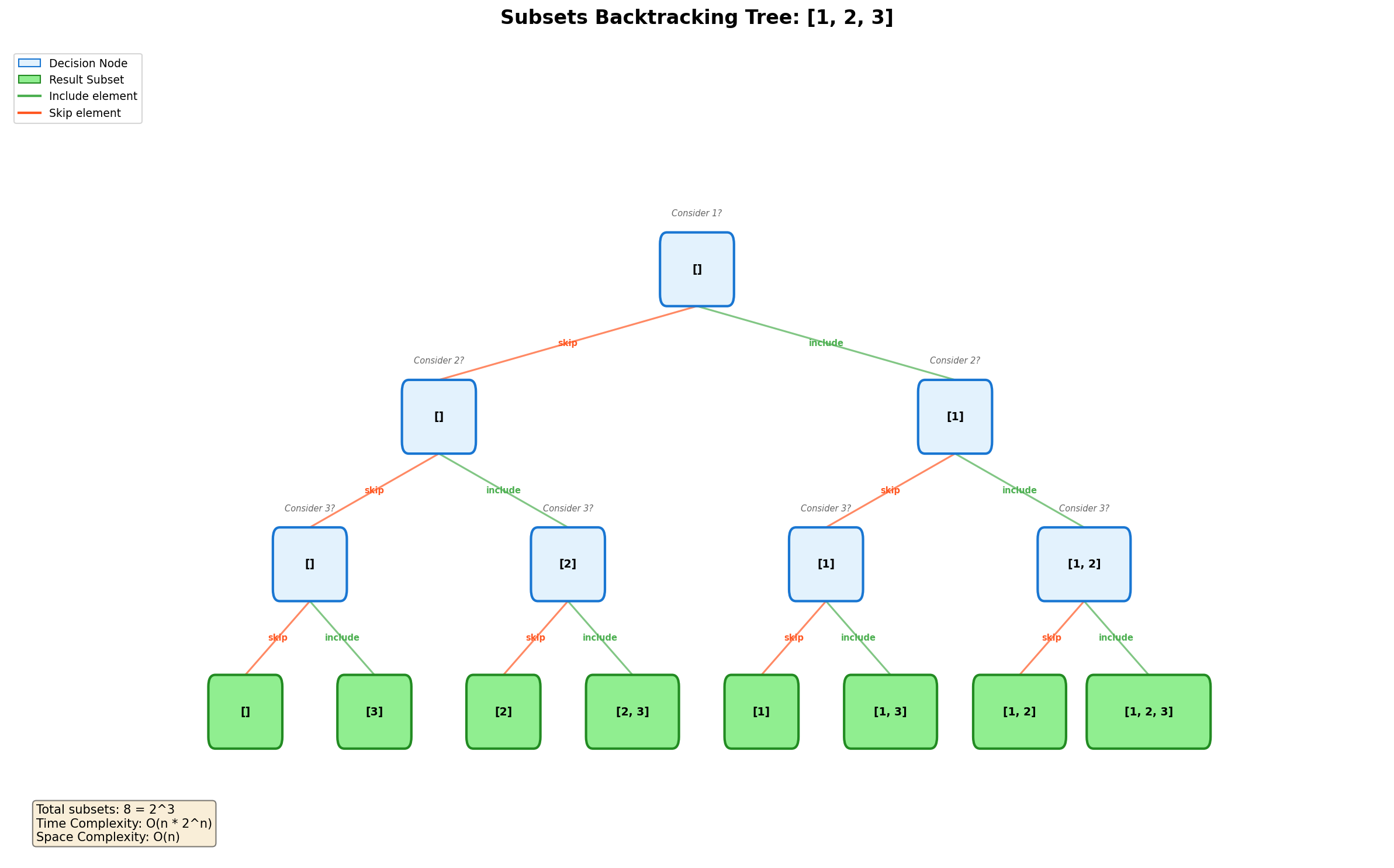
Decision Tree Structure
For each element, we make a binary decision:
- Include the element in the current subset
- Skip the element
                        []
                   /         \
              [1]              []
            /     \          /    \
        [1,2]    [1]      [2]      []
        /  \    /  \     /  \     /  \
[1,2,3][1,2][1,3][1][2,3][2] [3] []Every leaf node is a valid subset!
Backtracking Template
def subsets(nums):
    """
    Backtracking template for subset generation.

    Key insight: Every partial path is a valid subset!
    No need to check if path is "complete" - just add it.
    """
    result = []

    def backtrack(start, path):
        # Every path is a valid subset - add it!
        result.append(path[:])  # IMPORTANT: add copy, not reference

        # Explore: try adding each remaining element
        for i in range(start, len(nums)):
            path.append(nums[i])      # CHOOSE
            backtrack(i + 1, path)    # EXPLORE (i+1 to avoid duplicates)
            path.pop()                # UNCHOOSE (backtrack)

    backtrack(0, [])
return resultSolutions
Solution
def subsets(nums: list) -> list:
    """
    Generate all subsets using backtracking.

    Time Complexity: O(n * 2^n)
        - 2^n subsets
        - O(n) to copy each subset
    Space Complexity: O(n)
        - Recursion depth
        - Not counting output space
    """
    result = []

    def backtrack(start, path):
        # Add current subset (every path is valid)
        result.append(path[:])

        # Try adding each remaining element
        for i in range(start, len(nums)):
            path.append(nums[i])
            backtrack(i + 1, path)
            path.pop()

    backtrack(0, [])
    return result


# Test
print(subsets([1, 2, 3]))
# Output: [[], [1], [1, 2], [1, 2, 3], [1, 3], [2], [2, 3], [3]]public List<List<Integer>> subsets(int[] nums) {
List<List<Integer>> result = new ArrayList<>();
backtrack(result, new ArrayList<>(), nums, 0);
return result;
}
private void backtrack(List<List<Integer>> result,
List<Integer> path,
int[] nums,
int start) {
result.add(new ArrayList<>(path)); // every path is a valid subset
for (int i = start; i < nums.length; i++) {
path.add(nums[i]);
backtrack(result, path, nums, i + 1);
path.remove(path.size() - 1);
}
}Complexity: Time O(n * 2^n) · Space O(n)
- Time: There are 2^n subsets (power set), and each subset requires O(n) to copy into the result list.
- Space: Recursion depth is at most n (the length of nums), not counting the output storage.
Solution 2: Cascading (Iterative)
def subsets_iterative(nums: list) -> list:
    """
    Build subsets iteratively by adding each element to existing subsets.

    Time Complexity: O(n * 2^n)
    Space Complexity: O(1) - not counting output

    Process:
    Start: [[]]
    Add 1: [[], [1]]
    Add 2: [[], [1], [2], [1,2]]
    Add 3: [[], [1], [2], [1,2], [3], [1,3], [2,3], [1,2,3]]
    """
    result = [[]]

    for num in nums:
        # Add num to each existing subset
        result += [subset + [num] for subset in result]

    return result


# Test
print(subsets_iterative([1, 2, 3]))
# Output: [[], [1], [2], [1, 2], [3], [1, 3], [2, 3], [1, 2, 3]]Complexity: Time O(n * 2^n) · Space O(1)
- Time: For each of n elements, we double the result list (creating 2^n total subsets), and list concatenation is O(current size).
- Space: No additional space beyond the output; we only use the result list itself.
Solution 3: Bit Manipulation
def subsets_bits(nums: list) -> list:
    """
    Generate subsets using bit manipulation.

    Intuition: Each subset corresponds to a binary number from 0 to 2^n - 1
    - Bit i = 0: exclude nums[i]
    - Bit i = 1: include nums[i]

    Example for n=3:
    000 -> []
    001 -> [1]
    010 -> [2]
    011 -> [1, 2]
    100 -> [3]
    101 -> [1, 3]
    110 -> [2, 3]
    111 -> [1, 2, 3]

    Time Complexity: O(n * 2^n)
    Space Complexity: O(1) - not counting output
    """
    n = len(nums)
    result = []

    for mask in range(1 << n):  # 0 to 2^n - 1
        subset = []
        for i in range(n):
            if mask & (1 << i):  # Check if bit i is set
                subset.append(nums[i])
        result.append(subset)

    return result


# Test
print(subsets_bits([1, 2, 3]))
# Output: [[], [1], [2], [1, 2], [3], [1, 3], [2, 3], [1, 2, 3]]Complexity: Time O(n * 2^n) · Space O(1)
- Time: We iterate through 2^n bitmasks, and for each mask we check n bits to build the subset.
- Space: Only temporary variables for the mask and current subset; no recursion stack needed.
Solution 4: Include/Exclude Pattern
def subsets_include_exclude(nums: list) -> list:
    """
    Alternative backtracking with explicit include/exclude decisions.

    This pattern makes the binary decision tree more explicit.

    Time Complexity: O(n * 2^n)
    Space Complexity: O(n)
    """
    result = []

    def backtrack(index, path):
        if index == len(nums):
            result.append(path[:])
            return

        # Choice 1: Include nums[index]
        path.append(nums[index])
        backtrack(index + 1, path)
        path.pop()

        # Choice 2: Exclude nums[index]
        backtrack(index + 1, path)

    backtrack(0, [])
    return result


# Test
print(subsets_include_exclude([1, 2, 3]))
# Output: [[1, 2, 3], [1, 2], [1, 3], [1], [2, 3], [2], [3], []]Complexity: Time O(n * 2^n) · Space O(n)
- Time: The decision tree has 2^n leaf nodes (one per subset), and copying each subset takes O(n).
- Space: Maximum recursion depth is n (one level per element in nums).
Complexity Analysis
| Approach | Time | Space | Notes |
|---|---|---|---|
| Backtracking | O(n * 2^n) | O(n) | Most intuitive for interviews |
| Cascading | O(n * 2^n) | O(1) | Iterative approach |
| Bit Manipulation | O(n * 2^n) | O(1) | Elegant but less intuitive |
| Include/Exclude | O(n * 2^n) | O(n) | Explicit decision tree |
Why O(n * 2^n)?
- 2^n subsets exist (power set size)
- O(n) to copy each subset into result
- Total: O(n * 2^n)
Visual: Backtracking Execution
backtrack(0, [])
    result = [[]]
    |
    +-- backtrack(1, [1])
    |       result = [[], [1]]
    |       |
    |       +-- backtrack(2, [1, 2])
    |       |       result = [[], [1], [1,2]]
    |       |       |
    |       |       +-- backtrack(3, [1, 2, 3])
    |       |               result = [[], [1], [1,2], [1,2,3]]
    |       |
    |       +-- backtrack(3, [1, 3])
    |               result = [[], [1], [1,2], [1,2,3], [1,3]]
    |
    +-- backtrack(2, [2])
    |       result = [..., [2]]
    |       |
    |       +-- backtrack(3, [2, 3])
    |               result = [..., [2,3]]
    |
    +-- backtrack(3, [3])
            result = [..., [3]]

Final: [[], [1], [1,2], [1,2,3], [1,3], [2], [2,3], [3]]Common Mistakes
1. Not Copying the Path
# WRONG - all elements point to same list!
def subsets_wrong(nums):
    result = []
    def backtrack(start, path):
        result.append(path)  # Appends reference, not copy!
        for i in range(start, len(nums)):
            path.append(nums[i])
            backtrack(i + 1, path)
            path.pop()
    backtrack(0, [])
    return result  # All elements will be empty []!

# CORRECT
def subsets_correct(nums):
    result = []
    def backtrack(start, path):
        result.append(path[:])  # Append COPY using [:]
# or: result.append(list(path))2. Wrong Start Index
# WRONG - causes duplicates [1,2] and [2,1]
def backtrack(path):
    for i in range(len(nums)):  # Starts from 0 each time
        path.append(nums[i])
        backtrack(path)
        path.pop()

# CORRECT - start from current index to avoid duplicates
def backtrack(start, path):
    for i in range(start, len(nums)):
        path.append(nums[i])
        backtrack(i + 1, path)  # i + 1, not start + 1!
path.pop()Related Problems
Subsets II (LeetCode 90)
Problem: Given an integer array that may contain duplicates, return all possible subsets without duplicate subsets.
Key Insight: Sort array first, skip duplicates at the same recursion level.
Approach: Backtracking with duplicate skipping - if nums[i] == nums[i-1] and i > start, skip.
Complexity: O(n * 2^n) time, O(n) space
Link: Local Solution
Permutations (LeetCode 46)
Problem: Given an array of distinct integers, return all possible permutations.
Key Insight: Unlike subsets where order doesn't matter, permutations use ALL elements in EVERY ORDER.
Approach: Track used elements instead of start index. Every element can appear at any position.
Complexity: O(n * n!) time, O(n) space
Link: Local Solution
Combination Sum (LeetCode 39)
Problem: Find all unique combinations of candidates that sum to target. Same number may be used unlimited times.
Key Insight: Similar to subsets but with constraint (sum = target) and element reuse allowed.
Approach: Backtracking with remaining sum tracking. Use index i (not i+1) to allow element reuse.
Complexity: O(n^(target/min)) time, O(target/min) space
Link: Local Solution
Letter Combinations of a Phone Number (LeetCode 17)
Problem: Given a string of digits 2-9, return all possible letter combinations.
Key Insight: Different choices at each level (not include/exclude, but which letter from the digit's mapping).
Approach: Index-based recursion through digits, iterate through letter choices at each level.
Complexity: O(4^n * n) time, O(n) space
Link: Local Solution
Interview Tips
- Recognize the pattern: "All possible" usually means backtracking
- Draw the decision tree before coding
- Remember to copy:
path[:]notpath - Use start index to avoid generating duplicates like [1,2] and [2,1]
- Know multiple approaches: Backtracking, iterative, bit manipulation
Key Takeaways
- Every node in the recursion tree is a valid subset - no base case needed to add to result
- Start index prevents duplicates - only consider elements after current position
- Choose-Explore-Unchoose pattern is fundamental
- 2^n subsets exist for n elements - power set
- Bit manipulation offers elegant alternative - each subset maps to a binary number
Last updated: January 2026