Longest Common Subsequence
Problem Statement
Given two strings text1 and text2, return the length of their longest common subsequence. If there is no common subsequence, return 0.
A subsequence of a string is a new string generated from the original string with some characters (can be none) deleted without changing the relative order of the remaining characters.
For example, "ace" is a subsequence of "abcde".
A common subsequence of two strings is a subsequence that is common to both strings.
Input/Output Format
Input:
text1(str): First stringtext2(str): Second string
Output:
- (int): Length of the longest common subsequence
Constraints
1 <= text1.length, text2.length <= 1000text1andtext2consist of only lowercase English characters
Examples
Example 1: Standard Case
Input: text1 = "abcde", text2 = "ace"
Output: 3
Explanation: The longest common subsequence is "ace" with length 3.
text1: a b c d e
          |   |   |
text2: a - c - e

Common subsequence: "ace" (length 3)

Other common subsequences:
- "a"   (length 1)
- "c"   (length 1)
- "e"   (length 1)
- "ac"  (length 2)
- "ae"  (length 2)
- "ce"  (length 2)
- "ace" (length 3) <-- LongestExample 2: Different Strings
Input: text1 = "abc", text2 = "abc"
Output: 3
Explanation: The entire string is common. LCS = "abc".
Example 3: No Common Subsequence
Input: text1 = "abc", text2 = "def"
Output: 0
Explanation: No characters in common, so no common subsequence.
Example 4: One Character Match
Input: text1 = "bl", text2 = "yby"
Output: 1
Explanation: The longest common subsequence is "b" with length 1.
Visual Explanation
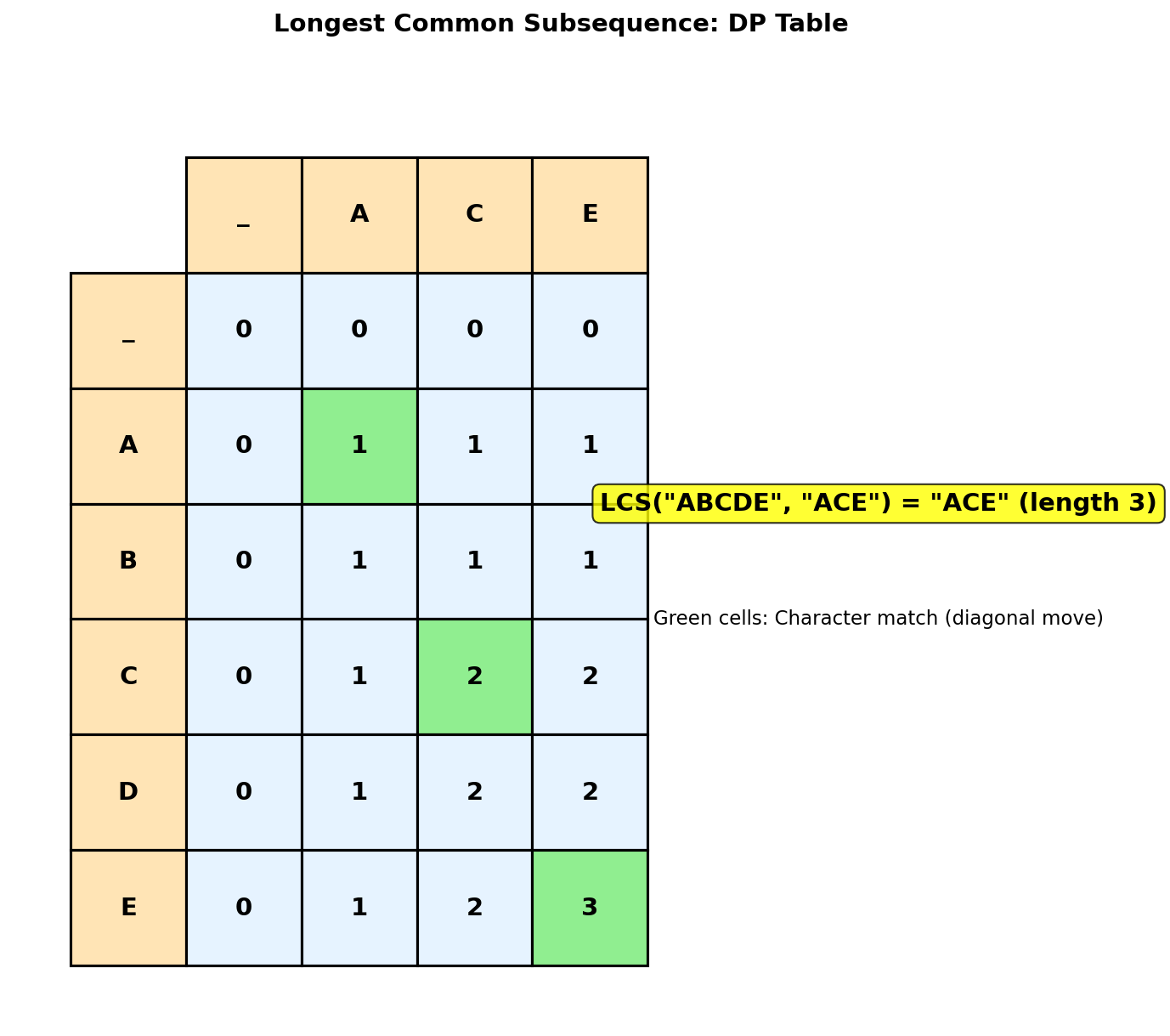
ASCII Art: DP Table Building
text1 = "ABCDE", text2 = "ACE"

DP Table: dp[i][j] = LCS length for text1[0..i-1] and text2[0..j-1]

            ""    A    C    E
          +----+----+----+----+
    ""    | 0  | 0  | 0  | 0  |
          +----+----+----+----+
    A     | 0  | 1  | 1  | 1  |  <- A matches A
          +----+----+----+----+
    B     | 0  | 1  | 1  | 1  |  <- B no match
          +----+----+----+----+
    C     | 0  | 1  | 2  | 2  |  <- C matches C
          +----+----+----+----+
    D     | 0  | 1  | 2  | 2  |  <- D no match
          +----+----+----+----+
    E     | 0  | 1  | 2  | 3  |  <- E matches E
          +----+----+----+----+

Recurrence:
If text1[i-1] == text2[j-1]:
    dp[i][j] = dp[i-1][j-1] + 1  (diagonal + 1)
Else:
    dp[i][j] = max(dp[i-1][j], dp[i][j-1])  (max of top or left)

Answer: dp[5][3] = 3Solution Code
Approach 1: Top-Down (Memoization)
from functools import lru_cache

def longestCommonSubsequence(text1: str, text2: str) -> int:
    """
    Find LCS length using memoization.

    For each position (i, j), compare characters:
    - If match: 1 + LCS of remaining strings
    - If no match: max of skipping char from either string

    Args:
        text1: First string
        text2: Second string

    Returns:
        Length of longest common subsequence

    Time Complexity: O(m * n)
    Space Complexity: O(m * n)
    """
    @lru_cache(maxsize=None)
    def dp(i: int, j: int) -> int:
        """Return LCS length for text1[i:] and text2[j:]."""
        # Base case: one string is empty
        if i == len(text1) or j == len(text2):
            return 0

        if text1[i] == text2[j]:
            # Characters match, include in LCS
            return 1 + dp(i + 1, j + 1)
        else:
            # No match, try skipping from either string
            return max(dp(i + 1, j), dp(i, j + 1))

return dp(0, 0)Complexity: Time O(m * n) · Space O(m * n)
- Time: Each unique (i, j) pair is computed exactly once due to memoization. With m positions in text1 and n in text2, we have O(m * n) states.
- Space: The memoization cache stores O(m * n) entries, plus recursion stack depth of O(m + n) for the deepest call path.
Approach 2: Bottom-Up (Tabulation)
def longestCommonSubsequence(text1: str, text2: str) -> int:
    """
    Find LCS length using bottom-up DP.

    Build a 2D table where dp[i][j] represents the LCS length
    for text1[0..i-1] and text2[0..j-1].

    Args:
        text1: First string
        text2: Second string

    Returns:
        Length of longest common subsequence

    Time Complexity: O(m * n)
    Space Complexity: O(m * n)
    """
    m, n = len(text1), len(text2)

    # dp[i][j] = LCS length for text1[0..i-1] and text2[0..j-1]
    dp = [[0] * (n + 1) for _ in range(m + 1)]

    for i in range(1, m + 1):
        for j in range(1, n + 1):
            if text1[i - 1] == text2[j - 1]:
                # Characters match
                dp[i][j] = dp[i - 1][j - 1] + 1
            else:
                # No match, take max of excluding either char
                dp[i][j] = max(dp[i - 1][j], dp[i][j - 1])

return dp[m][n]public int longestCommonSubsequence(String text1, String text2) {
int m = text1.length(), n = text2.length();
// dp[i][j] = LCS length for text1[0..i-1] and text2[0..j-1]
int[][] dp = new int[m + 1][n + 1];
for (int i = 1; i <= m; i++) {
for (int j = 1; j <= n; j++) {
if (text1.charAt(i - 1) == text2.charAt(j - 1)) {
// Characters match
dp[i][j] = dp[i - 1][j - 1] + 1;
} else {
// No match, take max of excluding either char
dp[i][j] = Math.max(dp[i - 1][j], dp[i][j - 1]);
}
}
}
return dp[m][n];
}Complexity: Time O(m * n) · Space O(m * n)
- Time: Two nested loops iterate through all (m+1) * (n+1) cells, with constant-time work at each cell.
- Space: The 2D dp table has dimensions (m+1) x (n+1) to store LCS lengths for all prefix combinations.
Approach 3: Space-Optimized (O(min(m,n)) space)
def longestCommonSubsequence(text1: str, text2: str) -> int:
    """
    Find LCS length with optimized space.

    Since we only need the previous row, we can use O(n) space.
    Further optimize by using the shorter string as columns.

    Args:
        text1: First string
        text2: Second string

    Returns:
        Length of longest common subsequence

    Time Complexity: O(m * n)
    Space Complexity: O(min(m, n))
    """
    # Ensure text2 is the shorter string
    if len(text1) < len(text2):
        text1, text2 = text2, text1

    m, n = len(text1), len(text2)

    # Only need current and previous row
    prev = [0] * (n + 1)
    curr = [0] * (n + 1)

    for i in range(1, m + 1):
        for j in range(1, n + 1):
            if text1[i - 1] == text2[j - 1]:
                curr[j] = prev[j - 1] + 1
            else:
                curr[j] = max(prev[j], curr[j - 1])

        # Swap rows
        prev, curr = curr, prev

return prev[n]Complexity: Time O(m * n) · Space O(min(m, n))
- Time: Same O(m * n) iterations as Approach 2, processing all cells row by row.
- Space: Only two arrays of size n+1 (prev and curr) are maintained. By swapping text1/text2 if needed, we ensure n = min(m, n).
Approach 4: Print Actual LCS
def longestCommonSubsequence_with_string(text1: str, text2: str) -> str:
    """
    Find and return the actual longest common subsequence.

    Args:
        text1: First string
        text2: Second string

    Returns:
        The longest common subsequence string

    Time Complexity: O(m * n)
    Space Complexity: O(m * n)
    """
    m, n = len(text1), len(text2)

    # Build DP table
    dp = [[0] * (n + 1) for _ in range(m + 1)]

    for i in range(1, m + 1):
        for j in range(1, n + 1):
            if text1[i - 1] == text2[j - 1]:
                dp[i][j] = dp[i - 1][j - 1] + 1
            else:
                dp[i][j] = max(dp[i - 1][j], dp[i][j - 1])

    # Backtrack to find the LCS
    lcs = []
    i, j = m, n

    while i > 0 and j > 0:
        if text1[i - 1] == text2[j - 1]:
            lcs.append(text1[i - 1])
            i -= 1
            j -= 1
        elif dp[i - 1][j] > dp[i][j - 1]:
            i -= 1
        else:
            j -= 1

return ''.join(reversed(lcs))Complexity: Time O(m * n) · Space O(m * n)
- Time: O(m * n) to build the DP table, plus O(m + n) to backtrack and reconstruct the actual LCS string.
- Space: The full 2D table is needed for backtracking, requiring O(m * n) space. The output string uses O(min(m, n)) additional space.
Complexity Analysis
| Approach | Time Complexity | Space Complexity |
|---|---|---|
| Top-Down (Memoization) | O(m * n) | O(m * n) |
| Bottom-Up (Tabulation) | O(m * n) | O(m * n) |
| Space-Optimized | O(m * n) | O(min(m, n)) |
Where m = len(text1), n = len(text2).
Edge Cases
Empty string:
pythonlongestCommonSubsequence("", "abc") # Returns 0Identical strings:
pythonlongestCommonSubsequence("abc", "abc") # Returns 3No common characters:
pythonlongestCommonSubsequence("abc", "xyz") # Returns 0One is subsequence of other:
pythonlongestCommonSubsequence("abc", "aXbYcZ") # Returns 3Single character strings:
pythonlongestCommonSubsequence("a", "a") # Returns 1 longestCommonSubsequence("a", "b") # Returns 0Repeated characters:
pythonlongestCommonSubsequence("aaa", "aa") # Returns 2
Backtracking to Find LCS
text1 = "ABCDE", text2 = "ACE"

DP Table after filling:
            ""    A    C    E
    ""       0    0    0    0
    A        0   [1]   1    1
    B        0    1    1    1
    C        0    1   [2]   2
    D        0    1    2    2
    E        0    1    2   [3]

Backtrack from dp[5][3] = 3:
- (5,3): E == E, add 'E', go to (4,2)
- (4,2): D != C, dp[3][2] > dp[4][1], go to (3,2)
- (3,2): C == C, add 'C', go to (2,1)
- (2,1): B != A, dp[1][1] > dp[2][0], go to (1,1)
- (1,1): A == A, add 'A', go to (0,0)
- (0,0): Done

LCS = reverse(['E', 'C', 'A']) = "ACE"Key Insights
Optimal Substructure: The LCS of two strings can be computed from LCS of their prefixes.
Two Choices at Each Position:
- If characters match: Include in LCS and advance both pointers
- If not match: Try excluding from either string
State Definition:
dp[i][j]= LCS length fortext1[0..i-1]andtext2[0..j-1].Base Cases: If either string is empty, LCS length is 0.
LCS vs LIS: LCS finds common elements between two sequences; LIS finds increasing elements in one sequence.
Related Problems
Shortest Common Supersequence (LeetCode 1092)
Problem: Find the shortest string that has both text1 and text2 as subsequences.
Key Insight: Build from LCS. The supersequence includes all characters from both strings, but shared characters (LCS) appear only once.
Approach: len(SCS) = len(text1) + len(text2) - len(LCS). Backtrack through DP table, including characters from both strings, with LCS characters added once.
Complexity: O(m * n) time, O(m * n) space
Edit Distance (LeetCode 72)
Problem: Find minimum operations (insert, delete, replace) to transform word1 into word2.
Key Insight: Similar 2D DP structure. When characters match, no operation needed. Otherwise, try all three operations and take minimum.
Approach: dp[i][j] = dp[i-1][j-1] if match, else 1 + min(dp[i-1][j], dp[i][j-1], dp[i-1][j-1]).
Complexity: O(m * n) time, O(m * n) space (optimizable to O(min(m,n)))
Longest Palindromic Subsequence (LeetCode 516)
Problem: Find the length of the longest palindromic subsequence in a string.
Key Insight: LCS of string with its reverse gives the longest palindromic subsequence.
Approach: LPS(s) = LCS(s, reverse(s)). Alternatively, use interval DP: dp[i][j] = LPS length for substring s[i..j].
Complexity: O(n^2) time, O(n^2) space (or O(n) with optimization)
Delete Operation for Two Strings (LeetCode 583)
Problem: Find minimum number of deletions to make two strings equal.
Key Insight: The remaining characters after deletions form the LCS. So min deletions = total chars - 2*LCS.
Approach: min_deletions = len(text1) + len(text2) - 2 * LCS(text1, text2).
Complexity: O(m * n) time, O(min(m, n)) space