Remove Duplicates from Sorted Array
Problem Statement
Given an integer array nums sorted in non-decreasing order, remove the duplicates in-place such that each unique element appears only once. The relative order of the elements should be kept the same.
Return the number of unique elements in nums.
Note: You must modify the array in-place with O(1) extra memory.
Examples
Example 1
Input: nums = [1, 1, 2]
Output: 2, nums = [1, 2, _]
Explanation: Your function should return k = 2, with the first two elements
of nums being 1 and 2 respectively. It does not matter what you leave beyond
the returned k (hence they are underscores).Example 2
Input: nums = [0, 0, 1, 1, 1, 2, 2, 3, 3, 4]
Output: 5, nums = [0, 1, 2, 3, 4, _, _, _, _, _]
Explanation: Your function should return k = 5, with the first five elements
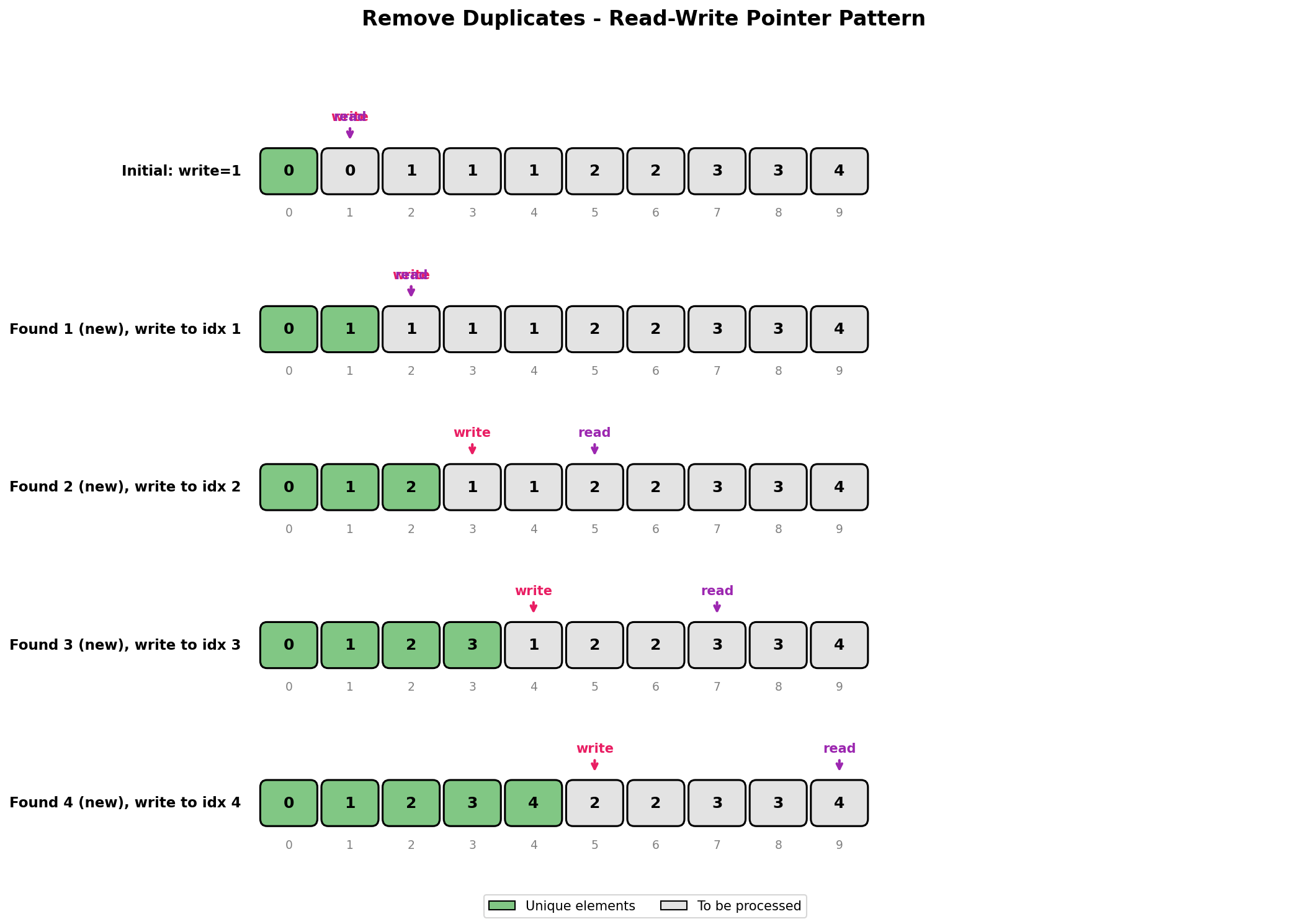
of nums being 0, 1, 2, 3, and 4 respectively.Visual Explanation
Approach: Two Pointers
Since the array is sorted, duplicates are adjacent. We use:
write_ptr: Position to write the next unique elementread_ptr: Scans through to find new unique elements
Algorithm
- If array is empty, return 0
- Initialize
write_ptr = 1(first element is always unique) - For each
read_ptrfrom 1 to n-1:- If
nums[read_ptr] != nums[write_ptr - 1], it's a new unique element - Write it to
write_ptrand incrementwrite_ptr
- If
- Return
write_ptras the count of unique elements
Solution
def removeDuplicates(nums: list[int]) -> int:
    """
    Remove duplicates from sorted array in-place.
    Returns the number of unique elements.

    Time Complexity: O(n)
    Space Complexity: O(1)
    """
    if not nums:
        return 0

    write_ptr = 1  # First element is always unique

    for read_ptr in range(1, len(nums)):
        # Found a new unique element
        if nums[read_ptr] != nums[write_ptr - 1]:
            nums[write_ptr] = nums[read_ptr]
            write_ptr += 1

return write_ptrpublic int removeDuplicates(int[] nums) {
if (nums == null || nums.length == 0) return 0;
int writePtr = 1; // First element is always unique
for (int readPtr = 1; readPtr < nums.length; readPtr++) {
// Found a new unique element
if (nums[readPtr] != nums[writePtr - 1]) {
nums[writePtr] = nums[readPtr];
writePtr++;
}
}
return writePtr;
}Complexity: Time O(n) · Space O(1)
- Time: Single pass through the array with the read pointer, each element is examined exactly once
- Space: Only uses two pointer variables (
write_ptr,read_ptr) regardless of array size
# Variation: Allow at most K duplicates
def removeDuplicates_k(nums: list[int], k: int = 2) -> int:
    """
    Remove duplicates allowing at most k occurrences of each element.

    Time Complexity: O(n)
    Space Complexity: O(1)
    """
    if len(nums) <= k:
        return len(nums)

    write_ptr = k

    for read_ptr in range(k, len(nums)):
        # Compare with element k positions back
        if nums[read_ptr] != nums[write_ptr - k]:
            nums[write_ptr] = nums[read_ptr]
            write_ptr += 1

return write_ptrComplexity: Time O(n) · Space O(1)
- Time: Single pass through the array starting from index k, comparing each element with the one k positions back
- Space: Only uses constant extra space for two pointers - modifies the array in-place
Step-by-Step Trace
For nums = [0, 0, 1, 1, 1, 2, 2, 3, 3, 4]:
| read_ptr | nums[read_ptr] | nums[write_ptr-1] | Action | write_ptr |
|---|---|---|---|---|
| 1 | 0 | 0 | Skip (duplicate) | 1 |
| 2 | 1 | 0 | Write, increment | 2 |
| 3 | 1 | 1 | Skip (duplicate) | 2 |
| 4 | 1 | 1 | Skip (duplicate) | 2 |
| 5 | 2 | 1 | Write, increment | 3 |
| 6 | 2 | 2 | Skip (duplicate) | 3 |
| 7 | 3 | 2 | Write, increment | 4 |
| 8 | 3 | 3 | Skip (duplicate) | 4 |
| 9 | 4 | 3 | Write, increment | 5 |
Result: k = 5, nums = [0, 1, 2, 3, 4, ...]
Complexity Analysis
| Metric | Complexity |
|---|---|
| Time | O(n) - Single pass through the array |
| Space | O(1) - Only using constant extra space for pointers |
Edge Cases
- Empty array:
[]-> Return 0 - Single element:
[1]-> Return 1 - All same elements:
[1, 1, 1, 1]-> Return 1,nums = [1, ...] - No duplicates:
[1, 2, 3, 4]-> Return 4, array unchanged - Two elements, same:
[1, 1]-> Return 1 - Two elements, different:
[1, 2]-> Return 2
Common Mistakes
- Starting write_ptr at 0 - Should start at 1 since first element is always kept
- Comparing wrong elements - Compare current with last written, not previous read
- Forgetting empty array check - Handle edge case first
- Not understanding "in-place" - No new array creation allowed
Related Problems
Remove Element (LeetCode 27)
Problem: Remove all instances of a specific value from array in-place.
Key Insight: Similar two-pointer approach, but check against target value instead of previous element.
Approach: Write pointer copies elements that don't match target. Return write pointer as new length.
Complexity: O(n) time, O(1) space
Move Zeroes (LeetCode 283)
Problem: Move all zeros to end while maintaining relative order of non-zeros.
Key Insight: Same read-write pointer pattern, filtering zeros specifically.
Approach: Write pointer tracks position for next non-zero. Swap non-zeros to write position.
Complexity: O(n) time, O(1) space
Remove Duplicates from Sorted Array II (LeetCode 80)
Problem: Remove duplicates allowing at most 2 occurrences of each element.
Key Insight: Generalize pattern by comparing with element k positions back instead of 1.
Approach: Compare nums[read] with nums[write - k]. If different, write and advance. Works for any k.
Complexity: O(n) time, O(1) space
Key Takeaways
- The "read-write pointer" pattern is essential for in-place array modification
- Sorted arrays simplify duplicate detection (they're adjacent)
- The variation with k duplicates uses the same pattern with minor modification
- Return value and array modification are both important parts of the solution