Cycle Detection in Graphs
Finding cycles in directed and undirected graphs
Overview
Cycle detection is a fundamental graph problem with different approaches depending on whether the graph is directed or undirected.
| Graph Type | Recommended Approach |
|---|---|
| Undirected | Union-Find or DFS with parent tracking |
| Directed | DFS with three-color marking (white/gray/black) |
Visual Overview
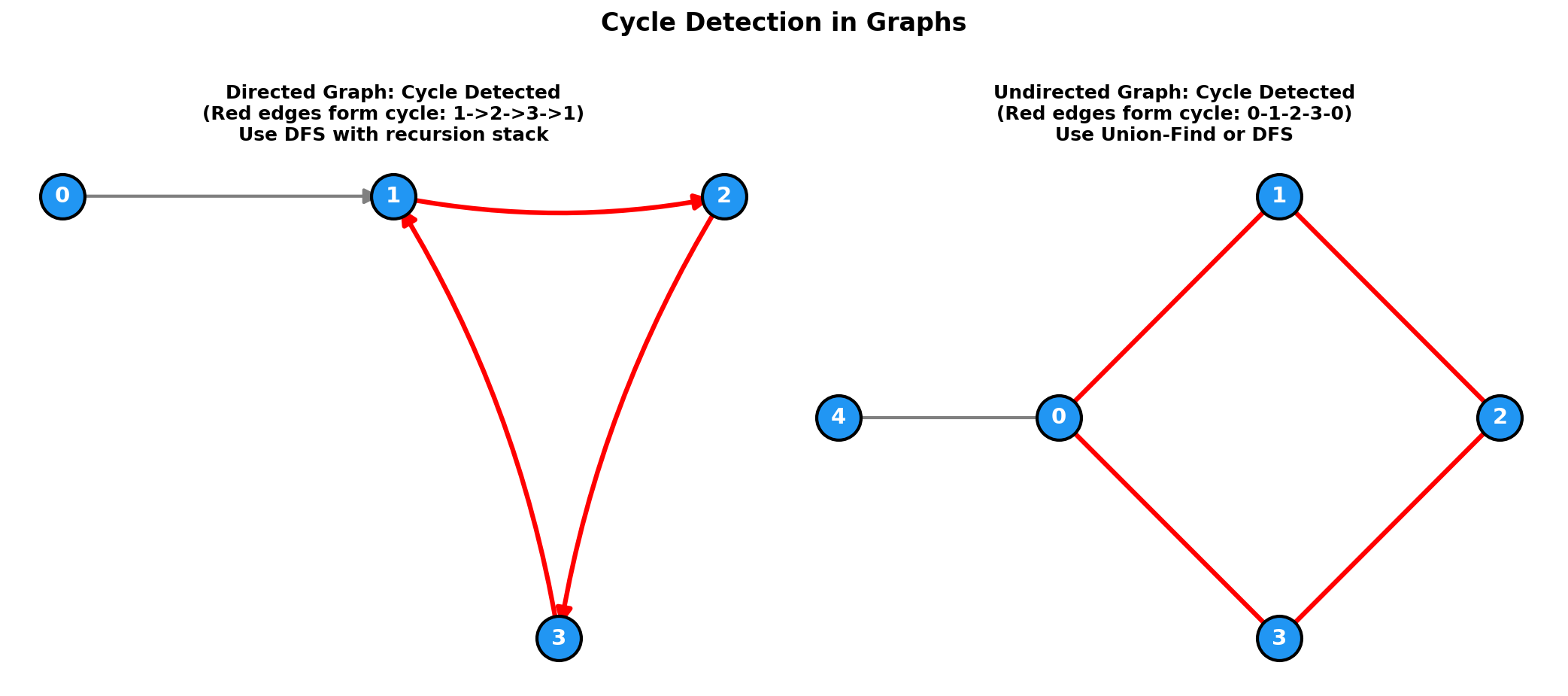
Part 1: Undirected Graph Cycle Detection
Problem
Given an undirected graph, determine if it contains a cycle.
Example
Input: n = 5, edges = [[0,1], [1,2], [2,3], [3,0], [0,4]]
Output: true

Graph:
  4
  |
  0 --- 1
  |     |
  3 --- 2

Cycle: 0 -> 1 -> 2 -> 3 -> 0Approach 1: Union-Find
Key Insight: If an edge connects two nodes that are already in the same connected component, adding that edge creates a cycle.
class UnionFind:
    def __init__(self, n):
        self.parent = list(range(n))
        self.rank = [0] * n

    def find(self, x):
        if self.parent[x] != x:
            self.parent[x] = self.find(self.parent[x])  # Path compression
        return self.parent[x]

    def union(self, x, y):
        px, py = self.find(x), self.find(y)
        if px == py:
            return False  # Already connected = cycle!

        # Union by rank
        if self.rank[px] < self.rank[py]:
            px, py = py, px
        self.parent[py] = px
        if self.rank[px] == self.rank[py]:
            self.rank[px] += 1
        return True

def hasCycleUndirected(n: int, edges: list[list[int]]) -> bool:
    uf = UnionFind(n)

    for u, v in edges:
        if not uf.union(u, v):
            return True  # Cycle detected!

return FalseComplexity: Time O(E * alpha(N)) · Space O(N)
- Time: Each edge is processed once; Union and Find operations take O(alpha(N)) amortized due to path compression and union by rank
- Space: Parent and rank arrays each require O(N) space for N nodes
Approach 2: DFS with Parent Tracking
Key Insight: In DFS, if we encounter a visited node that is NOT our parent, we've found a cycle.
from collections import defaultdict

def hasCycleUndirected(n: int, edges: list[list[int]]) -> bool:
    # Build adjacency list
    graph = defaultdict(list)
    for u, v in edges:
        graph[u].append(v)
        graph[v].append(u)

    visited = set()

    def dfs(node: int, parent: int) -> bool:
        """Returns True if cycle detected."""
        visited.add(node)

        for neighbor in graph[node]:
            if neighbor == parent:
                continue  # Skip edge we came from

            if neighbor in visited:
                return True  # Back edge = cycle!

            if dfs(neighbor, node):
                return True

        return False

    # Check all components (graph may be disconnected)
    for node in range(n):
        if node not in visited:
            if dfs(node, -1):
                return True

return FalseComplexity: Time O(V + E) · Space O(V + E)
- Time: Each node visited once, each edge examined twice (once from each endpoint in undirected graph)
- Space: Visited set O(V), adjacency list O(E), recursion stack up to O(V) depth
Why Parent Tracking Matters
In undirected graphs, each edge appears twice in the adjacency list (once for each direction). Without parent tracking:
Edge: 0 -- 1
Adjacency list: {0: [1], 1: [0]}

DFS from 0:
  Visit 0, mark visited
  Go to neighbor 1
  Visit 1, mark visited
  Go to neighbor 0
  0 is visited! Is this a cycle?
NO - this is just the edge we came from!Part 2: Directed Graph Cycle Detection
Problem
Given a directed graph, determine if it contains a cycle.
Example
Input: n = 4, edges = [[0,1], [1,2], [2,3], [3,1]]
Output: true

Graph:
  0 --> 1 --> 2
        ^     |
        |     v
        +--3--+

Cycle: 1 -> 2 -> 3 -> 1Approach: DFS with Three Colors
States:
- White (0): Unvisited
- Gray (1): Currently in recursion stack (being processed)
- Black (2): Completely processed
Key Insight: If we encounter a gray node, we've found a back edge (cycle).
from collections import defaultdict

def hasCycleDirected(n: int, edges: list[list[int]]) -> bool:
    # Build adjacency list
    graph = defaultdict(list)
    for u, v in edges:
        graph[u].append(v)

    # 0 = white (unvisited), 1 = gray (in progress), 2 = black (done)
    color = [0] * n

    def dfs(node: int) -> bool:
        """Returns True if cycle detected."""
        color[node] = 1  # Mark as in progress (gray)

        for neighbor in graph[node]:
            if color[neighbor] == 1:
                return True  # Back edge to node in current path = cycle!
            if color[neighbor] == 0:
                if dfs(neighbor):
                    return True

        color[node] = 2  # Mark as done (black)
        return False

    # Check all nodes (graph may be disconnected)
    for node in range(n):
        if color[node] == 0:
            if dfs(node):
                return True

return Falsepublic boolean hasCycleDirected(int n, int[][] edges) {
List<List<Integer>> graph = new ArrayList<>();
for (int i = 0; i < n; i++) graph.add(new ArrayList<>());
for (int[] e : edges) graph.get(e[0]).add(e[1]);
// 0 = white, 1 = gray, 2 = black
int[] color = new int[n];
for (int node = 0; node < n; node++)
if (color[node] == 0 && dfsDirected(graph, color, node)) return true;
return false;
}
private boolean dfsDirected(List<List<Integer>> graph, int[] color, int node) {
color[node] = 1;
for (int neighbor : graph.get(node)) {
if (color[neighbor] == 1) return true;
if (color[neighbor] == 0 && dfsDirected(graph, color, neighbor)) return true;
}
color[node] = 2;
return false;
}Complexity: Time O(V + E) · Space O(V + E)
- Time: Each node colored once (white to gray to black), each directed edge followed once
- Space: Color array O(V), adjacency list O(E), recursion stack up to O(V) for long paths
Alternative: Using Two Sets
def hasCycleDirected(n: int, edges: list[list[int]]) -> bool:
    graph = defaultdict(list)
    for u, v in edges:
        graph[u].append(v)

    visited = set()      # All visited nodes
    rec_stack = set()    # Nodes in current recursion path

    def dfs(node: int) -> bool:
        visited.add(node)
        rec_stack.add(node)

        for neighbor in graph[node]:
            if neighbor in rec_stack:
                return True  # Cycle!
            if neighbor not in visited:
                if dfs(neighbor):
                    return True

        rec_stack.remove(node)  # Backtrack
        return False

    for node in range(n):
        if node not in visited:
            if dfs(node):
                return True

return FalseComplexity: Time O(V + E) · Space O(V)
- Time: Same as three-color approach; each vertex and edge processed once
- Space: Two sets (visited, rec_stack) each up to O(V), plus recursion stack O(V)
Why Directed Graphs Need Different Approach
Directed graph:
  0 --> 1 --> 2
        ^
        |
        3

With edges: 0->1, 1->2, 3->1

DFS from 0:
  Visit 0 (gray)
  Visit 1 (gray)
  Visit 2 (gray)
  2 has no neighbors, mark black
  Back to 1, mark black
  Back to 0, mark black

DFS from 3:
  Visit 3 (gray)
  Neighbor 1 is BLACK (not gray)
This is NOT a cycle - 1 was fully processedIf we used simple visited set (like undirected), we'd incorrectly report a cycle when visiting node 1 from node 3.
Cycle Detection Using Topological Sort
If a directed graph has a valid topological ordering, it has NO cycles (it's a DAG).
from collections import defaultdict, deque

def hasCycleTopological(n: int, edges: list[list[int]]) -> bool:
    graph = defaultdict(list)
    in_degree = [0] * n

    for u, v in edges:
        graph[u].append(v)
        in_degree[v] += 1

    # Kahn's algorithm
    queue = deque([i for i in range(n) if in_degree[i] == 0])
    processed = 0

    while queue:
        node = queue.popleft()
        processed += 1

        for neighbor in graph[node]:
            in_degree[neighbor] -= 1
            if in_degree[neighbor] == 0:
                queue.append(neighbor)

    # If not all nodes processed, cycle exists
return processed != nComplexity: Time O(V + E) · Space O(V + E)
- Time: Building graph O(E), computing in-degrees O(V), BFS processes each node and edge once
- Space: Adjacency list O(E), in-degree array O(V), queue up to O(V) nodes
Finding the Cycle (Not Just Detecting)
Undirected: Return Cycle Nodes
def findCycleUndirected(n: int, edges: list[list[int]]) -> list[int]:
    graph = defaultdict(list)
    for u, v in edges:
        graph[u].append(v)
        graph[v].append(u)

    visited = set()
    parent = {}

    cycle_end = -1

    def dfs(node: int, par: int) -> int:
        """Returns the node where cycle starts, or -1."""
        nonlocal cycle_end
        visited.add(node)
        parent[node] = par

        for neighbor in graph[node]:
            if neighbor == par:
                continue
            if neighbor in visited:
                cycle_end = node
                return neighbor  # Cycle found!
            result = dfs(neighbor, node)
            if result != -1:
                return result

        return -1

    for node in range(n):
        if node not in visited:
            cycle_start = dfs(node, -1)
            if cycle_start != -1:
                # Reconstruct cycle by backtracking from cycle_end via parent
                cycle = [cycle_start]
                current = cycle_end
                while current != cycle_start:
                    cycle.append(current)
                    current = parent[current]
                cycle.append(cycle_start)
                return cycle[::-1]

return []Complexity: Time O(V + E) · Space O(V)
- Time: DFS traversal O(V + E), path reconstruction O(cycle length) in worst case O(V)
- Space: Visited set O(V), parent dictionary O(V), recursion stack O(V)
Directed: Return Cycle Nodes
def findCycleDirected(n: int, edges: list[list[int]]) -> list[int]:
    graph = defaultdict(list)
    for u, v in edges:
        graph[u].append(v)

    color = [0] * n
    parent = [-1] * n
    cycle_start = -1
    cycle_end = -1

    def dfs(node: int) -> bool:
        nonlocal cycle_start, cycle_end
        color[node] = 1

        for neighbor in graph[node]:
            if color[neighbor] == 1:
                cycle_start = neighbor
                cycle_end = node
                return True
            if color[neighbor] == 0:
                parent[neighbor] = node
                if dfs(neighbor):
                    return True

        color[node] = 2
        return False

    for node in range(n):
        if color[node] == 0:
            if dfs(node):
                # Reconstruct cycle
                cycle = [cycle_start]
                current = cycle_end
                while current != cycle_start:
                    cycle.append(current)
                    current = parent[current]
                cycle.append(cycle_start)
                return cycle[::-1]

return []Complexity: Time O(V + E) · Space O(V + E)
- Time: DFS traversal O(V + E), cycle reconstruction by backtracking through parent pointers O(V)
- Space: Color and parent arrays O(V), adjacency list O(E), recursion stack O(V)
Comparison Summary
| Aspect | Undirected | Directed |
|---|---|---|
| Union-Find | Works | Not recommended |
| DFS with parent | Works | Not sufficient |
| DFS with colors | Overkill | Required |
| Topological sort | N/A | Works (DAG check) |
| Key condition | Visited AND not parent | Gray (in recursion stack) |
LeetCode Problems
| Problem | Type | Key Concept |
|---|---|---|
| Graph Valid Tree (261) | Undirected | No cycle + connected |
| Course Schedule (207) | Directed | Cycle = can't complete |
| Course Schedule II (210) | Directed | Topological sort if no cycle |
| Redundant Connection (684) | Undirected | Find cycle-causing edge |
| Redundant Connection II (685) | Directed | More complex variant |
Interview Tips
- Clarify graph type first: Directed or undirected?
- Choose appropriate method:
- Undirected: Union-Find is elegant and efficient
- Directed: DFS with colors is the standard approach
- Handle disconnected graphs: Always loop through all nodes
- Explain the "why": Why parent tracking for undirected, why colors for directed
Common Follow-ups
Q: Find the cycle, not just detect it?
- A: Track parent pointers and backtrack when cycle found
Q: What if there are multiple cycles?
- A: Return first found, or modify to find all
Q: What about weighted graphs?
- A: Cycle detection logic is the same, weights don't matter