Merge Intervals
Problem Statement
Given an array of intervals where intervals[i] = [start_i, end_i], merge all overlapping intervals, and return an array of the non-overlapping intervals that cover all the intervals in the input.
Examples
Example 1
Input: intervals = [[1,3], [2,6], [8,10], [15,18]]
Output: [[1,6], [8,10], [15,18]]
Explanation: Since intervals [1,3] and [2,6] overlap, merge them into [1,6].Example 2
Input: intervals = [[1,4], [4,5]]
Output: [[1,5]]
Explanation: Intervals [1,4] and [4,5] are considered overlapping
(they share endpoint 4).Example 3
Input: intervals = [[1,4], [0,4]]
Output: [[0,4]]
Explanation: After sorting by start time, intervals become [[0,4], [1,4]].
These overlap and merge to [0,4].Visual Explanation
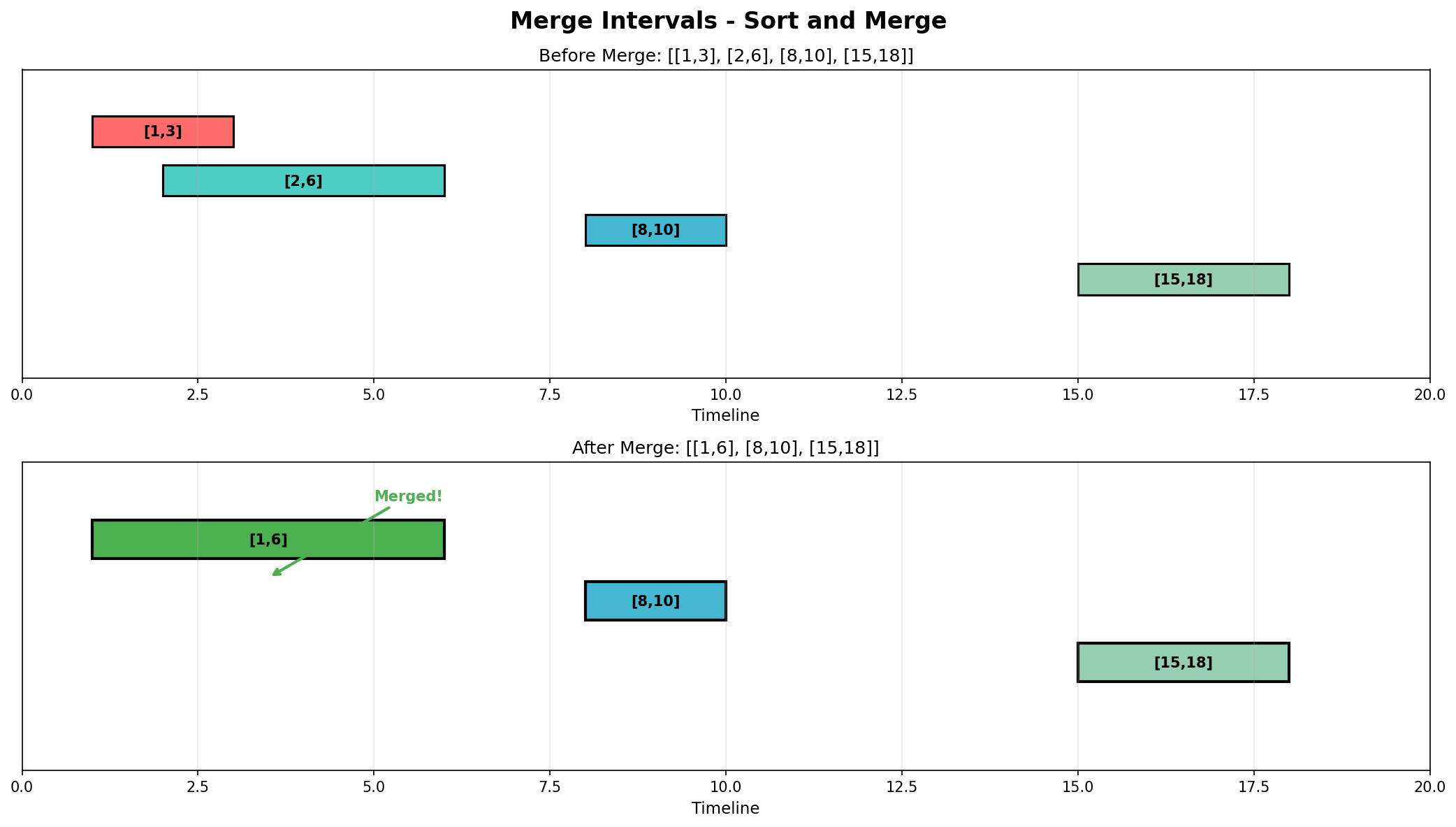
Key Insight
Two intervals [a, b] and [c, d] overlap if and only if c <= b (assuming they're sorted by start time).
Algorithm:
- Sort intervals by start time
- Iterate through sorted intervals
- Merge if current interval overlaps with previous
- Start new interval if no overlap
Solution
def merge(intervals: list[list[int]]) -> list[list[int]]:
    """
    Merge overlapping intervals.

    Time Complexity: O(n log n) - due to sorting
    Space Complexity: O(n) - for the result (O(log n) for sort)
    """
    if not intervals:
        return []

    # Sort by start time
    intervals.sort(key=lambda x: x[0])

    merged = [intervals[0]]

    for i in range(1, len(intervals)):
        current = intervals[i]
        last_merged = merged[-1]

        # Check for overlap
        if current[0] <= last_merged[1]:
            # Merge: extend the end of last interval
            last_merged[1] = max(last_merged[1], current[1])
        else:
            # No overlap: add current as new interval
            merged.append(current)

return mergedpublic int[][] merge(int[][] intervals) {
if (intervals == null || intervals.length == 0) return new int[0][0];
// Sort by start time
Arrays.sort(intervals, (a, b) -> Integer.compare(a[0], b[0]));
List<int[]> merged = new ArrayList<>();
merged.add(intervals[0]);
for (int i = 1; i < intervals.length; i++) {
int[] current = intervals[i];
int[] lastMerged = merged.get(merged.size() - 1);
// Check for overlap
if (current[0] <= lastMerged[1]) {
// Merge: extend the end of last interval
lastMerged[1] = Math.max(lastMerged[1], current[1]);
} else {
// No overlap: add current as new interval
merged.add(current);
}
}
return merged.toArray(new int[0][]);
}Complexity: Time O(n log n) · Space O(n)
- Time: Sorting dominates at O(n log n); the merge loop is a single O(n) pass through sorted intervals
- Space: Result array can hold up to n intervals (worst case: no overlaps); sorting uses O(log n) auxiliary space
# Alternative: Using a more explicit approach
def merge_explicit(intervals: list[list[int]]) -> list[list[int]]:
    """
    More explicit merge logic.
    """
    if not intervals:
        return []

    intervals.sort()
    merged = []
    current_start, current_end = intervals[0]

    for start, end in intervals[1:]:
        if start <= current_end:
            # Overlapping - extend current interval
            current_end = max(current_end, end)
        else:
            # Non-overlapping - save current and start new
            merged.append([current_start, current_end])
            current_start, current_end = start, end

    # Don't forget the last interval
    merged.append([current_start, current_end])

return mergedComplexity: Time O(n log n) · Space O(n)
- Time: Sorting is O(n log n); single pass through intervals with constant-time comparisons per interval
- Space: Merged array stores the result intervals; tracking variables use O(1) additional space
Step-by-Step Trace
For intervals = [[1,3], [2,6], [8,10], [15,18]]:
| Step | Current | Last Merged | Overlaps? | Action | Merged |
|---|---|---|---|---|---|
| Init | - | - | - | Add [1,3] | [[1,3]] |
| 1 | [2,6] | [1,3] | 2 <= 3 Yes | Extend to [1,6] | [[1,6]] |
| 2 | [8,10] | [1,6] | 8 <= 6 No | Add [8,10] | [[1,6], [8,10]] |
| 3 | [15,18] | [8,10] | 15 <= 10 No | Add [15,18] | [[1,6], [8,10], [15,18]] |
Complexity Analysis
| Metric | Complexity |
|---|---|
| Time | O(n log n) - Dominated by sorting |
| Space | O(n) - Result array; O(log n) for sort |
Edge Cases
- Empty input:
[]->[] - Single interval:
[[1,5]]->[[1,5]] - No overlaps:
[[1,2], [4,5]]->[[1,2], [4,5]] - All overlap:
[[1,10], [2,5], [3,7]]->[[1,10]] - Touching endpoints:
[[1,4], [4,5]]->[[1,5]] - Nested intervals:
[[1,10], [3,5]]->[[1,10]] - Unsorted input:
[[3,4], [1,2]]->[[1,2], [3,4]]
Variations
Insert Interval
def insert(intervals: list[list[int]], newInterval: list[int]) -> list[list[int]]:
    """
    Insert a new interval into a sorted list of non-overlapping intervals.
    """
    result = []
    i = 0
    n = len(intervals)

    # Add all intervals that come before newInterval
    while i < n and intervals[i][1] < newInterval[0]:
        result.append(intervals[i])
        i += 1

    # Merge overlapping intervals
    while i < n and intervals[i][0] <= newInterval[1]:
        newInterval[0] = min(newInterval[0], intervals[i][0])
        newInterval[1] = max(newInterval[1], intervals[i][1])
        i += 1
    result.append(newInterval)

    # Add all intervals that come after
    while i < n:
        result.append(intervals[i])
        i += 1

return resultComplexity: Time O(n) · Space O(n)
- Time: Three sequential while loops each advance through at most n intervals total (single pass overall)
- Space: Result array stores up to n + 1 intervals (all original plus the new merged interval)
Interval List Intersections
def intervalIntersection(A: list[list[int]], B: list[list[int]]) -> list[list[int]]:
    """
    Find intersections of two lists of intervals.
    """
    result = []
    i = j = 0

    while i < len(A) and j < len(B):
        # Find intersection
        start = max(A[i][0], B[j][0])
        end = min(A[i][1], B[j][1])

        if start <= end:
            result.append([start, end])

        # Move pointer with smaller end
        if A[i][1] < B[j][1]:
            i += 1
        else:
            j += 1

return resultComplexity: Time O(m + n) · Space O(min(m, n))
- Time: Each pointer advances at most m or n times respectively; total iterations bounded by m + n
- Space: Result can contain at most min(m, n) intersections (each intersection consumes one interval from each list)
Meeting Rooms (Can Attend All Meetings?)
def canAttendMeetings(intervals: list[list[int]]) -> bool:
    """
    Return true if a person can attend all meetings (no overlaps).
    """
    intervals.sort()

    for i in range(1, len(intervals)):
        if intervals[i][0] < intervals[i - 1][1]:
            return False

return TrueComplexity: Time O(n log n) · Space O(1)
- Time: Sorting is O(n log n); checking adjacent pairs for overlap is a single O(n) pass
- Space: Sorting is done in-place; only loop variables used (no auxiliary data structures)
Meeting Rooms II (Minimum Rooms Needed)
import heapq

def minMeetingRooms(intervals: list[list[int]]) -> int:
    """
    Find minimum number of meeting rooms needed.
    """
    if not intervals:
        return 0

    intervals.sort()
    heap = []  # Min-heap of end times

    for start, end in intervals:
        if heap and heap[0] <= start:
            heapq.heappop(heap)
        heapq.heappush(heap, end)

return len(heap)Complexity: Time O(n log n) · Space O(n)
- Time: Sorting is O(n log n); each meeting does at most one heap push/pop, each O(log n), totaling O(n log n)
- Space: Heap can grow to n elements if all meetings overlap (e.g., all start at the same time)
Common Mistakes
- Forgetting to sort - Intervals may not be in order
- Wrong overlap condition - Should be
current[0] <= last[1] - Not updating end correctly - Use
max(last[1], current[1]) - Forgetting last interval in explicit approach
- Modifying input - May need to copy if input shouldn't change
Related Problems
Insert Interval (LeetCode 57)
Problem: Insert a new interval into a sorted list of non-overlapping intervals, merging if necessary.
Key Insight: Three phases - add intervals before, merge overlapping, add intervals after.
Approach: Iterate through intervals. Add non-overlapping before new interval, merge overlapping ones, then add remaining.
Complexity: O(n) time, O(n) space
Interval List Intersections (LeetCode 986)
Problem: Find intersections of two lists of sorted, disjoint intervals.
Key Insight: Use two pointers, one for each list. Intersection exists when max(starts) <= min(ends).
Approach: Compare intervals from both lists. Move pointer of interval that ends first.
Complexity: O(m + n) time, O(1) space (excluding output)
Meeting Rooms (LeetCode 252)
Problem: Determine if a person can attend all meetings (no overlaps).
Key Insight: Sort by start time, check if any meeting starts before previous one ends.
Approach: Sort intervals, check adjacent pairs for overlap.
Complexity: O(n log n) time, O(1) space
Meeting Rooms II (LeetCode 253)
Problem: Find minimum number of meeting rooms required.
Key Insight: Track concurrent meetings using min-heap of end times or sweep line.
Approach: Sort by start time, use min-heap to track earliest ending meeting. If new meeting starts after heap top, reuse room.
Complexity: O(n log n) time, O(n) space
Non-overlapping Intervals (LeetCode 435)
Problem: Find minimum intervals to remove to make remaining intervals non-overlapping.
Key Insight: Greedy - always keep interval that ends earliest to leave room for more.
Approach: Sort by end time. If overlap, remove the one ending later. Count removals.
Complexity: O(n log n) time, O(1) space
Employee Free Time (LeetCode 759)
Problem: Find common free time intervals for all employees given their schedules.
Key Insight: Merge all schedules, then find gaps between merged intervals.
Approach: Flatten all intervals, sort, merge overlapping. Free time is gaps between merged intervals.
Complexity: O(n log n) time, O(n) space
Key Takeaways
- Always sort by start time before processing intervals
- Overlap condition:
next_start <= current_end - When merging: extend
endtomax(current_end, next_end) - This is a fundamental pattern for all interval problems
- Consider edge case of touching endpoints (usually treated as overlapping)