Regular Expression Matching
Problem Statement
Given an input string s and a pattern p, implement regular expression matching with support for '.' and '*' where:
'.'Matches any single character.'*'Matches zero or more of the preceding element.
The matching should cover the entire input string (not partial).
Input/Output Format
Input:
s(str): Input stringp(str): Pattern with.and*wildcards
Output:
- (bool): True if the entire string matches the pattern
Constraints
1 <= s.length <= 201 <= p.length <= 20scontains only lowercase English letterspcontains only lowercase English letters,., and*- It is guaranteed for each appearance of
*, there will be a previous valid character to match
Examples
Example 1: No Match
Input: s = "aa", p = "a"
Output: false
Explanation: Pattern "a" matches only a single 'a', but the string has two.
Example 2: Star Matches Multiple
Input: s = "aa", p = "a*"
Output: true
Explanation:'a*' means zero or more of 'a'. With two 'a's, it matches.
Example 3: Dot Star
Input: s = "ab", p = ".*"
Output: true
Explanation:".*" means zero or more of any character. It matches any string.
Example 4: Complex Pattern
Input: s = "aab", p = "c*a*b"
Output: true
Explanation:
c* -> matches zero 'c' (empty)
a* -> matches "aa"
b  -> matches "b"

So "c*a*b" matches "aab"Example 5: Mismatch
Input: s = "mississippi", p = "mis*is*p*."
Output: false
Explanation: The p* part can't match "ssissi" correctly. One 'p' isn't enough.
Visual Explanation
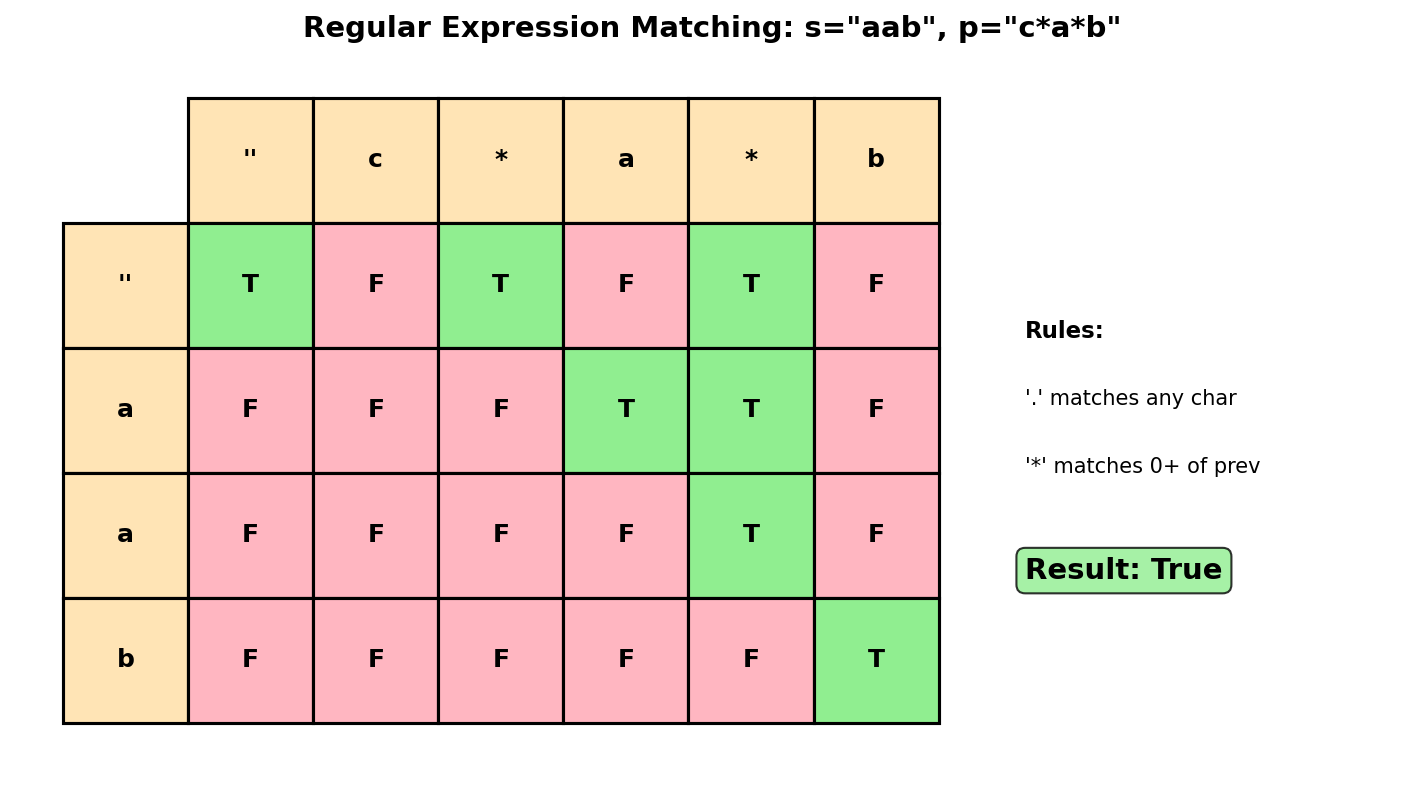
ASCII Art: Pattern Matching States
s = "aab", p = "c*a*b"

State transitions:
==================

c* can match:
  - "" (zero c's) -> move past c* in pattern
  - "c" (one c) -> stay at c* in pattern
  - "cc" (two c's) -> stay at c* in pattern

a* can match:
  - "" (zero a's)
  - "a" (one a)
  - "aa" (two a's)
  - ...

DP Table: dp[i][j] = does s[0:i] match p[0:j]?

          ""   c    *    a    *    b
          p[0] p[1] p[2] p[3] p[4] p[5]
        +----+----+----+----+----+----+
 ""     | T  | F  | T  | F  | T  | F  |
 s[0]   +----+----+----+----+----+----+
 a      | F  | F  | F  | T  | T  | F  |
 s[1]   +----+----+----+----+----+----+
 a      | F  | F  | F  | F  | T  | F  |
 s[2]   +----+----+----+----+----+----+
 b      | F  | F  | F  | F  | F  | T  |
 s[3]   +----+----+----+----+----+----+

dp[3][5] = True -> Match!Solution Code
Approach 1: Top-Down (Memoization)
from functools import lru_cache

def isMatch(s: str, p: str) -> bool:
    """
    Check regex match using memoization.

    Handle three cases:
    1. Regular character match
    2. '.' matches any character
    3. '*' matches zero or more of preceding

    Args:
        s: Input string
        p: Pattern

    Returns:
        True if entire string matches pattern

    Time Complexity: O(m * n)
    Space Complexity: O(m * n)
    """
    @lru_cache(maxsize=None)
    def dp(i: int, j: int) -> bool:
        """Check if s[i:] matches p[j:]."""
        # Base case: pattern exhausted
        if j == len(p):
            return i == len(s)

        # Check if first characters match
        first_match = i < len(s) and (p[j] == s[i] or p[j] == '.')

        # Handle '*' (look ahead)
        if j + 1 < len(p) and p[j + 1] == '*':
            # Two options:
            # 1. '*' matches zero of preceding -> skip "x*"
            # 2. '*' matches one+ of preceding -> consume one char, stay at "*"
            return (dp(i, j + 2) or  # Zero match
                   (first_match and dp(i + 1, j)))  # One+ match

        # Regular match (including '.')
        return first_match and dp(i + 1, j + 1)

return dp(0, 0)Complexity: Time O(m * n) · Space O(m * n)
- Time: Each unique (i, j) state is computed at most once due to memoization, where i ranges over string length m and j over pattern length n.
- Space: The cache stores O(m * n) entries, plus recursion stack depth of O(m + n) in the worst case.
Approach 2: Bottom-Up (Tabulation)
def isMatch(s: str, p: str) -> bool:
    """
    Check regex match using bottom-up DP.

    Build solution from end of strings to beginning.

    Args:
        s: Input string
        p: Pattern

    Returns:
        True if entire string matches pattern

    Time Complexity: O(m * n)
    Space Complexity: O(m * n)
    """
    m, n = len(s), len(p)

    # dp[i][j] = True if s[i:] matches p[j:]
    dp = [[False] * (n + 1) for _ in range(m + 1)]
    dp[m][n] = True  # Empty string matches empty pattern

    # Fill from bottom-right to top-left
    for i in range(m, -1, -1):
        for j in range(n - 1, -1, -1):
            first_match = i < m and (p[j] == s[i] or p[j] == '.')

            if j + 1 < n and p[j + 1] == '*':
                # Option 1: Zero occurrences of p[j]
                # Option 2: One+ occurrences (if first char matches)
                dp[i][j] = dp[i][j + 2] or (first_match and dp[i + 1][j])
            else:
                dp[i][j] = first_match and dp[i + 1][j + 1]

return dp[0][0]Complexity: Time O(m * n) · Space O(m * n)
- Time: Two nested loops iterate through all (m+1) * (n+1) states, with constant-time operations per state.
- Space: The 2D dp table has dimensions (m+1) x (n+1) to store boolean match results.
Approach 3: Forward DP (Alternative)
def isMatch(s: str, p: str) -> bool:
    """
    Check regex match using forward DP.

    dp[i][j] = True if s[0:i] matches p[0:j]

    Args:
        s: Input string
        p: Pattern

    Returns:
        True if entire string matches pattern

    Time Complexity: O(m * n)
    Space Complexity: O(m * n)
    """
    m, n = len(s), len(p)

    # dp[i][j] = True if s[0:i] matches p[0:j]
    dp = [[False] * (n + 1) for _ in range(m + 1)]
    dp[0][0] = True

    # Handle patterns like a*, a*b*, a*b*c* that match empty string
    for j in range(2, n + 1):
        if p[j - 1] == '*':
            dp[0][j] = dp[0][j - 2]

    for i in range(1, m + 1):
        for j in range(1, n + 1):
            if p[j - 1] == '*':
                # Zero occurrences: dp[i][j-2]
                # One+ occurrences: dp[i-1][j] if chars match
                zero_match = dp[i][j - 2]
                one_plus = (dp[i - 1][j] and
                           (p[j - 2] == s[i - 1] or p[j - 2] == '.'))
                dp[i][j] = zero_match or one_plus
            elif p[j - 1] == '.' or p[j - 1] == s[i - 1]:
                dp[i][j] = dp[i - 1][j - 1]

return dp[m][n]public boolean isMatch(String s, String p) {
int m = s.length(), n = p.length();
// dp[i][j] = true if s[0:i] matches p[0:j]
boolean[][] dp = new boolean[m + 1][n + 1];
dp[0][0] = true;
// Handle patterns like a*, a*b*, a*b*c* that match empty string
for (int j = 2; j <= n; j++) {
if (p.charAt(j - 1) == '*') {
dp[0][j] = dp[0][j - 2];
}
}
for (int i = 1; i <= m; i++) {
for (int j = 1; j <= n; j++) {
if (p.charAt(j - 1) == '*') {
// Zero occurrences: dp[i][j-2]
boolean zeroMatch = dp[i][j - 2];
// One+ occurrences: dp[i-1][j] if chars match
boolean onePlus = dp[i - 1][j]
&& (p.charAt(j - 2) == s.charAt(i - 1) || p.charAt(j - 2) == '.');
dp[i][j] = zeroMatch || onePlus;
} else if (p.charAt(j - 1) == '.' || p.charAt(j - 1) == s.charAt(i - 1)) {
dp[i][j] = dp[i - 1][j - 1];
}
}
}
return dp[m][n];
}Complexity: Time O(m * n) · Space O(m * n)
- Time: Same as Approach 2, processing all states from top-left to bottom-right with constant-time transitions.
- Space: Full 2D table of size (m+1) x (n+1) to store reachability from string start.
Approach 4: Space-Optimized
def isMatch(s: str, p: str) -> bool:
    """
    Check regex match with O(n) space.

    Only need current and previous row.

    Args:
        s: Input string
        p: Pattern

    Returns:
        True if entire string matches pattern

    Time Complexity: O(m * n)
    Space Complexity: O(n)
    """
    m, n = len(s), len(p)

    # Previous row
    prev = [False] * (n + 1)
    prev[0] = True

    # Initialize: patterns matching empty string
    for j in range(2, n + 1):
        if p[j - 1] == '*':
            prev[j] = prev[j - 2]

    for i in range(1, m + 1):
        curr = [False] * (n + 1)

        for j in range(1, n + 1):
            if p[j - 1] == '*':
                zero_match = curr[j - 2] if j >= 2 else False
                one_plus = (prev[j] and
                           (p[j - 2] == s[i - 1] or p[j - 2] == '.'))
                curr[j] = zero_match or one_plus
            elif p[j - 1] == '.' or p[j - 1] == s[i - 1]:
                curr[j] = prev[j - 1]

        prev = curr

return prev[n]Complexity: Time O(m * n) · Space O(n)
- Time: Still processes all m * n states, but only keeps two rows in memory at a time.
- Space: Only two arrays of size n+1 (prev and curr) are maintained, reducing space from O(m*n) to O(n).
Complexity Analysis
| Approach | Time Complexity | Space Complexity |
|---|---|---|
| Top-Down | O(m * n) | O(m * n) |
| Bottom-Up | O(m * n) | O(m * n) |
| Space-Optimized | O(m * n) | O(n) |
Where m = len(s), n = len(p).
Edge Cases
Empty string:
pythonisMatch("", "") # True isMatch("", "a") # False isMatch("", "a*") # True (zero a's) isMatch("", ".*") # True (zero any chars) isMatch("", "a*b*") # TrueStar matching zero:
pythonisMatch("abc", "a*abc") # True (a* matches zero) isMatch("b", "a*b") # TrueDot matching any:
pythonisMatch("ab", "..") # True isMatch("ab", ".*") # True isMatch("a", ".") # TrueComplex patterns:
pythonisMatch("aaa", "a*a") # True (a* matches "aa", then "a") isMatch("ab", ".*c") # False
Understanding the '*' Operator
The key insight: x* can match:
1. Zero 'x' characters (skip x* entirely)
2. One or more 'x' characters

For "aaa" matching "a*":
- dp(0, 0): trying to match "aaa" with "a*"
  - Zero match: dp(0, 2) = match "" with "" -> True? No wait...

Let me be more careful with indexing:
s = "aaa", p = "a*"

Using dp[i][j] = s[0:i] matches p[0:j]:
dp[0][0] = True (empty matches empty)
dp[0][2] = dp[0][0] = True (a* matches empty)
dp[1][2] = dp[0][2] or (match 'a' and dp[0][2]) = True or True = True
dp[2][2] = dp[1][2] or (match 'a' and dp[1][2]) = True
dp[3][2] = True

So "aaa" matches "a*"Key Insights
'*' Operates on Preceding:
a*is a unit, not*alone.Two Choices for '*':
- Skip the
x*entirely (zero matches) - Match one character and stay at
x*(one+ matches)
- Skip the
'.' is Simple: Just matches any single character.
State Definition:
dp[i][j]= whethers[0:i]matchesp[0:j].Empty Pattern Edge: Patterns like
a*b*c*can match empty string.
Related Problems
Wildcard Matching (LeetCode 44)
Problem: Match string with pattern containing ? (any single char) and * (any sequence).
Key Insight: Simpler than regex because * is independent - doesn't modify preceding character.
Approach: For *: dp[i][j] = dp[i][j-1] or dp[i-1][j] (match empty OR match one char). No need to look at preceding character.
Complexity: O(m * n) time, O(n) space optimized
Edit Distance (LeetCode 72)
Problem: Minimum insert/delete/replace operations to transform one string to another.
Key Insight: Same 2D DP structure comparing prefixes of two strings.
Approach: dp[i][j] = dp[i-1][j-1] if match, else 1 + min(insert, delete, replace). Similar structure but different recurrence.
Complexity: O(m * n) time, O(min(m,n)) space
Longest Common Subsequence (LeetCode 1143)
Problem: Find length of longest subsequence present in both strings.
Key Insight: Another 2D string DP. Different goal (maximize length) but similar table structure.
Approach: dp[i][j] = dp[i-1][j-1] + 1 if match, else max(dp[i-1][j], dp[i][j-1]).
Complexity: O(m * n) time, O(min(m,n)) space
Valid Parenthesis String (LeetCode 678)
Problem: Check if string with (, ), and * (can be (, ), or empty) is valid.
Key Insight: Pattern matching with wildcard, but tracking balance instead of string match.
Approach: Track range [lo, hi] of possible open paren counts. ( increases both, ) decreases both, * expands range. Valid if 0 in final range.
Complexity: O(n) time, O(1) space