Daily Temperatures
LeetCode 739 | Difficulty: Medium | Pattern: Monotonic Stack
Problem Statement
Given an array of integers temperatures represents the daily temperatures, return an array answer such that answer[i] is the number of days you have to wait after the i-th day to get a warmer temperature.
If there is no future day for which this is possible, keep answer[i] == 0 instead.
Examples
Example 1:
Input: temperatures = [73,74,75,71,69,72,76,73]
Output: [1,1,4,2,1,1,0,0]Example 2:
Input: temperatures = [30,40,50,60]
Output: [1,1,1,0]Example 3:
Input: temperatures = [30,60,90]
Output: [1,1,0]Constraints
1 <= temperatures.length <= 10^530 <= temperatures[i] <= 100
Intuition
This is a classic Next Greater Element problem with a twist: instead of returning the greater value, we return the distance (number of days) to that element.
Key Insight: Use a monotonic decreasing stack to track indices of temperatures waiting for a warmer day. When we find a warmer temperature, calculate the index difference.
Visualization
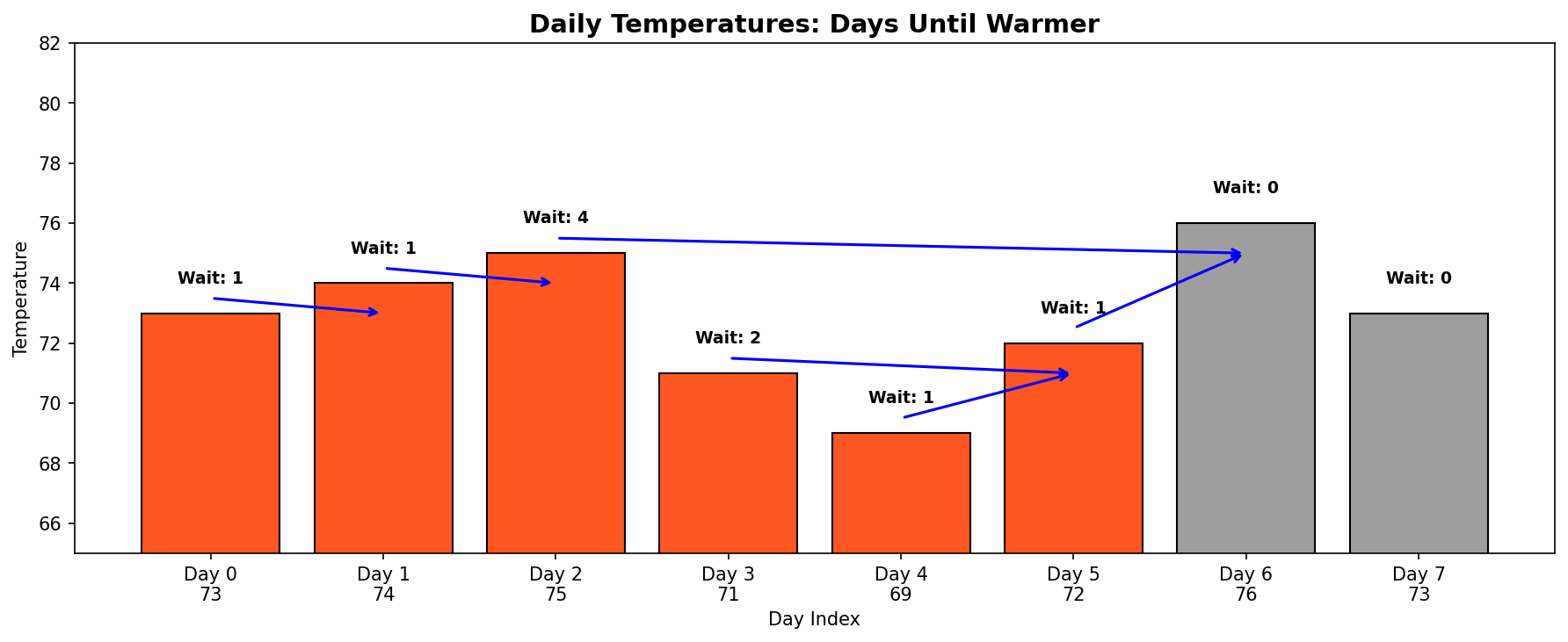
temperatures = [73, 74, 75, 71, 69, 72, 76, 73]
                 0   1   2   3   4   5   6   7

Day 0 (73): Wait 1 day for 74
Day 1 (74): Wait 1 day for 75
Day 2 (75): Wait 4 days for 76
Day 3 (71): Wait 2 days for 72
Day 4 (69): Wait 1 day for 72
Day 5 (72): Wait 1 day for 76
Day 6 (76): No warmer day (0)
Day 7 (73): No warmer day (0)

Output: [1, 1, 4, 2, 1, 1, 0, 0]Solution: Monotonic Stack
def dailyTemperatures(temperatures: list[int]) -> list[int]:
    """
    Find days until warmer temperature using monotonic decreasing stack.

    Stack stores indices of temperatures waiting for a warmer day.
    When we find warmer temp, pop and calculate day difference.

    Time: O(n) - each element pushed and popped at most once
    Space: O(n) - stack size in worst case
    """
    n = len(temperatures)
    result = [0] * n
    stack = []  # Monotonic decreasing stack of indices

    for i in range(n):
        # Pop all temperatures smaller than current (they found warmer day)
        while stack and temperatures[stack[-1]] < temperatures[i]:
            prev_idx = stack.pop()
            result[prev_idx] = i - prev_idx  # Days until warmer

        stack.append(i)

    # Remaining indices in stack have no warmer day (result stays 0)
return resultpublic int[] dailyTemperatures(int[] temperatures) {
int n = temperatures.length;
int[] result = new int[n];
Deque<Integer> stack = new ArrayDeque<>(); // monotonic decreasing stack of indices
for (int i = 0; i < n; i++) {
while (!stack.isEmpty() && temperatures[stack.peek()] < temperatures[i]) {
int prevIdx = stack.pop();
result[prevIdx] = i - prevIdx;
}
stack.push(i);
}
return result;
}Complexity: Time O(n) · Space O(n)
- Time: Each index pushed exactly once and popped at most once, totaling 2n operations = O(n)
- Space: Stack can hold all n indices in worst case (strictly decreasing temperatures like [76, 75, 74, 73])
Step-by-Step Walkthrough
temperatures = [73, 74, 75, 71, 69, 72, 76, 73]
result = [0, 0, 0, 0, 0, 0, 0, 0]
stack = []

i=0, temp=73:
  Stack empty, push 0
  stack = [0]

i=1, temp=74:
  74 > 73 (temp at index 0)
  Pop 0, result[0] = 1-0 = 1
  Stack empty, push 1
  stack = [1]
  result = [1, 0, 0, 0, 0, 0, 0, 0]

i=2, temp=75:
  75 > 74 (temp at index 1)
  Pop 1, result[1] = 2-1 = 1
  Stack empty, push 2
  stack = [2]
  result = [1, 1, 0, 0, 0, 0, 0, 0]

i=3, temp=71:
  71 < 75, push 3
  stack = [2, 3]

i=4, temp=69:
  69 < 71, push 4
  stack = [2, 3, 4]

i=5, temp=72:
  72 > 69 (temp at index 4)
  Pop 4, result[4] = 5-4 = 1
  72 > 71 (temp at index 3)
  Pop 3, result[3] = 5-3 = 2
  72 < 75, push 5
  stack = [2, 5]
  result = [1, 1, 0, 2, 1, 0, 0, 0]

i=6, temp=76:
  76 > 72 (temp at index 5)
  Pop 5, result[5] = 6-5 = 1
  76 > 75 (temp at index 2)
  Pop 2, result[2] = 6-2 = 4
  Stack empty, push 6
  stack = [6]
  result = [1, 1, 4, 2, 1, 1, 0, 0]

i=7, temp=73:
  73 < 76, push 7
  stack = [6, 7]

Done! Indices 6, 7 remain in stack (no warmer day)
Final result = [1, 1, 4, 2, 1, 1, 0, 0]Alternative: Process Right to Left
def dailyTemperatures(temperatures: list[int]) -> list[int]:
    """
    Process from right to left.
    For each day, look at previously processed days to find next warmer.

    Time: O(n) - not immediately obvious, but each comparison
          leads to jumping forward, amortized O(n)
    """
    n = len(temperatures)
    result = [0] * n

    for i in range(n - 2, -1, -1):
        j = i + 1

        while j < n:
            if temperatures[j] > temperatures[i]:
                result[i] = j - i
                break
            elif result[j] == 0:
                # No warmer day after j, so no warmer day after i either
                result[i] = 0
                break
            else:
                # Jump to the next potentially warmer day
                j += result[j]

return resultComplexity: Time O(n) · Space O(1)
- Time: O(n) amortized; jumping via result[j] skips already-processed elements, each element visited at most twice
- Space: O(1) excluding the result array; no auxiliary data structure needed
Complexity Analysis
| Approach | Time | Space |
|---|---|---|
| Brute Force | O(n^2) | O(1) |
| Monotonic Stack | O(n) | O(n) |
| Right to Left | O(n) | O(1)* |
*Output array not counted as extra space
Why Monotonic Stack is O(n)?
- Each index is pushed onto stack exactly once
- Each index is popped from stack at most once
- Total operations: 2n = O(n)
Edge Cases
def test_daily_temperatures():
    # All same temperatures
    assert dailyTemperatures([70, 70, 70]) == [0, 0, 0]

    # Strictly increasing
    assert dailyTemperatures([70, 71, 72, 73]) == [1, 1, 1, 0]

    # Strictly decreasing
    assert dailyTemperatures([73, 72, 71, 70]) == [0, 0, 0, 0]

    # Single element
    assert dailyTemperatures([70]) == [0]

    # Two elements
    assert dailyTemperatures([70, 71]) == [1, 0]
    assert dailyTemperatures([71, 70]) == [0, 0]

    # Valley pattern
assert dailyTemperatures([73, 71, 72]) == [0, 1, 0]Common Mistakes
Returning temperature instead of days
python# Wrong: result[prev_idx] = temperatures[i] # Correct: result[prev_idx] = i - prev_idxUsing <= instead of <
python# Wrong: while stack and temperatures[stack[-1]] <= temperatures[i] # This would treat equal temperatures as "warmer"Forgetting remaining stack elements
- Elements left in stack have no warmer day
- They correctly default to 0 from initialization
Variations
Days Until Colder Temperature
def daysUntilColder(temperatures: list[int]) -> list[int]:
    """Monotonic INCREASING stack."""
    n = len(temperatures)
    result = [0] * n
    stack = []

    for i in range(n):
        while stack and temperatures[stack[-1]] > temperatures[i]:
            prev_idx = stack.pop()
            result[prev_idx] = i - prev_idx
        stack.append(i)

return resultComplexity: Time O(n) · Space O(n)
- Time: Same O(n) as main solution; condition change does not affect iteration count
- Space: Monotonic increasing stack stores up to n indices
Circular Temperatures
def dailyTemperaturesCircular(temperatures: list[int]) -> list[int]:
    """Allow wrap-around to find warmer day."""
    n = len(temperatures)
    result = [0] * n
    stack = []

    for i in range(2 * n):
        idx = i % n
        while stack and temperatures[stack[-1]] < temperatures[idx]:
            prev_idx = stack.pop()
            result[prev_idx] = (idx - prev_idx) % n or n
        if i < n:
            stack.append(idx)

return resultComplexity: Time O(n) · Space O(n)
- Time: O(2n) = O(n); iterates array twice to handle circular wrap-around
- Space: Stack holds at most n indices from the first pass
Interview Tips
What Interviewers Look For
- Pattern Recognition: Identify as Next Greater Element variant
- Monotonic Stack: Know when to use decreasing vs increasing
- Index vs Value: Track indices, return distance
Common Follow-up Questions
"Can you solve it with O(1) space?"
- Yes, using right-to-left approach with jumping
"What if we need the actual warmer temperature, not days?"
- Store and return
temperatures[i]instead ofi - prev_idx
- Store and return
"What about circular temperatures?"
- Iterate 2n times, use modulo for index
"How would you handle real-time streaming data?"
- Maintain the stack, process new temperatures as they arrive
Related Problems
Next Greater Element I (LeetCode 496)
Problem: Given nums1 (subset of nums2), find the next greater element in nums2 for each element of nums1.
Key Insight: Build hashmap of next greater elements for all nums2 elements, then lookup for nums1.
Approach: Monotonic decreasing stack on nums2. When current > stack top, record mapping. Query map for nums1.
Complexity: O(n + m) time, O(n) space
Next Greater Element II (LeetCode 503)
Problem: Given a circular array, find the next greater element for each element.
Key Insight: Iterate array twice (2n) to simulate circular behavior with monotonic decreasing stack.
Approach: Loop 2n times using i % n for index. Only push indices in first pass.
Complexity: O(n) time, O(n) space
Online Stock Span (LeetCode 901)
Problem: Return span (consecutive days with price <= today) for each daily price in stream.
Key Insight: Previous greater element problem. Stack stores (price, span), accumulate spans when popping.
Approach: Monotonic decreasing stack. Pop prices <= current, sum their spans + 1 for result.
Complexity: O(1) amortized per call
Largest Rectangle in Histogram (LeetCode 84)
Problem: Given histogram bar heights, find the largest rectangle area.
Key Insight: For each bar, find left and right boundaries (first shorter bar). Area = height * width.
Approach: Monotonic increasing stack of indices. When popping, calculate area with popped height and width from boundaries.
Complexity: O(n) time, O(n) space