Top K Frequent Elements
Find the k most frequent elements using heap and hash map
Problem Statement
Given an integer array nums and an integer k, return the k most frequent elements. You may return the answer in any order.
LeetCode: Problem 347 - Top K Frequent Elements
Examples
Example 1
Input: nums = [1, 1, 1, 2, 2, 3], k = 2
Output: [1, 2]Explanation:
- Element 1 appears 3 times
- Element 2 appears 2 times
- Element 3 appears 1 time
- The 2 most frequent are [1, 2]
Example 2
Input: nums = [1], k = 1
Output: [1]Constraints
1 <= nums.length <= 10^5-10^4 <= nums[i] <= 10^4kis in the range[1, the number of unique elements in the array]- It is guaranteed that the answer is unique
Visualization
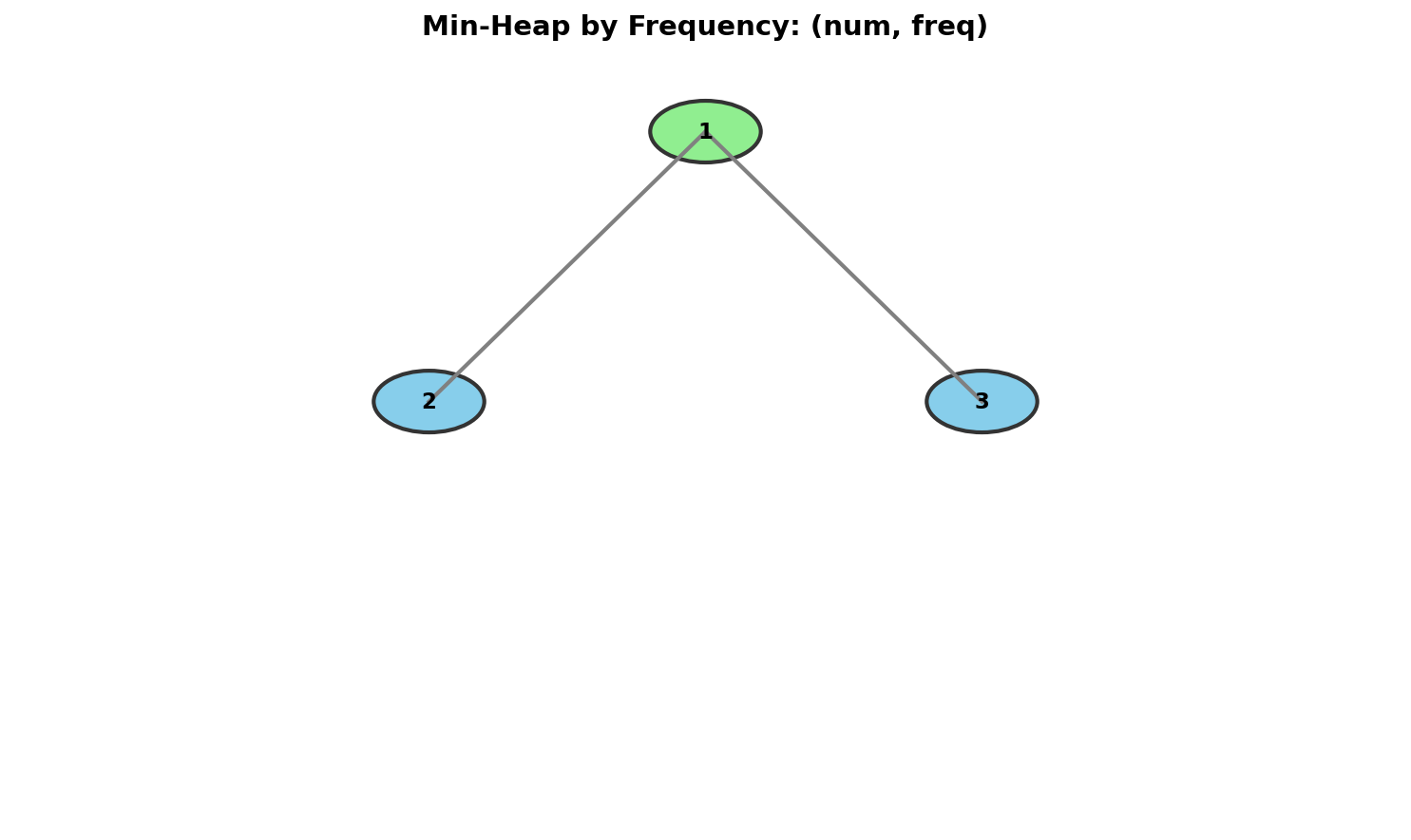
Approach
Key Insight
This problem combines two techniques:
- Hash Map to count frequencies
- Heap to find top K by frequency
We can use either:
- Min-heap of size k: Keep the k most frequent (similar to Kth Largest)
- Bucket sort: O(n) time using frequency as index
Solution 1: Min-Heap of Size K
import heapq
from collections import Counter

def topKFrequent(nums: list[int], k: int) -> list[int]:
    """
    Find k most frequent elements using min-heap.

    Algorithm:
    1. Count frequencies using Counter
    2. Maintain min-heap of size k with (frequency, element) pairs
    3. The heap root is the kth most frequent

    Time: O(n log k) - n elements, heap operations O(log k)
    Space: O(n) for counter + O(k) for heap
    """
    # Step 1: Count frequencies
    count = Counter(nums)

    # Step 2: Use min-heap of size k
    # Heap stores (frequency, element) - min by frequency
    min_heap = []

    for num, freq in count.items():
        if len(min_heap) < k:
            heapq.heappush(min_heap, (freq, num))
        elif freq > min_heap[0][0]:
            heapq.heapreplace(min_heap, (freq, num))

    # Step 3: Extract elements from heap
return [num for freq, num in min_heap]import java.util.HashMap;
import java.util.Map;
import java.util.PriorityQueue;
import java.util.ArrayList;
import java.util.List;
class Solution {
public int[] topKFrequent(int[] nums, int k) {
// Step 1: Count frequencies
Map<Integer, Integer> count = new HashMap<>();
for (int num : nums) {
count.merge(num, 1, Integer::sum);
}
// Step 2: Min-heap of size k, ordered by frequency
PriorityQueue<int[]> minHeap = new PriorityQueue<>(
(a, b) -> Integer.compare(a[1], b[1]) // [element, frequency]
);
for (Map.Entry<Integer, Integer> entry : count.entrySet()) {
int num = entry.getKey();
int freq = entry.getValue();
if (minHeap.size() < k) {
minHeap.offer(new int[]{num, freq});
} else if (freq > minHeap.peek()[1]) {
minHeap.poll();
minHeap.offer(new int[]{num, freq});
}
}
// Step 3: Extract elements
int[] result = new int[k];
int i = 0;
for (int[] entry : minHeap) {
result[i++] = entry[0];
}
return result;
}
}Complexity: Time O(n log k) · Space O(n)
- Time: Counting frequencies takes O(n). Processing m unique elements with heap operations of O(log k) each gives O(m log k). Since m <= n, total is O(n log k)
- Space: O(n) for the frequency counter, plus O(k) for the heap
Step-by-Step Walkthrough
nums = [1, 1, 1, 2, 2, 3], k = 2

Step 1: Count frequencies
        {1: 3, 2: 2, 3: 1}

Step 2: Process each (num, freq) pair

Process (1, 3):
    heap size < k, push (3, 1)
    Heap: [(3, 1)]

Process (2, 2):
    heap size < k, push (2, 2)
    Heap: [(2, 2), (3, 1)]  <- min-heap by frequency

Process (3, 1):
    1 > heap[0][0] (which is 2)? NO
    Skip
    Heap: [(2, 2), (3, 1)]

Step 3: Extract elements
Result: [2, 1]Solution 2: Bucket Sort (Optimal O(n))
from collections import Counter

def topKFrequent_bucket(nums: list[int], k: int) -> list[int]:
    """
    Find k most frequent using bucket sort.

    Key Insight: Frequency ranges from 1 to n, so we can use
    frequency as bucket index.

    Time: O(n) - counting and bucket creation
    Space: O(n) - for buckets
    """
    count = Counter(nums)

    # Create buckets: bucket[i] contains elements with frequency i
    # Frequency can range from 1 to len(nums)
    buckets = [[] for _ in range(len(nums) + 1)]

    for num, freq in count.items():
        buckets[freq].append(num)

    # Collect top k from highest frequency buckets
    result = []
    for freq in range(len(buckets) - 1, 0, -1):
        for num in buckets[freq]:
            result.append(num)
            if len(result) == k:
                return result

return resultComplexity: Time O(n) · Space O(n)
- Time: Counting takes O(n). Creating n+1 buckets is O(n). Filling and scanning buckets is O(n) since we process each unique element once
- Space: O(n) for the counter and O(n) for the bucket array
Bucket Sort Visualization
nums = [1, 1, 1, 2, 2, 3, 3, 3, 3], k = 2

Frequencies: {1: 3, 2: 2, 3: 4}

Buckets (index = frequency):
+-------+-------+-------+-------+-------+
| idx 0 | idx 1 | idx 2 | idx 3 | idx 4 |
+-------+-------+-------+-------+-------+
|  [ ]  |  [ ]  |  [2]  |  [1]  |  [3]  |
+-------+-------+-------+-------+-------+
            ^       ^       ^
            |       |       |
        freq=2  freq=3  freq=4

Scan from right to left:
- bucket[4] has [3] -> add to result
- bucket[3] has [1] -> add to result
- Result has k=2 elements, done!

Result: [3, 1]Solution 3: Using nlargest
import heapq
from collections import Counter

def topKFrequent_nlargest(nums: list[int], k: int) -> list[int]:
    """
    Use Python's built-in nlargest for cleaner code.

    Time: O(n log k)
    Space: O(n)
    """
    count = Counter(nums)
    # nlargest returns k largest by key function
return heapq.nlargest(k, count.keys(), key=count.get)Complexity: Time O(n log k) · Space O(n)
- Time: Counting takes O(n). nlargest processes m unique elements with heap operations, giving O(m log k) where m <= n
- Space: O(n) for the Counter
Complexity Comparison
| Approach | Time | Space | Notes |
|---|---|---|---|
| Min-Heap (size k) | O(n log k) | O(n + k) | Best when k << n |
| Max-Heap (all elements) | O(n + m log m) | O(n + m) | m = unique elements |
| Bucket Sort | O(n) | O(n) | Optimal for dense frequencies |
| Sort by frequency | O(n + m log m) | O(n) | Simple but slower |
Common Mistakes
Heap order confusion
python# Wrong: This is a max-heap by frequency (negate frequency) heapq.heappush(heap, (-freq, num)) # Correct for min-heap of size k: heapq.heappush(heap, (freq, num))Forgetting to handle ties
- The problem guarantees unique answer
- But in general, handle ties by secondary sorting (e.g., by element value)
Using list as frequency key
- Lists are not hashable; use tuple or individual elements
Follow-up Questions
Q1: What if we need the k least frequent elements?
Use a max-heap of size k (negate frequencies):
def bottomKFrequent(nums: list[int], k: int) -> list[int]:
    count = Counter(nums)
    max_heap = []

    for num, freq in count.items():
        if len(max_heap) < k:
            heapq.heappush(max_heap, (-freq, num))
        elif freq < -max_heap[0][0]:
            heapq.heapreplace(max_heap, (-freq, num))

return [num for _, num in max_heap]Q2: What if elements are streaming?
Combine with a HashMap that updates frequencies, then periodically query top K:
class TopKStream:
    def __init__(self, k: int):
        self.k = k
        self.count = Counter()

    def add(self, num: int) -> None:
        self.count[num] += 1

    def getTopK(self) -> list[int]:
return heapq.nlargest(self.k, self.count.keys(), key=self.count.get)Q3: What if we need top K words by frequency (strings)?
Same approach, but handle tie-breaking by lexicographic order:
def topKFrequentWords(words: list[str], k: int) -> list[str]:
    count = Counter(words)
    # Sort by (-frequency, word) for max-freq, then alphabetical
    return heapq.nsmallest(k, count.keys(),
key=lambda w: (-count[w], w))Related Problems
Kth Largest Element in an Array (LeetCode 215)
Problem: Find the kth largest element in an unsorted array.
Key Insight: Use min-heap of size k - no frequency counting needed, just track the k largest values directly.
Approach: Maintain min-heap of size k. For each element, if larger than heap root, replace it. The root is always the kth largest.
Complexity: O(n log k) time, O(k) space
Sort Characters By Frequency (LeetCode 451)
Problem: Given a string, sort it in decreasing order based on the frequency of characters.
Key Insight: Similar frequency counting, but need to sort all characters, not just top k.
Approach: Count frequencies with hash map, then either sort by frequency or use bucket sort where bucket index = frequency. Bucket sort achieves O(n) time.
Complexity: O(n log n) with sorting, O(n) with bucket sort
Top K Frequent Words (LeetCode 692)
Problem: Given an array of words and integer k, return the k most frequent words sorted by frequency (and lexicographically for ties).
Key Insight: Same as Top K Frequent Elements, but must handle lexicographic tie-breaking.
Approach: Use min-heap with custom comparator: (-frequency, word). For ties in frequency, sort words in reverse lexicographic order so the "smaller" word stays in heap.
# Tie-breaking: nsmallest with (-freq, word) key
return heapq.nsmallest(k, count.keys(),
key=lambda w: (-count[w], w))Complexity: O(n log k) time, O(n) space
Interview Tips
Start with frequency counting
- Mention
Counterin Python orHashMapin Java/C++ - This is O(n) and necessary for any approach
- Mention
Discuss tradeoffs
- Heap: O(n log k) time, better when k << n
- Bucket sort: O(n) time, uses more space
Know when to use each
- Heap: When k is small relative to n
- Bucket sort: When frequency range is bounded
- Sorting: When you need all elements sorted by frequency
Edge cases
- All elements are the same
- k equals number of unique elements
- Single element array