Container With Most Water
Problem Statement
You are given an integer array height of length n. There are n vertical lines drawn such that the two endpoints of the ith line are (i, 0) and (i, height[i]).
Find two lines that together with the x-axis form a container, such that the container contains the most water.
Return the maximum amount of water a container can store.
Note: You may not slant the container.
Examples
Example 1
Input: height = [1, 8, 6, 2, 5, 4, 8, 3, 7]
Output: 49
Explanation: The vertical lines at indices 1 and 8 (height 8 and 7)
form the container with the most water.
Area = min(8, 7) * (8 - 1) = 7 * 7 = 49Example 2
Input: height = [1, 1]
Output: 1
Explanation: Area = min(1, 1) * (1 - 0) = 1Visual Explanation
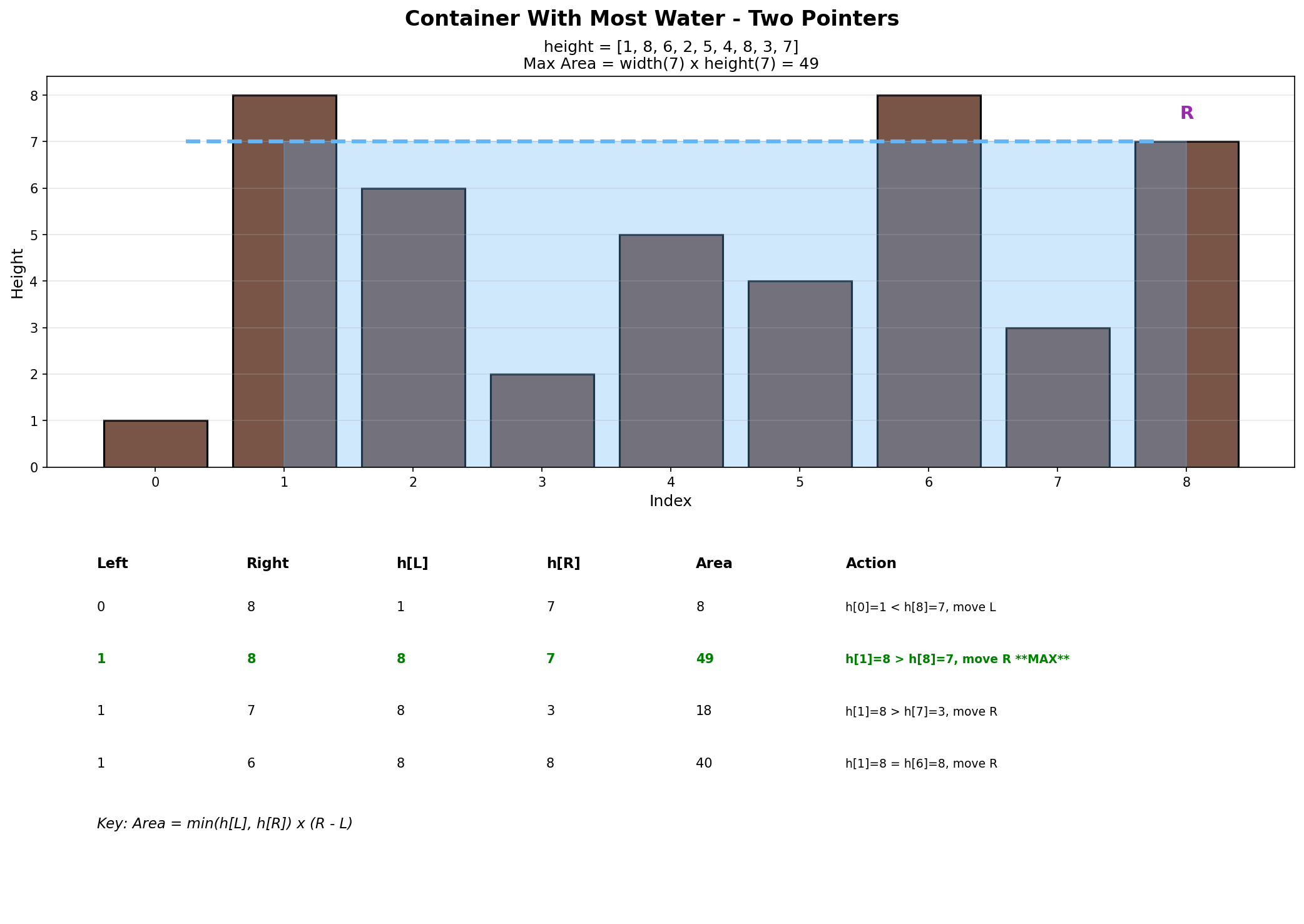
Key Insight: Two Pointers
The area between two lines is determined by:
- Width: Distance between the two lines
- Height: The minimum of the two line heights
Start with the widest possible container (left and right ends), then try to find taller lines by moving pointers inward.
Critical insight: Always move the pointer pointing to the shorter line. Why?
- The area is limited by the shorter line
- Moving the shorter line might find a taller line and increase area
- Moving the taller line can only decrease or maintain area
Solution
def maxArea(height: list[int]) -> int:
    """
    Find maximum water container using two pointers.

    Time Complexity: O(n)
    Space Complexity: O(1)
    """
    left = 0
    right = len(height) - 1
    max_water = 0

    while left < right:
        # Calculate current area
        width = right - left
        h = min(height[left], height[right])
        current_water = width * h
        max_water = max(max_water, current_water)

        # Move the pointer at shorter height
        if height[left] < height[right]:
            left += 1
        else:
            right -= 1

return max_waterpublic int maxArea(int[] height) {
int left = 0;
int right = height.length - 1;
int maxWater = 0;
while (left < right) {
// Calculate current area
int width = right - left;
int h = Math.min(height[left], height[right]);
int currentWater = width * h;
maxWater = Math.max(maxWater, currentWater);
// Move the pointer at shorter height
if (height[left] < height[right]) {
left++;
} else {
right--;
}
}
return maxWater;
}Complexity (Two Pointers): Time O(n) · Space O(1)
- Time: Each pointer moves inward at most n times total; the while loop runs at most n-1 iterations
- Space: Only three variables (
left,right,max_water) regardless of array size
# Brute force for comparison (don't use in interview)
def maxArea_bruteforce(height: list[int]) -> int:
    """
    Check all pairs - O(n^2).
    """
    max_water = 0
    n = len(height)

    for i in range(n):
        for j in range(i + 1, n):
            width = j - i
            h = min(height[i], height[j])
            max_water = max(max_water, width * h)

return max_waterComplexity (Brute Force): Time O(n^2) · Space O(1)
- Time: Nested loops check all n*(n-1)/2 pairs of lines
- Space: Only one tracking variable for maximum water
Step-by-Step Trace
For height = [1, 8, 6, 2, 5, 4, 8, 3, 7]:
| left | right | height[left] | height[right] | width | area | max_water | Move |
|---|---|---|---|---|---|---|---|
| 0 | 8 | 1 | 7 | 8 | 8 | 8 | left++ |
| 1 | 8 | 8 | 7 | 7 | 49 | 49 | right-- |
| 1 | 7 | 8 | 3 | 6 | 18 | 49 | right-- |
| 1 | 6 | 8 | 8 | 5 | 40 | 49 | right-- |
| 1 | 5 | 8 | 4 | 4 | 16 | 49 | right-- |
| 1 | 4 | 8 | 5 | 3 | 15 | 49 | right-- |
| 1 | 3 | 8 | 2 | 2 | 4 | 49 | right-- |
| 1 | 2 | 8 | 6 | 1 | 6 | 49 | right-- |
| 1 | 1 | - | - | - | - | 49 | stop |
Result: Maximum water = 49
Why Two Pointers Work
Proof of correctness:
- We start with maximum width
- At each step, we move the pointer at the shorter line
- The line we're moving away from cannot be part of a better solution because:
- Any container using it would have the same or smaller height
- Any container using it would have smaller width
- Therefore, we never miss the optimal solution
Complexity Analysis
| Approach | Time | Space |
|---|---|---|
| Two Pointers | O(n) | O(1) |
| Brute Force | O(n^2) | O(1) |
Edge Cases
- Two elements:
[1, 1]-> Area = 1 - Ascending heights:
[1, 2, 3, 4]-> Area = 4 (indices 0, 3) - Descending heights:
[4, 3, 2, 1]-> Area = 4 (indices 0, 3) - Same heights:
[5, 5, 5, 5]-> Area = 15 (indices 0, 3) - One tall, rest short:
[1, 1, 100, 1, 1]-> Area = 4
Common Mistakes
- Moving wrong pointer - Must move the shorter one
- Calculating area incorrectly - Use min(heights), not max or sum
- Off-by-one in width - Width = right - left (not right - left + 1)
- Forgetting edge cases - Minimum 2 elements needed
Difference from Trapping Rain Water
| Container With Most Water | Trapping Rain Water |
|---|---|
| Only 2 lines matter | All lines matter |
| Water on top of bars | Water between bars |
| Area = min(h[i], h[j]) * (j - i) | Water trapped in each position |
| Choose best pair | Sum of all trapped water |
Container:       Trapping:
   |~~~~|           |
   |    |           |~~|  |
   | ~~ |   vs    ~~|~~|~~|
---+----+--- --+--+--+--Related Problems
Trapping Rain Water (LeetCode 42)
Problem: Given elevation map, compute how much water can be trapped after rain.
Key Insight: Water at each position = min(maxLeft, maxRight) - height. Different from Container because we sum water at ALL positions, not just between two lines.
Approach: Two pointers from ends, process side with smaller max. Or use prefix/suffix arrays.
Complexity: O(n) time, O(1) space with two pointers
Largest Rectangle in Histogram (LeetCode 84)
Problem: Find largest rectangle area in histogram where each bar has width 1.
Key Insight: For each bar, find how far left and right it can extend as the minimum height. Use monotonic stack.
Approach: Maintain monotonic increasing stack. When a shorter bar appears, calculate areas for taller bars in stack.
Complexity: O(n) time, O(n) space
Maximal Rectangle (LeetCode 85)
Problem: Find largest rectangle containing only 1s in a binary matrix.
Key Insight: Build histogram row by row, then apply Largest Rectangle in Histogram.
Approach: For each row, calculate heights (consecutive 1s above). Apply histogram algorithm to each row.
Complexity: O(m*n) time, O(n) space
Key Takeaways
- Two pointers from ends is optimal for this "maximize area" problem
- Always move the pointer at the shorter line
- The greedy choice is provably correct
- Don't confuse with trapping rain water (different problem)
- Area formula: width * min(left_height, right_height)