House Robber
Problem Statement
You are a professional robber planning to rob houses along a street. Each house has a certain amount of money stashed. The only constraint stopping you from robbing each of them is that adjacent houses have security systems connected, and it will automatically contact the police if two adjacent houses are broken into on the same night.
Given an integer array nums representing the amount of money at each house, return the maximum amount of money you can rob tonight without alerting the police.
Input/Output Format
Input:
nums(List[int]): An array wherenums[i]represents the money in housei
Output:
- (int): Maximum amount of money that can be robbed without robbing adjacent houses
Constraints
1 <= nums.length <= 1000 <= nums[i] <= 400
Examples
Example 1: Simple Case
Input: nums = [1, 2, 3, 1]
Output: 4
Explanation:
- Rob house 0 (money = 1) and house 2 (money = 3)
- Total = 1 + 3 = 4
Houses:    [0]    [1]    [2]    [3]
            |      |      |      |
Money:     $1     $2     $3     $1
            ^             ^
           ROB           ROB

Cannot rob adjacent houses!
Option 1: Rob [0, 2] = 1 + 3 = 4  <-- Best
Option 2: Rob [0, 3] = 1 + 1 = 2
Option 3: Rob [1, 3] = 2 + 1 = 3
Option 4: Rob [1]    = 2
Option 5: Rob [2] = 3Example 2: Larger Array
Input: nums = [2, 7, 9, 3, 1]
Output: 12
Explanation:
- Rob house 0 (money = 2), house 2 (money = 9), and house 4 (money = 1)
- Total = 2 + 9 + 1 = 12
Houses:    [0]    [1]    [2]    [3]    [4]
            |      |      |      |      |
Money:     $2     $7     $9     $3     $1
            ^             ^             ^
           ROB           ROB           ROB

Analysis:
- Rob [0, 2, 4]: 2 + 9 + 1 = 12  <-- Best
- Rob [1, 3]:    7 + 3 = 10
- Rob [1, 4]:    7 + 1 = 8
- Rob [0, 2]:    2 + 9 = 11
- Rob [0, 3]: 2 + 3 = 5Example 3: Two Houses
Input: nums = [2, 1]
Output: 2
Explanation: Only one house can be robbed. Choose the one with more money.
Houses:    [0]    [1]
            |      |
Money:     $2     $1
            ^
           ROB

Max(2, 1) = 2Visual Explanation
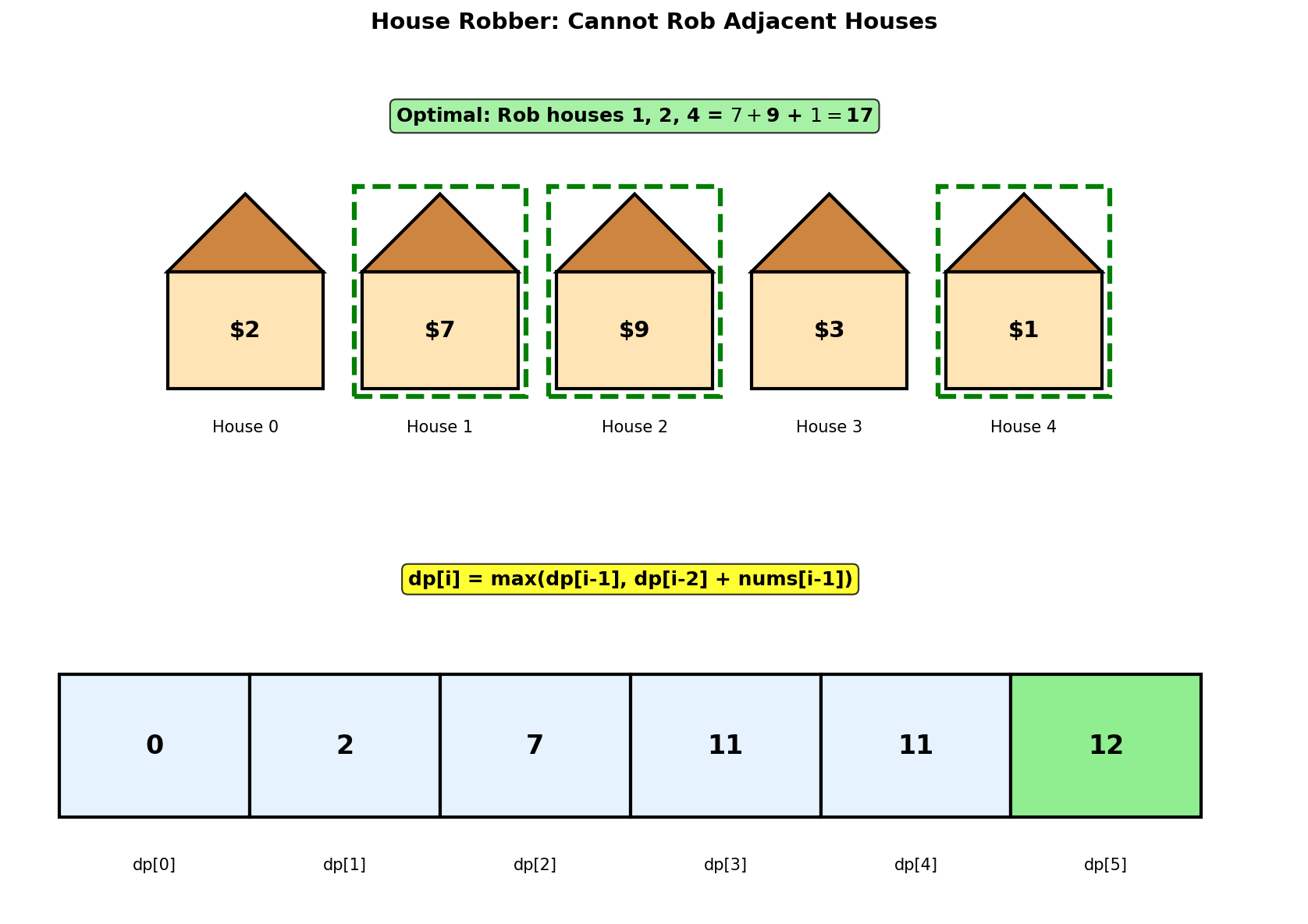
ASCII Art: DP Table Building
nums = [2, 7, 9, 3, 1]

Building DP table:
dp[i] = max money robbing houses 0..i-1

Index:     0     1     2     3     4     5
         +-----+-----+-----+-----+-----+-----+
dp[]:    |  0  |  2  |  7  |  11 |  11 |  12 |
         +-----+-----+-----+-----+-----+-----+
           ^     ^
           |     |
       base    can only rob
       case    house 0

Recurrence: dp[i] = max(dp[i-1], dp[i-2] + nums[i-1])

Decision at each house:
- Skip this house: keep dp[i-1]
- Rob this house:  dp[i-2] + nums[i-1]

Trace:
dp[0] = 0                                    (no houses)
dp[1] = 2                                    (only house 0)
dp[2] = max(dp[1], dp[0] + 7) = max(2, 7) = 7
dp[3] = max(dp[2], dp[1] + 9) = max(7, 11) = 11
dp[4] = max(dp[3], dp[2] + 3) = max(11, 10) = 11
dp[5] = max(dp[4], dp[3] + 1) = max(11, 12) = 12

Answer: dp[5] = 12Solution Code
Approach 1: Top-Down (Memoization)
from typing import List

def rob(nums: List[int]) -> int:
    """
    Find maximum money that can be robbed using memoization.

    At each house, we have two choices:
    1. Rob current house: Add its value + max from house+2 onwards
    2. Skip current house: Take max from house+1 onwards

    Args:
        nums: Array of money in each house

    Returns:
        Maximum money that can be robbed

    Time Complexity: O(n)
    Space Complexity: O(n)
    """
    n = len(nums)
    memo = {}

    def dp(i: int) -> int:
        """Return max money robbing houses from index i to end."""
        # Base case: no more houses
        if i >= n:
            return 0

        if i in memo:
            return memo[i]

        # Choice: rob this house or skip it
        rob_current = nums[i] + dp(i + 2)  # Must skip next house
        skip_current = dp(i + 1)

        memo[i] = max(rob_current, skip_current)
        return memo[i]

return dp(0)Complexity: Time O(n) · Space O(n)
- Time: Each house index from 0 to n-1 is computed exactly once due to memoization, giving O(n) total operations.
- Space: The memoization dictionary stores at most n entries, plus the recursion stack can go n levels deep in the worst case.
Approach 2: Bottom-Up (Tabulation)
from typing import List

def rob(nums: List[int]) -> int:
    """
    Find maximum money that can be robbed using bottom-up DP.

    dp[i] represents the maximum money that can be robbed
    from houses 0 to i-1.

    Args:
        nums: Array of money in each house

    Returns:
        Maximum money that can be robbed

    Time Complexity: O(n)
    Space Complexity: O(n)
    """
    n = len(nums)

    if n == 0:
        return 0
    if n == 1:
        return nums[0]

    # dp[i] = max money robbing from house 0 to house i-1
    dp = [0] * (n + 1)
    dp[0] = 0         # No houses
    dp[1] = nums[0]   # Only first house

    for i in range(2, n + 1):
        # Either skip house i-1, or rob it
        dp[i] = max(dp[i - 1], dp[i - 2] + nums[i - 1])

return dp[n]Complexity: Time O(n) · Space O(n)
- Time: Single pass through the array from index 2 to n, performing constant-time operations at each step.
- Space: The dp array of size n+1 stores the maximum value achievable for each prefix of houses.
Approach 3: Space-Optimized Bottom-Up
from typing import List

def rob(nums: List[int]) -> int:
    """
    Find maximum money with O(1) space.

    Since we only need the previous two values, we can
    optimize space to O(1).

    Args:
        nums: Array of money in each house

    Returns:
        Maximum money that can be robbed

    Time Complexity: O(n)
    Space Complexity: O(1)
    """
    n = len(nums)

    if n == 0:
        return 0
    if n == 1:
        return nums[0]

    # prev2 = dp[i-2], prev1 = dp[i-1]
    prev2 = 0
    prev1 = nums[0]

    for i in range(1, n):
        # Current house decision
        current = max(prev1, prev2 + nums[i])
        prev2 = prev1
        prev1 = current

return prev1public int rob(int[] nums) {
int n = nums.length;
if (n == 0) return 0;
if (n == 1) return nums[0];
// prev2 = dp[i-2], prev1 = dp[i-1]
int prev2 = 0;
int prev1 = nums[0];
for (int i = 1; i < n; i++) {
// Current house decision
int current = Math.max(prev1, prev2 + nums[i]);
prev2 = prev1;
prev1 = current;
}
return prev1;
}Complexity: Time O(n) · Space O(1)
- Time: Single linear pass through the array performing constant-time max operations at each house.
- Space: Only two variables (prev1, prev2) are maintained regardless of input size, achieving constant space.
Approach 4: Alternative Formulation
from typing import List

def rob(nums: List[int]) -> int:
    """
    Alternative approach tracking 'rob' and 'not_rob' states.

    At each position, track:
    - rob: max money if we rob current house
    - not_rob: max money if we don't rob current house

    Args:
        nums: Array of money in each house

    Returns:
        Maximum money that can be robbed

    Time Complexity: O(n)
    Space Complexity: O(1)
    """
    if not nums:
        return 0

    # rob = max money if previous house was robbed
    # not_rob = max money if previous house was NOT robbed
    rob_prev = 0
    not_rob_prev = 0

    for money in nums:
        # If we rob current, previous must NOT have been robbed
        rob_curr = not_rob_prev + money

        # If we don't rob current, take max of previous states
        not_rob_curr = max(rob_prev, not_rob_prev)

        rob_prev = rob_curr
        not_rob_prev = not_rob_curr

return max(rob_prev, not_rob_prev)Complexity: Time O(n) · Space O(1)
- Time: Iterates through each house exactly once, updating two state variables in constant time per iteration.
- Space: Uses only four variables (rob_prev, not_rob_prev, rob_curr, not_rob_curr) regardless of array size.
Complexity Analysis
| Approach | Time Complexity | Space Complexity |
|---|---|---|
| Top-Down (Memoization) | O(n) | O(n) |
| Bottom-Up (Tabulation) | O(n) | O(n) |
| Space-Optimized | O(n) | O(1) |
| State-based | O(n) | O(1) |
Edge Cases
Empty array:
pythonrob([]) # Returns 0Single house:
pythonrob([5]) # Returns 5Two houses:
pythonrob([1, 2]) # Returns 2 (rob house with more money)All equal values:
pythonrob([5, 5, 5, 5]) # Returns 10 (rob houses 0 and 2)Decreasing values:
pythonrob([10, 5, 3, 1]) # Returns 13 (rob houses 0 and 2)One very large value:
pythonrob([1, 100, 1]) # Returns 100 (just rob middle house)
Key Insights
Decision at Each Step: For each house, decide whether to rob it or skip it. This creates a binary decision tree that DP efficiently handles.
Non-Adjacency Constraint: If we rob house
i, we cannot rob housei-1ori+1. This gives us the recurrence:dp[i] = max(dp[i-1], dp[i-2] + nums[i]).State Definition:
dp[i]= maximum money obtainable considering houses from index 0 to i-1.Optimal Substructure: The maximum money from houses 0 to i depends only on the solutions for houses 0 to i-1 and 0 to i-2.
No Backtracking Needed: The greedy choice of "rob or skip" at each position, when done with DP, guarantees the global optimum.
Related Problems
House Robber II (LeetCode 213)
Problem: Houses are arranged in a circle, meaning the first and last houses are adjacent. Find maximum money you can rob without robbing adjacent houses.
Key Insight: Since first and last are adjacent, we cannot rob both. Split into two linear subproblems: rob houses [0, n-2] OR rob houses [1, n-1].
Approach: max(rob(nums[0:n-1]), rob(nums[1:n])) using the original House Robber algorithm.
Complexity: O(n) time, O(1) space
House Robber III (LeetCode 337)
Problem: Houses are arranged in a binary tree. The thief cannot rob two directly connected (parent-child) houses. Find maximum money.
Key Insight: Tree DP with two states per node: max if we rob this node vs. max if we skip this node.
Approach: DFS returning tuple (rob_this, skip_this). If rob current: sum skip values of children. If skip current: sum max of each child's options.
Complexity: O(n) time, O(h) space where h is tree height
Delete and Earn (LeetCode 740)
Problem: Given array nums, if you take element x, you earn x points but must delete all x-1 and x+1. Find maximum points.
Key Insight: Transform to House Robber by counting frequency. Taking all occurrences of value v prevents taking v-1 or v+1.
Approach: Create array where points[v] = v * count[v]. Then apply House Robber DP on points array.
Complexity: O(n + max(nums)) time, O(max(nums)) space
Paint House (LeetCode 256)
Problem: Paint n houses with 3 colors (red, blue, green). Each house has different costs for each color. No two adjacent houses can have the same color. Find minimum total cost.
Key Insight: Similar non-adjacency constraint but with multiple choices instead of binary. Track minimum cost ending with each color.
Approach: dp[i][c] = cost[i][c] + min(dp[i-1][other colors]). Track 3 states per house.
Complexity: O(n) time, O(1) space