Median of Two Sorted Arrays
Problem Statement
Given two sorted arrays nums1 and nums2 of size m and n respectively, return the median of the two sorted arrays.
The overall run time complexity should be O(log(m+n)).
Examples
Example 1
Input: nums1 = [1, 3], nums2 = [2]
Output: 2.0
Explanation: merged array = [1, 2, 3] and median is 2.Example 2
Input: nums1 = [1, 2], nums2 = [3, 4]
Output: 2.5
Explanation: merged array = [1, 2, 3, 4] and median is (2 + 3) / 2 = 2.5.Example 3
Input: nums1 = [0, 0], nums2 = [0, 0]
Output: 0.0Visual Explanation
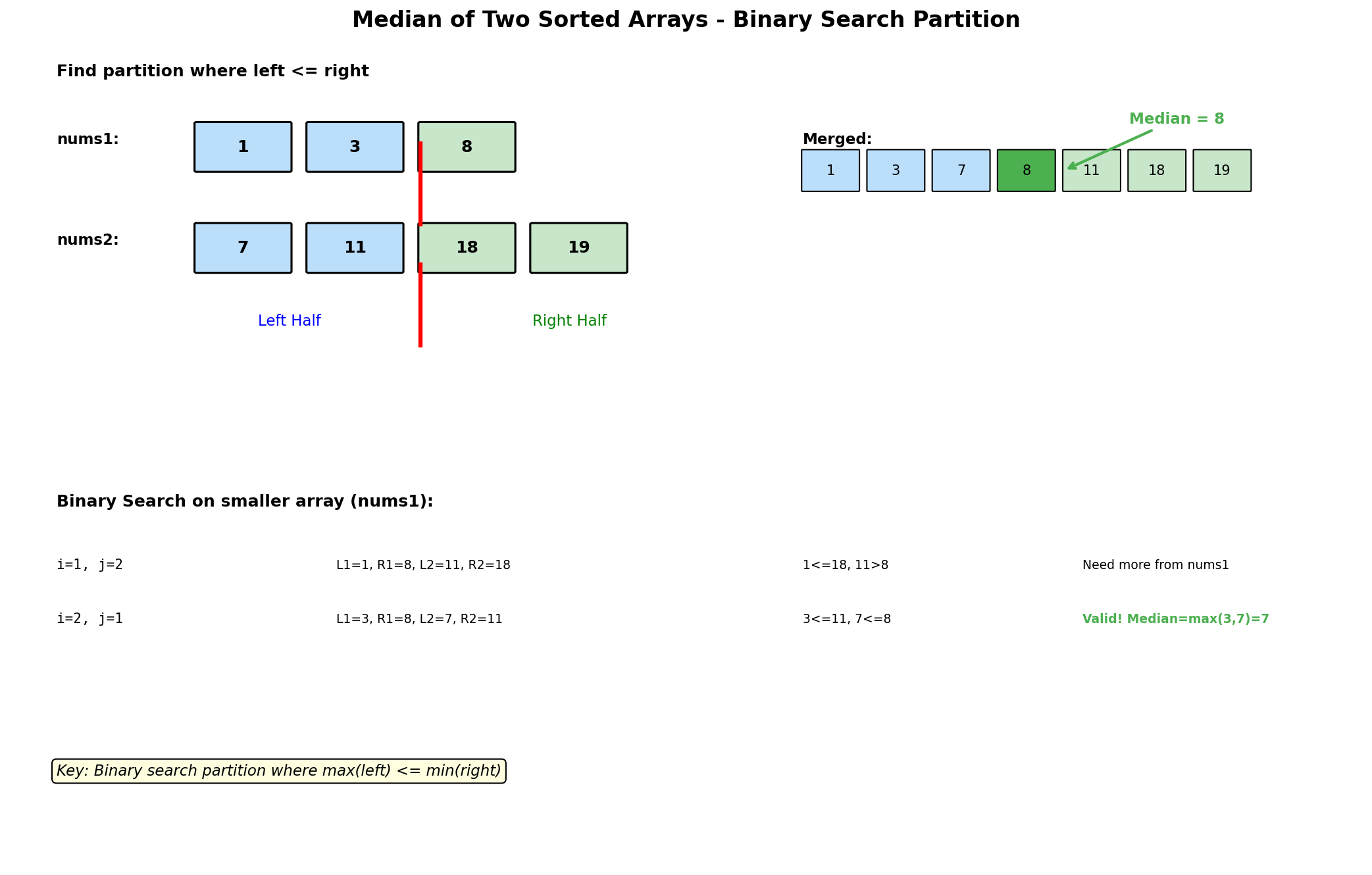
Key Insight: Binary Search on Partition
Instead of merging arrays (O(m+n)), we binary search on where to partition.
For combined array to have left half and right half:
- Left half should have
(m + n + 1) // 2elements - If we take
ielements from nums1, we takehalf_len - ifrom nums2
Valid partition condition:
nums1[i-1] <= nums2[j](left of nums1 <= right of nums2)nums2[j-1] <= nums1[i](left of nums2 <= right of nums1)
Solution
def findMedianSortedArrays(nums1: list[int], nums2: list[int]) -> float:
    """
    Find median using binary search on partition.

    Time Complexity: O(log(min(m, n)))
    Space Complexity: O(1)
    """
    # Ensure nums1 is the smaller array
    if len(nums1) > len(nums2):
        nums1, nums2 = nums2, nums1

    m, n = len(nums1), len(nums2)
    half_len = (m + n + 1) // 2

    left, right = 0, m

    while left <= right:
        # Partition positions
        i = (left + right) // 2  # Partition in nums1
        j = half_len - i          # Partition in nums2

        # Elements around partitions
        nums1_left = float('-inf') if i == 0 else nums1[i - 1]
        nums1_right = float('inf') if i == m else nums1[i]
        nums2_left = float('-inf') if j == 0 else nums2[j - 1]
        nums2_right = float('inf') if j == n else nums2[j]

        if nums1_left <= nums2_right and nums2_left <= nums1_right:
            # Found valid partition
            if (m + n) % 2 == 1:
                # Odd total: median is max of left side
                return float(max(nums1_left, nums2_left))
            else:
                # Even total: median is average of max left and min right
                return (max(nums1_left, nums2_left) +
                        min(nums1_right, nums2_right)) / 2
        elif nums1_left > nums2_right:
            # nums1 partition is too far right
            right = i - 1
        else:
            # nums1 partition is too far left
            left = i + 1

raise ValueError("Input arrays are not sorted")public double findMedianSortedArrays(int[] nums1, int[] nums2) {
// Ensure nums1 is the smaller array
if (nums1.length > nums2.length) {
int[] tmp = nums1; nums1 = nums2; nums2 = tmp;
}
int m = nums1.length, n = nums2.length;
int halfLen = (m + n + 1) / 2;
int left = 0, right = m;
while (left <= right) {
// Partition positions
int i = left + (right - left) / 2; // Partition in nums1
int j = halfLen - i; // Partition in nums2
// Elements around partitions
int nums1Left = (i == 0) ? Integer.MIN_VALUE : nums1[i - 1];
int nums1Right = (i == m) ? Integer.MAX_VALUE : nums1[i];
int nums2Left = (j == 0) ? Integer.MIN_VALUE : nums2[j - 1];
int nums2Right = (j == n) ? Integer.MAX_VALUE : nums2[j];
if (nums1Left <= nums2Right && nums2Left <= nums1Right) {
// Found valid partition
if ((m + n) % 2 == 1) {
// Odd total: median is max of left side
return Math.max(nums1Left, nums2Left);
} else {
// Even total: median is average of max left and min right
return (Math.max(nums1Left, nums2Left) +
(double) Math.min(nums1Right, nums2Right)) / 2.0;
}
} else if (nums1Left > nums2Right) {
// nums1 partition is too far right
right = i - 1;
} else {
// nums1 partition is too far left
left = i + 1;
}
}
throw new IllegalArgumentException("Input arrays are not sorted");
}Complexity: Time O(log(min(m, n))) · Space O(1)
- Time: Binary search on the smaller array; each iteration halves the search space. We always search the smaller array to minimize iterations.
- Space: Only constant variables for partition indices and boundary elements (
i,j,nums1_left, etc.)
# Simpler O(m+n) approach for understanding
def findMedianSortedArrays_merge(nums1: list[int], nums2: list[int]) -> float:
    """
    Merge and find median - O(m+n) time.
    """
    merged = []
    i = j = 0

    while i < len(nums1) and j < len(nums2):
        if nums1[i] <= nums2[j]:
            merged.append(nums1[i])
            i += 1
        else:
            merged.append(nums2[j])
            j += 1

    merged.extend(nums1[i:])
    merged.extend(nums2[j:])

    n = len(merged)
    if n % 2 == 1:
        return float(merged[n // 2])
    else:
return (merged[n // 2 - 1] + merged[n // 2]) / 2Complexity: Time O(m + n) · Space O(m + n)
- Time: Linear merge of both arrays element by element until fully merged
- Space: Creates a new merged array storing all (m + n) elements
# Optimized: stop at median position
def findMedianSortedArrays_optimized_merge(nums1: list[int], nums2: list[int]) -> float:
    """
    Only merge until median position - O((m+n)/2) time.
    """
    m, n = len(nums1), len(nums2)
    total = m + n
    target = total // 2

    i = j = 0
    prev = curr = 0

    for _ in range(target + 1):
        prev = curr
        if i < m and (j >= n or nums1[i] <= nums2[j]):
            curr = nums1[i]
            i += 1
        else:
            curr = nums2[j]
            j += 1

    if total % 2 == 1:
        return float(curr)
    else:
return (prev + curr) / 2Complexity: Time O((m + n) / 2) · Space O(1)
- Time: Only iterates up to the median position (half the total elements) rather than merging the entire arrays
- Space: Uses only constant variables (
prev,curr,i,j) without creating a merged array
Step-by-Step Trace
For nums1 = [1, 3], nums2 = [2]:
m = 2, n = 1, half_len = (2+1+1)//2 = 2

Binary search on nums1 partition:

Iteration 1:
  left = 0, right = 2
  i = 1 (take 1 element from nums1)
  j = 2 - 1 = 1 (take 1 element from nums2)

  nums1: [1 | 3]
  nums2: [2 |  ]

  nums1_left = 1, nums1_right = 3
  nums2_left = 2, nums2_right = inf

  Check: 1 <= inf ✓, 2 <= 3 ✓
  Valid partition!

  Total = 3 (odd)
Median = max(nums1_left, nums2_left) = max(1, 2) = 2.0Complexity Analysis
| Approach | Time | Space |
|---|---|---|
| Binary Search | O(log(min(m,n))) | O(1) |
| Full Merge | O(m+n) | O(m+n) |
| Partial Merge | O((m+n)/2) | O(1) |
Edge Cases
- Empty array:
[]and[1]-> 1.0 - Different sizes:
[1,2]and[3,4,5,6] - One element each:
[1]and[2]-> 1.5 - No overlap:
[1,2]and[3,4]-> 2.5 - Full overlap:
[1,3]and[2,4]-> 2.5 - Duplicates:
[1,1,1]and[1,1,1]-> 1.0
Common Mistakes
- Not handling empty partitions - Use -inf and inf for boundaries
- Wrong half_len calculation - Use
(m + n + 1) // 2for correct left side - Binary search on wrong array - Search on smaller array for O(log(min))
- Off-by-one errors - Partition index
imeansielements on left - Integer vs float - Return float for even length case
Why Binary Search Works
If we partition both arrays:

nums1:  [...left1...] | [...right1...]
nums2:  [...left2...] | [...right2...]

Valid if:
1. max(left1) <= min(right2)  -- left1 elements are smaller than right2
2. max(left2) <= min(right1)  -- left2 elements are smaller than right1

If condition 1 fails (left1 too big): move partition left in nums1
If condition 2 fails (left2 too big): move partition right in nums1

Since arrays are sorted, binary search converges to valid partition.Related Problems
Merge Sorted Array (LeetCode 88)
Problem: Merge nums2 into nums1 (nums1 has extra space at end).
Key Insight: Merge from the END to avoid overwriting - fill largest elements first.
Approach: Three pointers: one at end of nums1 values, one at end of nums2, one at end of merged area. Compare and place larger.
Complexity: O(m + n) time, O(1) space
Kth Smallest Element in a Sorted Matrix (LeetCode 378)
Problem: Find kth smallest in matrix where rows and columns are sorted.
Key Insight: Binary search on VALUE (not index). Count elements <= mid.
Approach: Binary search range [matrix[0][0], matrix[n-1][n-1]]. For each mid, count elements <= mid using staircase traversal.
Complexity: O(n * log(max - min)) time, O(1) space
Find K-th Smallest Pair Distance (LeetCode 719)
Problem: Find kth smallest absolute difference among all pairs.
Key Insight: Binary search on distance value. Count pairs with distance <= mid.
Approach: Sort array. Binary search on distance [0, max-min]. For each mid, count pairs with distance <= mid using two pointers.
Complexity: O(n log n + n log(max-min)) time, O(1) space
Key Takeaways
- This is one of the hardest array problems - requires deep understanding
- Binary search on partition is the key insight
- Always binary search on the smaller array for O(log(min(m,n)))
- Handle edge cases with -inf and +inf for empty partitions
- The valid partition condition ensures correct left/right split
- Understanding this problem helps with many "kth element" problems