Partition Equal Subset Sum
Problem Statement
Given an integer array nums, return true if you can partition the array into two subsets such that the sum of the elements in both subsets is equal, or false otherwise.
This is a classic subset sum problem, which is a special case of the 0/1 Knapsack problem.
Input/Output Format
Input:
nums(List[int]): Array of positive integers
Output:
- (bool): True if array can be partitioned into two equal-sum subsets
Constraints
1 <= nums.length <= 2001 <= nums[i] <= 100
Examples
Example 1: Partitionable Array
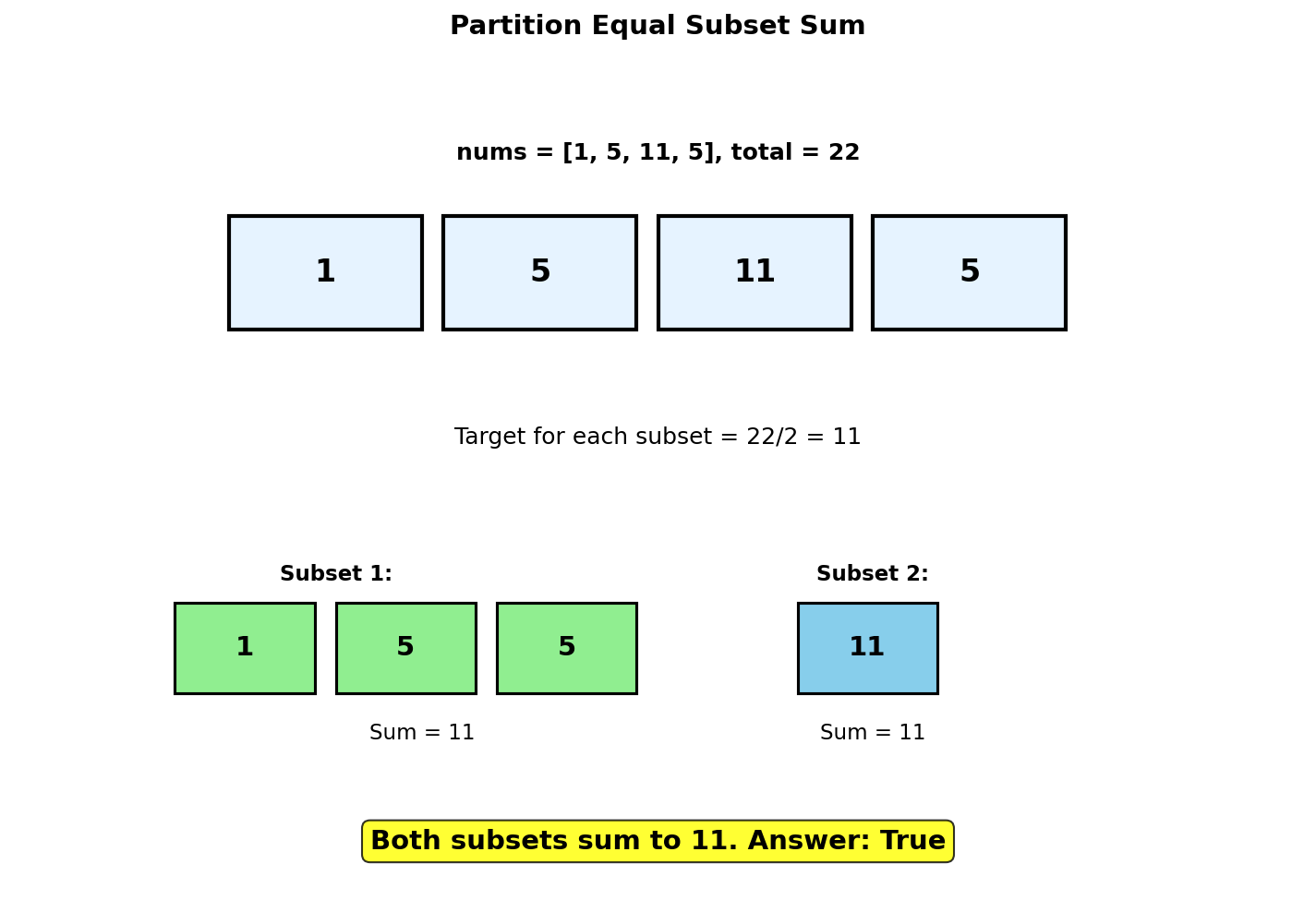
Input: nums = [1, 5, 11, 5]
Output: true
Explanation:
Total sum = 1 + 5 + 11 + 5 = 22
Target for each subset = 22 / 2 = 11

Partition:
- Subset 1: [1, 5, 5] -> sum = 11
- Subset 2: [11]      -> sum = 11

Both subsets have equal sum!Example 2: Not Partitionable
Input: nums = [1, 2, 3, 5]
Output: false
Explanation:
Total sum = 1 + 2 + 3 + 5 = 11
Target would be 11 / 2 = 5.5

Since total is odd, equal partition is impossible.Example 3: Two Elements
Input: nums = [1, 1]
Output: true
Explanation:
Partition: [1] and [1]Example 4: Single Element
Input: nums = [5]
Output: false
Explanation: Cannot partition single element into two non-empty subsets.
Visual Explanation
ASCII Art: DP Table Building
nums = [1, 5, 11, 5], target = 11

DP Table: dp[i][j] = true if we can achieve sum j using elements 0..i-1

            Sum j
            0    1    2    3    4    5    6    7    8    9   10   11
          +---+----+----+----+----+----+----+----+----+----+----+----+
Item 0    | T |  F |  F |  F |  F |  F |  F |  F |  F |  F |  F |  F |
(no item) +---+----+----+----+----+----+----+----+----+----+----+----+
Item 1    | T |  T |  F |  F |  F |  F |  F |  F |  F |  F |  F |  F |
(1)       +---+----+----+----+----+----+----+----+----+----+----+----+
Item 2    | T |  T |  F |  F |  F |  T |  T |  F |  F |  F |  F |  F |
(1,5)     +---+----+----+----+----+----+----+----+----+----+----+----+
Item 3    | T |  T |  F |  F |  F |  T |  T |  F |  F |  F |  F |  T |
(1,5,11)  +---+----+----+----+----+----+----+----+----+----+----+----+
Item 4    | T |  T |  F |  F |  F |  T |  T |  F |  F |  F |  T |  T |
(1,5,11,5)+---+----+----+----+----+----+----+----+----+----+----+----+
                                                                  ^
                                                                  |
                                                            Answer: T

dp[4][11] = True means we can form sum 11 using some subset.Solution Code
Approach 1: Top-Down (Memoization)
from typing import List
from functools import lru_cache

def canPartition(nums: List[int]) -> bool:
    """
    Check if array can be partitioned using memoization.

    If we can find a subset with sum = total/2, the remaining
    elements will also sum to total/2.

    Args:
        nums: Array of positive integers

    Returns:
        True if partitionable

    Time Complexity: O(n * sum)
    Space Complexity: O(n * sum)
    """
    total = sum(nums)

    # If total is odd, impossible to partition equally
    if total % 2 != 0:
        return False

    target = total // 2
    n = len(nums)

    @lru_cache(maxsize=None)
    def dp(index: int, remaining: int) -> bool:
        """Check if we can achieve 'remaining' sum using nums[index:]."""
        # Base cases
        if remaining == 0:
            return True
        if index >= n or remaining < 0:
            return False

        # Include or exclude current element
        return dp(index + 1, remaining - nums[index]) or dp(index + 1, remaining)

return dp(0, target)Complexity: Time O(n * sum) · Space O(n * sum)
- Time: At most n*sum unique subproblems, each computed in O(1) with memoization
- Space: Memoization cache stores up to n*sum states plus O(n) recursion stack
Approach 2: Bottom-Up (Tabulation)
from typing import List

def canPartition(nums: List[int]) -> bool:
    """
    Check if array can be partitioned using bottom-up DP.

    dp[i][j] = True if we can form sum j using elements 0..i-1.

    Args:
        nums: Array of positive integers

    Returns:
        True if partitionable

    Time Complexity: O(n * sum)
    Space Complexity: O(n * sum)
    """
    total = sum(nums)

    if total % 2 != 0:
        return False

    target = total // 2
    n = len(nums)

    # dp[i][j] = can form sum j using first i elements
    dp = [[False] * (target + 1) for _ in range(n + 1)]

    # Base case: sum 0 is achievable with empty subset
    for i in range(n + 1):
        dp[i][0] = True

    for i in range(1, n + 1):
        for j in range(1, target + 1):
            # Don't include nums[i-1]
            dp[i][j] = dp[i - 1][j]

            # Include nums[i-1] if possible
            if j >= nums[i - 1]:
                dp[i][j] = dp[i][j] or dp[i - 1][j - nums[i - 1]]

return dp[n][target]Complexity: Time O(n * sum) · Space O(n * sum)
- Time: Filling n rows and sum columns with O(1) work per cell
- Space: 2D DP table of size (n+1) x (target+1)
Approach 3: Space-Optimized (1D Array)
from typing import List

def canPartition(nums: List[int]) -> bool:
    """
    Check if array can be partitioned with O(sum) space.

    Key: Iterate in reverse to avoid using same element twice.

    Args:
        nums: Array of positive integers

    Returns:
        True if partitionable

    Time Complexity: O(n * sum)
    Space Complexity: O(sum)
    """
    total = sum(nums)

    if total % 2 != 0:
        return False

    target = total // 2

    # dp[j] = True if we can form sum j
    dp = [False] * (target + 1)
    dp[0] = True

    for num in nums:
        # Iterate in REVERSE to avoid using same element twice
        for j in range(target, num - 1, -1):
            dp[j] = dp[j] or dp[j - num]

return dp[target]public boolean canPartition(int[] nums) {
int total = 0;
for (int n : nums) total += n;
if (total % 2 != 0) return false;
int target = total / 2;
// dp[j] = true if we can form sum j
boolean[] dp = new boolean[target + 1];
dp[0] = true;
for (int num : nums) {
// Iterate in REVERSE to avoid using same element twice
for (int j = target; j >= num; j--) {
dp[j] = dp[j] || dp[j - num];
}
}
return dp[target];
}Complexity: Time O(n * sum) · Space O(sum)
- Time: For each of n elements, iterate through up to sum/2 values
- Space: Single 1D array of size target+1 (sum/2 + 1)
Approach 4: Using Set (Alternative)
from typing import List

def canPartition(nums: List[int]) -> bool:
    """
    Check if array can be partitioned using a set.

    Track all achievable sums at each step.

    Args:
        nums: Array of positive integers

    Returns:
        True if partitionable

    Time Complexity: O(n * sum)
    Space Complexity: O(sum)
    """
    total = sum(nums)

    if total % 2 != 0:
        return False

    target = total // 2

    # Set of achievable sums
    achievable = {0}

    for num in nums:
        # Add new sums by including current number
        new_sums = set()
        for s in achievable:
            new_sum = s + num
            if new_sum == target:
                return True
            if new_sum < target:
                new_sums.add(new_sum)
        achievable.update(new_sums)

return target in achievableComplexity: Time O(n * sum) · Space O(sum)
- Time: For each element, potentially add new sums up to target
- Space: Set stores at most target distinct achievable sums
Approach 5: Bitset Optimization
from typing import List

def canPartition(nums: List[int]) -> bool:
    """
    Check if array can be partitioned using bitset.

    Use integer as a bitset where bit i is set if sum i is achievable.

    Args:
        nums: Array of positive integers

    Returns:
        True if partitionable

    Time Complexity: O(n * sum / 64) with bitset optimization
    Space Complexity: O(sum / 64)
    """
    total = sum(nums)

    if total % 2 != 0:
        return False

    target = total // 2

    # bits[i] = 1 means sum i is achievable
    bits = 1  # Sum 0 is achievable

    for num in nums:
        bits |= bits << num

return (bits >> target) & 1 == 1Complexity: Time O(n * sum / 64) · Space O(sum / 64)
- Time: Bitwise OR and shift operations process 64 bits at once
- Space: Single integer acts as bitset, with implicit O(sum) bits
Complexity Analysis
| Approach | Time Complexity | Space Complexity |
|---|---|---|
| Top-Down | O(n * sum) | O(n * sum) |
| Bottom-Up | O(n * sum) | O(n * sum) |
| 1D Array | O(n * sum) | O(sum) |
| Set | O(n * sum) | O(sum) |
| Bitset | O(n * sum / 64) | O(sum / 64) |
Edge Cases
Odd total sum:
pythoncanPartition([1, 2, 4]) # Returns False (sum=7, odd)Single element:
pythoncanPartition([2]) # Returns FalseTwo equal elements:
pythoncanPartition([5, 5]) # Returns TrueAlready sorted:
pythoncanPartition([1, 2, 3, 4, 5, 5]) # Returns True ([5,5] and [1,2,3,4])Large single element:
pythoncanPartition([1, 1, 100]) # Returns False (102/2=51, can't reach)All same elements:
pythoncanPartition([3, 3, 3, 3]) # Returns True ([3,3] and [3,3])
Why Reverse Iteration in 1D?
Consider nums = [2, 2] with target = 2

Forward iteration (WRONG for 0/1 knapsack):
Initial: dp = [T, F, F]

num = 2:
  j=2: dp[2] = dp[2] or dp[0] = F or T = T -> dp = [T, F, T]

num = 2:
  j=2: dp[2] = dp[2] or dp[0] = T or T = T

Both items processed correctly? Let's check:
We need to ensure each item is used at most once.

Actually, forward iteration works here BUT consider:
nums = [2] with target = 4

Forward iteration:
  j=2: dp[2] = dp[0] = T
  j=4: dp[4] = dp[2] = T  <- WRONG! Used 2 twice!

Reverse iteration:
  j=4: dp[4] = dp[2] = F (dp[2] not yet updated)
  j=2: dp[2] = dp[0] = T

Reverse order ensures we use old values, not newly updated ones.Key Insights
Reduction to Subset Sum: If total sum is S, we need to find a subset with sum S/2. The remaining elements will automatically sum to S/2.
Odd Sum = Impossible: If total is odd, equal partition is impossible.
0/1 Knapsack Variant: This is exactly the subset sum problem, which is a special case of 0/1 knapsack where all values equal weights.
State Definition:
dp[j]= True if we can form sum j using available elements.Recurrence:
dp[j] = dp[j] or dp[j - nums[i]]for each element.Early Termination: Can return True as soon as target sum is achieved.
Related Problems
Partition to K Equal Sum Subsets (LeetCode 698)
Problem: Determine if array can be partitioned into k subsets with equal sum.
Key Insight: Generalization of equal partition. Use backtracking with pruning or bitmask DP. Each element must be assigned to exactly one of k buckets.
Approach: Sort descending, backtrack assigning each element to a bucket. Prune when bucket exceeds target. Bitmask DP: dp[mask] = true if elements in mask can be partitioned.
Complexity: O(k * 2^n) for bitmask DP, exponential for backtracking with good pruning
Target Sum (LeetCode 494)
Problem: Count ways to assign +/- to each element to achieve target sum.
Key Insight: Transform: P - N = target, P + N = sum, so P = (target + sum) / 2. Count subsets with sum P.
Approach: dp[s] += dp[s-num] counts subsets. Unlike partition (boolean), we count ways. Transform target sum problem to subset count problem.
Complexity: O(n * sum) time, O(sum) space
0/1 Knapsack (Classic)
Problem: Given items with weights and values, maximize value within capacity constraint.
Key Insight: Partition is a special case where weight = value = element, and we check if target sum is achievable.
Approach: dp[w] = max(dp[w], dp[w-weight[i]] + value[i]). Partition subset sum is boolean variant: dp[s] = dp[s] or dp[s-num].
Complexity: O(n * W) time, O(W) space
Minimum Subset Sum Difference (LeetCode 2035 variant)
Problem: Partition array into two subsets minimizing absolute difference of their sums.
Key Insight: Find largest achievable sum S <= total/2. Min difference = total - 2*S.
Approach: Run subset sum DP to find all achievable sums. Find largest sum not exceeding total/2. The complementary subset has sum total-S, so difference = |S - (total-S)| = |2S - total|.
Complexity: O(n * sum) time, O(sum) space