Cheapest Flights Within K Stops
Shortest path with hop constraint using BFS or Bellman-Ford
Problem Statement
LeetCode 787: Cheapest Flights Within K Stops
There are n cities connected by some number of flights. You are given an array flights where flights[i] = [fromi, toi, pricei] indicates that there is a flight from city fromi to city toi with cost pricei.
You are also given three integers src, dst, and k, return the cheapest price from src to dst with at most k stops. If there is no such route, return -1.
Note: A route with k stops means k + 1 edges (flights).
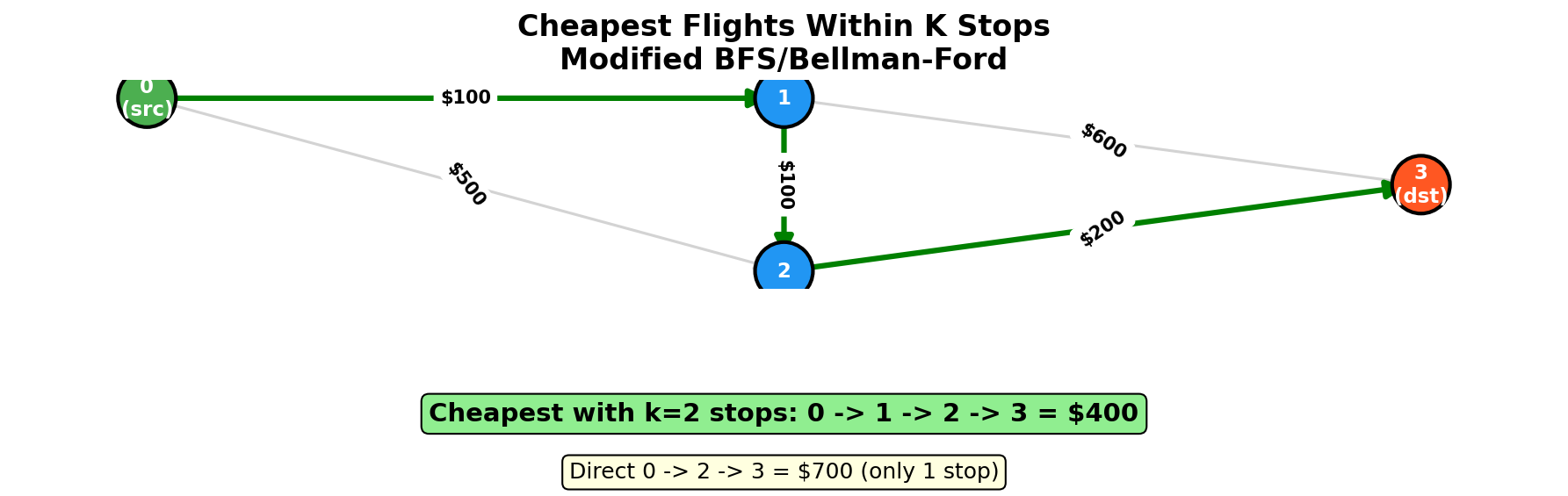
Visual Overview
Examples
Example 1
Input: n = 4, flights = [[0,1,100],[1,2,100],[2,0,100],[1,3,600],[2,3,200]]
       src = 0, dst = 3, k = 1
Output: 700

Explanation:
        0 --$100--> 1 --$600--> 3
        |          |
      $100       $100
        v          v
        2 <-------/
        |
      $200
        v
        3

With at most k=1 stops:
  - 0 -> 3 (no direct flight)
  - 0 -> 1 -> 3 = $100 + $600 = $700 (1 stop) VALID
  - 0 -> 1 -> 2 -> 3 = $100 + $100 + $200 = $400 (2 stops) INVALID (k=1)

Answer: $700Example 2
Input: n = 3, flights = [[0,1,100],[1,2,100],[0,2,500]]
       src = 0, dst = 2, k = 1
Output: 200

  0 --$100--> 1 --$100--> 2
  |                       ^
  +-------$500-----------+

With k=1 stop:
  - 0 -> 2 = $500 (0 stops)
  - 0 -> 1 -> 2 = $200 (1 stop)

Answer: $200 (cheaper even though more stops)Why Dijkstra Doesn't Work Directly
Standard Dijkstra might skip a shorter-distance path that uses more edges, but that path might be necessary to satisfy the k-stop constraint later.
Example: k=2
  Path A: 0 -> 1 -> 3 (cost $800, 1 stop)
  Path B: 0 -> 2 -> 4 -> 3 (cost $400, 2 stops)

Dijkstra at node 3 might only keep Path A (shorter edges to 3).
But if we need to go to node 5 with k=3:
  - Via A: 0 -> 1 -> 3 -> 5 (2 stops) VALID
- Via B: 0 -> 2 -> 4 -> 3 -> 5 (3 stops) VALID and cheaper!Solution 1: BFS with Level Tracking
Process level by level, where each level represents one more stop.
from collections import defaultdict, deque

def findCheapestPrice(n: int, flights: list[list[int]], src: int, dst: int, k: int) -> int:
    # Build adjacency list
    graph = defaultdict(list)
    for u, v, price in flights:
        graph[u].append((v, price))

    # BFS with level tracking
    # dist[node] = minimum cost to reach node
    dist = [float('inf')] * n
    dist[src] = 0

    queue = deque([(src, 0)])  # (node, cost)
    stops = 0

    while queue and stops <= k:
        # Process all nodes at current level
        for _ in range(len(queue)):
            node, cost = queue.popleft()

            for neighbor, price in graph[node]:
                new_cost = cost + price

                # Only add if we found a cheaper path
                if new_cost < dist[neighbor]:
                    dist[neighbor] = new_cost
                    queue.append((neighbor, new_cost))

        stops += 1

return dist[dst] if dist[dst] != float('inf') else -1Complexity: Time O(E * K) · Space O(N + E)
- Time: BFS processes up to K levels, each level can examine all E edges in worst case
- Space: Distance array O(N), queue can hold multiple instances of nodes O(N*K), adjacency list O(E)
Complexity
| Aspect | Complexity | Explanation |
|---|---|---|
| Time | O(E * K) | Each edge processed up to K times |
| Space | O(N + E) | Distance array + queue |
Solution 2: Bellman-Ford (K iterations)
Bellman-Ford naturally limits the number of edges by controlling iterations.
def findCheapestPrice(n: int, flights: list[list[int]], src: int, dst: int, k: int) -> int:
    # Initialize distances
    INF = float('inf')
    dist = [INF] * n
    dist[src] = 0

    # k stops = k + 1 edges, so k + 1 iterations
    for _ in range(k + 1):
        # Important: use a copy to prevent using updates from this iteration
        temp = dist.copy()

        for u, v, price in flights:
            if dist[u] != INF and dist[u] + price < temp[v]:
                temp[v] = dist[u] + price

        dist = temp

return dist[dst] if dist[dst] != INF else -1public int findCheapestPrice(int n, int[][] flights, int src, int dst, int k) {
final int INF = Integer.MAX_VALUE / 2;
int[] dist = new int[n];
Arrays.fill(dist, INF);
dist[src] = 0;
// k stops = k + 1 edges, so k + 1 iterations
for (int i = 0; i <= k; i++) {
int[] temp = dist.clone();
for (int[] flight : flights) {
int u = flight[0], v = flight[1], price = flight[2];
if (dist[u] != INF && dist[u] + price < temp[v])
temp[v] = dist[u] + price;
}
dist = temp;
}
return dist[dst] == INF ? -1 : dist[dst];
}Complexity: Time O(E * K) · Space O(N)
- Time: K+1 iterations (for K stops), each iterating through all E edges
- Space: Two distance arrays of size N (current and temp); no graph storage needed
Why Copy is Necessary
# WITHOUT copy (WRONG):
dist = [0, inf, inf]
for u, v, price in [[0,1,100], [1,2,100]]:
    if dist[u] + price < dist[v]:
        dist[v] = dist[u] + price
# After iteration 1: dist = [0, 100, 200]
# But we only wanted 1 edge! Node 2 shouldn't be updated yet.

# WITH copy (CORRECT):
temp = dist.copy()  # temp = [0, inf, inf]
for u, v, price in flights:
    if dist[u] + price < temp[v]:
        temp[v] = dist[u] + price
# After: temp = [0, 100, inf] (correct for 1 edge)Complexity
| Aspect | Complexity | Explanation |
|---|---|---|
| Time | O(E * K) | K iterations, each processing E edges |
| Space | O(N) | Distance array |
Solution 3: Modified Dijkstra with State
Track both cost AND number of stops as state.
import heapq
from collections import defaultdict

def findCheapestPrice(n: int, flights: list[list[int]], src: int, dst: int, k: int) -> int:
    graph = defaultdict(list)
    for u, v, price in flights:
        graph[u].append((v, price))

    # Min-heap: (cost, node, stops)
    heap = [(0, src, 0)]

    # Track minimum stops to reach each node
    # (we might revisit with more cost but fewer stops)
    min_stops = [float('inf')] * n

    while heap:
        cost, node, stops = heapq.heappop(heap)

        # Skip if over the stop limit or already reached with fewer stops
        if stops > k + 1 or stops > min_stops[node]:
            continue

        # Reached destination within the stop limit
        if node == dst:
            return cost

        min_stops[node] = stops

        # Only expand while another edge stays within the limit
        if stops < k + 1:
            for neighbor, price in graph[node]:
                heapq.heappush(heap, (cost + price, neighbor, stops + 1))

return -1Complexity: Time O(E * K * log(N*K)) · Space O(N * K)
- Time: Potentially NK states in heap, each extraction/insertion O(log(NK)); can revisit nodes with different stop counts
- Space: Heap can hold O(N*K) entries, min_stops array O(N), adjacency list O(E)
Note: This Dijkstra variant can be slower due to revisiting nodes with different stop counts.
Comparison of Approaches
| Approach | Time | Space | Pros | Cons |
|---|---|---|---|---|
| BFS | O(E * K) | O(N + E) | Simple, level-based | May process same node multiple times |
| Bellman-Ford | O(E * K) | O(N) | Clean, guaranteed correctness | Processes all edges each iteration |
| Modified Dijkstra | O(E * K * log(NK)) | O(N * K) | Can be faster for small K | More complex, heap overhead |
Process Visualization
Common Mistakes
1. Using k Instead of k+1 Iterations
# WRONG: k stops means k+1 edges!
for _ in range(k):  # Should be k+1
# ...2. Not Using Copy in Bellman-Ford
# WRONG: Updates propagate within same iteration
for u, v, price in flights:
    if dist[u] + price < dist[v]:
        dist[v] = dist[u] + price  # Uses updated dist[u]!

# CORRECT: Use copy
temp = dist.copy()
for u, v, price in flights:
    if dist[u] + price < temp[v]:  # Read from dist, write to temp
        temp[v] = dist[u] + price
dist = temp3. Standard Dijkstra Without Stop Tracking
# WRONG: Doesn't track stops
if neighbor not in dist:
    dist[neighbor] = cost + price
    heap.push((cost + price, neighbor))

# CORRECT: Track stops as part of state
heap.push((cost + price, neighbor, stops + 1))Edge Cases
- src == dst: Return 0 (already at destination)
- k = 0: Only direct flights allowed
- No path exists: Return -1
- Multiple paths with same cost: Either works
- Negative prices: Problem states prices are positive
Variations
Exactly K Stops (Not At Most)
# Only check at iteration K, not update at all iterations
for i in range(k + 1):
    # ...
# Only return dist[dst] if exactly k+1 edges usedReturn the Path
def findCheapestPath(n, flights, src, dst, k):
    # Track parent at each (node, stops) state
    parent = {}
    # ... run algorithm ...
# Reconstruct path from dstRelated Problems
Network Delay Time (LeetCode 743)
Problem: Find minimum time for a signal to reach all nodes in a weighted directed graph from a source node.
Key Insight: Classic single-source shortest path - find max of all shortest paths (Dijkstra).
Approach: Run Dijkstra from source, return maximum distance among all reachable nodes.
Complexity: O((V+E) log V) time, O(V+E) space
Minimum Cost to Reach Destination in Time (LeetCode 1928)
Problem: Find minimum cost path where total travel time must be within maxTime constraint.
Key Insight: State-based shortest path tracking both cost and time as separate dimensions.
Approach: Modified Dijkstra with state (node, remaining_time). Prune paths exceeding time limit.
Complexity: O(V * maxTime * log(V * maxTime)) time, O(V * maxTime) space
K-Similar Strings (LeetCode 854)
Problem: Find minimum swaps to transform string s1 into s2 where strings are anagrams.
Key Insight: BFS where each state is a string configuration, edges are single swaps.
Approach: BFS from s1, generate neighbors by swapping mismatched characters, stop when reaching s2.
Complexity: O(N! / (N-K)!) worst case, where K is number of different positions
Interview Tips
- Recognize the constraint: The "at most K stops" prevents standard Dijkstra
- Mention multiple approaches: BFS and Bellman-Ford both work well
- Explain why copy matters: Key insight for Bellman-Ford
- Clarify K vs edges: K stops = K+1 edges
Follow-up Questions
Q: What if we want exactly K stops?
- A: Only consider paths with exactly K+1 edges
Q: What if there are negative prices (refunds)?
- A: Bellman-Ford still works, but need to check for negative cycles
Q: How to handle ties (same price)?
- A: Return any valid path, or prefer fewer stops