K-Nearest Neighbors (KNN)
Instance-based learning - distance metrics, k selection, curse of dimensionality
Overview
KNN predicts by finding the
Algorithm Steps
- Store all training data (lazy learning - no training phase)
- Compute distance to all training points for new query
- Find
nearest neighbors - Aggregate: majority vote (classification) or mean (regression)
How K Affects Predictions
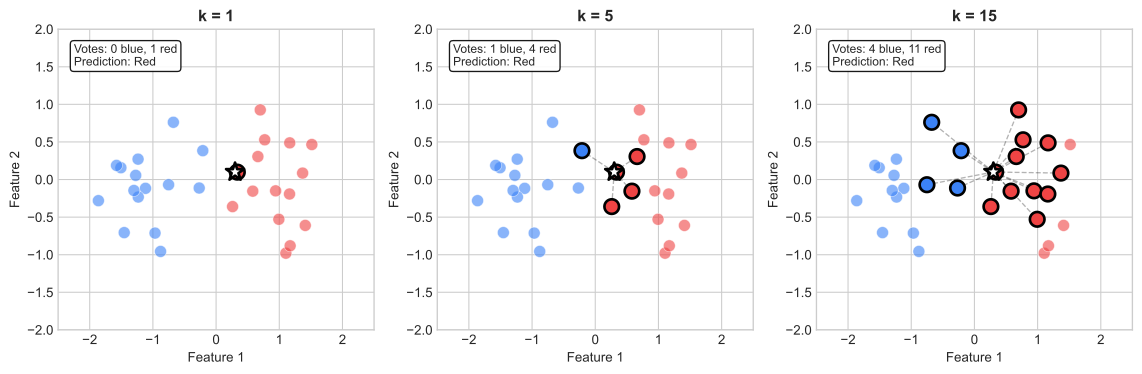
| k Value | Behavior | Trade-off |
|---|---|---|
| Highly flexible, captures noise | High variance, overfitting | |
| Complex decision boundary | May overfit | |
| Smooth decision boundary | May underfit | |
| Always predicts majority class | No learning |
Decision Boundaries
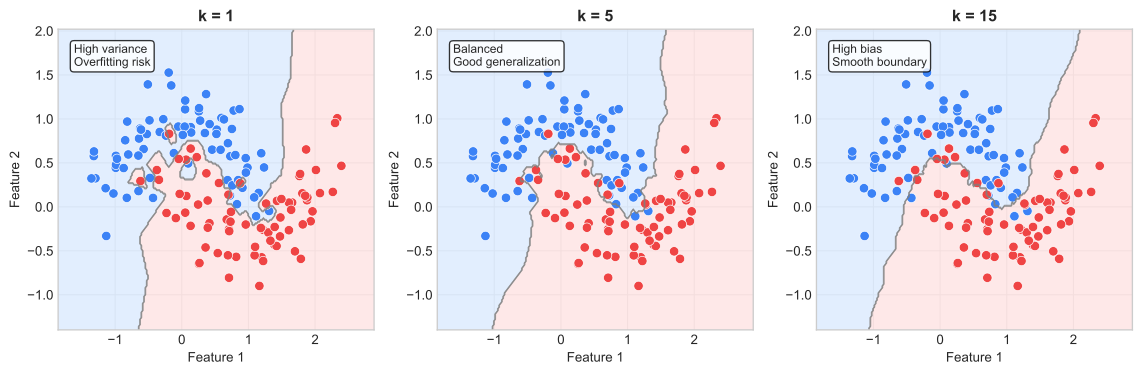
- Small k: Jagged boundaries, sensitive to individual points
- Large k: Smoother boundaries, more robust to noise
- Optimal k: Found via cross-validation
Distance Metrics
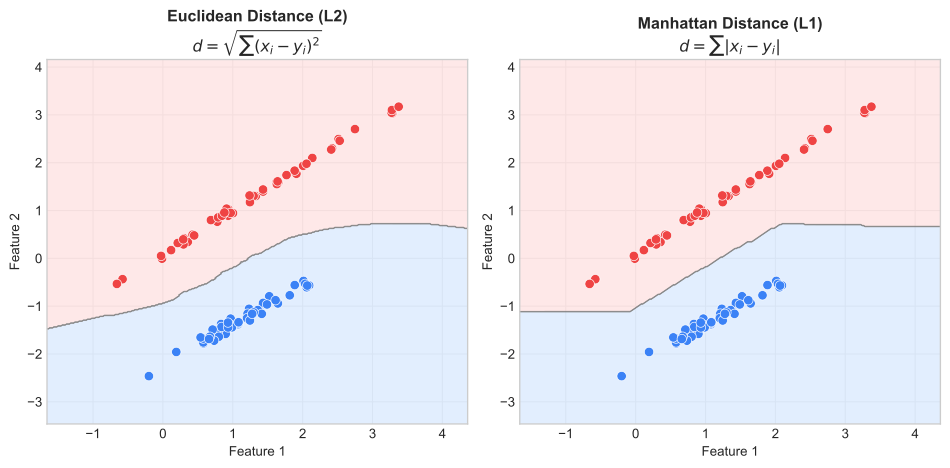
Common Metrics
| Metric | Formula | Best For |
|---|---|---|
| Euclidean (L2) | Continuous features (default) | |
| Manhattan (L1) | High-dimensional, robust to outliers | |
| Cosine | Text/documents, sparse vectors | |
| Minkowski | Generalized ( |
Important: Always normalize/scale features before using Euclidean distance!
Choosing K
Selection Methods
| Method | Description |
|---|---|
| Cross-validation | Most reliable - test multiple k values |
| Rule of thumb | |
| Odd k for binary | Avoids ties in voting |
Weighted KNN
Weight neighbors by inverse distance to reduce sensitivity to k choice:
# Weighted KNN in sklearn
knn = KNeighborsClassifier(n_neighbors=5, weights='distance')Curse of Dimensionality
The Problem
In high dimensions (
- All points become approximately equidistant
- "Nearest" neighbor isn't meaningfully closer
- Volume concentrates at hypercube edges
Volume Example
For a unit hypercube with inner cube of side 0.9:
| Dimensions | Inner Volume |
|---|---|
| 90% | |
| 35% | |
| ~0% |
Solutions
- Dimensionality reduction: PCA, t-SNE before KNN
- Feature selection: Remove irrelevant features
- Manhattan distance: More robust in high-d
- Approximate NN: LSH, Annoy, Faiss
Complexity
| Operation | Brute Force | With KD-tree |
|---|---|---|
| Training | ||
| Prediction | ||
| Space |
Speed Optimizations
| Method | When to Use |
|---|---|
| KD-Tree | |
| Ball Tree | Higher dimensions than KD-tree |
| LSH | Approximate NN, very large datasets |
| Annoy/Faiss | Production systems, millions of points |
Strengths vs Weaknesses
| Strengths | Weaknesses |
|---|---|
| Simple, no training phase | Slow prediction |
| No distribution assumptions | Memory intensive |
| Naturally handles multi-class | Curse of dimensionality |
| Easy to add new data | Sensitive to feature scale |
| Adapts locally | All features affect distance |
Code Reference
import numpy as np
from sklearn.neighbors import KNeighborsClassifier
from sklearn.preprocessing import StandardScaler
from sklearn.model_selection import cross_val_score

# ALWAYS scale features for KNN
scaler = StandardScaler()
X_train_scaled = scaler.fit_transform(X_train)
X_test_scaled = scaler.transform(X_test)

# Basic KNN
knn = KNeighborsClassifier(n_neighbors=5, metric='euclidean')
knn.fit(X_train_scaled, y_train)

# Weighted KNN (recommended)
knn_weighted = KNeighborsClassifier(
    n_neighbors=5,
    weights='distance',
    metric='euclidean'
)

# Find optimal k via cross-validation
k_range = range(1, 31)
cv_scores = [
    cross_val_score(
        KNeighborsClassifier(n_neighbors=k),
        X_train_scaled, y_train, cv=5
    ).mean()
    for k in k_range
]
best_k = k_range[np.argmax(cv_scores)]

# Fast queries with KD-tree
knn_fast = KNeighborsClassifier(
    n_neighbors=5,
    algorithm='kd_tree',  # 'ball_tree', 'auto'
    leaf_size=30
)

# Get neighbors for interpretability
distances, indices = knn.kneighbors(X_test_scaled[:1], n_neighbors=5)Interview Questions
Q1: How do you choose k?
Use cross-validation to find optimal k. Start with
, use odd k for binary classification. Consider weighted KNN to reduce sensitivity to k choice.
Q2: What's the curse of dimensionality?
In high dimensions, all points become equidistant, making "nearest" meaningless. Solutions: reduce dimensions (PCA), select features, use Manhattan distance, or approximate NN methods.
Q3: KNN vs model-based approaches?
Use KNN: low dimensions (
), complex boundaries, online learning, interpretability needed. Use model-based: high dimensions, fast prediction required, parametric assumptions hold, limited memory.
Q4: How to speed up KNN?
- KD-tree/Ball-tree for low-d exact NN
- LSH/Annoy/Faiss for approximate NN at scale
- Prototype selection to reduce dataset
- Dimensionality reduction (PCA)
Quick Reference Card
K-NEAREST NEIGHBORS
---------------------------------------------
Algorithm: Store data, find k nearest at prediction
Classify:  Majority vote among k neighbors
Regress:   Mean of k neighbors' values

DISTANCE METRICS
---------------------------------------------
Euclidean: sqrt(sum((xi-yi)^2))  - default
Manhattan: sum(|xi-yi|)          - robust, high-d
Cosine:    1 - cos(theta)        - text, sparse

CHOOSING K
---------------------------------------------
Small k: Complex boundary, may overfit
Large k: Smooth boundary, may underfit
Method:  Cross-validation (best), sqrt(n) (rule)

COMPLEXITY
---------------------------------------------
Training:   O(1)
Prediction: O(n*d), or O(d log n) with KD-tree
Space:      O(n*d)

CURSE OF DIMENSIONALITY
---------------------------------------------
Problem: In high-d, all points equidistant
Fix:     Reduce dimensions, feature selection

USE WHEN
---------------------------------------------
+ Low-dimensional data (d < 20)
+ Complex/irregular boundaries
+ Online learning / easy updates
- High-dimensional data
- Fast prediction needed
- Limited memory