Activation Functions
The source of non-linearity — why neural networks can learn complex functions
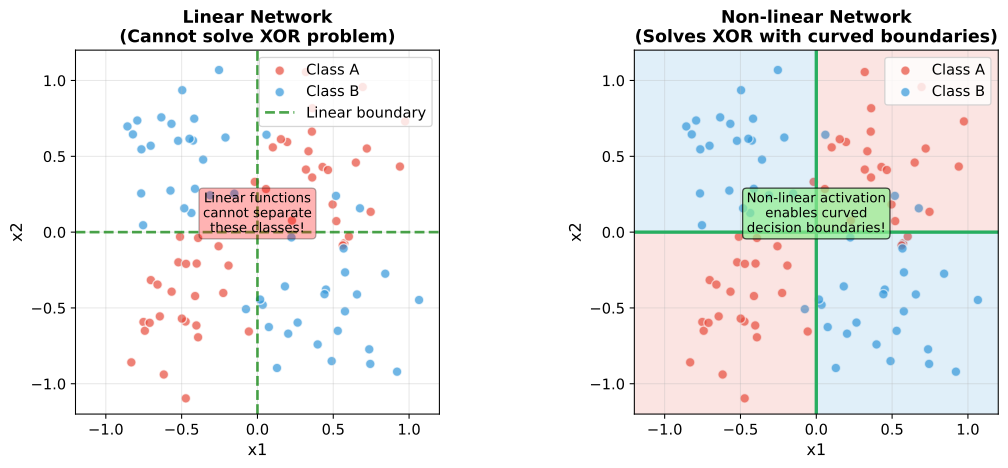
Why Non-linearity is Essential
Without activation functions, a neural network is just a series of linear transformations — and the composition of linear functions is still linear.
The Linear Collapse Problem
Consider a 2-layer network without activations:
No matter how many layers, the result is equivalent to a single linear transformation. Non-linear activation functions break this limitation.
Classic Activations
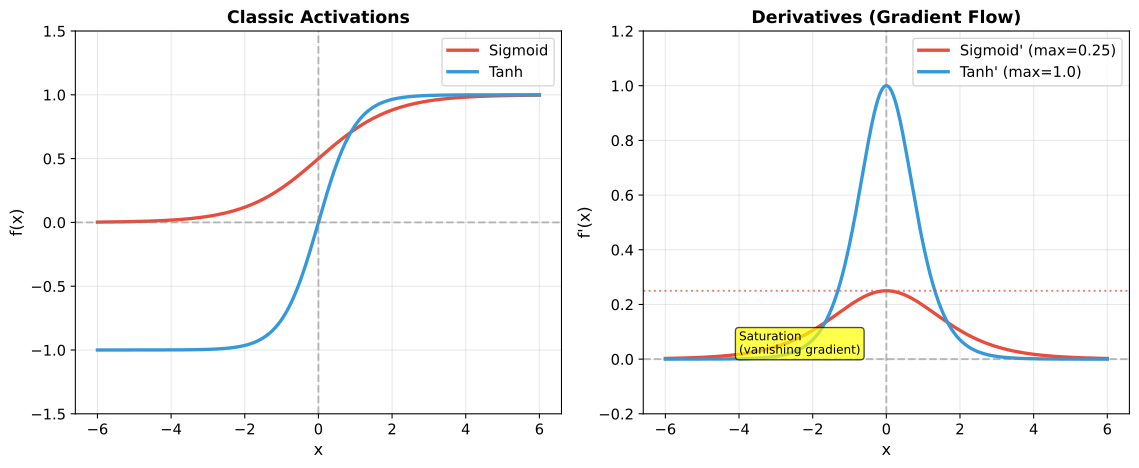
Sigmoid
| Property | Value |
|---|---|
| Range | (0, 1) |
| Derivative | |
| Max gradient | 0.25 (at x=0) |
Pros: Smooth, bounded, interpretable as probability
Cons:
- Vanishing gradients: gradient
, compounds through layers - Not zero-centered: outputs always positive, causing zig-zag gradients
- Computationally expensive: exponential function
Tanh
| Property | Value |
|---|---|
| Range | (-1, 1) |
| Derivative | |
| Max gradient | 1.0 (at x=0) |
Pros: Zero-centered (better than sigmoid), stronger gradients
Cons: Still saturates for large inputs, vanishing gradients persist
The ReLU Family
ReLU (Rectified Linear Unit)
| Property | Value |
|---|---|
| Range | |
| Derivative | 1 if x > 0, else 0 |
| Computation | Very fast (just max) |
Pros:
- No vanishing gradient for positive inputs
- Computationally efficient
- Promotes sparsity (many zeros)
- Converges faster in practice
Cons:
- Dying ReLU problem (see below)
- Not zero-centered
- Unbounded (can cause exploding activations)
The Dying ReLU Problem
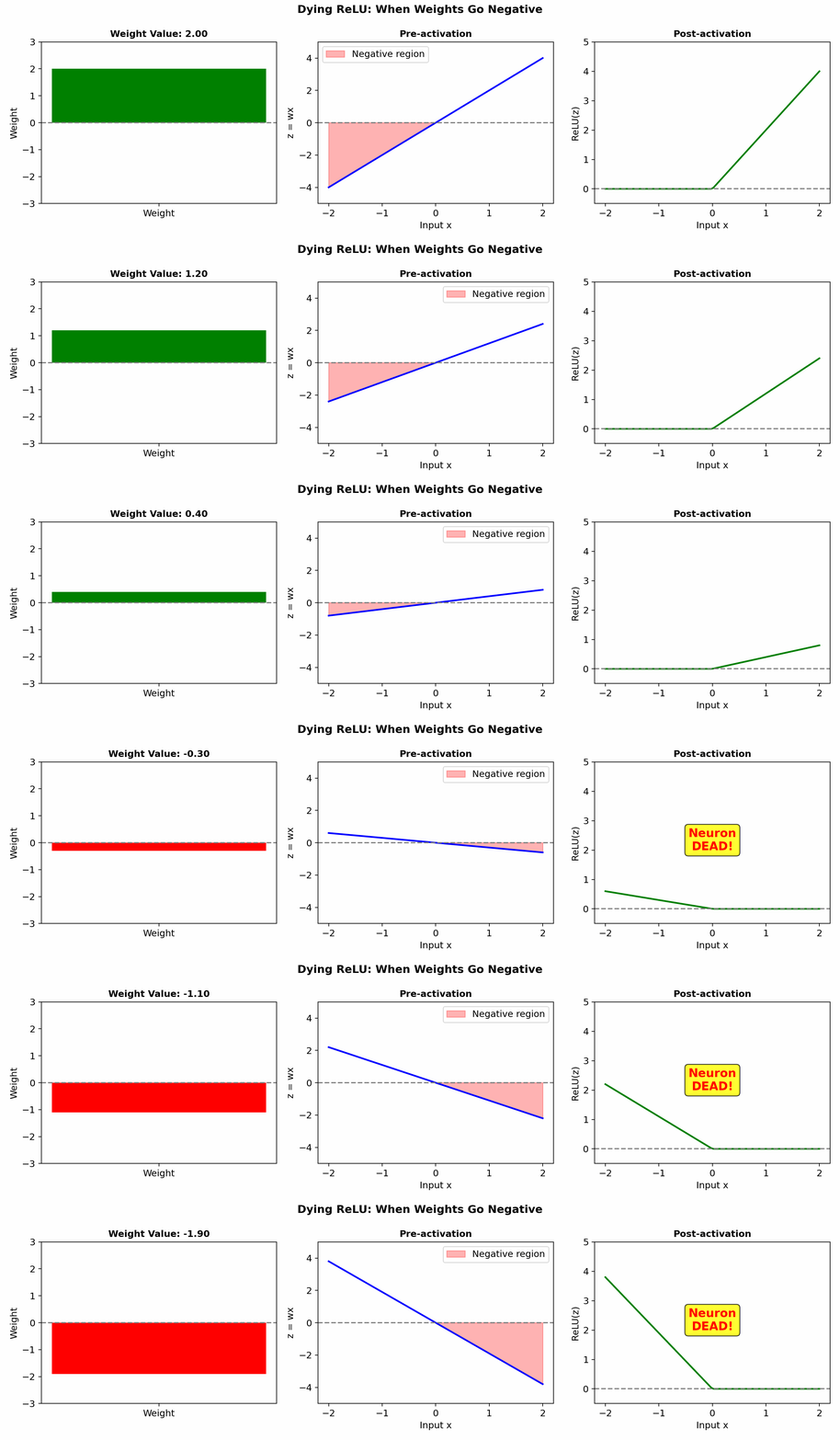
When a neuron's weights produce negative inputs for all training examples:
- ReLU outputs 0 for all inputs
- Gradient is 0, so weights don't update
- Neuron is "dead" — permanently stuck
Causes:
- Large learning rate pushing weights too negative
- Poor initialization
- Large negative bias
Solutions:
- Leaky ReLU variants
- Proper initialization (He initialization)
- Batch normalization
- Lower learning rates
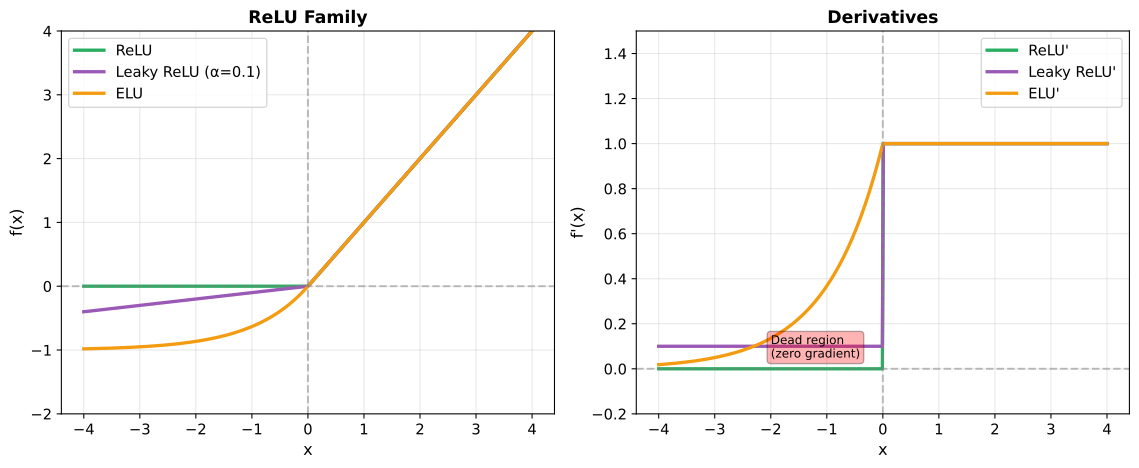
Leaky ReLU
Typically
Parametric ReLU (PReLU)
Same as Leaky ReLU, but
ELU (Exponential Linear Unit)
Smooth negative region, pushes mean activations toward zero.
Modern Activations
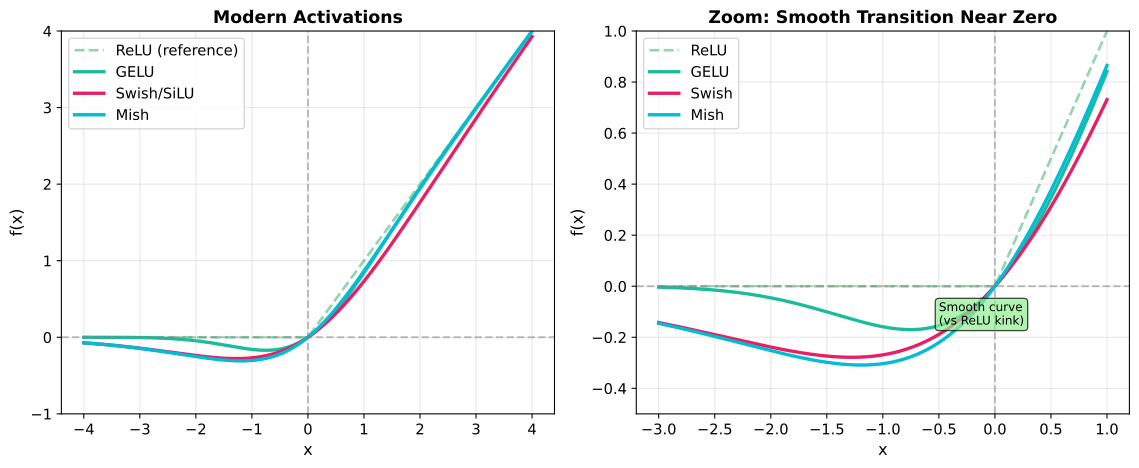
GELU (Gaussian Error Linear Unit)
Approximation:
Key insight: GELU weights inputs by their probability under a Gaussian distribution. Inputs with higher magnitude are more likely to be "kept".
| Property | Value |
|---|---|
| Range | |
| Smoothness | Everywhere differentiable |
| Use case | Transformers (BERT, GPT) |
Why transformers use GELU:
- Smooth gradients help deep network optimization
- Probabilistic interpretation suits attention mechanisms
- Empirically outperforms ReLU in transformers
Swish / SiLU
Self-gated activation — the input gates itself through a sigmoid.
Mish
Smooth, non-monotonic, shows good results in vision models.
Output Layer Activations
The output layer activation depends on the task:
| Task | Activation | Output | Loss Function |
|---|---|---|---|
| Binary classification | Sigmoid | P(y=1) | Binary cross-entropy |
| Multi-class (single label) | Softmax | P(y=k) for each class | Categorical cross-entropy |
| Multi-label | Sigmoid (per output) | P(y_k=1) per label | Binary CE per label |
| Regression | None (linear) | Real values | MSE |
Softmax
Converts logits to probabilities that sum to 1. Key: assumes mutually exclusive classes.
Numerical Stability
For softmax, subtract max before exponentiating:
def stable_softmax(x):
    exp_x = np.exp(x - np.max(x, axis=-1, keepdims=True))
return exp_x / np.sum(exp_x, axis=-1, keepdims=True)Choosing Activations
Hidden Layers
| Scenario | Recommended | Rationale |
|---|---|---|
| Default choice | ReLU | Fast, effective, well-understood |
| Dying ReLU issues | Leaky ReLU or ELU | Maintains gradient for negative inputs |
| Transformers | GELU | Smooth, matches architecture well |
| Very deep CNNs | ReLU + BatchNorm | Normalization prevents dead neurons |
Decision Flowchart
Is this a transformer?
  └─ Yes → GELU
  └─ No → Is this the output layer?
          └─ Yes → Task-specific (sigmoid/softmax/linear)
          └─ No → Are neurons dying?
                  └─ Yes → Leaky ReLU or ELU
└─ No → ReLUGradient Flow Comparison
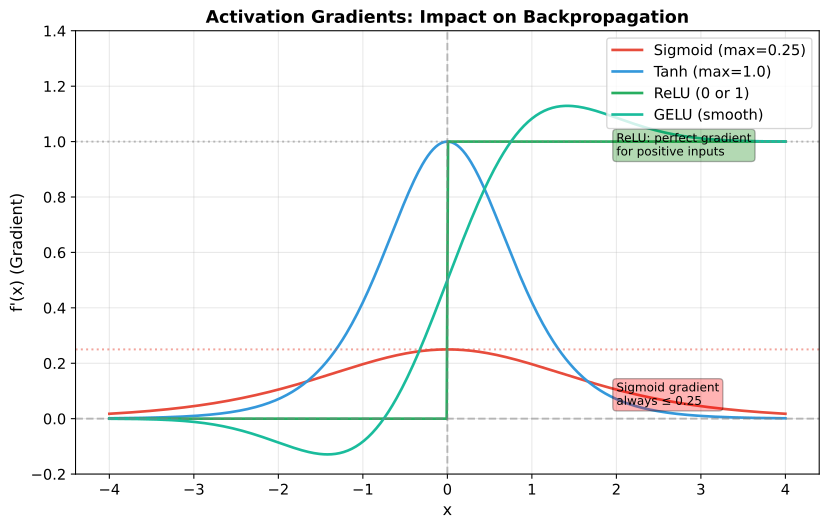
| Activation | Gradient at x=0 | Gradient at x=5 | Gradient at x=-5 |
|---|---|---|---|
| Sigmoid | 0.25 | ~0 (saturated) | ~0 (saturated) |
| Tanh | 1.0 | ~0 (saturated) | ~0 (saturated) |
| ReLU | undefined (0 or 1) | 1.0 | 0 |
| GELU | 0.5 | ~1.0 | ~0 |
Interview Questions
Q1: "Explain the dying ReLU problem and how to fix it."
The dying ReLU problem occurs when neurons consistently output 0 for all training inputs. Since ReLU's gradient is 0 for negative inputs, these neurons receive no gradient and cannot update their weights — they're "dead."
Causes:
- Large learning rates pushing weights too negative
- Poor weight initialization
- Large negative bias terms
Solutions:
- Leaky ReLU:
— small gradient for negative inputs - He initialization:
— keeps activations in good range - Batch normalization: normalizes inputs, reducing extreme values
- Lower learning rate: prevents drastic weight changes
- Gradient clipping: bounds updates during training
Q2: "Why do transformers use GELU instead of ReLU?"
GELU (Gaussian Error Linear Unit) weights inputs by their "probability" under a Gaussian:
Why it works for transformers:
- Smooth gradients: Unlike ReLU's sharp corner at 0, GELU is smooth everywhere, helping optimization in very deep networks (transformers have 12-96 layers)
- Probabilistic interpretation: Inputs are weighted by their likelihood of being "important" — aligns with attention's soft weighting
- Non-monotonic: Small negative values aren't completely zeroed, preserving some gradient signal
- Empirical results: GELU consistently outperforms ReLU in transformer architectures (BERT, GPT showed this)
Trade-off: GELU is more expensive to compute than ReLU, but this cost is negligible compared to attention computation in transformers.
Q3: "When would you use sigmoid vs softmax in the output layer?"
Sigmoid for multi-label classification:
- Each class is independent
- Multiple labels can be true simultaneously
- Example: Image tags (beach, sunset, people — all can be true)
- Output: Independent probabilities for each class
Softmax for multi-class classification:
- Classes are mutually exclusive
- Exactly one label is correct
- Example: ImageNet (exactly one object category)
- Output: Probability distribution summing to 1
Key difference: Softmax enforces competition between classes (if P(cat) increases, P(dog) must decrease). Sigmoid treats each output independently.
Code difference:
python# Multi-label: sigmoid per output + binary CE loss = sum(BCE(sigmoid(logits[i]), labels[i]) for i in classes) # Multi-class: softmax + categorical CE loss = CE(softmax(logits), one_hot_label)
Key Takeaways
Non-linearity is essential — without it, any deep network collapses to a single linear transformation.
ReLU dominates — simple, fast, and effective for most applications.
Dying ReLU is real — use Leaky ReLU, proper initialization, or normalization to prevent it.
GELU for transformers — smooth gradients and probabilistic interpretation suit attention-based architectures.
Output activation matches the task — sigmoid for multi-label, softmax for multi-class, linear for regression.