Gradient Problems
Training challenges — vanishing, exploding gradients and their solutions
The Fundamental Problem
Deep networks face a fundamental training challenge: gradients must flow through many layers, and they can either vanish (become too small) or explode (become too large).
Why It Matters
- Vanishing gradients: Early layers receive near-zero gradients → no learning
- Exploding gradients: Huge weight updates → training diverges, NaN losses
Both prevent successful training of deep networks.
Vanishing Gradients
What Happens
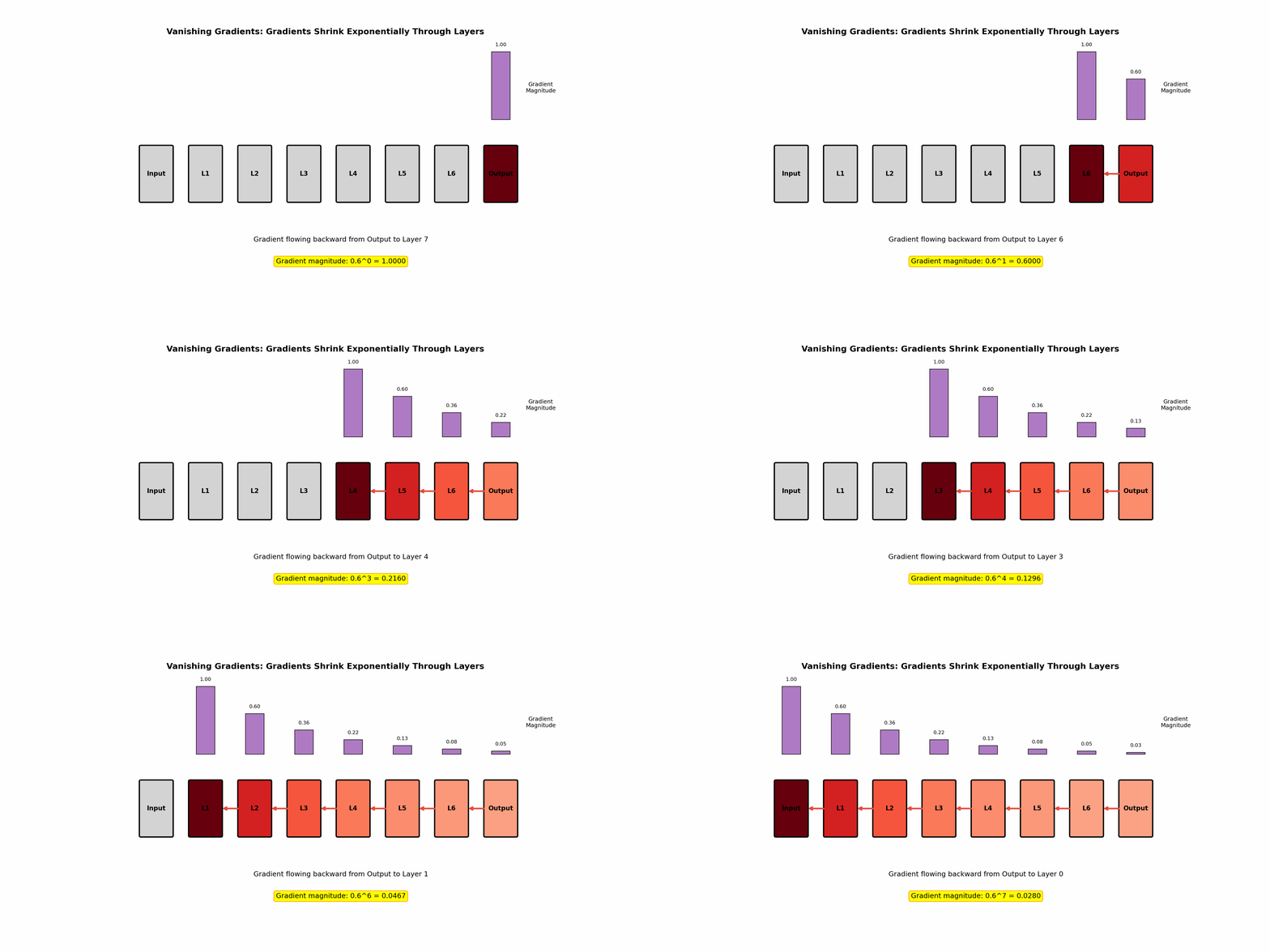
Gradients shrink exponentially as they propagate backward:
If each term
Causes
1. Saturating Activations (Sigmoid, Tanh)
Sigmoid derivative:
At saturation (large
Multiple layers:
2. Poor Initialization
If weights are too small:
- Activations shrink through layers
- Pre-activations enter saturation region
- Derivatives become tiny
3. Deep Networks
More layers = more multiplicative factors < 1 = faster decay
Symptoms
| Symptom | Indication |
|---|---|
| Early layers don't update | Near-zero gradients |
| Slow training | Only later layers learning |
| Training plateaus | Model stuck at suboptimal |
Exploding Gradients
What Happens
Gradients grow exponentially:
If each term
Causes
1. Poor Initialization
Weights too large → activations grow through layers → gradients multiply to huge values.
2. Recurrent Networks
RNNs multiply through time steps. Even small > 1 factors compound over 100+ steps.
3. Unstable Architectures
Networks without normalization or skip connections are prone to explosion.
Symptoms
| Symptom | Indication |
|---|---|
| Loss = NaN | Numerical overflow |
| Loss spikes | Unstable updates |
| Weights become very large | Explosion in progress |
| Model output is NaN | Completely diverged |
Mathematical Analysis
The Jacobian Perspective
For a layer
The Jacobian's eigenvalues determine gradient flow:
- All eigenvalues < 1: vanishing
- Any eigenvalue > 1: potential exploding
For L Layers
Gradient w.r.t. first layer weights:
If average
Detection
Gradient Monitoring
def check_gradients(model):
    for name, param in model.named_parameters():
        if param.grad is not None:
            grad_norm = param.grad.norm().item()
            print(f"{name}: grad_norm = {grad_norm:.6f}")

            if grad_norm < 1e-7:
                print(f"  WARNING: Vanishing gradient!")
            elif grad_norm > 1e3:
print(f" WARNING: Exploding gradient!")Activation Monitoring
def check_activations(model, x):
    activations = {}
    def hook(name):
        def fn(module, input, output):
            activations[name] = output.detach()
        return fn

    # Register hooks
    for name, module in model.named_modules():
        module.register_forward_hook(hook(name))

    model(x)

    for name, act in activations.items():
print(f"{name}: mean={act.mean():.4f}, std={act.std():.4f}")Warning Signs
| Check | Healthy | Vanishing | Exploding |
|---|---|---|---|
| Gradient norm | 1e-3 to 1e1 | < 1e-7 | > 1e3 or NaN |
| Activation std | ~1 | → 0 through layers | → ∞ through layers |
| Loss curve | Decreasing | Flat | NaN or spikes |
Solutions for Vanishing Gradients
1. ReLU Activation
ReLU derivative is 1 for positive inputs — no shrinkage.
Caveat: Dying ReLU (use Leaky ReLU if this occurs)
2. Residual Connections (Skip Connections)
Gradient:
Even if
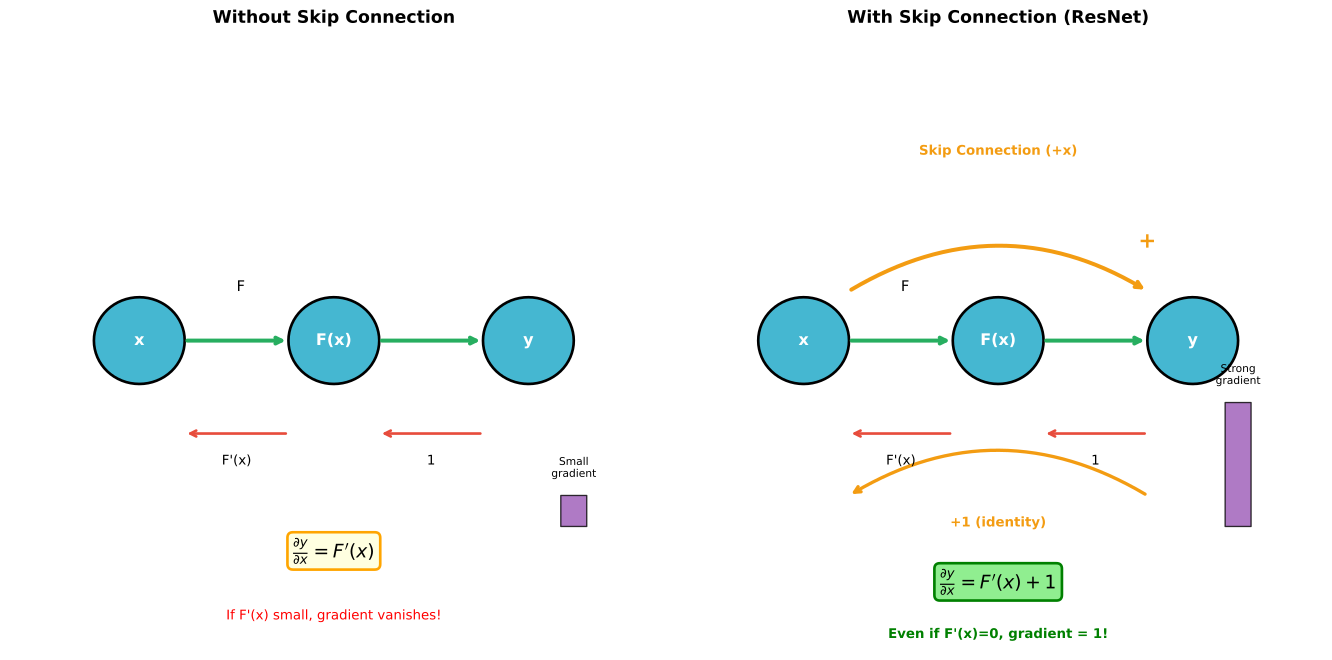
Key insight: Skip connections change multiplication to addition in gradient flow.
3. Proper Initialization
| Activation | Initialization | Variance |
|---|---|---|
| Sigmoid/Tanh | Xavier | |
| ReLU | He |
Maintains variance through layers, preventing shrinkage.
4. Batch/Layer Normalization
Normalization keeps activations in a good range:
- Prevents saturation (keeps pre-activations centered)
- Maintains gradient magnitude through layers
- Acts as a "reset" for statistics at each layer
5. Highway Networks / Dense Connections
Highway: Learnable gates control skip connections DenseNet: Connect each layer to all previous layers
Both provide multiple paths for gradient flow.
Solutions for Exploding Gradients
1. Gradient Clipping
Bound gradient magnitude:
Clip by value:
torch.nn.utils.clip_grad_value_(parameters, clip_value)Clip by norm (preferred):
torch.nn.utils.clip_grad_norm_(parameters, max_norm=1.0)Clips the global gradient norm while preserving direction.
2. Lower Learning Rate
Smaller updates = less amplification of instability.
# If training is unstable, try reducing LR
optimizer = Adam(params, lr=1e-4) # instead of 1e-33. Proper Initialization
He/Xavier initialization prevents initial explosion.
4. Batch Normalization
Normalizes activations, preventing them from growing unboundedly.
RNNs: A Special Case
RNNs are particularly prone to gradient problems due to unrolling over many time steps.
Why RNNs Are Worse
For T time steps:
With T = 100+, even factors slightly different from 1 cause extreme values.
Solutions for RNNs
- LSTM/GRU: Gating mechanisms control gradient flow
- Gradient clipping: Essential for RNN training (typically max_norm=1.0)
- Truncated BPTT: Limit backprop to recent time steps
- Use transformers: Attention provides direct paths regardless of distance
Interview Questions
Q1: "How do skip connections help with vanishing gradients?"
Skip connections add the input directly to the output:
Gradient analysis:
Even if
(vanishing), the +1 term ensures gradient flows. For a deep network with skip connections:
- Gradient is a sum over paths, not a product
- Some paths go through identity connections (gradient = 1)
- Early layers always receive some gradient signal
Why this matters:
- Without skips:
— vanishes if any is small - With skips: Gradient can flow directly through identity path
This is why ResNet can train 152 layers while plain networks fail beyond ~20.
Q2: "How would you diagnose gradient issues in a network?"
Step 1: Monitor gradient norms per layer
pythonfor name, param in model.named_parameters(): print(f"{name}: grad_norm={param.grad.norm()}")
- Very small (< 1e-7): vanishing
- Very large (> 1e3) or NaN: exploding
Step 2: Check activation distributions
- Plot histograms of activations at each layer
- All near 0: vanishing activations (and gradients)
- All near -1/1 (for tanh): saturated, vanishing gradients
Step 3: Monitor training curves
- Loss doesn't decrease: possible vanishing
- Loss = NaN or spikes: exploding
Step 4: Layer-wise analysis
- Compare gradient norms between early and late layers
- Large ratio (early << late): vanishing
- Early layers not updating: vanishing
Solutions based on diagnosis:
- Vanishing: ReLU, skip connections, normalization, He init
- Exploding: gradient clipping, lower LR, normalization
Q3: "Why is gradient clipping important for RNNs?"
RNNs unroll through many time steps, creating very deep computation graphs. Gradients multiply at each step:
For T=100 steps:
- If average factor = 0.9:
(vanishing) - If average factor = 1.1:
(exploding) Gradient clipping bounds the explosion:
pythonclip_grad_norm_(parameters, max_norm=1.0)
- Scales gradients to have max norm of 1.0
- Preserves gradient direction
- Prevents catastrophic weight updates
- Allows stable training despite occasional gradient spikes
Why essential for RNNs:
- Single unstable example can cause gradient explosion
- Without clipping: one bad batch destroys learned weights
- LSTM/GRU help with vanishing but clipping still needed for stability
Key Takeaways
Vanishing gradients: Gradients shrink exponentially → early layers don't learn. Caused by saturating activations and deep networks.
Exploding gradients: Gradients grow exponentially → NaN losses. Caused by poor initialization and unstable training.
ReLU replaces saturating activations — gradient is 1 for positive inputs.
Skip connections provide gradient highways — +1 term ensures gradient flow.
Gradient clipping is essential for RNNs — prevents single bad examples from destroying training.
Monitor gradients during training — early detection prevents wasted compute.