Decoder Architecture
The decoder predicts output tokens one at a time, using causal masking to maintain the autoregressive constraint and cross-attention to incorporate encoder context.
Three-Layer Decoder Block Overview
Unlike the encoder from Module 5, which processes the entire input sequence bidirectionally, the decoder operates autoregressively and must maintain causality: each output token depends only on previously generated tokens, not future ones. The standard decoder block contains three main layers:
Key differences from the encoder:
- Causal masking in self-attention prevents attending to future positions
- Cross-attention layer allows the decoder to attend to encoder outputs
- Each position processes sequentially during inference (though training uses teacher forcing)
- Output is fed back as input for the next token generation step
Causal (Masked) Self-Attention
The Autoregressive Constraint
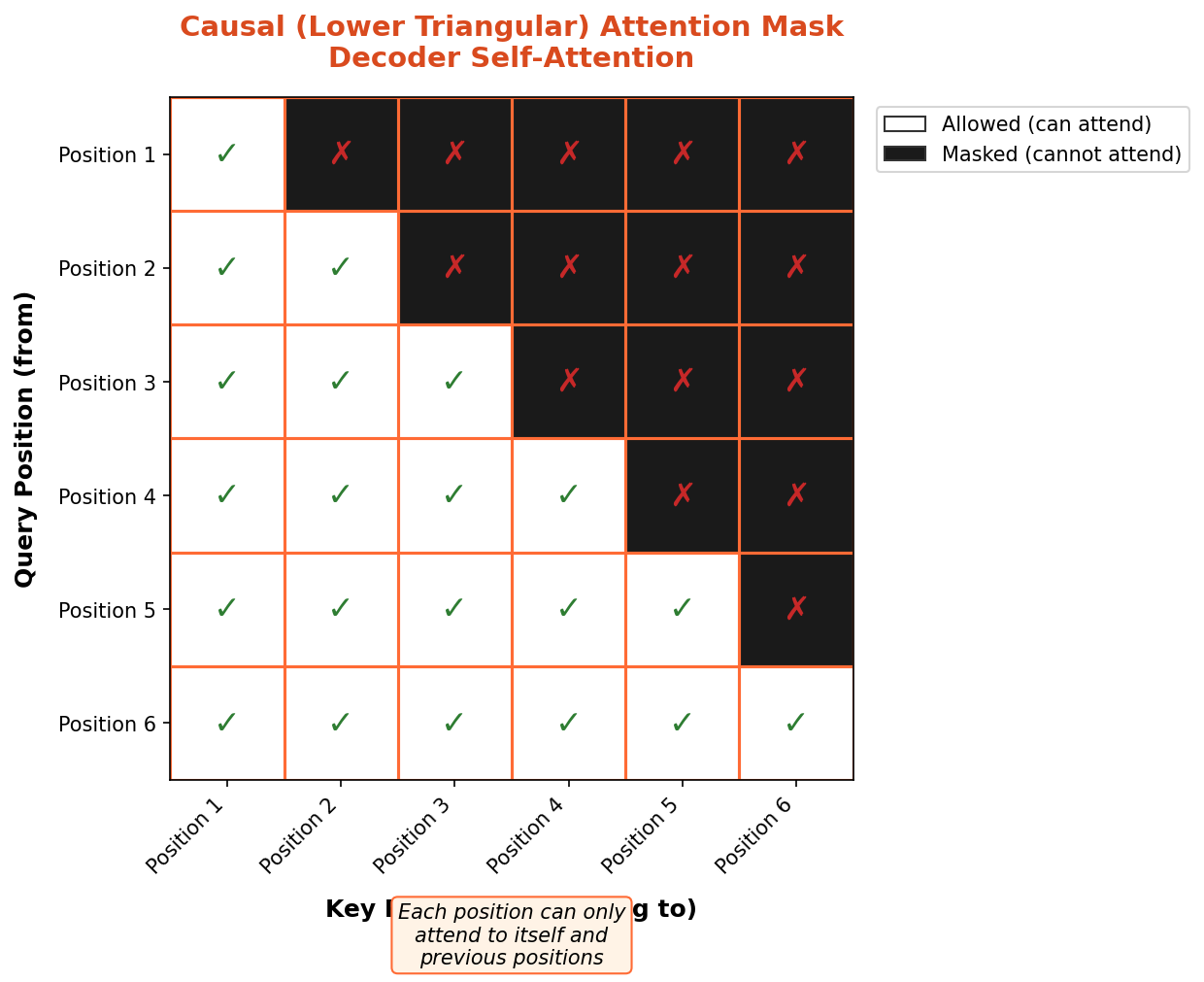
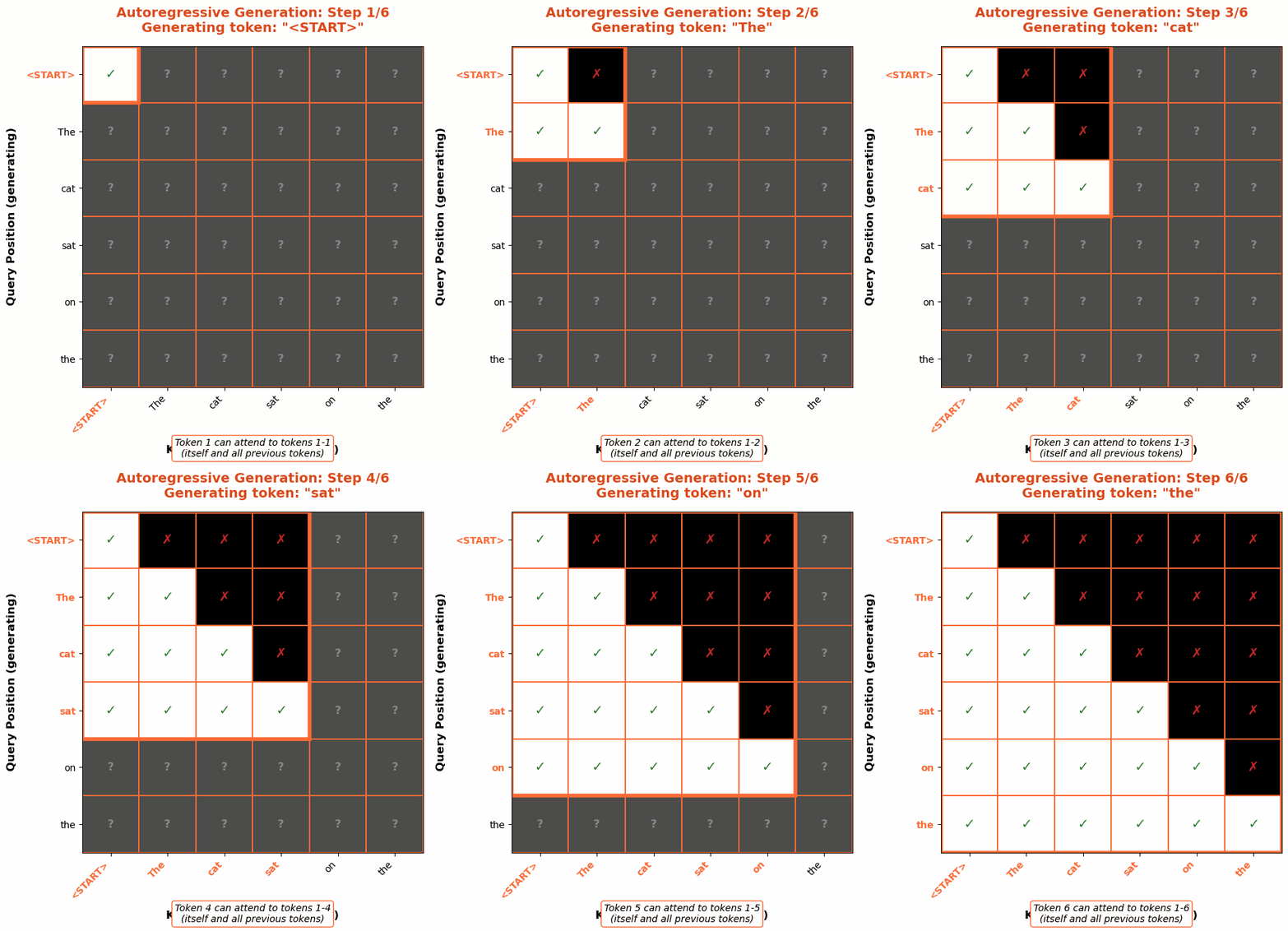
The decoder must satisfy a fundamental constraint: position i can only attend to positions j where j ≤ i. This ensures that when predicting token t, the model only uses information from tokens 1 through t-1 and the encoder.
Why is this necessary? Because during inference, future tokens don't exist yet. The model generates one token at a time, and each new token must depend only on what came before.
Mask Implementation
Causal masking is implemented by modifying the attention scores before the softmax operation. For an attention score matrix of shape (seq_len, seq_len), we create a triangular mask:
# Create causal mask (lower triangular matrix)
seq_len = 5
mask = torch.tril(torch.ones((seq_len, seq_len)))
# mask[i, j] = 1 if j <= i (can attend), 0 if j > i (cannot attend)

# Apply mask during attention computation:
# Before softmax, set masked positions to -∞
scores = Q @ K.T / sqrt(d_k)
scores = scores.masked_fill(mask == 0, float('-inf'))
attention_weights = softmax(scores, dim=-1)Visualization of causal mask for sequence length 5:
Position: 0 1 2 3 4
       0 [✓ ✗ ✗ ✗ ✗]
       1 [✓ ✓ ✗ ✗ ✗]
       2 [✓ ✓ ✓ ✗ ✗]
       3 [✓ ✓ ✓ ✓ ✗]
4 [✓ ✓ ✓ ✓ ✓]Where ✓ means "can attend to" and ✗ means "masked out."
Training vs. Inference
Training with Teacher Forcing:
# During training, we have the ground truth sequence [START, w1, w2, w3, STOP]
# We can pass all positions through the decoder at once (parallel processing)
decoder_output = decoder(encoder_output, target_tokens)
# The causal mask ensures position i only attends to positions < i

# Loss computed on all positions simultaneously
loss = cross_entropy(decoder_output, target_tokens)Inference (Autoregressive Generation):
output_tokens = [START_TOKEN]
while True:
    # Pass all accumulated tokens
    logits = decoder(encoder_output, output_tokens)

    # Take the logits of the last position only
    next_token_logits = logits[-1, :]
    next_token = argmax(next_token_logits)

    output_tokens.append(next_token)
    if next_token == STOP_TOKEN or len(output_tokens) > max_length:
        break

return output_tokensThis difference is critical: training is efficient (all positions in parallel), but inference is sequential (one token at a time).
KV-Cache: Optimization for Fast Inference
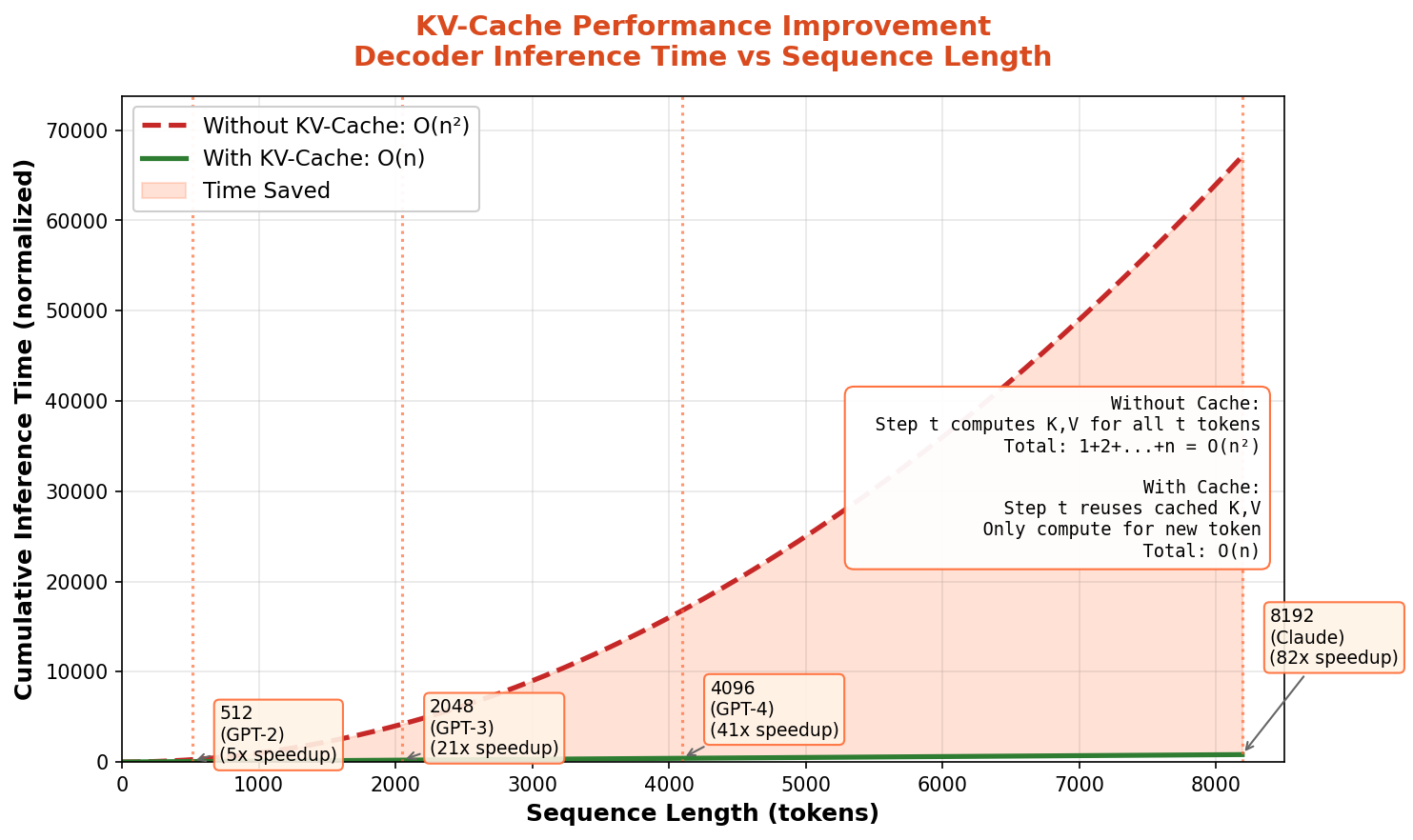
Computing attention from scratch at each generation step is wasteful. Position 5 recomputes attention over positions 1-4, which we already computed at step 4. The KV-cache solves this:
# Instead of recomputing K and V for all previous positions,
# we cache them and only compute K and V for the new token

cache = {}  # Dictionary of cached K, V for each layer

for step in range(max_length):
    new_token_ids = output_tokens[-1:]  # Only the newest token

    for layer_idx in range(num_layers):
        Q = compute_query(new_token_ids)

        if layer_idx not in cache:
            cache[layer_idx] = {'K': None, 'V': None}

        K_new = compute_key(new_token_ids)
        V_new = compute_value(new_token_ids)

        # Concatenate with previous K, V
        K = torch.cat([cache[layer_idx]['K'], K_new], dim=1)
        V = torch.cat([cache[layer_idx]['V'], V_new], dim=1)

        # Normal attention computation
        attention_output = scaled_dot_product_attention(Q, K, V)

        # Update cache
        cache[layer_idx]['K'] = K
cache[layer_idx]['V'] = VImpact on performance:
- Without cache: O(n²) computation per token (n = sequence length so far)
- With cache: O(n) computation per token
- Typical speedup: 4-10x faster inference on long sequences
- Trade-off: Uses memory to store K, V for all previous tokens
Cross-Attention
The cross-attention layer allows the decoder to incorporate information from the encoder's output. This is what makes sequence-to-sequence models work.
Mechanism
In cross-attention:
- Q (Query): Comes from the decoder (what the decoder is looking for)
- K, V (Keys, Values): Come from the encoder (what information is available)
The decoder can now attend to any position in the encoder output without causal restrictions, since the encoder is fixed and non-autoregressive.
Intuition
Think of translation: "The cat sat on the mat" → "Le chat s'est assis sur le tapis"
As the decoder generates each French word, it attends to the encoder's understanding of the entire English sentence. The cross-attention layer asks: "Given what I just generated, what parts of the encoder's representation do I need?"
Key observation: While decoder self-attention is causal, cross-attention is not causal. The decoder can attend to any encoder position.
Autoregressive Generation
Generation Process
def generate(encoder_output, max_length=100, strategy='greedy'):
    batch_size = encoder_output.shape[0]

    # Initialize with start token
    current_tokens = torch.full((batch_size, 1), START_TOKEN_ID, dtype=torch.long)
    finished = torch.zeros(batch_size, dtype=torch.bool)

    for step in range(max_length):
        # Decode one token
        logits = decoder(encoder_output, current_tokens)
        next_token_logits = logits[:, -1, :]  # Shape: (batch_size, vocab_size)

        if strategy == 'greedy':
            next_tokens = next_token_logits.argmax(dim=-1, keepdim=True)
        elif strategy == 'beam_search':
            next_tokens = beam_search_step(next_token_logits, beam_width=5)
        elif strategy == 'sampling':
            probs = softmax(next_token_logits / temperature, dim=-1)
            next_tokens = torch.multinomial(probs, num_samples=1)

        # Update finished sequences
        finished |= (next_tokens == END_TOKEN_ID).squeeze(-1)
        next_tokens[finished] = PAD_TOKEN_ID

        # Append new tokens
        current_tokens = torch.cat([current_tokens, next_tokens], dim=1)

        if finished.all():
            break

    return current_tokens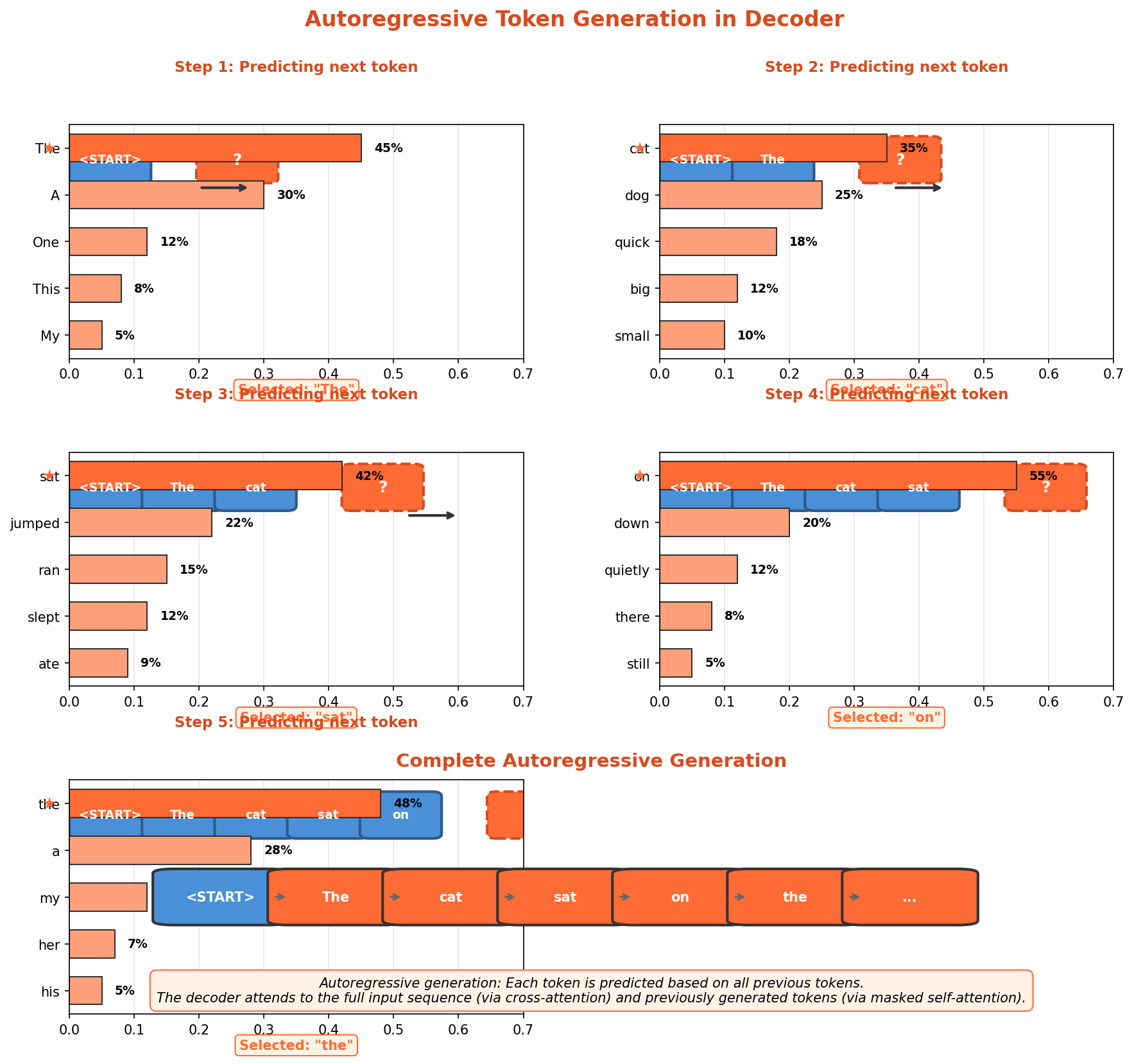
Decoding Strategies
| Strategy | Method | Quality | Speed | Use Case |
|---|---|---|---|---|
| Greedy | argmax(logits) | Low | Fastest | Baselines, quick inference |
| Beam Search | Keep top-k sequences | Medium-High | Slow | Best quality, machine translation |
| Sampling | Sample from distribution | Medium | Fast | Diverse outputs, creative tasks |
| Top-k/Nucleus | Sample from filtered distribution | Medium-High | Fast | Balanced quality and diversity |
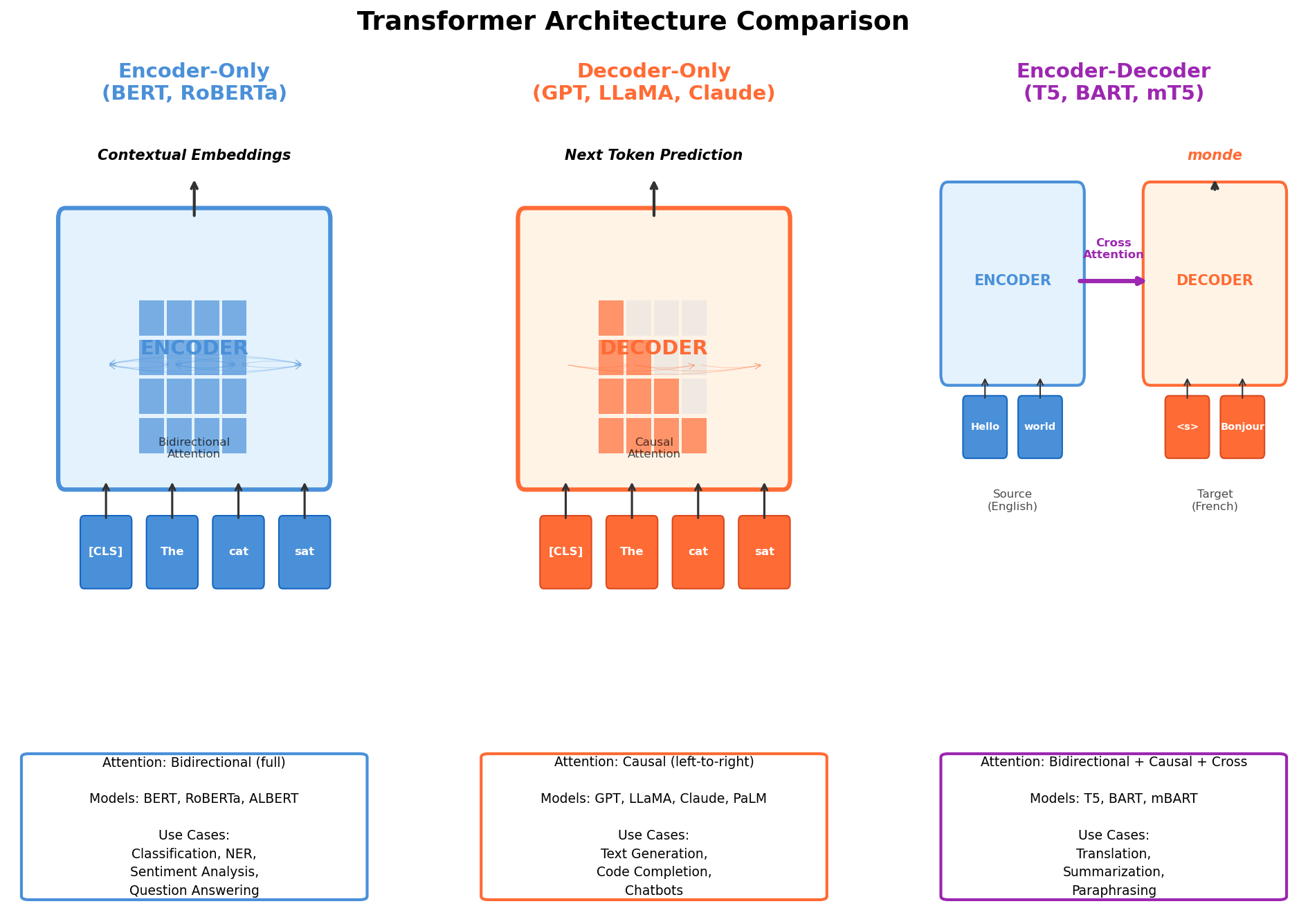
Encoder vs. Decoder vs. Encoder-Decoder
Different architectures suit different tasks:
| Architecture | Example | Masking | Use Case |
|---|---|---|---|
| Encoder-Only (BERT) | Classification, NER | Bidirectional (none) | Understand input without generating output |
| Decoder-Only (GPT, Llama) | Text generation | Causal masking | Autoregressive generation only |
| Encoder-Decoder (T5, BART) | Translation, summarization | Encoder: none, Decoder: causal | Conditioning generation on input context |
When to use each:
- Encoder-only: Classification, question answering, sentiment analysis
- Decoder-only: Open-ended generation, language modeling
- Encoder-decoder: Seq2seq tasks where output depends on input (translation, summarization, paraphrasing)
KV-Cache for Efficient Inference (In-Depth)
Why Cache K and V?
During inference, the bottleneck is memory bandwidth, not computation. Computing attention scores involves many small operations that don't fully utilize GPU cores. Recomputing K and V for all previous tokens is redundant memory movement.
Trade-offs
Without cache:
- Memory: Only store input + model parameters
- Computation: Recompute K, V at each step
- Latency per token: O(seq_len) (grows as sequence gets longer)
With cache:
- Memory: Store K, V for all previous tokens (~2x more for 1st layer, less for deeper layers)
- Computation: Only compute K, V for new token
- Latency per token: Constant O(1) (independent of sequence length)
Typical requirements:
- Caching for 2048-token context: ~4GB extra memory (for large models like LLaMA-7B)
- Speedup: 5-20x faster depending on sequence length
Implementation Considerations
class DecoderWithCache(nn.Module):
    def forward(self, x, encoder_output, past_cache=None):
        new_cache = []

        # Self-attention with cache
        residual = x
        attn_out, self_cache = self.self_attn(x, past_cache[0] if past_cache else None)
        new_cache.append(self_cache)
        x = self.norm1(residual + attn_out)  # Residual

        # Cross-attention (no cache needed, encoder is fixed)
        residual = x
        cross_out = self.cross_attn(x, encoder_output, encoder_output)
        x = self.norm2(residual + cross_out)  # Residual

        # Feed-forward
        residual = x
        ffn_out = self.ffn(x)
        x = self.norm3(residual + ffn_out)  # Residual

return x, new_cacheProduction systems often use quantization with KV-cache to reduce memory requirements while maintaining inference speed.
Interview Questions
Q1: Explain why causal masking is necessary in the decoder. What happens if you remove it?
Answer: Causal masking enforces the autoregressive constraint: each token can only depend on previously generated tokens. This is necessary because:
During inference, future tokens don't exist yet. The model generates one token at a time, and each token must be computable from previous tokens alone.
Without causal masking, the model would "cheat" during training by attending to future tokens. This creates a train-test mismatch: the training objective doesn't match inference reality.
Concrete example: Translating "Hello world" to French. At position 1 (generating "Bonjour"), if we allow attention to position 2 (which should be "monde"), the model learns to use information that won't be available during inference.
If you remove causal masking:
- The model would perform better on training loss (it has access to all information)
- It would fail catastrophically at inference (it tries to attend to non-existent tokens)
Q2: How does KV-cache reduce inference latency? What are the trade-offs?
Answer:The Problem: Without caching, computing the attention output for step t requires:
- Computing K and V from all previous tokens (1 to t)
- Computing Q from the new token
- This is O(t) operations, growing with sequence length
The Solution: Store K and V from previous steps:
Step 1: Compute K₁, V₁, Q₁ → Output
Step 2: Reuse K₁, V₁ + compute K₂, V₂, Q₂ → Output
Step 3: Reuse K₁, K₂, V₁, V₂ + compute K₃, V₃, Q₃ → OutputLatency improvement: From O(n²) total (n steps of O(n) work) to O(n) total.
Trade-offs:
- Memory: Must store all previous K, V. For a 7B model with 2K context, ~4GB extra.
- Batch processing: Harder to batch different sequence lengths (need variable cache sizes).
- Implementation complexity: Cache management adds engineering burden.
Decision: Always use in production for autoregressive inference. The latency gains far outweigh memory costs.
Q3: Why is cross-attention necessary? Can't the decoder just work with the encoder output directly?
Answer: Cross-attention is necessary for flexible alignment between encoder and decoder representations.
Consider a translation task: "The cat sat on the mat" → "Le chat s'est assis sur le tapis"
If the decoder only had the final encoder representation:
- It's a fixed vector summarizing the entire input
- As the decoder generates each word, it can't dynamically decide which parts of the input are relevant
- Word alignment information is lost
With cross-attention:
- The decoder can query different parts of the encoder for different words
- When generating "chat" (cat), it attends heavily to the "cat" part of the encoder
- This allows the model to learn explicit alignments
Why not just concatenate encoder output?
- Cross-attention learns what to attend to—it's learned alignment, not fixed
- This is far more flexible and generalizes better than fixed representations
Q4: What is the difference between teacher forcing and autoregressive generation? When do we use each?
Answer:Teacher Forcing (during training):
- We have the correct sequence: "The cat sat on the mat"
- We feed all tokens simultaneously to the decoder
- The decoder learns to predict position i given ground truth positions 1 to i-1
- All positions computed in parallel (very efficient)
Autoregressive Generation (during inference):
- We don't have ground truth
- We generate one token at a time
- Each token is fed back as input for the next prediction
- Sequential process (not parallelizable)
The Problem: This is a train-test mismatch. During training with teacher forcing:
- Position 2 always sees correct token at position 1
- Position 3 always sees correct tokens at positions 1-2
- The model learns to depend on perfect previous predictions
During inference:
- Position 2 sees the predicted token from position 1 (possibly wrong)
- Position 3 sees predicted tokens from positions 1-2 (possibly wrong)
- Errors compound, creating worse performance than training
Solutions:
- Scheduled sampling: Gradually replace ground truth with predictions during training
- Exposure bias training: Mix teacher-forced and predicted tokens during training
- Beam search: Keep multiple hypotheses to reduce the impact of early errors
Quick Reference Card
Decoder Block Structure
Masked Self-Attn → LayerNorm → Cross-Attn → LayerNorm → FFN → LayerNormKey Equations
Causal Mask Application:
Cross-Attention:
Generation Pseudocode
output = [START]
while len(output) < max_len:
    logits = decoder(encoder_output, output)
    next_token = sample(logits[-1])
    output.append(next_token)
    if next_token == END:
breakArchitecture Comparison
| Feature | Encoder | Decoder |
|---|---|---|
| Masking | None (bidirectional) | Causal (autoregressive) |
| Self-Attention | ✓ | ✓ (masked) |
| Cross-Attention | ✗ | ✓ |
| Input | Full sequence | One token at a time (inference) |
| Processing | Parallel | Parallel (train), Sequential (inference) |
When to Use
- Encoder-only: BERT, RoBERTa → Classification
- Decoder-only: GPT, Llama → Generation
- Encoder-Decoder: T5, BART → Seq2seq (translation, summarization)
Performance Optimizations
- KV-Cache: 5-20x faster inference (memory trade-off)
- Flash Attention: 2-4x faster attention computation
- Quantization: 4-8x smaller model with minimal quality loss
- Batch inference: Group requests for better GPU utilization
Common Pitfalls
- Forgetting causal mask → train-test mismatch
- Not using KV-cache → slow inference
- Training only with teacher forcing → exposure bias
- Beam search width too large → quadratic memory growth