Optimizers
The engine of learning — from SGD to Adam and beyond
Gradient Descent Fundamentals
All neural network training is based on gradient descent: move parameters in the direction that decreases the loss.
Batch vs Stochastic vs Mini-batch
| Type | Gradient Computed On | Trade-offs |
|---|---|---|
| Batch GD | Entire dataset | Accurate but slow, no escape from local minima |
| Stochastic GD | Single sample | Fast, noisy, helps escape local minima |
| Mini-batch GD | Batch of samples | Best of both worlds, parallelizable |
Mini-batch is standard — typically 32, 64, 128, or 256 samples.
Momentum
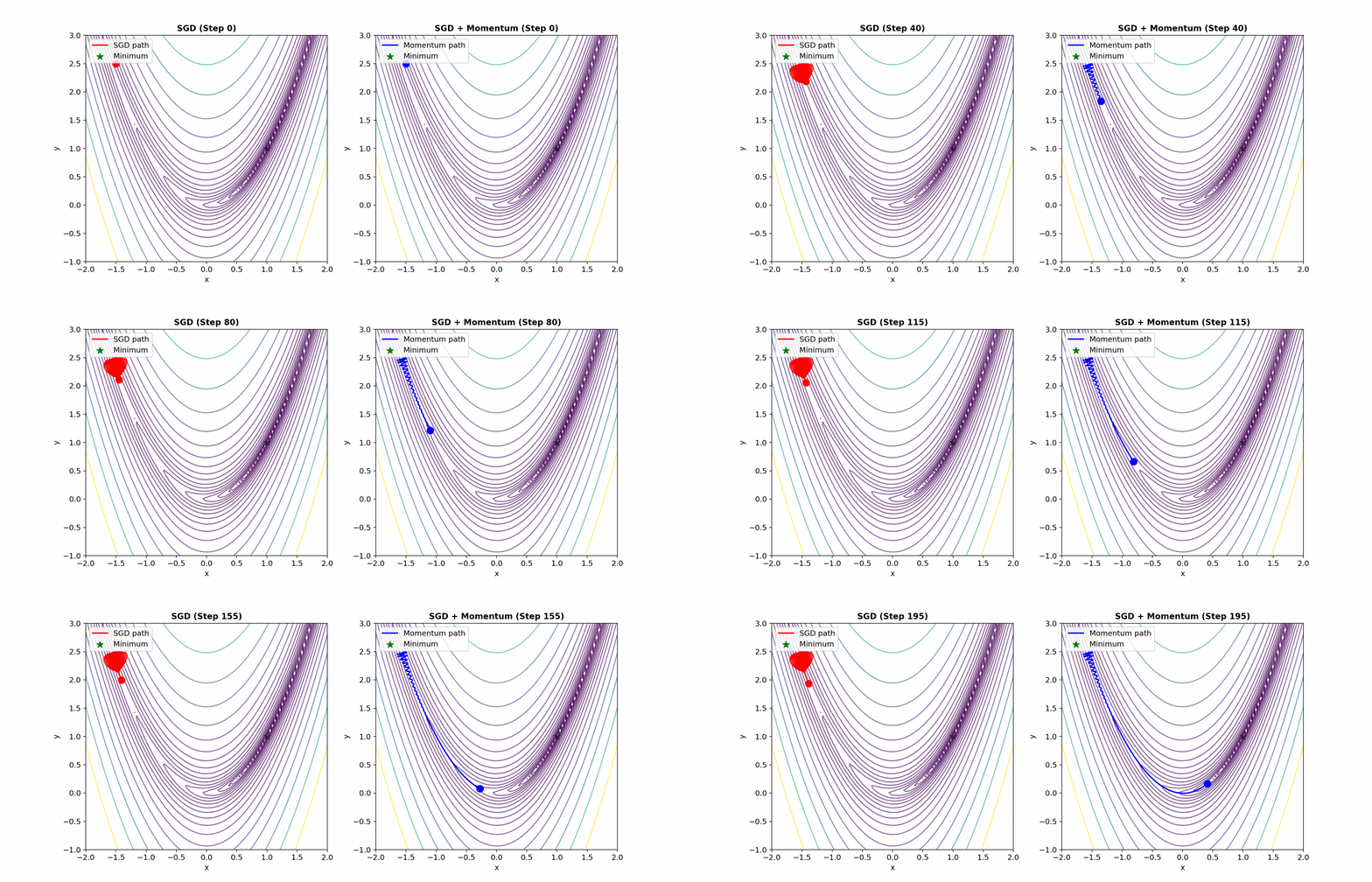
Momentum accelerates gradient descent by accumulating velocity in consistent directions.
Intuition
Imagine a ball rolling down a hill:
- Accelerates in consistent downhill direction
- Dampens oscillations in other directions
Algorithm
Typical
Benefits
- Faster convergence in consistent gradient directions
- Dampens oscillations in high-curvature directions
- Helps escape shallow local minima (momentum carries through)
Adaptive Learning Rates
Different parameters may need different learning rates. Adaptive methods adjust per-parameter.
Adagrad
Adapts learning rate based on historical gradients:
Problem: Learning rate only decreases — eventually too small.
RMSprop
Fixes Adagrad with exponential moving average:
Typical
Adam (Adaptive Moment Estimation)
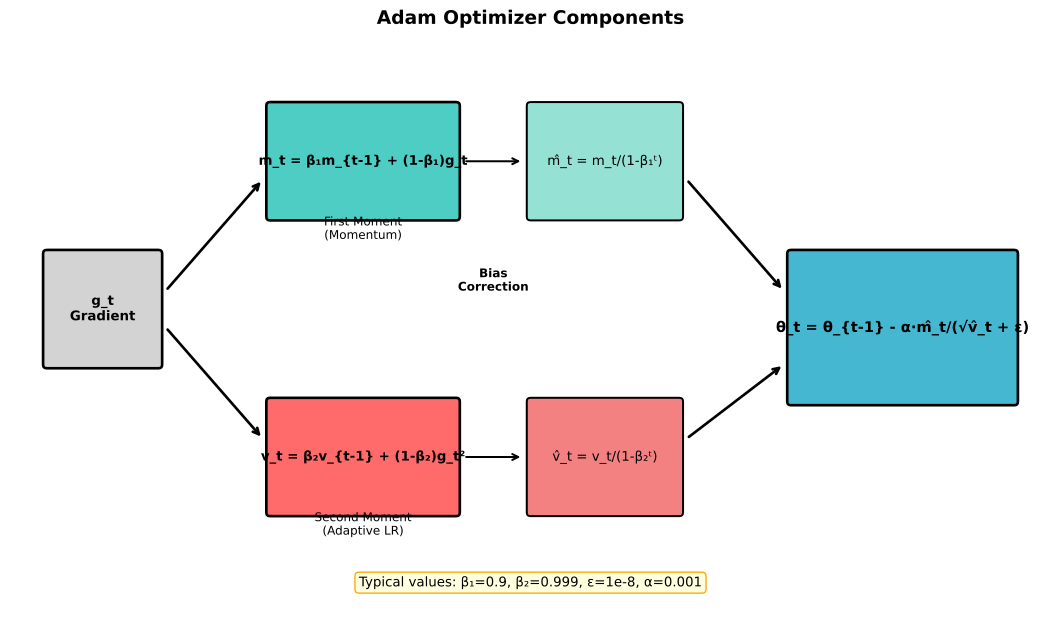
Adam combines momentum (first moment) with RMSprop (second moment).
Algorithm
First moment (mean) estimate:
Second moment (variance) estimate:
Bias correction (important early in training):
Update:
Default Hyperparameters
| Parameter | Default | Role |
|---|---|---|
| 0.001 | Learning rate | |
| 0.9 | First moment decay | |
| 0.999 | Second moment decay | |
| 1e-8 | Numerical stability |
Why Bias Correction?
At
Bias correction:
AdamW (Decoupled Weight Decay)
AdamW fixes a subtle bug in how Adam implements L2 regularization.
The Problem
L2 regularization adds
But Adam's adaptive scaling interferes with the regularization!
The Solution
Decouple weight decay from the gradient:
Weight decay is applied directly, not through gradients.
When to Use
- AdamW for transformers — standard in BERT, GPT, etc.
- Adam for most other cases — simpler, usually works fine
- If using weight decay with Adam, prefer AdamW
Learning Rate Schedules
The optimal learning rate often changes during training.
Step Decay
Reduce LR by factor at specific epochs:
lr = initial_lr * (0.1 ** (epoch // 30)) # Decay by 10x every 30 epochsExponential Decay
Cosine Annealing
Smooth decay from max to min over T steps.
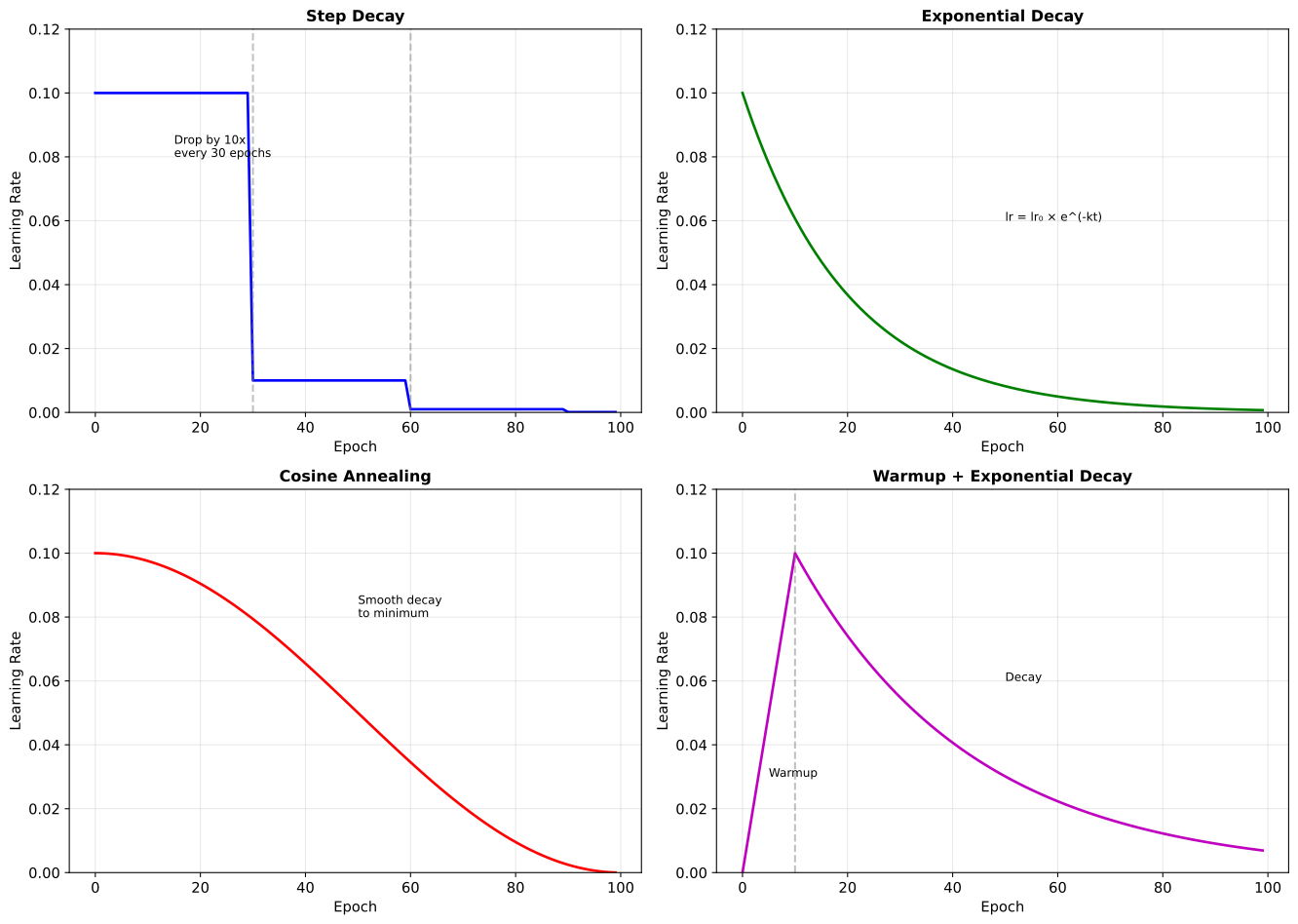
Warmup
Start with very low LR, gradually increase:
if step < warmup_steps:
    lr = initial_lr * (step / warmup_steps)
else:
lr = schedule(step - warmup_steps)Why warmup?
- At initialization, gradients may be unstable
- High LR early can cause divergence
- Warmup lets model find stable region before large steps
- Essential for large batch training and transformers
OneCycleLR
Learning rate increases then decreases over training:
- Start low (warmup)
- Peak in middle
- Decay to very low at end
Often achieves better results in fewer epochs.
Optimizer Comparison
| Optimizer | Pros | Cons | Best For |
|---|---|---|---|
| SGD | Simple, generalizes well | Slow, sensitive to LR | Vision with LR schedule |
| SGD + Momentum | Faster than SGD | Still needs tuning | ImageNet training |
| Adam | Fast, adaptive, works out of box | May generalize worse | Default, prototyping |
| AdamW | Proper weight decay | Slightly more complex | Transformers |
| RAdam | Robust early training | Less common | When Adam diverges early |
Decision Guide
Transformers?
  └─ AdamW with warmup + cosine decay

CNNs for final training?
  └─ SGD + momentum + step/cosine decay

Quick prototyping?
  └─ Adam with default settings

Training unstable?
  └─ Add warmup, reduce LR, try RAdam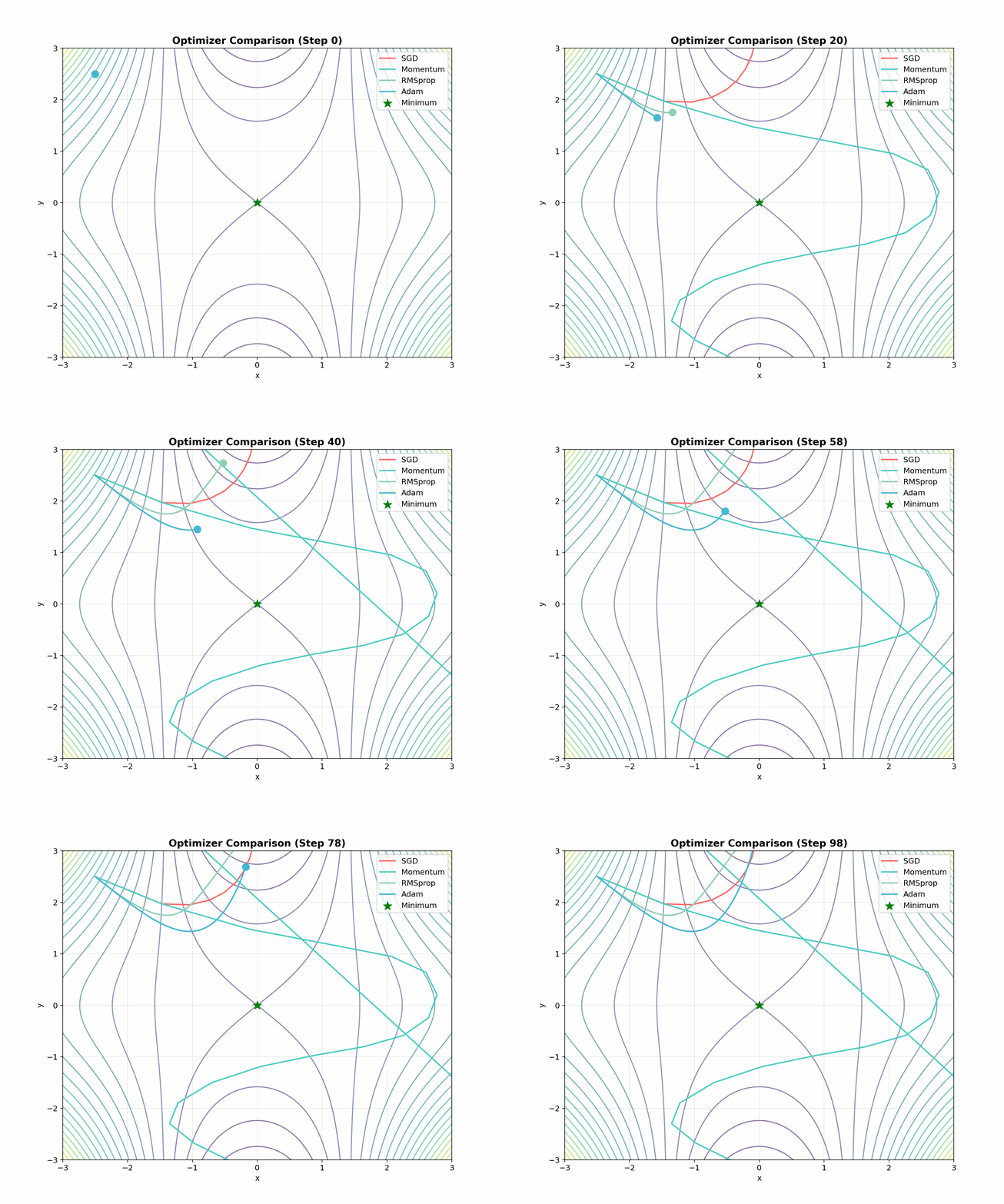
Practical Recommendations
Learning Rate Selection
- Start with defaults: Adam 1e-3, SGD 0.1
- LR finder: Train for short time with increasing LR, find where loss starts exploding
- Grid search: Try [1e-2, 1e-3, 1e-4] and pick best
Batch Size Considerations
- Larger batch → can use larger LR (linear scaling rule)
- Larger batch → may generalize worse (sharper minima)
- Gradient accumulation simulates large batches with small memory
Common Issues
| Issue | Likely Cause | Solution |
|---|---|---|
| Loss = NaN | LR too high | Reduce LR, add gradient clipping |
| Loss plateaus | LR too low or stuck | Increase LR or use scheduler |
| Loss oscillates | LR too high | Reduce LR |
| Training diverges | No warmup | Add warmup period |
Interview Questions
Q1: "Explain how Adam works."
Adam combines two ideas:
First moment (momentum):
Exponential moving average of gradients — accelerates in consistent directions.
Second moment (adaptive LR):
Exponential moving average of squared gradients — scales LR by gradient magnitude.
Bias correction:
Corrects initialization bias (moments start at 0).
Update:
Result: Each parameter gets adapted learning rate based on its gradient history. Parameters with large, consistent gradients get smaller effective LR; parameters with small gradients get larger effective LR.
Q2: "When would you use SGD over Adam?"
SGD with momentum often generalizes better for computer vision:
- ImageNet: Best results typically with SGD + momentum + LR schedule
- Adam can find sharper minima, which may generalize worse
- SGD's implicit regularization through noise may help
When to use SGD:
- Final training when you want best generalization
- Large-scale vision models (ResNet, EfficientNet on ImageNet)
- When you have time to tune LR schedule
When to use Adam:
- Prototyping (works out of box)
- Transformers/NLP (AdamW is standard)
- GANs (more stable than SGD)
- When SGD training is unstable
Practical approach: Start with Adam for fast iteration, try SGD for final training if needed.
Q3: "Why is learning rate warmup important?"
At initialization, gradients are unreliable:
- Based on random weights
- May point in wrong directions
- Large steps can cause divergence
Warmup addresses this:
- Start with very low LR (e.g., 0.1x final LR)
- Gradually increase over warmup period (e.g., 1000 steps)
- Allows model to find stable region before taking large steps
When warmup is critical:
- Large batch training: Gradients have lower variance, can "overshoot" more easily
- Transformers: Deep models with many attention layers are sensitive to early training
- Adam's bias correction issues: Even with correction, early updates can be unstable
Typical warmup:
- Linear increase over first 5-10% of training
- Or fixed number of steps (1000-10000)
Key Takeaways
Momentum accelerates convergence by accumulating velocity in consistent directions.
Adam adapts learning rates per-parameter using first and second moment estimates.
AdamW decouples weight decay — use it for transformers.
Learning rate schedules (warmup + decay) are crucial for good results.
SGD may generalize better than Adam for vision; Adam is standard for transformers.
Warmup prevents early divergence in large batch training and deep models.