Deep Reinforcement Learning
Scaling RL with neural networks — DQN, experience replay, and stability tricks
One-Sentence Summary
Deep RL uses neural networks as function approximators to handle high-dimensional state spaces, with DQN innovations like experience replay and target networks enabling stable training on complex tasks like Atari games.
Why Deep Learning + RL?
The Curse of Dimensionality
Traditional tabular RL methods (Q-tables) work well when state and action spaces are small and discrete. Consider these scenarios:
| Problem | State Space Size | Feasible for Tables? |
|---|---|---|
| Tic-Tac-Toe | ~5,000 states | Yes |
| Chess | ~ | No |
| Atari (84x84 pixels) | No | |
| Robot control | Continuous | No |
For high-dimensional or continuous spaces, we cannot store a separate Q-value for every state-action pair.
Function Approximation
Instead of memorizing Q-values, we approximate them with a parameterized function:
where
Benefits:
- Generalization: Similar states get similar Q-values
- Scalability: Handle any input dimensionality
- Feature learning: Network learns relevant features automatically
DQN: The Breakthrough
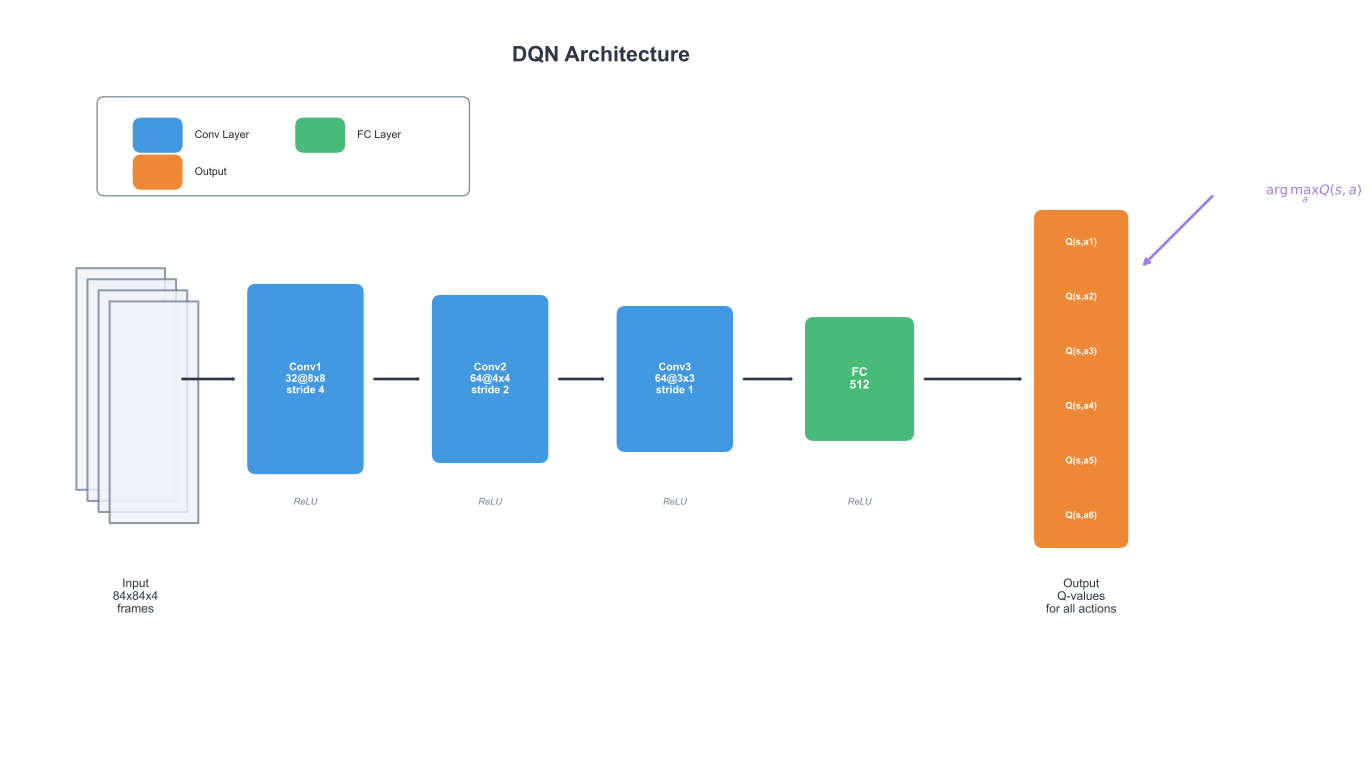
DeepMind's DQN (2013-2015) achieved human-level performance on 49 Atari games using a single architecture. The key insight: raw pixels go in, optimal actions come out.
Architecture
Input: 84x84x4 stacked grayscale frames
       ↓
Conv Layer 1: 32 filters, 8x8, stride 4, ReLU
       ↓
Conv Layer 2: 64 filters, 4x4, stride 2, ReLU
       ↓
Conv Layer 3: 64 filters, 3x3, stride 1, ReLU
       ↓
Flatten → FC Layer: 512 units, ReLU
       ↓
Output: Q-values for each action (e.g., 18 for Atari)The network outputs Q-values for all actions simultaneously, enabling efficient action selection via
The Deadly Triad Problem
Naive deep RL combining (1) function approximation, (2) bootstrapping (TD learning), and (3) off-policy learning often diverges. DQN introduced two critical stabilization techniques.
Innovation 1: Experience Replay
The Problem with Online Learning
In standard RL, the agent learns from consecutive experiences
- Correlation: Sequential samples are highly correlated, violating the i.i.d. assumption of SGD
- Catastrophic forgetting: Recent experiences overwrite knowledge of earlier states
The Solution: Replay Buffer
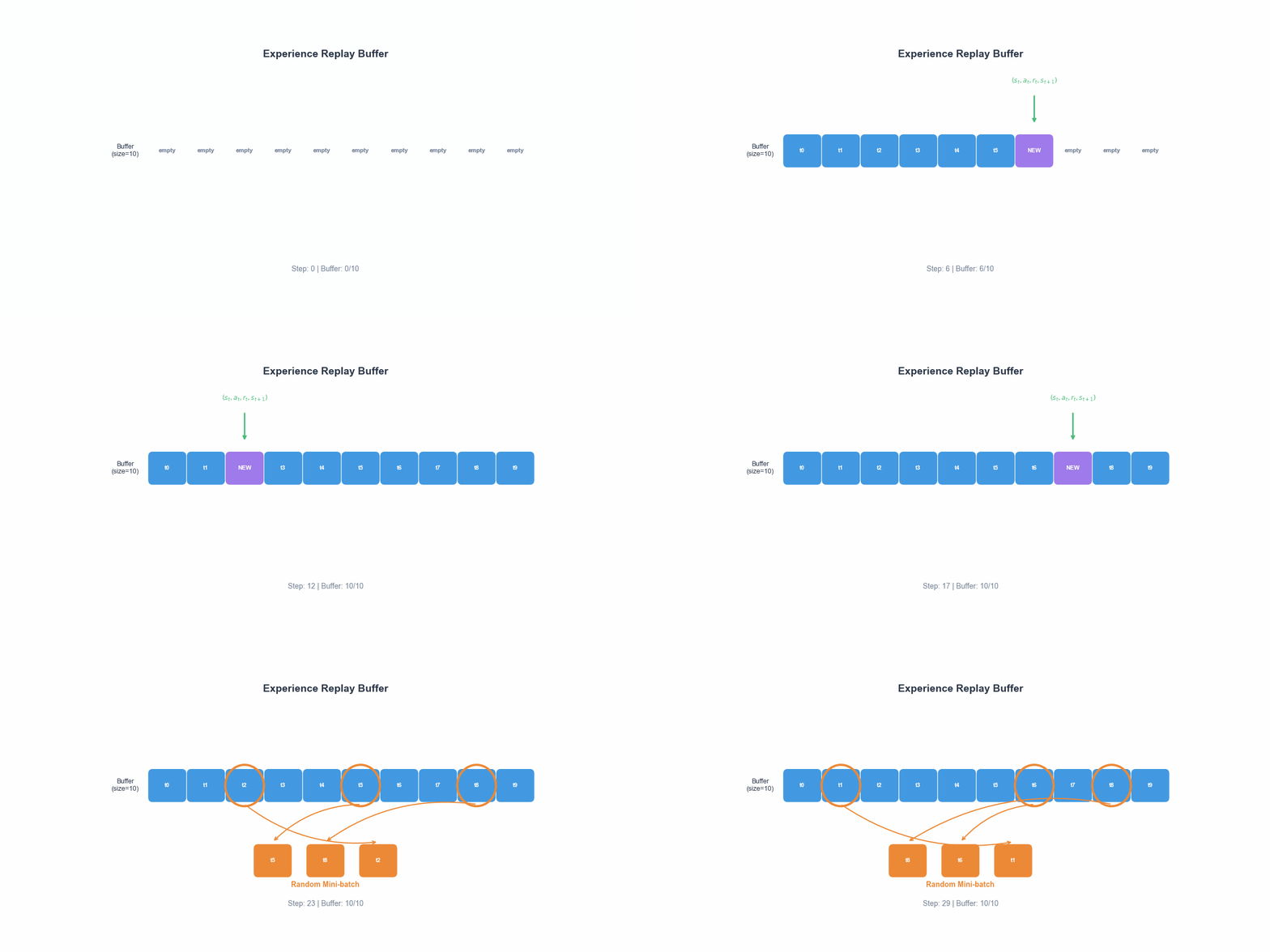
Store transitions in a circular buffer of fixed capacity (e.g., 1 million transitions):
During training, sample random mini-batches from this buffer.
Benefits:
- Decorrelation: Random sampling breaks temporal correlations
- Data efficiency: Each experience can be used multiple times
- Stable gradients: Mini-batch averaging reduces variance
Implementation Insight
# Simplified replay buffer logic
buffer.append((state, action, reward, next_state, done))
if len(buffer) >= batch_size:
    batch = random.sample(buffer, batch_size)
train_on_batch(batch)Innovation 2: Target Network
The Moving Target Problem
In Q-learning, we minimize the TD error:
Both the prediction
Analogy: Imagine trying to hit a target that moves every time you adjust your aim.
The Solution: Frozen Target Network
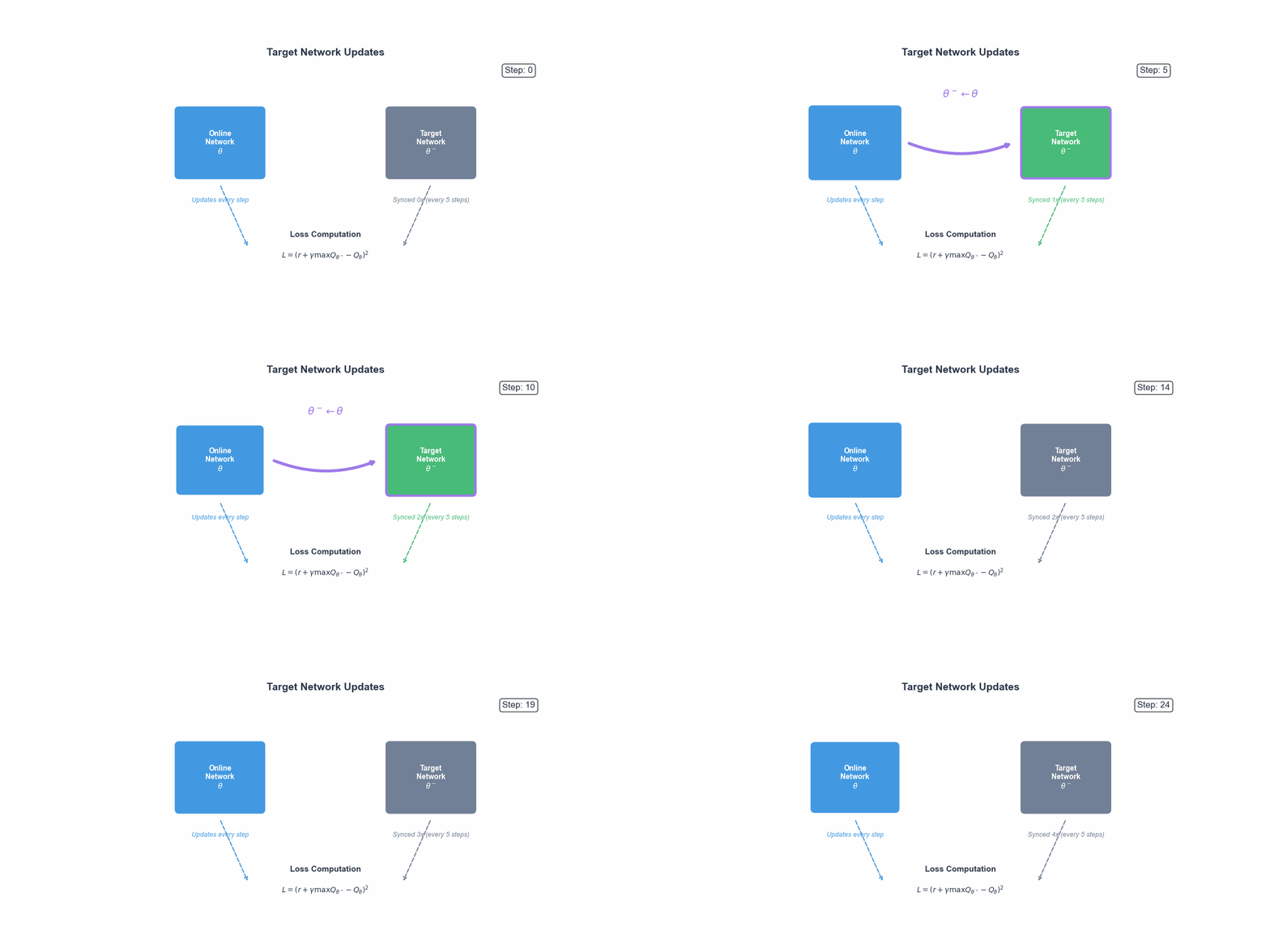
Maintain two networks:
- Online network
: Updated every step - Target network
: Updated periodically (every steps)
The loss becomes:
Update strategies:
- Hard update: Copy weights every
steps: - Soft update (Polyak averaging):
where
Double DQN: Reducing Overestimation
The Overestimation Problem
Standard Q-learning uses
The
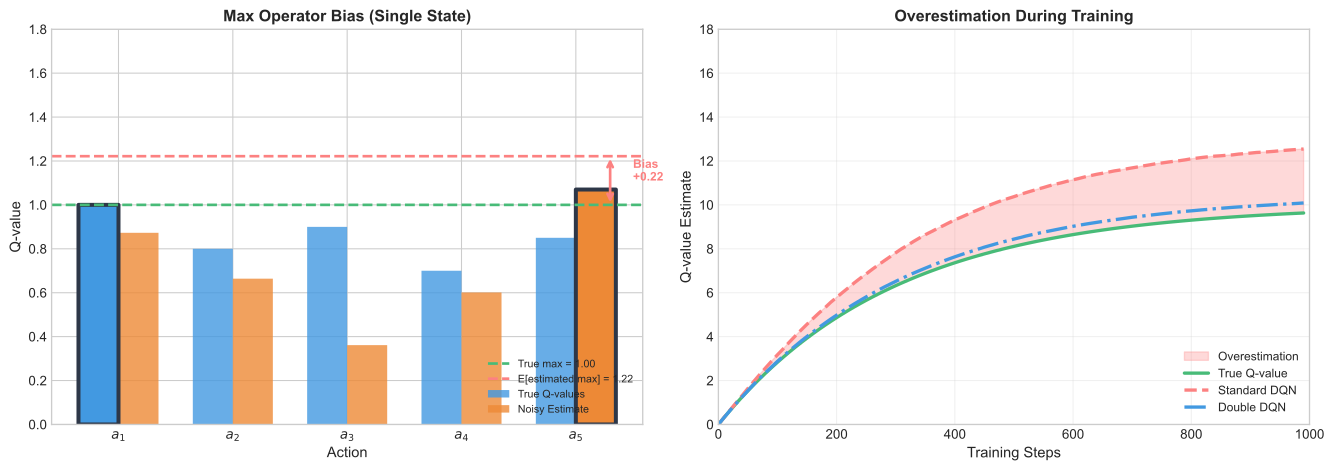
Why it matters: Overestimation propagates through bootstrapping, leading to unrealistically high Q-values and suboptimal policies.
The Solution: Decouple Selection and Evaluation
Double DQN uses:
- Online network to select the best action
- Target network to evaluate that action
This decoupling prevents the same noise from both selecting and evaluating actions, reducing overestimation significantly.
Dueling DQN: Value and Advantage Streams
Architectural Insight
Not all states require knowing the value of each action. In some states, any action leads to similar outcomes (e.g., empty road in driving). In others, action choice matters critically (e.g., approaching obstacle).
Dueling DQN separates the Q-function into two streams:
where:
= State value: How good is it to be in state ? = Advantage: How much better is action than average?
Architecture
      Shared Convolutional Layers
                ↓
          ┌─────┴─────┐
          ↓           ↓
    Value Stream   Advantage Stream
      FC → 1       FC → |A| values
          ↓           ↓
          └─────┬─────┘
                ↓
Q(s,a) = V(s) + (A(s,a) - mean(A))The subtraction of
Benefits:
- Efficient learning: V(s) updated by all actions, not just the one taken
- Better generalization: Learns state value independently of action-specific nuances
Rainbow DQN: The Full Package
Rainbow (2017) combined six DQN improvements, achieving state-of-the-art Atari performance:
| Component | Purpose |
|---|---|
| Double DQN | Reduce overestimation bias |
| Prioritized Replay | Sample important transitions more often |
| Dueling Architecture | Separate value and advantage |
| Multi-step Learning | Use n-step returns for faster propagation |
| Distributional RL | Model full return distribution, not just mean |
| Noisy Nets | Learned exploration via noisy network layers |
Key insight from ablation studies: Prioritized replay and multi-step learning provided the largest individual gains.
Stability Challenges in Deep RL
Why Deep RL is Hard
| Challenge | Cause | Mitigation |
|---|---|---|
| Non-stationarity | Policy changes as training progresses | Target networks, slower updates |
| Sample correlation | Sequential experience collection | Experience replay |
| Overestimation | Max operator bias | Double DQN |
| Sparse rewards | Infrequent feedback signals | Reward shaping, curiosity |
| Credit assignment | Long delays between action and reward | Multi-step returns, eligibility traces |
| Hyperparameter sensitivity | Many interacting components | Extensive tuning, Rainbow defaults |
Practical Tips
- Start with known-good hyperparameters (e.g., Rainbow defaults)
- Monitor Q-value magnitudes — rapid growth indicates instability
- Use learning rate warmup for initial stability
- Clip rewards to [-1, 1] for consistent scale across games
- Frame stacking (typically 4 frames) provides velocity information
Interview Questions
Q1: "Why do we need experience replay in DQN?"
"Experience replay serves three critical purposes:
1. Decorrelation: In online RL, consecutive samples are highly correlated (frame
looks like frame ). This violates SGD's i.i.d. assumption and causes the network to overfit to recent experiences. Random sampling from a large buffer breaks these correlations. 2. Data efficiency: Each transition can be sampled multiple times. Since collecting experience is often expensive (especially in real-world robotics), reusing data dramatically improves sample efficiency.
3. Stability: By maintaining a buffer of diverse experiences, we prevent catastrophic forgetting of earlier learned behaviors. The network sees a stable distribution of training data.
Without replay, DQN training diverges or learns suboptimal policies on most complex tasks."
Q2: "Explain the target network and why it helps stabilize training."
"In Q-learning, we minimize:
The problem: Both the prediction and target depend on the same weights
. Each gradient step changes , which changes the target we're trying to reach. This creates a 'moving target' problem — like trying to hit something that moves every time you adjust your aim. The solution: Maintain a separate target network
that's updated slowly:
- Every
steps (e.g., 10,000), copy: - Or use soft updates:
Now the target
stays fixed for many updates, giving the online network a stable objective to optimize. This dramatically reduces variance and prevents divergence."
Q3: "What is the overestimation problem in Q-learning and how does Double DQN address it?"
"The problem: Standard Q-learning uses
. The max operator is biased upward when there's estimation noise. Consider: if true Q-values are all 0, but estimates have noise
, then will pick the positive noise, giving expected value . This bias compounds through bootstrapping across many states. Why it matters: Overestimated Q-values lead to overconfident, suboptimal policies. The agent thinks bad actions are good because their Q-values are inflated.
Double DQN solution: Decouple action selection from evaluation:
The online network (
) selects the best action, but the target network ( ) evaluates it. Since different networks have different noise patterns, the selection bias doesn't compound with evaluation bias. Empirically, this significantly reduces overestimation and improves final performance."
Quick Reference Card
DEEP RL (DQN) FUNDAMENTALS
═══════════════════════════════════════════════════════════════

WHY DEEP RL?
───────────────────────────────────────────────────────────────
- Tabular methods fail in high-dimensional state spaces
- Neural networks approximate Q(s,a) → generalization
- Learn features automatically from raw inputs (pixels)

DQN INNOVATIONS
───────────────────────────────────────────────────────────────
Experience Replay:  Store transitions, sample randomly
                    Breaks correlations, improves data efficiency

Target Network:     Separate network for computing targets
                    Hard update (copy every C steps) or
                    Soft update (Polyak: τθ + (1-τ)θ⁻)

DOUBLE DQN
───────────────────────────────────────────────────────────────
Problem:    max operator overestimates Q-values
Solution:   Select action with online net, evaluate with target
            y = r + γ Q(s', argmax_a Q(s',a;θ); θ⁻)

DUELING DQN
───────────────────────────────────────────────────────────────
Architecture: Q(s,a) = V(s) + (A(s,a) - mean(A))
Benefit:      Learns state value from all actions

RAINBOW COMPONENTS
───────────────────────────────────────────────────────────────
Double DQN          | Prioritized Replay    | Dueling
Multi-step Returns  | Distributional RL     | Noisy Nets

STABILITY TIPS
───────────────────────────────────────────────────────────────
- Monitor Q-value magnitudes (shouldn't explode)
- Clip rewards to [-1, 1]
- Use frame stacking (4 frames typical)
- Start with proven hyperparameters
- Soft target updates often more stable than hardKey Takeaways
Function approximation enables RL to scale to high-dimensional state spaces where tabular methods fail.
Experience replay breaks temporal correlations and improves sample efficiency by reusing past experiences.
Target networks provide stable optimization targets, preventing the "moving target" problem that causes divergence.
Double DQN reduces overestimation bias by decoupling action selection from evaluation.
Dueling architectures separate state value from action advantages, enabling more efficient learning.
Deep RL remains challenging due to non-stationarity, sample correlation, and hyperparameter sensitivity — always start with proven configurations.