Temporal Difference Learning
Learning from incomplete episodes — Q-learning, SARSA, and bootstrapping
One-Sentence Summary
Temporal Difference (TD) learning combines Monte Carlo's model-free learning with Dynamic Programming's bootstrapping to update value estimates after each step, without waiting for episode completion.
Core Concept: Bootstrapping
TD learning's key insight: update estimates based on other estimates rather than waiting for final outcomes.
Monte Carlo vs Dynamic Programming vs TD
| Method | Updates When | Requires Model | Uses |
|---|---|---|---|
| Monte Carlo | End of episode | No | Actual returns |
| Dynamic Programming | Any time | Yes | Expected returns |
| TD Learning | Each step | No | Estimated returns |
TD combines the best of both worlds:
- From MC: Learn directly from experience (model-free)
- From DP: Update estimates using other estimates (bootstrapping)
TD(0): The Foundation
The TD Update Rule
Where:
= learning rate = discount factor = TD target (bootstrapped estimate) = TD error
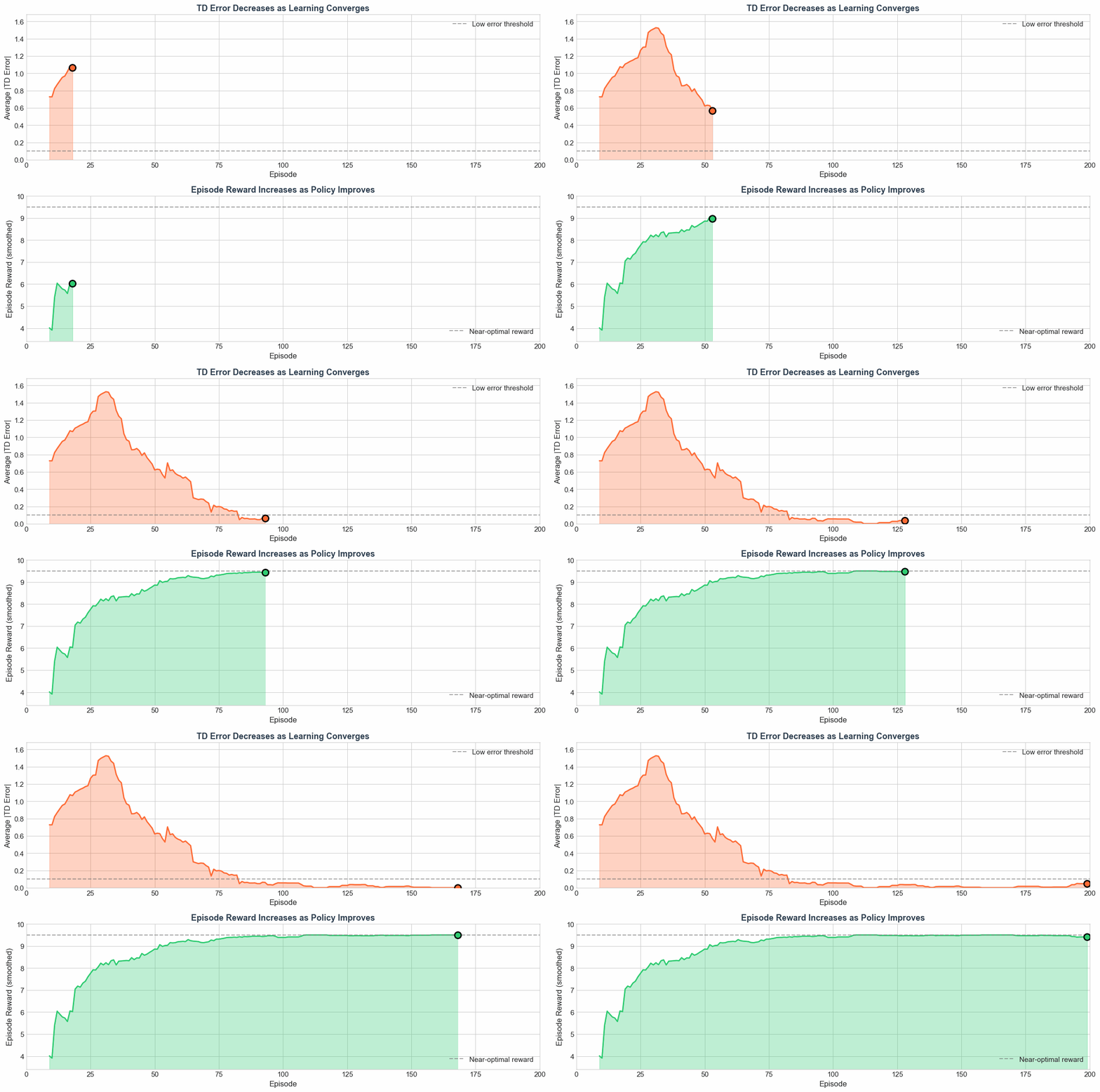
TD Error: The Learning Signal
The TD error
| TD Error | Meaning | Update Direction |
|---|---|---|
| Outcome better than expected | Increase | |
| Outcome worse than expected | Decrease | |
| Prediction was accurate | No change |
SARSA: On-Policy TD Control
SARSA learns action-values (Q-values) while following the current policy.
The SARSA Update
Name origin: State, Action, Reward, State, Action
SARSA Algorithm
Initialize Q(s, a) arbitrarily
For each episode:
    Initialize S
    Choose A from S using policy derived from Q (e.g., epsilon-greedy)
    For each step of episode:
        Take action A, observe R, S'
        Choose A' from S' using policy derived from Q
        Q(S, A) <- Q(S, A) + alpha * [R + gamma * Q(S', A') - Q(S, A)]
        S <- S'
        A <- A'
Until S is terminalOn-Policy Behavior
SARSA is on-policy because it updates Q using the action
Consequence: SARSA learns a safer policy that accounts for exploration behavior.
Q-Learning: Off-Policy TD Control
Q-learning learns the optimal action-values regardless of the policy being followed.
The Q-Learning Update
Key difference from SARSA: Uses
Q-Learning Algorithm
Initialize Q(s, a) arbitrarily
For each episode:
    Initialize S
    For each step of episode:
        Choose A from S using policy derived from Q (e.g., epsilon-greedy)
        Take action A, observe R, S'
        Q(S, A) <- Q(S, A) + alpha * [R + gamma * max_a Q(S', a) - Q(S, A)]
        S <- S'
Until S is terminalOff-Policy Behavior
Q-learning is off-policy because:
- Behavior policy: The policy used to explore (e.g., epsilon-greedy)
- Target policy: The greedy policy it learns (always picks max Q)
These can be different, enabling learning from any exploration strategy.
SARSA vs Q-Learning: The Cliff Walking Example
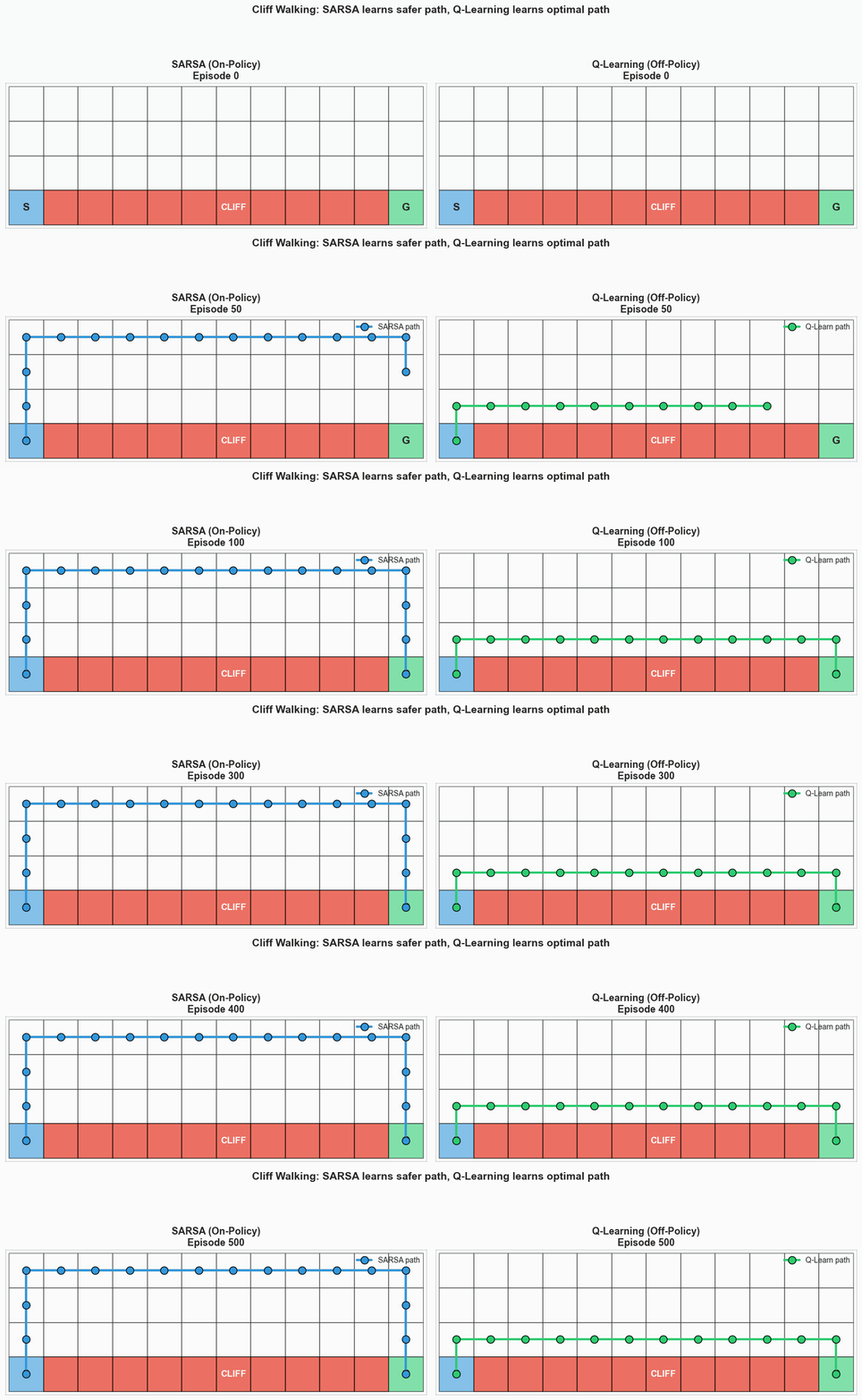
The Setup
A grid world with:
- Start state (bottom-left)
- Goal state (bottom-right)
- Cliff along the bottom (stepping in = large negative reward, return to start)
- Two viable paths: safe (along top) vs optimal (along cliff edge)
Behavioral Differences
| Algorithm | Learned Policy | Why |
|---|---|---|
| SARSA | Safe path (top) | Accounts for epsilon-greedy exploration near cliff |
| Q-Learning | Optimal path (edge) | Learns optimal regardless of exploration danger |
SARSA learns the safer path because it knows that during exploration, the agent might accidentally fall off the cliff. Q-learning ignores this and learns the mathematically optimal path.
When to Use Each
| Use SARSA When | Use Q-Learning When |
|---|---|
| Safety matters during learning | Only final policy matters |
| Online deployment | Offline learning, then deploy |
| Robot that can damage itself | Simulation with no real consequence |
| Conservative behavior preferred | Pure optimality desired |
Q-Table Evolution
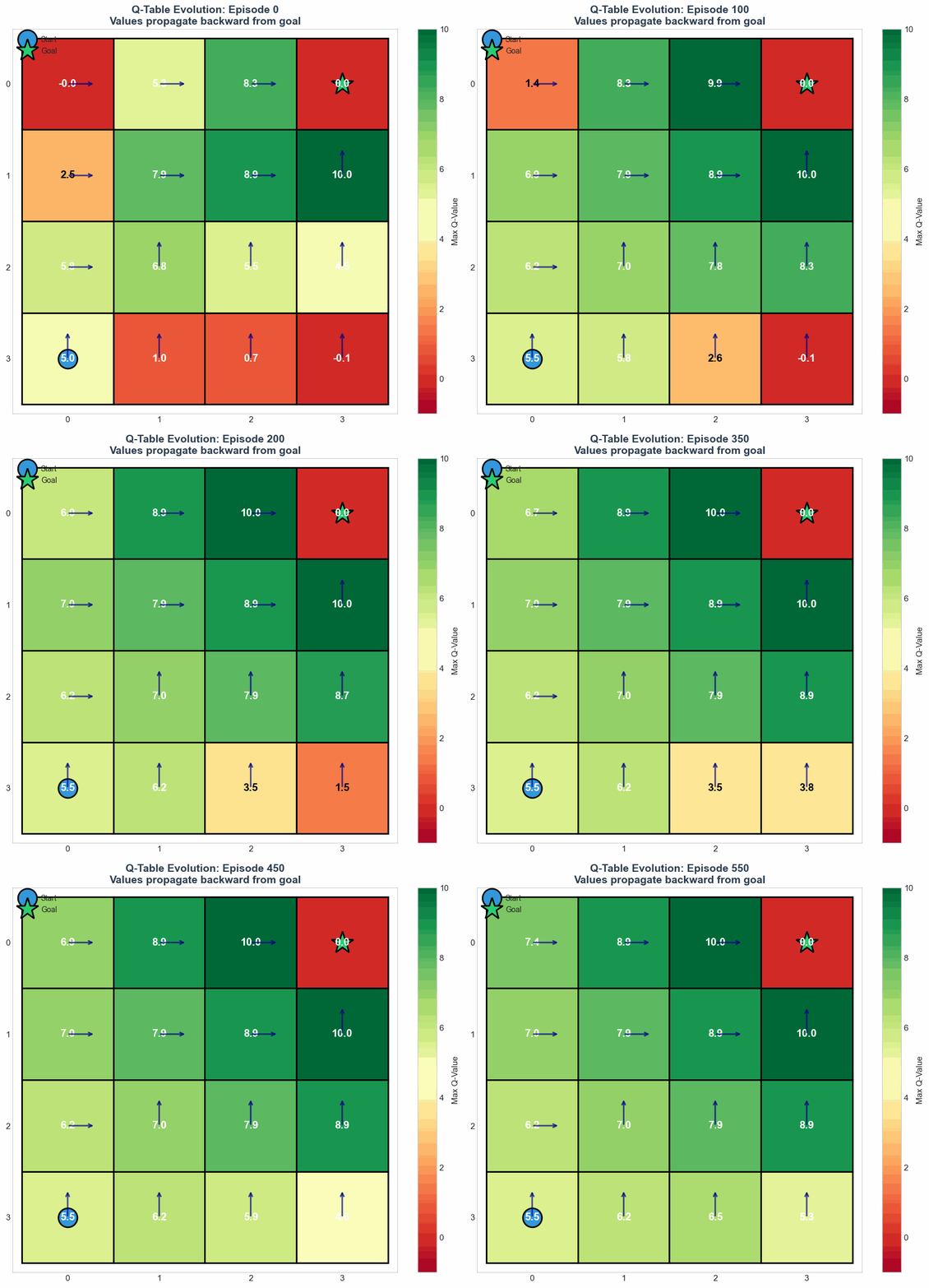
The animation shows how Q-values propagate backward from the goal through the state space as the agent explores.
Experience Replay
A technique that dramatically improves sample efficiency in TD learning.
The Problem
TD updates are correlated (consecutive states are similar), leading to:
- Unstable learning
- Forgetting earlier experiences
- Inefficient use of data
The Solution
Store experiences in a replay buffer and sample randomly:
Benefits:
- Breaks correlations: Random sampling decorrelates updates
- Data efficiency: Reuse each experience multiple times
- Stability: Prevents catastrophic forgetting
Implementation Sketch
# Store experience
buffer.append((state, action, reward, next_state, done))

# Sample random batch
batch = random.sample(buffer, batch_size)

# Update Q for each experience in batch
for (s, a, r, s_next, done) in batch:
    target = r + gamma * max(Q[s_next]) * (1 - done)
Q[s][a] += alpha * (target - Q[s][a])Convergence Properties
Theoretical Guarantees
| Algorithm | Converges To | Conditions |
|---|---|---|
| TD(0) | True value function | Under policy, infinite visits |
| SARSA | Optimal Q* | GLIE, Robbins-Monro |
| Q-Learning | Optimal Q* | All (s,a) visited infinitely |
GLIE: Greedy in the Limit with Infinite Exploration
- All state-action pairs visited infinitely often
- Policy converges to greedy as
Robbins-Monro conditions (on learning rate
Common choice:
Practical Considerations
| Factor | Effect on Convergence |
|---|---|
| Learning rate too high | Oscillation, instability |
| Learning rate too low | Slow convergence |
| Exploration too high | Slow convergence, noisy Q-values |
| Exploration too low | Suboptimal policy (stuck in local optimum) |
Comparison Summary
| Aspect | SARSA | Q-Learning |
|---|---|---|
| Policy | On-policy | Off-policy |
| Target | ||
| Behavior | Conservative | Risk-neutral |
| Data Reuse | Limited | Experience replay friendly |
| Convergence | To policy's Q | To optimal Q* |
Interview Questions
Q1: "Explain the difference between SARSA and Q-Learning."
"Both SARSA and Q-learning are TD control algorithms that learn Q-values, but they differ in their target calculation:
SARSA (on-policy):
- Target:
where is the action actually taken - Learns Q-values for the policy being followed
- More conservative because it accounts for exploratory actions
Q-Learning (off-policy):
- Target:
- Learns optimal Q-values regardless of behavior policy
- More sample-efficient (can use experience replay)
Example: In cliff-walking, SARSA learns the safer path because it knows epsilon-greedy might step off the cliff. Q-learning learns the optimal path along the edge because it assumes optimal behavior."
Q2: "What is bootstrapping in TD learning?"
"Bootstrapping means updating estimates based on other estimates rather than waiting for actual outcomes.
Non-bootstrapping (Monte Carlo):
- Wait until episode ends
- Use actual return:
Bootstrapping (TD):
- Update after each step
- Use estimated return:
Trade-off:
- MC has no bias (uses true returns) but high variance
- TD has bias (estimates may be wrong) but lower variance
- TD is often preferred because it learns faster and works for continuing tasks."
Q3: "Why is experience replay important for Q-learning?"
"Experience replay stores transitions
in a buffer and samples randomly for updates. Benefits:
- Breaks temporal correlation: Consecutive samples are correlated; random sampling provides i.i.d.-like data for stable learning
- Sample efficiency: Each experience can be reused many times
- Enables off-policy learning: Q-learning can learn from any data, including old experiences
Why Q-learning but not SARSA?
- Q-learning is off-policy, so it can learn from any data
- SARSA is on-policy; old experiences may not reflect current policy's behavior
Limitation: Requires storing potentially large buffers (memory cost)"
Quick Reference Card
TEMPORAL DIFFERENCE LEARNING
---------------------------------------------------
TD(0):     V(S) <- V(S) + alpha * [R + gamma*V(S') - V(S)]
SARSA:     Q(S,A) <- Q(S,A) + alpha * [R + gamma*Q(S',A') - Q(S,A)]
Q-Learn:   Q(S,A) <- Q(S,A) + alpha * [R + gamma*max_a Q(S',a) - Q(S,A)]

TD ERROR (delta)
---------------------------------------------------
delta = R + gamma*V(S') - V(S)
Positive: outcome better than expected
Negative: outcome worse than expected

ON-POLICY VS OFF-POLICY
---------------------------------------------------
SARSA:     On-policy  - learns Q for behavior policy
Q-Learn:   Off-policy - learns Q* regardless of behavior

KEY PROPERTIES
---------------------------------------------------
Bootstrapping: Updates use estimates (not final returns)
Model-free:    No environment model needed
Online:        Updates after each transition

EXPERIENCE REPLAY
---------------------------------------------------
Store: (s, a, r, s', done) in buffer
Sample: Random batch for updates
Benefits: Breaks correlation, reuses dataFurther Reading
- Sutton & Barto, Chapter 6: Temporal-Difference Learning
- Watkins (1989): Q-Learning (original paper)
- Rummery & Niranjan (1994): SARSA introduction
- Lin (1992): Experience Replay in RL