Normalization
Stabilizing training — BatchNorm, LayerNorm, and when to use each
Why Normalization?
During training, the distribution of each layer's inputs changes as the weights of preceding layers update. This is called internal covariate shift.
The Problem
- Layer 2 learns to process outputs from Layer 1
- Layer 1's weights change → Layer 1's output distribution changes
- Layer 2 must constantly adapt to a moving target
The Solution
Normalize activations to have consistent statistics (zero mean, unit variance), making optimization easier.
Batch Normalization (BatchNorm)
BatchNorm normalizes across the batch dimension — computing mean and variance over all samples in a mini-batch for each feature.
Algorithm
For a mini-batch
Step 1: Compute batch statistics
Step 2: Normalize
Step 3: Scale and shift (learnable)
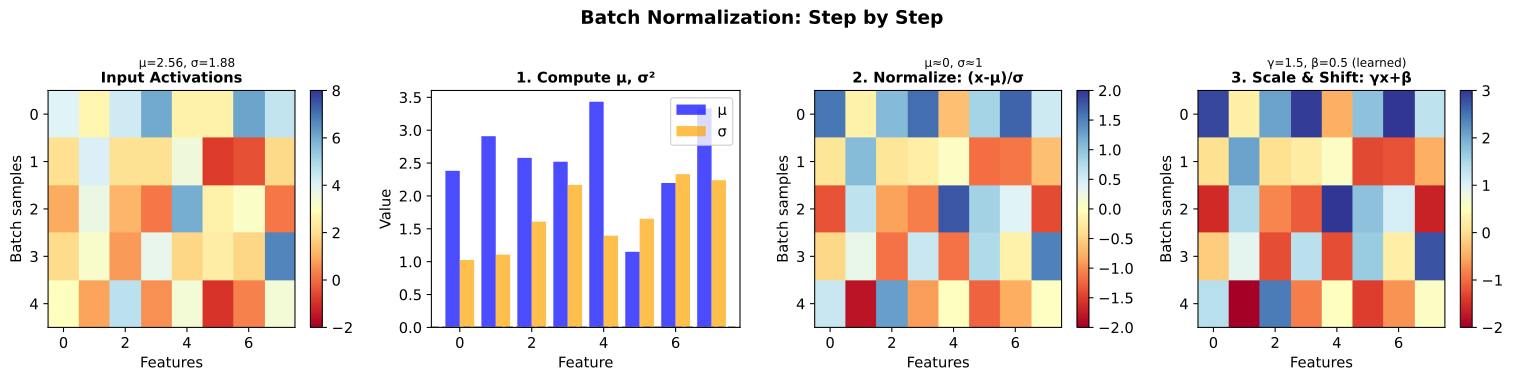
Learnable Parameters
- If
and , we recover the original distribution - The network learns the optimal amount of normalization
Training vs Inference
| Phase | Mean/Variance Source |
|---|---|
| Training | Current mini-batch statistics |
| Inference | Running average accumulated during training |
Why different? Inference may be single samples (no batch), and we want deterministic outputs.
# During training
running_mean = momentum * running_mean + (1 - momentum) * batch_mean
running_var = momentum * running_var + (1 - momentum) * batch_var

# During inference
y = gamma * (x - running_mean) / sqrt(running_var + eps) + betaLayer Normalization (LayerNorm)
LayerNorm normalizes across the feature dimension — computing mean and variance over all features for each sample independently.
Comparison with BatchNorm
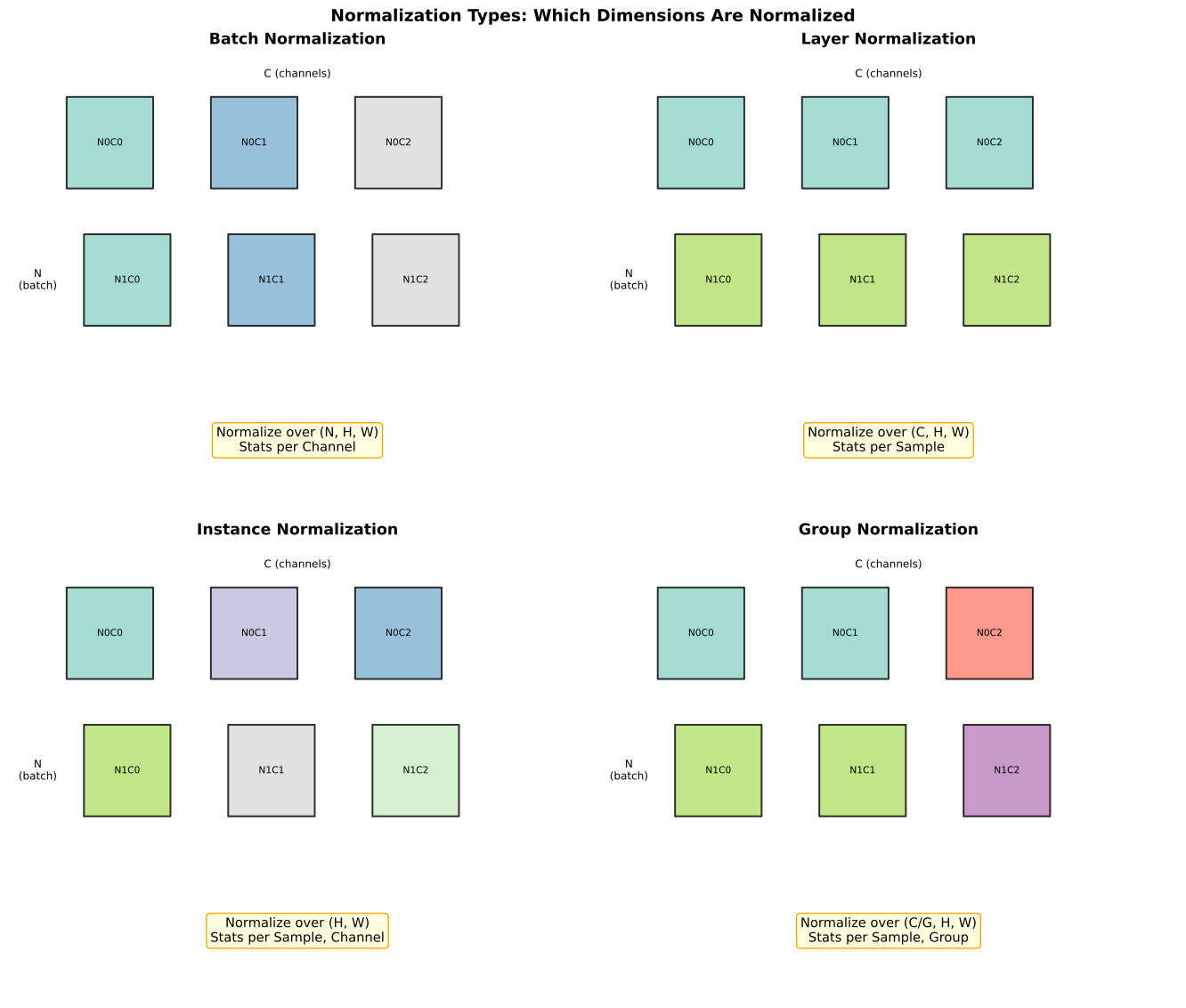
For a 4D tensor (N, C, H, W):
| Normalization | Dimensions Normalized | Statistics Per |
|---|---|---|
| BatchNorm | (N, H, W) | Channel |
| LayerNorm | (C, H, W) | Sample |
| InstanceNorm | (H, W) | Sample, Channel |
| GroupNorm | (C/G, H, W) | Sample, Group |
When to Use LayerNorm
- Transformers: Self-attention has no batch dimension in attention computation
- RNNs: Sequence length varies, batch statistics are unstable
- Small batch sizes: When batch statistics are too noisy
- Online learning: Single-sample processing
LayerNorm in Transformers
# Transformer layer with LayerNorm
x = x + self_attention(layer_norm(x))  # Pre-norm
x = x + ffn(layer_norm(x))Group Normalization (GroupNorm)
GroupNorm divides channels into groups and normalizes within each group.
Motivation
BatchNorm fails with small batches (noisy statistics). LayerNorm may not capture channel-wise patterns in vision tasks. GroupNorm is a compromise.
Algorithm
Split C channels into G groups, normalize within each group:
# Reshape (N, C, H, W) -> (N, G, C//G, H, W)
# Normalize over (C//G, H, W) dimensionsWhen to Use
- Object detection/segmentation: Small batch sizes (1-2) due to high-resolution images
- Vision + small batches: When BatchNorm fails but you want channel structure
- Example: Mask R-CNN uses GroupNorm
Instance Normalization
Normalizes each sample, each channel independently.
Use Case
Style transfer: Want to normalize away style while preserving content structure.
# Normalize over (H, W) only
for each sample:
    for each channel:
normalize(x[sample, channel, :, :])Effects on Training
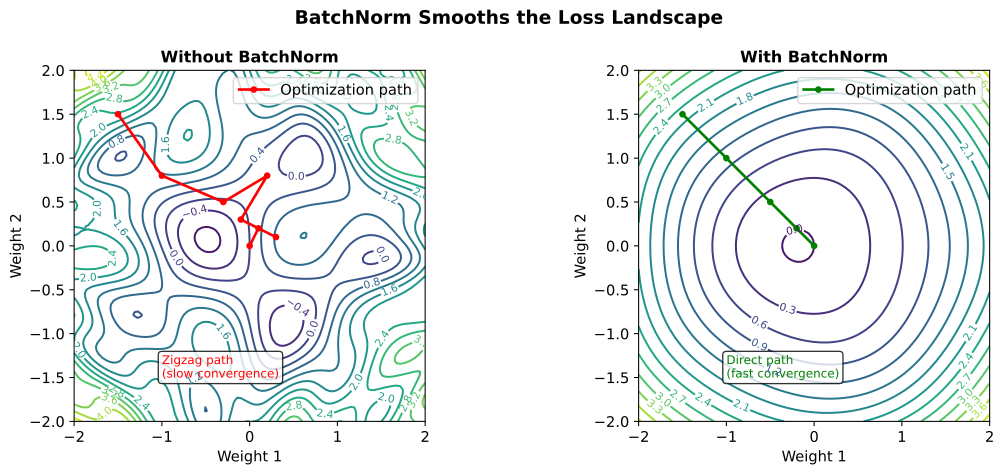
Smoother Loss Landscape
BatchNorm makes the loss landscape significantly smoother, enabling:
- Higher learning rates
- Faster convergence
- More stable training
Regularization Effect
BatchNorm adds noise through batch statistics, acting as regularization:
- Each sample's normalization depends on other samples in the batch
- Different batches produce different normalizations
- Similar to dropout's noise injection
Allows Higher Learning Rates
Without normalization, large learning rates cause:
- Activations to explode
- Gradients to explode
- Training to diverge
With normalization:
- Activations are bounded
- Gradients are more stable
- Larger learning rates are safe
Comparison Summary
| Method | Normalizes Over | Batch Size Dependent | Best For |
|---|---|---|---|
| BatchNorm | (N, H, W) per channel | Yes | CNNs with batch size > 16 |
| LayerNorm | (C, H, W) per sample | No | Transformers, RNNs |
| GroupNorm | (C/G, H, W) per sample | No | CNNs with small batch |
| InstanceNorm | (H, W) per channel, sample | No | Style transfer |
Decision Flowchart
What architecture?
├── Transformer
│   └── LayerNorm
├── RNN/LSTM
│   └── LayerNorm
├── CNN
│   ├── Batch size >= 16?
│   │   └── BatchNorm
│   └── Batch size < 16?
│       └── GroupNorm
└── Style Transfer
└── InstanceNormImplementation Details
Where to Place Normalization
Post-activation (original BatchNorm paper):
Linear → BatchNorm → ReLUPre-activation (common in modern architectures):
BatchNorm → ReLU → LinearFor transformers, Pre-LayerNorm is common:
x = x + Attention(LayerNorm(x))Affine Parameters
Most implementations have affine=True by default:
nn.BatchNorm2d(channels, affine=True)  # learns gamma, beta
nn.LayerNorm(dim, elementwise_affine=True)Setting affine=False removes learnable scale/shift.
Interview Questions
Q1: "Explain the difference between BatchNorm and LayerNorm."
BatchNorm normalizes across the batch dimension:
- Computes mean/variance over all samples for each feature
- Statistics: Per channel (for CNNs) or per feature
- Requires batch of samples; behavior differs train vs inference
LayerNorm normalizes across the feature dimension:
- Computes mean/variance over all features for each sample
- Statistics: Per sample
- Independent of batch size; same behavior train and inference
When to use each:
- BatchNorm: CNNs with batch size >= 16
- LayerNorm: Transformers (no batch in attention), RNNs (variable sequence length), small batches
Key insight: BatchNorm depends on batch composition; LayerNorm depends only on the current sample.
Q2: "Why does BatchNorm behave differently during training vs inference?"
During training: Uses mini-batch statistics (mean, variance computed over current batch)
- Each sample's normalization depends on other samples in the batch
- Provides stochastic regularization
During inference: Uses running averages accumulated during training
- Deterministic output (same input → same output)
- Works with single samples (no batch needed)
- Running stats:
Why different?
- Inference may be single samples — no batch to compute statistics from
- We want deterministic predictions for deployment
- Batch statistics would vary based on what else is in the batch
Gotcha: Must call
model.eval()before inference to use running stats!
Q3: "When would you use GroupNorm over BatchNorm?"
Use GroupNorm when batch size is small (typically < 16):
The problem with small batches:
- BatchNorm statistics become noisy
- High variance in mean/variance estimates
- Training becomes unstable
GroupNorm solution:
- Normalizes within groups of channels per sample
- No dependence on batch size
- Stable statistics even with batch size = 1
Common use cases:
- Object detection (Mask R-CNN) — high-resolution images limit batch size to 1-2
- Semantic segmentation — same reason
- Multi-GPU training with small per-GPU batch
Trade-off: GroupNorm may be slightly worse than BatchNorm when batch size is large, but the difference is small.
Key Takeaways
Normalization stabilizes training by ensuring consistent activation statistics.
BatchNorm normalizes over batch dimension — great for CNNs with large batches.
LayerNorm normalizes over feature dimension — essential for transformers and RNNs.
GroupNorm bridges the gap — works for CNNs with small batch sizes.
Training vs inference: BatchNorm uses batch stats during training, running averages during inference.
Secondary effects: Smoother loss landscape, regularization, allows higher learning rates.